Promised Land
p. 53 · Read in the full issue
The Banabans, modern Hebrews and their Promised Land
Treasure Islands by Pearl Binder is a book which had to be written. It is the story of the delightfully naive Banabans and the rape of their home land, the island of Banaba or Ocean Island.
It tells of their continuing trust in British justice despite a history of disappointment, de ceit and dishonesty.
Basically, the book is a care ful recounting of the trials of the Banabans since the day in 1900 when Albert Ellis first dis covered that Ocean Island was almost pure phosphate. He negotiated a contract with the
unworldly and kindly
Banabans for the Pacific Islands Company Ltd. This first contract gave that company the right to mine
phosphate over a significant
area of the island for a term of “nine hundred and ninety nine
years” for the payment of only £5O per annum, “or trade to that value.”
From that day on, the ruin of Ocean Island began.
It has forced the Banabans out of their villages and homes, despoiled the land and de
stroyed the trees. Eventually,
the Banabans had to leave.
They were resettled on Rabi Island off the coast of Vanua
Levu, Fiji. Although they have
been on Rabi since 1945 they continue to long for their home island with a strength only paralleled by that of the Hebrew people for Israel.
Time and time again the Bri tish Phosphate Commission, who followed the Pacific Islands Co in mining the phos
phate, negotiated further con
tracts from the Banabans with what can only be described as
“bullying tactics”. Today,
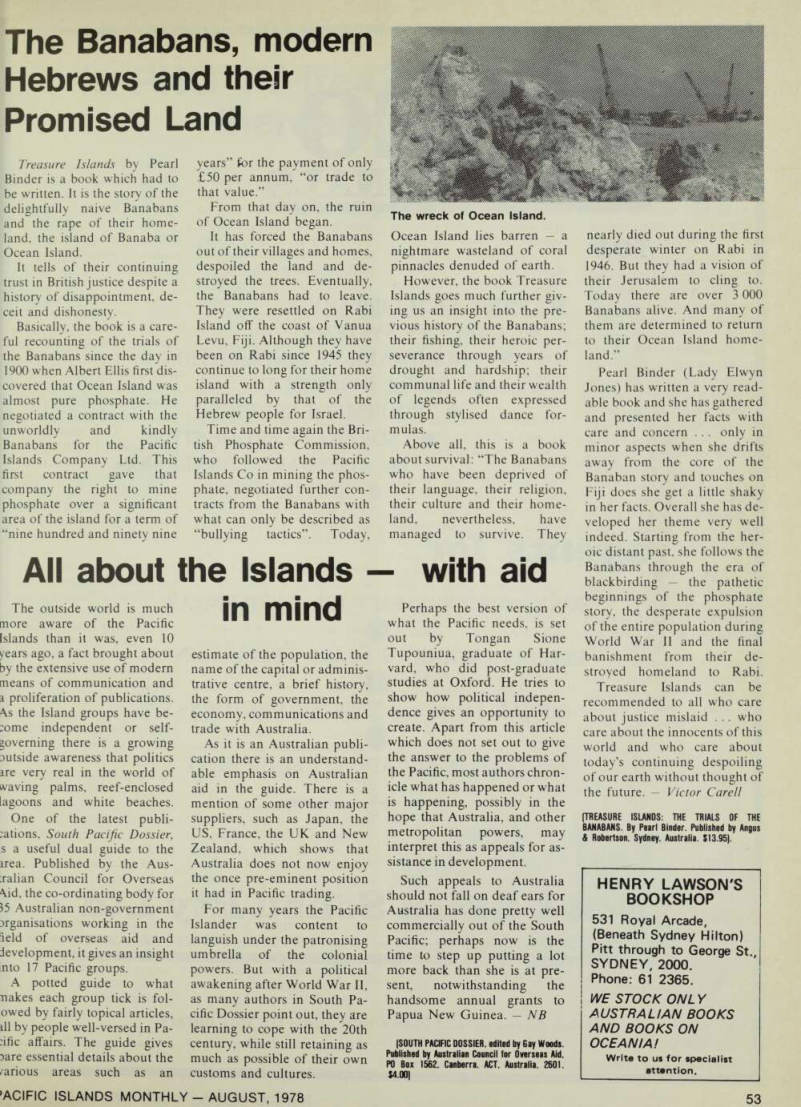
Ocean Island lies barren a nightmare wasteland of coral pinnacles denuded of earth.
However, the book Treasure Islands goes much further giv ing us an insight into the pre vious history of the Banabans; their fishing, their heroic per severance through years of
drought and hardship; their
communal life and their wealth
of legends often expressed
through stylised dance for
mulas.
Above all, this is a book about survival: “The Banabans who have been deprived of
their language, their religion,
their culture and their home land. nevertheless, have
managed to survive. They
nearly died out during the first desperate winter on Rabi in 1946. But they had a vision of their Jerusalem to cling to.
Today there are over 3 000 Banabans alive. And many of them are determined to return to their Ocean Island home land.”
Pearl Binder (Lady Elwyn Jones) has written a very read able book and she has gathered and presented her facts with care and concern . . . only in minor aspects when she drifts away from the core of the Banaban story and touches on Fiji does she get a little shaky in her facts. Overall she has de veloped her theme very well indeed. Starting from the her oic distant past, she follows the Banabans through the era of
blackbirding the pathetic
beginnings of the phosphate
story, the desperate expulsion
of the entire population during World War II and the final banishment from their de stroyed homeland to Rabi.
Treasure Islands can be recommended to all who care about justice mislaid ... who care about the innocents of this world and who care about
today’s continuing despoiling
of our earth without thought of
the future.
Victor Carell
(Treasure Islands: The Trials Of The
BANABANS. By Pearl Binder. Published by Angus & Robertson. Sydney. Australia. 51 3.95).
The wreck of Ocean Island.