People
pp. 52-53 · Read in the full issue
When I did a sketch of Cap tain “Frog” Evans, MBE, VRD, for the April, 1961, issue of PIM, with a re spectable biography and a couple of suspicious gaps, I though it could then be filed away for posterity, writes Captain Brett Hilder.
Frog, complete with mono cle, was then Harbourmaster at Madang. He retired early, in 1965, after 12 years service in PNG. He had been in the Pacific before World War 11, and during it, but went “finish” to start an entirely new life of retirement, hun tin’, shootin’ and fishin’ in County Wexford, in the Irish Republic. There, he found the natives very like Polynesians; they couldn’t care less what denomination you belonged to, as long as you were fond of horses, dogs and an argument over anything except religion.
So different from Northern Ireland.
Although Frog coached the local fishermen to get their fishing master’s licences, he missed the sunshine so much that he jumped at a chance of going to Ghana, West Africa, to teach African tug-masters to be pilots, at the modern port of Tema. He was then transferred to the capital port of Takoradi as Harbour master and ship-surveyor.
After surviving three govern ment coups he retired again in June, 1972, and made for the south of England to resume his glider flying, for which he had obtained his bronze “C” in Ghana. The English sum mer was terrible, even cold in the Dorset Hills, and colder still at several thousand feet up in a glider. Here were no vultures, as in Ghana, to give pilots a hint of thermal uplift.
Even jungle-bashing in Malaya might be better, but the Pacific called again, and Frog grabbed a job with IMCO of the United Nations to go to Samoa in December, 1972.
Western Samoa needed a marine expert, and they got one, but there were no dry docks, slipways or marine workshops like those in Malaya, PNG and Africa. De spite the frustration of not
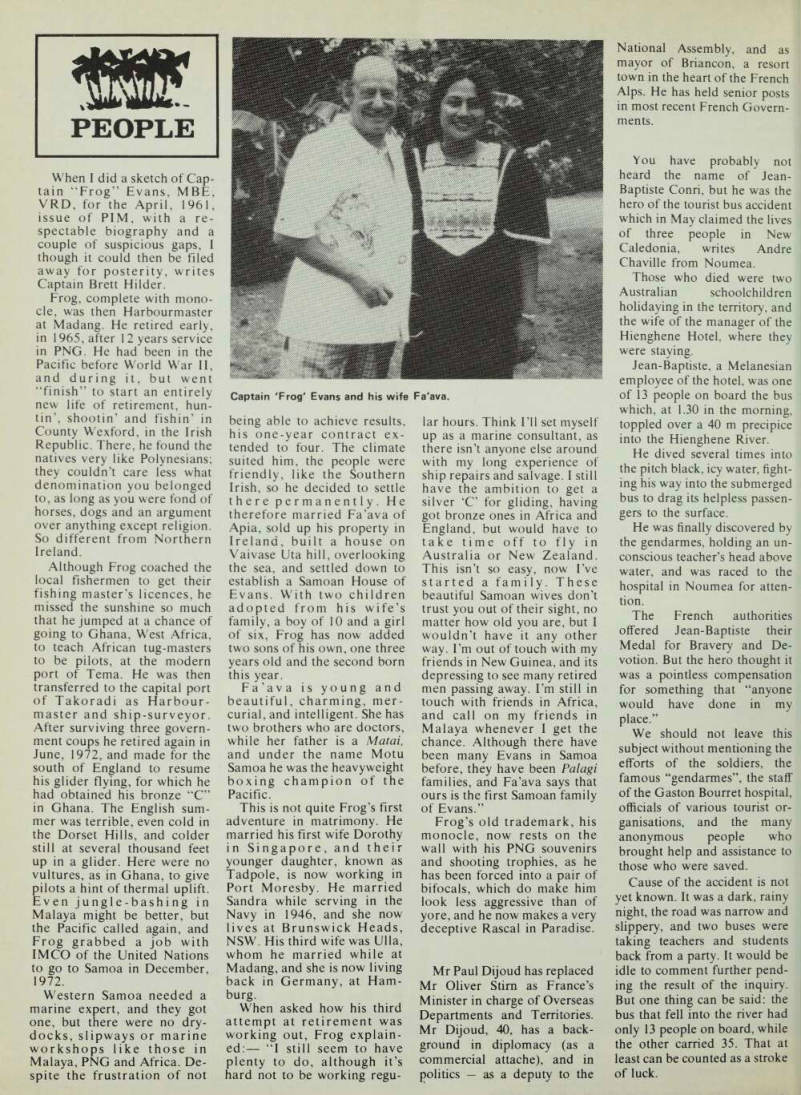
being able to achieve results, his one-year contract ex tended to four. The climate suited him, the people were friendly, like the Southern Irish, so he decided to settle the re per m anen 11 y. He therefore married Fa’ava of Apia, sold up his property in Ireland, built a house on Vaivase Uta hill, overlooking the sea, and settled down to establish a Samoan House of Evans. With two children adopted from his wife’s family, a boy of 10 and a girl of six, Frog has now added two sons of his own, one three years old and the second born this year.
Fa'ava is young and beautiful, charming, mer curial, and intelligent. She has two brothers who are doctors, while her father is a Matai, and under the name Motu Samoa he was the heavyweight boxing champion of the Pacific.
This is not quite Frog’s first adventure in matrimony. He married his first wife Dorothy in Singapore, and their younger daughter, known as Tadpole, is now working in Port Moresby. He married Sandra while serving in the Navy in 1946, and she now lives at Brunswick Heads, NSW. His third wife was Ulla, whom he married while at Madang, and she is now living back in Germany, at Ham burg.
When asked how his third attempt at retirement was working out, Frog explain ed;— “I still seem to have plenty to do, although it’s hard not to be working regu
lar hours. Think I’ll set myself up as a marine consultant, as there isn’t anyone else around with my long experience of ship repairs and salvage. I still have the ambition to get a silver ‘C’ for gliding, having got bronze ones in Africa and England, but would have to take time off to fly in Australia or New Zealand.
This isn’t so easy, now I’ve started a family. These beautiful Samoan wives don’t trust you out of their sight, no matter how old you are, but I wouldn’t have it any other way. I’m out of touch with my friends in New Guinea, and its depressing to see many retired men passing away. I’m still in touch with friends in Africa, and call on my friends in Malaya whenever I get the chance. Although there have been many Evans in Samoa before, they have been Palagi families, and Fa’ava says that ours is the first Samoan family of Evans.”
Frog’s old trademark, his monocle, now rests on the wall with his PNG souvenirs and shooting trophies, as he has been forced into a pair of bifocals, which do make him look less aggressive than of yore, and he now makes a very deceptive Rascal in Paradise.
Mr Paul Dijoud has replaced Mr Oliver Stim as France’s Minister in charge of Overseas Departments and Territories.
Mr Dijoud, 40, has a back ground in diplomacy (as a commercial attache), and in politics as a deputy to the
National Assembly, and as mayor of Briancon, a resort town in the heart of the French Alps. He has held senior posts in most recent French Govern ments.
You have probably not heard the name of Jean- Baptiste Conri, but he was the hero of the tourist bus accident which in May claimed the lives of three people in New Caledonia, writes Andre Chaville from Noumea.
Those who died were two Australian schoolchildren holidaying in the territory, and the wife of the manager of the
Hienghene Hotel, where they
were staying.
Jean-Baptiste, a Melanesian employee of the hotel, was one of 13 people on board the bus which, at 1.30 in the morning, toppled over a 40 m precipice into the Hienghene River.
He dived several times into
the pitch black, icy water, fight
ing his way into the submerged bus to drag its helpless passen gers to the surface.
He was finally discovered by the gendarmes, holding an un conscious teacher’s head above water, and was raced to the hospital in Noumea for atten tion.
The French authorities offered Jean-Baptiste their Medal for Bravery and De votion. But the hero thought it
was a pointless compensation
for something that “anyone would have done in my
place.”
We should not leave this
subject without mentioning the
efforts of the soldiers, the famous “gendarmes”, the staff of the Gaston Bourret hospital, officials of various tourist or ganisations, and the many anonymous people who brought help and assistance to those who were saved.
Cause of the accident is not yet known. It was a dark, rainy night, the road was narrow and slippery, and two buses were taking teachers and students back from a party. It would be idle to comment further pend ing the result of the inquiry.
But one thing can be said: the bus that fell into the river had only 13 people on board, while the other carried 35. That at least can be counted as a stroke of luck.
Captain 'Frog' Evans and his wife Fa'ava.
Mr M. A. (Matt) Ramsden
has been appointed general
manager. New Zealand, of Air New Zealand. He was pre viously the director of commer cial services of NZ National
Airways Corporation, the
country’s internal airline, which has now joined forces with Air New Zealand, the NZ international airline. Mr Ramsden is immediate past president of the Pacific Area Travel Association. He has been involved in a number of PATA activities and has been Dn the board of that organis ation for the last four years. He is chairman of the marketing :ommittee of the NZ Tourism Advisory Council, a member of ;he NZ Travel Industry Train ng Council, a life member, fel ow and past-president of the lnstitute of Travel, a fellow )f the Chartered Institute of Fransport and an executive nember of the National Travel Association of New Zealand.
Joseph Thomas, from north Malekula in the New Hebrides, is nearing the end of the three months in Suva working in the
display department of Bums
Philp (SS) Co Ltd store. He is the second New Hebridean to go overseas to study art and de sign. He is a Big Nambas from
Brenwei village, and graduated
from Malapoa College in 1977.
He first showed that he was a talented designer when he designed his school’s emblem, and painted it on the wall of the
Malapoa assembly hall. He
was awarded a $5OO scholar ship to Irelp meet expenses in Fiji, and Air Pacific gave him a free trip to Suva. While in Fiji
he gained extra experience
from the Fiji Arts Council. In his work in Burns Philp in Suva he gained experience in silk
screen printing, ticket writing,
sign writing and advertising.
Adolph Noser, 76, the American-born, bike-riding, former Catholic Archbishop of Madang, Papua New Guinea, has been offered the chance to go back to the United States to spend his retirement there.
“What do I want to go back for?” he asks. “Fm not sick.
There is still work here for me to do. As long as Fm capable of doing it I’ll stay right here.”
The Archbishop is op
timistic about the future of Papua New Guinea, where he has spent the last 25 years.
“The wantok system will go,” he says. “Economics make this inevitable, though not necessarily for the good.
“The country will find its own way with a new culture that will be a blending of Papua New Guinean and Western ways, with neither dominant.
“The people must learn to work, then the future will be unlimited. But all this will take time, maybe one or two generations.”
The problems of the young trouble the archbishop. He sees most of them as being re lated to education. While he does not have a solution, he has a proposal.
“There is a real problem not only with the educated, but also the uneducated because of lack of schools.
“Those who are educated and cannot get a job despair.
“The despair among the
uneducated, unemployed
youngsters is caused, they believe, because they have not had an education.
“Perhaps the introduction of some type of government civil youth corps, with a minimum of regimentation, could be the answer.”
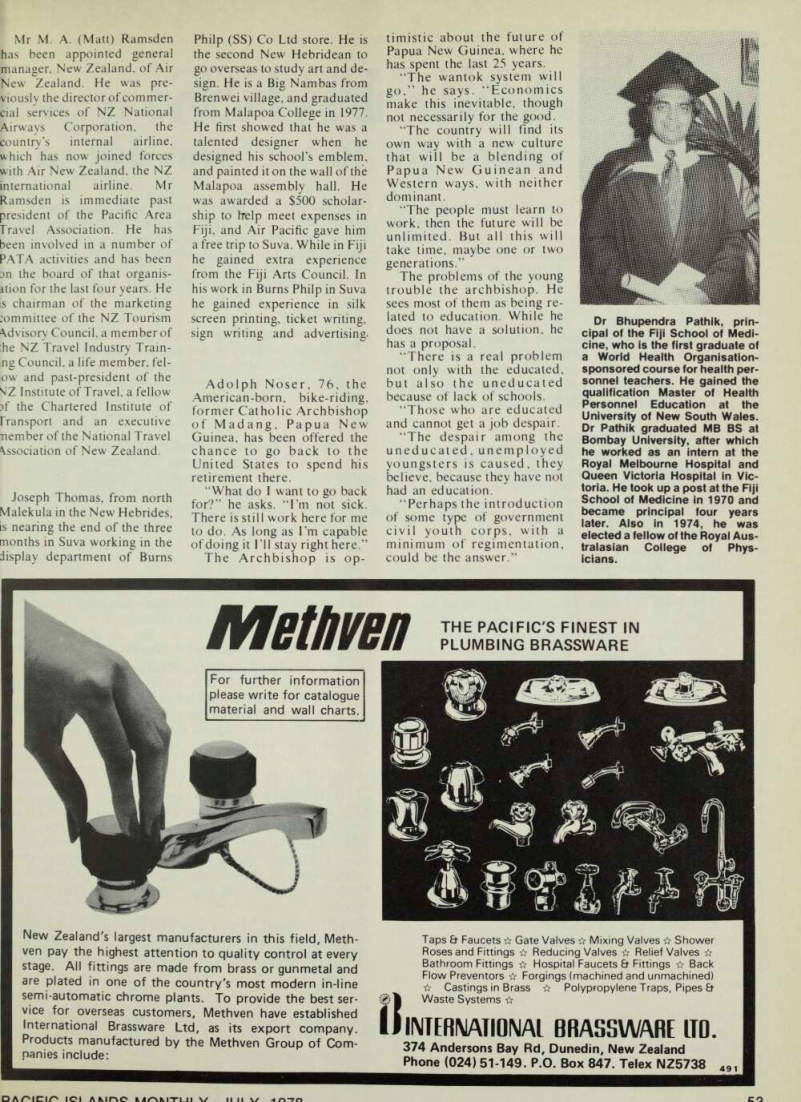
Dr Bhupendra Pathik, prin cipal of the Fiji School of Medi cine, who is the first graduate of a World Health Organisation sponsored course for health per sonnel teachers. He gained the qualification Master of Health Personnel Education at the University of New South Wales.
Dr Pathik graduated MB BS at
Bombay University, after which
he worked as an intern at the Royal Melbourne Hospital and Queen Victoria Hospital in Vic toria. He took up a post at the Fiji School of Medicine in 1970 and became principal four years later. Also in 1974, he was elected a fellow of the Royal Aus
tralasian College of Phys
icians.