Currents
pp. 39-51 · Read in the full issue

Political
Png Honesty’
Code Shelved
PNG Prime Minister Michael Somare’s Leadership Code, under which parliamen tary and public service leaders would have to shed their pri vate holdings in companies, or resign, has been shelved.
Mr Somare’s announcement in parliament that he had de cided to postpone further con sideration of the measure while a “non-political committee” advises him was hailed by the Opposition as the end of the move in its present form.
The Opposition believes the shelving will become per manent, and that the new pro
posals which may eventually
emerge will bear little resem blance to the original, writes Gus Smales from Port
Moresby.
There are strong suggestions, too, that Mr Somare pulled the legislation out of the present sitting of parliament to save his government.
Rifts between the coalition partnership and unrest from backbenchers have been part of the contentious background to the legislation. Mr Somare has played down the dif ferences, claiming that the strength of the coalition is suf ficient to overcome differing
opinions.
But the shelving of the bill suggests he has now realised the potential for a really serious rift is much stronger than he had acepted.
Under the leadership code legislation, all men and women defined as “National Policy Makers” would have to sell all their business interests and shareholdings. This would apply to every interest, no matter how longstanding, how small or how non contentious.
The move would have effec tively prevented any person from even a “comfortable”
financial family background
from holding important politi
cal, public service or statutory office.
The proposed legislation
banned any trust arrangements which would allow leaders to return to their private interests after a term in public life. The
proposed legislation would
have affected between 150 and 200 men and women, including the Cabinet itself.
In the wave of criticism which arose, Mr Somare’s motives were generally
accepted as being straight
forward, but the legislation was attacked on the grounds of
being impractical. There were
fears that it would be imposs ible to administer honestly, and that it could lose PNG the ser vices of some of its best leaders and potential leaders.
Some criticism accused Mr Somare of deliberately want ing to surround himself with nonentities, to bolster his own personal influence.
Announcing the shelving of
the legislation for the time being, Mr Somare said there was no suggestion that he was
deviating from his previously
expressed objective. He was
still determined to present the code, and he believed the code was in the national interest to
prevent corruption.
However, he believed it would be unwise to introduce the legislation at the current sit tings of parliament, as had been planned. This was be cause parliament was in a “somewhat volatile state” at present, and not in the best pos ition for a reasoned debate on a vital issue.
In the meantime, he would
appoint a non-political com
mittee to advise him on certain aspects of the bills and the form of their presentation.
But there was no suggestion the legislation, or its concept, was being dropped, Mr Somare said.
The Hebrides’
New Calm
An atmosphere of calm and co-operation between rival Melanesian political forces, unthinkable a few short months ago, has made its timid
entry into the New Hebridean scene.
The new, more hopeful, pol itical climate stems from a series of discussions between the government of Chief Minister George Kalsakau and top representatives of the
Vanuaaku Party.
Beginning at the end of March, the talks continued through April into May and culminated in: •An agreement that both sides would participate in an ad hoc committee on electoral re form, whose work should be completed in 10 to 15 months; • That on completion of the committee’s work, fresh elec tions will be held these should go far to removing the difficulties created by the fact that the Vanuaaku Party boy cotted the proposed November 29, 1977, poll which gave rise to the present Representative Assembly, and the Kalsakau government, neither of which was in fact elected by popular vote; • That following the start of the work of the ad hoc com mittee, scheduled for May 8, the Vanuaaku Party would sus
pend indefinitely the activities
of its People’s Provisional Government this removes the main government objection to Vanuaaku Party tactics, since the PPG was seen as a di rect challenge to its own auth ority over New Hebridean territory as a whole.
The French/Bislama fort
nightly Nabanga commented
in its May 13 issue: “From March 31 onwards a meeting which seemed to be a last-ditch effort brought together in the Chief Minister’s office Mr Maxime Carlot, chairman of
the Representative Assembly,
all ministers of the govern ment, and seven of the main leaders of the Vanuaaku Party, Father Lini, and Messrs Sope, Matas, Kalkao, Naupa, Abil and Bice.
“From one effort at com munication to another, from one concession to another, the participants found themselves relaxing, smiles began to appear on their faces, and it be came clear that, despite the confrontations of the past, they
were, when all was said and done, among brothers.
“The event showed how true it is that in the New Hebrides and often enough in other places as well the white man’s presence does not make it easier to have a fruitful ‘tok tok’.”
Micronesia
Breakthrough
The 1978 annual hearing of the United Nations Trustee ship Council on conditions in the US Trust Territory of the Pacific was considerably more relaxed than in some earlier years due to recent improved understanding between the
parties.
In a major breakthrough in the tortured and torrid nego tiations between the US and Micronesia on future political status, the US has agreed that the proposed constitution of the Federated States of Micronesia is “compatible” with Micronesia’s status of free association with the US.
The Micronesians have long sought to win a public commit ment from the US that the pro posed constitution was
compatible with the principle
of free association.
The US had previously refused to make such a com mitment.
The change in position was announced by President Carter’s personal represen tative, Ambassador Peter R.
Rosenblatt, following talks in Hilo, Hawaii, in April with negotiators from the Micronesian Commission on Future Political Status and Transition, the Palau Political Status Commission and the Marshall Islands Political Status Commission.
The compatibility question
is especially important in the
period, leading up to the July
12 referendum on the consti
tution (PIM, May, p 6) because
of the possible public miscon ception that approval of the constitution would mean that Micronesia would become independent. The spectre of independence, and lower levels of US financial assistance than could be extended under a status of free association, has
often been given as a reason for a “No” vote on the consti tution.
The US concession on “com patibility” was matched on the Micronesian side by agreement that the US would have “full authority and responsibility for security and defence matters in or relating to Micronesia”, and that “this authority and re sponsibility will be assured for
15 years”.
The previous Micronesian
negotiating position has been
that such authority would rest with the US for only five years.
A major bombshell was
dropped during the Trustee
ship Council proceedings when
Mr Roman Tmetuchl, chair man of the Palau Political Status Commission, an nounced that he opposed the proposed superport for Palau.
He said his new-found oppo sition to the superport was based on his understanding that “reasonable economic ar rangement with the United States is forthcoming”.
A key to the Palauan spokes man’s change of heart on the issue may be found in the rev elation by the Los Angeles Times that “all references to the proposal (for a superport) had been mysteriously dropped from the final draft of a study on the economic future of Micronesia done last year by the United Nations” (PIM, May, p 13).
It is reasonable to assume that if the UN report ignored the proposal, those who com piled it had information that Washington itself wanted it shelved. It would be surprising if such an important piece of information had not found its way to the ear of Tmetuchl dur ing his visit to the United States for the Trusteeship Council
meeting.
Those War
Time Hangings
Papua New Guinea has de cided not to make any official comment on circumstances
surrounding wartime hangings
carried out by Australian Mili tary Tribunals. (PIM, June, P 5)
Mr Barry Jones (Labor Vic) said in the Australian Parlia ment early in May that more than 30 Papua New Guineans were executed by Australia for collaborating with Japanese invaders in PNG.
Although the executions are historically documented, Mr Jonfcs claimed the official re cords had been destroyed to
protect people in high places.
The historical records show that the executions were for murder and rape, and not for collaboration with Japanese forces.
The newspaper, The Aus tralian, published a report towards the end of May claim ing that the PNG Government had castigated Mr Jones for attempting to embarrass re lations between PNG and Aus tralia, or for trying to gain
personal glory.
The report said the PNG De fence Minister, Mr Mona, had made the statement in National Parliament in Port
Moresby several days earlier.
However, no statement on the affair was made in the PNG National Parliament, although newsmen were shown an embargoed copy of a planned statement which was with drawn before being given to
parliament.
It is understood that the PNG Government sees the issue, in the form raised by Mr Jones, as a purely Australian domestic matter.
This is because the contro versy does not concern the hangings themselves, but involves what happened to official sets of Australian docu ments.
Cooks: Action,
Reaction
An inquiry into alleged brib ery and corruption in the Cook Islands’ March 30 elections has been told that the Premier, Sir Albert Henry, has asked for $327 000 from the Cooks’
philatelic bureau “to help
finance a major project for the islands”.
The inquiry is being con ducted in Auckland by Mr Jus tice Donne, Chief Justice of the Cook Islands.
The general manager of the Cook Islands Development Co Ltd, Mr James Little, told the inquiry that his company ran the philatelic bureau with the Cook Islands Government.
He produced two letters from Sir Albert requesting money from the bureau.
The first letter, written in February, asked for $4 000 towards the cost of setting up a new company, the Cook Islands Government New Pro jects Co Ltd, whose aim would be to attract outside capital for
the development of projects
within the Cook Islands.
The second letter, dated March 13, said the new company wanted to help “in
the financing of a major project
for the Cook Islands”, adding: “Substantial finance will be re quired and I would be pleased if you would forward to me a cheque in external funds for SNZ327 000 made out to the
above company.”
Earlier, the hearing had been told of a series of bank trans fers involving the New Projects Co had been carried out before six charter flights to Rarotonga for Cook Islands Party sup porters were paid for.
Sir Albert announced in late May that he planned to strengthen his grip on the islands by holding an election for three newly created seats within the next couple of months. The new Legislative Assembly seats are all on the main island of Rarotonga. Sir Albert said he was confident his party would win them all.
Other plans announced in the May speech from the throne to the Cooks’ Legislat ive Assembly by Mr Justice Donne, acting in his capacity as the Queen’s representative in the Cooks, could also radically
change the Cooks political
scene.
The first of two amendments designed to “remove the col onial or neo-colonial flavour from the constitution” pro poses “a change in the manner by which her Majesty the Queen will be represented in the Cook Islands from an offi cer of the Ministry of Foreign Affairs in New Zealand to a representative appointed on the recommendation of the
Government of the Cook Islands”.
The Legislative Assembly
voted at the middle of May to change the Constitution,
providing for the appointment
of a Head of State (Kauono) by the Queen on the recommen dation of the Premier after con sultation with the Cabinet.
Torres Strait
Lines Drawn
Neither Australia nor Papua New Guinea have made any
significant concessions or gains
in the international boundary arrangements which will apply between the two countries, writes Gus Smales in Port
Moresby.
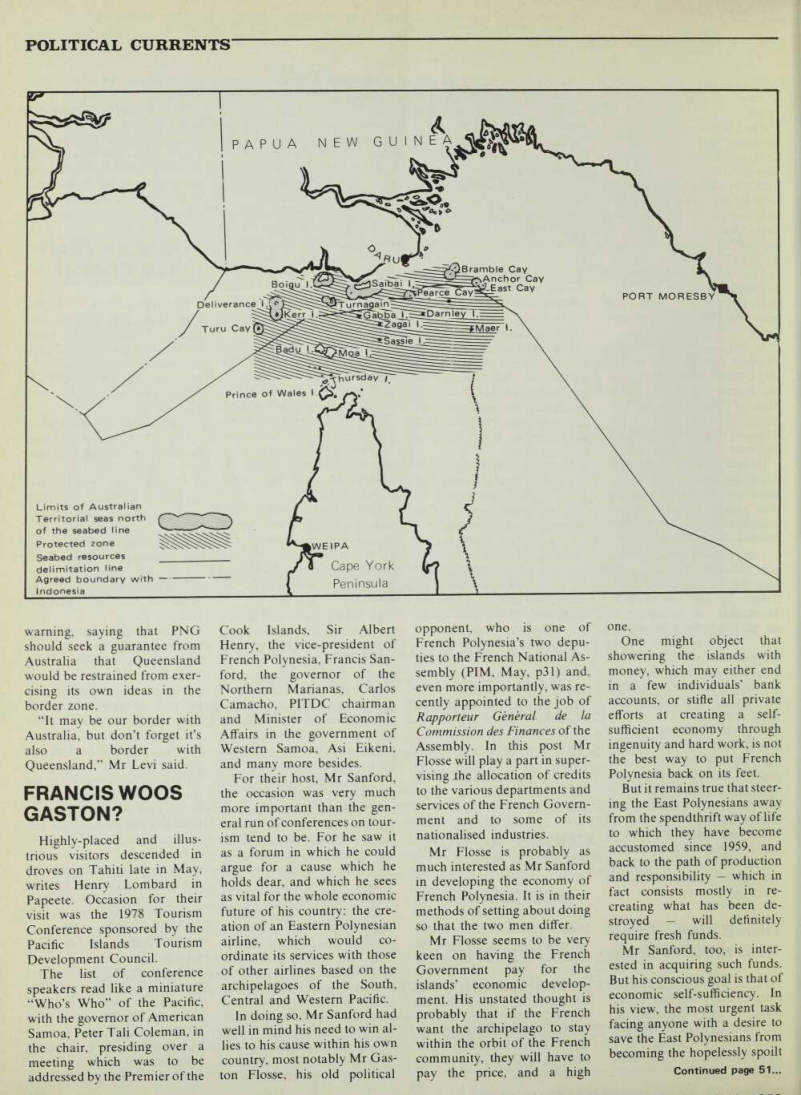
The boundary arrangements will take in three main lines on the map, and here is how they will be drawn: • There will be an inter national seabed boundary which will separate one country from the other; • A protected zone in which both countries will be involved, irrespective of the inter national boundary which the protected zone will straddle, and • A collection of eight Aus tralian islands and reef en claves inside the PNG
boundary.
The protected zone is seen by both governments as the most vital part of the boundary arrangements. It will be about 180 nautical miles from east to west and about 70 nautical miles from north to south in the Torres Strait Sea region. This is the area between the most northerly part of Australia and the southwest coast of the PNG mainland.
The protected zone will take in almost every island, reef and cay within the Torres Strait
zone, excluding only the big
Australian offshore group of islands centred on Thursday Island.
The PNG Government was told later, “beware of Queensland” when PNG and Australia implement their border arrangements.
Mr Noel Levi, a government back-bencher and a former Secretary for Defence, gave the
warning, saying that PNG
should seek a guarantee from Australia that Queensland would be restrained from exer cising its own ideas in the border zone.
“It may be our border with Australia, but don’t forget it’s also a border with Queensland,” Mr Levi said.
Francis Woos
Gaston?
Highly-placed and illus trious visitors descended in droves on Tahiti late in May, writes Henry Lombard in Papeete. Occasion for their visit was the 1978 Tourism Conference sponsored by the Pacific Islands Tourism
Development Council.
The list of conference speakers read like a miniature “Who’s Who” of the Pacific, with the governor of American Samoa, Peter Tali Coleman, in the chair, presiding over a meeting which was to be addressed by the Premier of the
Cook Islands, Sir Albert
Henry, the vice-president of
French Polynesia, Francis San ford, the governor of the Northern Marianas, Carlos Camacho, PITDC chairman and Minister of Economic Affairs in the government of Western Samoa, Asi Eikeni, and many more besides.
For their host, Mr Sanford, the occasion was very much more important than the gen eral run of conferences on tour ism tend to be. For he saw it as a forum in which he could argue for a cause which he holds dear, and which he sees as vital for the whole economic future of his country: the cre ation of an Eastern Polynesian airline, which would co ordinate its services with those of other airlines based on the archipelagoes of the South, Central and Western Pacific.
In doing so, Mr Sanford had well in mind his need to win al lies to his cause within his own country, most notably Mr Gas ton Flosse, his old political
opponent, who is one of
French Polynesia’s two depu
ties to the French National As
sembly (PIM, May, p3l) and,
even more importantly, was re
cently appointed to the job of
Rapporteur General de la Commission des Finances of the Assembly. In this post Mr Flosse will play a part in super vising Ihe allocation of credits to the various departments and services of the French Govern ment and to some of its nationalised industries.
Mr Flosse is probably as much interested as Mr Sanford in developing the economy of French Polynesia. It is in their methods of setting about doing so that the two men differ.
Mr Flosse seems to be very keen on having the French Government pay for the islands’ economic develop ment. His unstated thought is probably that if the French want the archipelago to stay within the orbit of the French community, they will have to pay the price, and a high
one.
One might object that
showering the islands with money, which may either end in a few individuals’ bank accounts, or stifle all private efforts at creating a self sufficient economy through ingenuity and hard work, is not the best way to put French Polynesia back on its feet.
But it remains true that steer ing the East Polynesians away from the spendthrift way of life to which they have become accustomed since 1959, and back to the path of production and responsibility which in fact consists mostly in re creating what has been de stroyed will definitely require fresh funds.
Mr Sanford, too, is inter ested in acquiring such funds.
But his conscious goal is that of economic self-sufficiency. In his view, the most urgent task facing anyone with a desire to save the East Polynesians from
becoming the hopelessly spoilt
Continued page 51...
children of a super-welfare state is to use what money is available on sound invest ments, such as the Eastern
Polynesian airline project.
Hence his anxiety to win a resounding endorsement from the tourism conference for the project. Mr Flosse could thus be obliged to climb on the bandwagon and to plead, in Paris, the need for capital to get the airline started.
It may seem strange to think of these two long-standing pol itical foes working in tandem in such a cause. But in politics, perhaps more than in any other human activity, one’s enemy of today may be one’s best friend and ally of tomorrow.
The Relief
Of Norfolk
The Norfolk pines swayed
visibly with the sighs of relief of Norfolk Island inhabitants following the May visit of Aus tralia’s Minister for Home Affairs, Mr R. J. Ellicott, QC.
For Mr Ellicott had presented them with what amounted to a bonanza of con cessions in terms of Australian Government policy towards the island. The most important of these were: • Australian laws will not be extended automatically to Nor folk, which will continue to have its own peculiar mixture of laws. • Australian taxes will not be extended to Norfolk. • Australian social service benefits will not be extended to Norfolk. • Any decision on represen tation for Norfolk in the Aus tralian Parliament will be put off for at least a year, and con sidered by a proposed “Nor folk Island Legislative
Assembly.”
One local commentator wrote jubilantly; “Mr Ellicott mentioned various minor as pects of the Nimmo Report, as though the government is accepting some parts of it while not accepting other parts but with its main recommenda tions rejected the report is now a dead letter.”
The report of the 1976 Royal
Commission presided over by
Sir John Nimmo had recom
mended sweeping measures of integration of Norfolk with the Australian mainland.
So the muskets which some had been threatening to take from their racks (PIM, June, p 19) can stay on the wall. For the time being at least, life on Norfolk Island can return to the leisurely pace for which it is renowned.
Mr Ellicott’s visit was the culminating point of 18 months of sometimes feverish political activity in Norfolk affairs.
Among the more spectacular recent gestures of the Islanders was the despatch of a dele gation to American Samoa by the Society of Descendants of the Pitcairn Settlers. The dele
gation comprised Mr Ken
Nobbs, president of the society, Mr Greg Quintal, a member of the society and the longest-serving member of the Norfolk Island Council, and Mr Ed Howard, American born editor of the Norfolk Island News, who acted as dele
gation secretary.
Society members, whose ancestors were part-Tahitian, had taken careful note of the inaugural address in January of American Samoa’s first elected governor, Mr Peter Tali Coleman, in which he said: “Mindful that we are Polynesians, as well as Samoans, we reach out our hands for our brothers and sis ters who live in Western Samoa, Tonga, Niue, Tuvalu, the Cook Islands, and in other neighbouring island communi ties in the Pacific. As we share a common past, so we share a common future, so must we
voyage together.”
In April the Pitcairners set out on a voyage to take the hand of kinship that had thus been offered them. They were not disappointed. Mr Coleman and his government greeted them as long-separated mem bers of the family. As the governor said in greeting them; “We have been expecting you for a long time.”
While Norfolk Islanders are breathing more easily since the Ellicott visit, in view of their past experience they are un likely to relax their vigilance against attempts by Australian
politicians to find loopholes in the new arrangements.
Such vigilance will only be
sharpened by the fact, angrily
noted on Norfolk, that the re port, Australia and the Pacific, prepared by the Senate Stand ing Committee on Defence and Foreign Affairs, has been writ ten as if Norfolk Island had
already been integrated into
Australia. Norfolk Island simply does not appear in the report’s list of countries and territories in the Pacific re
gion.
One further question about the status of Norfolk might be asked.
The amended Canberra Agreement of 1975, which is virtually the charter of the South Pacific Commission, says (Article V): “Australia (in respect of itself and its terri tories) 2 votes with the pro viso that Australia will not exercise the second vote until such time as Norfolk Island participates in the Con ference.”
The next South Pacific Con ference meets in Noumea in October. Will there be a Nor folk Island representative seated at the conference table?
Hostages: A
Tangled Tale
‘Confused’ seems as good a word as most to describe re ports in late May-early June of the alleged capture of a num ber of Indonesian officials who
were being held hostage by
rebels in jungle country in Irian Jaya north of the border with Papua New Guinea.
First reports said that the nine hostages included the commander of the Jayapura military district. Colonel Ismaeil, the intelligence chief in the province of Irian Jaya, Colonel Ameral, and the chair man of the provincial parlia ment, Mr Domine Nalaole.
The reports said that the rebel Free West Papua Move ment (OPM) was demanding an international conference, including Australia and Papua New Guinea, to negotiate their claims for independence from Indonesia, as a condition of re lease of the hostages. Other
wise they would be killed.
The reports added that a senior PNG provincial official had claimed to have received a duplicate of the rebels’ letter to Papua New Guinea’s Foreign Minister. Mr Ebia Olewale. outlining their demands.
But Mr Olewale later denied that there had been any com munication with him from the rebels. He was echoed by Aus tralia’s Acting Foreign Minis ter. Mr lan Sinclair, who said Australia had received no approaches, and was not in volved.
Entering the fray, Mr Jus
peth Siregar. information offi
cer at the Indonesian embassy in Port Moresby, denied that the “rebels” were really rebels at all. They had been at one lime, he said, but had surren dered.
They had been co-operating
with the government until this “hot-headed action brought on
by dissatisfaction”.
Later, a letter received in
Port Moresby by a family with
relatives in Jayapura. the Irian
Jaya capital, accused Indone
sian officials of inventing a story that a ransom was being demanded for the hostages.
The rebels are not mercenaries interested in money, the letters said, but want an acknowledge ment that the independence of Irian Jaya will be recognised and implemented. The letters claimed that if the hostages who are officials acknowledge
this by signing documents, they
will be released.
Sources in Port Moresby in June reported that a “huge” military operation had been launched by Indonesian forces to rescue the hostages.
But this was immediately de
nied by a military spokesman
in Jakarta who said; “There was no such operation ... if
there were operations, they
were only of a routine nature and by small units.”
The claims and counter claims will no doubt be sorted out with time. All that can now be said with confidence is that Indonesia’s problem with rebels in Irian Jaya, and Papua New Guinea’s problem in re lation both to the rebels and to Indonesia, are refusing to go away.