Clouds in the sky
pp. 9-10 · Read in the full issue
Nowhere has any formerly
dependent territory ever
moved into independence under a sky entirely free of pol itical clouds. The Solomon Islands are no exception.
The weeks leading up to
independence saw a simmering
conflict between the central government in Honiara and the Western Council, local auth ority of the Western District (PIM, June, p 18).
On April 6, six Western members of the Legislative As sembly staged a walk-out, say ing that the Western Council
was not happy with the way the government had approached them. “All people in the West ern District wanted indepen dence, but before that came
about they wanted security,”
said a Western spokesman. (Three other Western members who are Ministers remained in their seats.) The walk-out was in support of a resolution of the Western
Council asking the Legislative
Assembly to consider granting
state government before independence to the Western District. This would entail local
control of natural resources, finance, administration, lands,
internal migration and legis
lation.
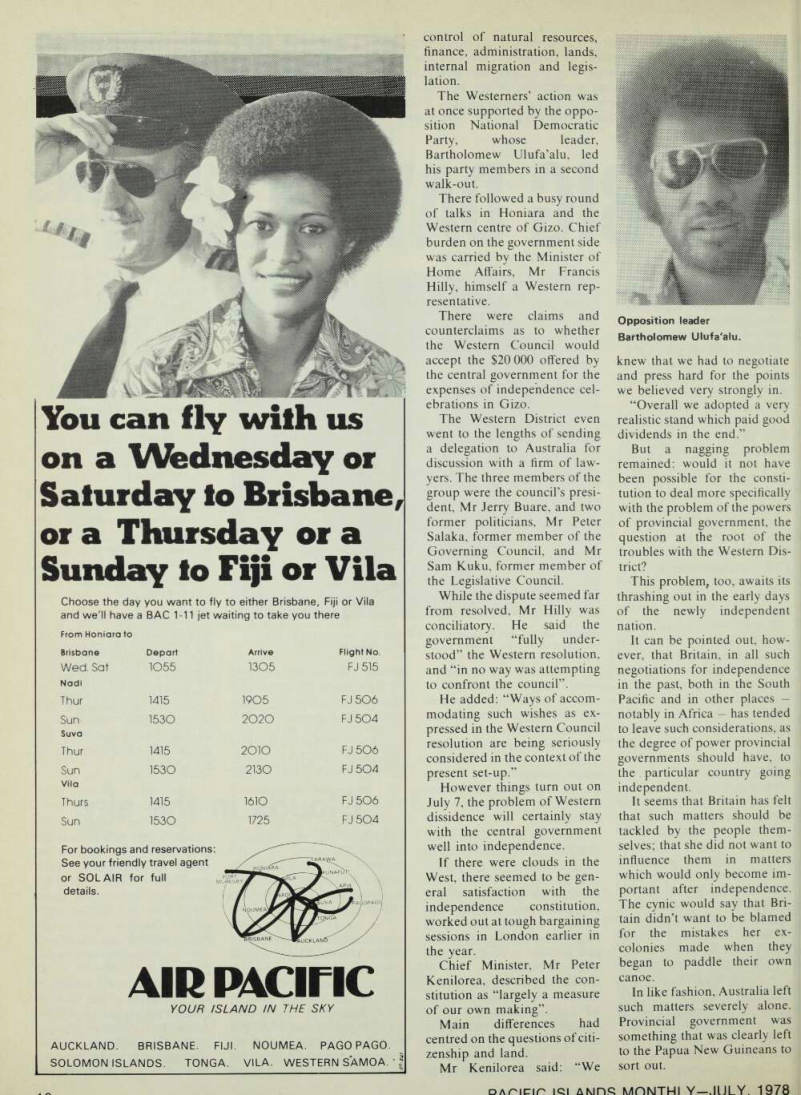
The Westerners’ action was at once supported by the oppo sition National Democratic Party, whose leader, Bartholomew Ulufa’alu, led his party members in a second walk-out.
There followed a busy round of talks in Honiara and the Western centre of Gizo. Chief burden on the government side was carried by the Minister of Home Affairs, Mr Francis Hilly, himself a Western rep resentative.
There were claims and counterclaims as to whether the Western Council would accept the $2O 000 offered by the central government for the expenses of independence cel ebrations in Gizo.
The Western District even went to the lengths of sending a delegation to Australia for discussion with a firm of law yers. The three members of the group were the council’s presi dent, Mr Jerry Buare, and two former politicians, Mr Peter Salaka, former member of the Governing Council, and Mr Sam Kuku, former member of the Legislative Council.
While the dispute seemed far from resolved, Mr Hilly was conciliatory. He said the government “fully under stood” the Western resolution, and “in no way was attempting to confront the council”.
He added: “Ways of accom modating such wishes as ex pressed in the Western Council resolution are being seriously considered in the context of the
present set-up.”
However things turn out on July 7, the problem of Western dissidence will certainly stay with the central government well into independence.
If there were clouds in the West, there seemed to be gen eral satisfaction with the
independence constitution,
worked out at tough bargaining sessions in London earlier in the year.
Chief Minister, Mr Peter Kenilorea, described the con stitution as “largely a measure of our own making”.
Main differences had centred on the questions of citi zenship and land.
Mr Kenilorea said; “We
knew that we had to negotiate and press hard for the points we believed very strongly in.
“Overall we adopted a very realistic stand which paid good dividends in the end.”
But a nagging problem
remained; would it not have been possible for the consti tution to deal more specifically with the problem of the powers of provincial government, the question at the root of the troubles with the Western Dis trict?
This problem, too, awaits its
thrashing out in the early days
of the newly independent nation.
It can be pointed out, how ever, that Britain, in all such
negotiations for independence
in the past, both in the South Pacific and in other places notably in Africa has tended to leave such considerations, as the degree of power provincial governments should have, to
the particular country going
independent.
It seems that Britain has felt that such matters should be tackled by the people them selves; that she did not want to influence them in matters which would only become im portant after independence.
The cynic would say that Bri tain didn’t want to be blamed for the mistakes her ex colonies made when they began to paddle their own canoe.
In like fashion, Australia left such matters severely alone.
Provincial government was something that was clearly left to the Papua New Guineans to sort out.
Opposition leader Bartholomew Ulufa'alu.