Prime Minister
pp. 11-13 · Read in the full issue
CHE RISE AND RISE OF A MODEST
Peter L. Young traces the course of the political career of Mr Peter Kenilorea, first Prime Minister of the independent Solomon Islands. Then, in an exclusive question-and-answer interview, he takes us inside the mind of this leader of the world’s newest independent nation.
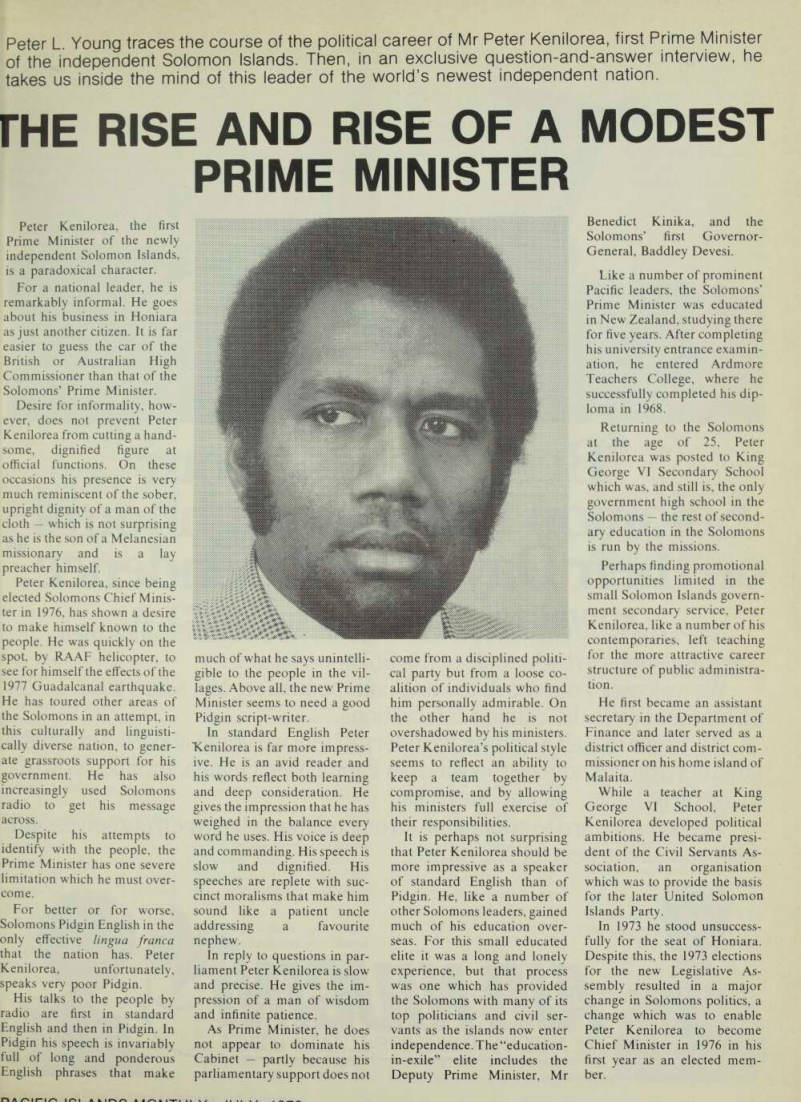
Peter Kenilorea, the first Prime Minister of the newly independent Solomon Islands, is a paradoxical character.
For a national leader, he is remarkably informal. He goes about his business in Honiara as just another citizen. It is far easier to guess the car of the British or Australian High Commissioner than that of the Solomons’ Prime Minister.
Desire for informality, how ever, does not prevent Peter Kenilorea from cutting a hand
some, dignified figure at
official functions. On these occasions his presence is very much reminiscent of the sober, upright dignity of a man of the cloth which is not surprising as he is the son of a Melanesian missionary and is a lay
preacher himself.
Peter Kenilorea, since being elected Solomons Chief Minis ter in 1976, has shown a desire to make himself known to the people. He was quickly on the spot, by RAAF helicopter, to see for himself the effects of the 1977 Guadalcanal earthquake.
He has toured other areas of the Solomons in an attempt, in
this culturally and linguisti
cally diverse nation, to gener ate grassroots support for his government. He has also increasingly used Solomons radio to get his message across.
Despite his attempts to identify with the people, the Prime Minister has one severe limitation which he must over come.
For better or for worse, Solomons Pidgin English in the
only effective lingua franca
that the nation has. Peter
Kenilorea, unfortunately,
speaks very poor Pidgin.
His talks to the people by radio are first in standard English and then in Pidgin. In Pidgin his speech is invariably full of long and ponderous
English phrases that make
much of what he says unintelli gible to the people in the vil lages. Above all, the new Prime Minister seems to need a good
Pidgin script-writer.
In standard English Peter Xenilorea is far more impress ive. He is an avid reader and his words reflect both learning and deep consideration. He gives the impression that he has weighed in the balance every word he uses. His voice is deep and commanding. His speech is slow and dignified. His speeches are replete with suc cinct moralisms that make him sound like a patient uncle addressing a favourite
nephew.
In reply to questions in par liament Peter Kenilorea is slow and precise. He gives the im pression of a man of wisdom and infinite patience.
As Prime Minister, he does not appear to dominate his Cabinet partly because his parliamentary support does not
come from a disciplined politi cal party but from a loose co alition of individuals who find him personally admirable. On the other hand he is not overshadowed by his ministers.
Peter Kenilorea’s political style
seems to reflect an ability to
keep a team together by
compromise, and by allowing
his ministers full exercise of
their responsibilities.
It is perhaps not surprising that Peter Kenilorea should be more impressive as a speaker of standard English than of Pidgin. He, like a number of other Solomons leaders, gained much of his education over seas. For this small educated elite it was a long and lonely experience, but that process was one which has provided the Solomons with many of its top politicians and civil ser vants as the islands now enter independence. The “education in-exile” elite includes the Deputy Prime Minister, Mr
Benedict Kinika, and the Solomons’ first Governor- General, Baddley Devesi.
Like a number of prominent Pacific leaders, the Solomons’
Prime Minister was educated in New Zealand, studying there for five years. After completing his university entrance examin ation, he entered Ardmore Teachers College, where he
successfully completed his dip
loma in 1968.
Returning to the Solomons at the age of 25, Peter Kenilorea was posted to King
George VI Secondary School
which was, and still is, the only government high school in the Solomons the rest of second ary education in the Solomons is run by the missions.
Perhaps finding promotional
opportunities limited in the small Solomon Islands govern ment secondary service, Peter Kenilorea, like a number of his
contemporaries, left teaching
for the more attractive career structure of public administra tion.
He first became an assistant secretary in the Department of Finance and later served as a district officer and district com missioner on his home island of Malaita.
While a teacher at King George VI School, Peter
Kenilorea developed political
ambitions. He became presi dent of the Civil Servants As sociation, an organisation which was to provide the basis for the later United Solomon
Islands Party.
In 1973 he stood unsuccess fully for the seat of Honiara.
Despite this, the 1973 elections for the new Legislative As sembly resulted in a major change in Solomons politics, a change which was to enable Peter Kenilorea to become Chief Minister in 1976 in his first year as an elected mem ber.
The 1973 elections changed the character of the Solomons legislature. Only five out of 14 members of the previous body, the Governing Council, were returned to the newly constituted Legislative As
sembly.
Entering the new legislature
were 10 new members who had been active in the Civil Ser vants Association. Their com mon outlook brought to the
legislature a comparatively
unified bloc that later formed the United Solomon Islands
Party.
The then Chief Minister, Solomon Mamaloni, although
not favouring political parties,
rallied the experienced mem bers of the legislature into the
People’s Progressive Party.
The PPP was increasingly at Loggerheads with USIP Mam
aloni, previously regarded by
the colonial administration as a radical, now seemed cast by USIP as a conservative on the independence issue. Mamaloni was for going slowly towards independence. USIP were
seeking independence as soon
as possible.
Mamaloni resigned in 1976 after the elections. He gave no
reasons for his resignation but was clearly fed up with politics and the inability of the PPP and USIP to work well
together.
Peter Kenilorea had stood for his home East ‘Are ‘Are dis trict on the island of Malaita in 1976 and was successful in win ning the seat. With Mamaloni’s resignation, Kenilorea was elected Chief Minister by the
Legislative Assembly on July
14, 1976.
Peter Kenilorea’s rapid rise is explicable if it is remem bered that the base of his sup port, was from members of the Civil Servants Association, who had been elected three
years previously.
Although the base of Mr Kenilorea’s support was the United Solomon Islands Party, he has often said that he does not believe in political parties.
He regards the advent of party politics in the Solomons as premature and potentially divisive.
Two weeks after his election to the post of Chief Minister, Mr Kenilorea was on his way to Nauru to address the South Pacific Conference where he acquitted himself well in a speech arguing for an end to
the confusion and waste caused by overlapping Pacific
development organisations.
After this conference, Peter Kenilorea played host to Papua New Guinea’s Prime Minister, Michael Somare.
This did something to better re lations between the two coun tries, which had become strained after the previous Solomons’ Chief Minister, Solomon Mamaloni, was credited with making indiscreet remarks in support of Father John Momis’
Bougainville separatist move
ment. Peter Kenilorea realises that just as the view of the Solomons Government, on the question of Bougainville, is im portant to the Somare Govern ment, so the attitude of Port Moresby to the Solomons’ own separatists in the west is im portant to Honiara.
Peter Kenilorea is, on his re cord, a democrat and a cau tious moderniser. While he does not like everything he sees in modern society, he equally scorns those who bemoan the passing of traditional culture, while taking advantage of all that Western technology has to offer.
His point of view was well
expressed in an article he wrote for a recent issue of Pacific Perspective in which he said: “Was it really the colonialists’ fault that mini-skirts became the idol of our Honiara girls?
Did colonialists come to the Solomons with the doctrine that man’s value is found in mini-skirts and that girls in
ankle-length apparel would be
punished? No. Are we our selves sure what cultural value in traditional dressing is being devalued by mini-skirts? Re member that the birthday suit was the dress norm of our traditional culture.”
Peter Kenilorea is above all a man of principle. He is a tee totaller and a sincere Christian.
He sees debate as inevitable, and says that he welcomes con structive criticism.
He has no illusions about the future. He has said: “Indepen dence means the transfer of power and responsibility. It does not mean immediate per sonal benefits. It brings its obli gations as well as its rewards, its problems as well as its
joys.”
Or, as he put it in his Christ mas message to the people of the Solomons, “The only thing we have to fear is ourselves.”