The Big Day: The Solomons Celebrate
Honiara did not exist before World War 11. At best, American servicemen who served in that war remember it as a nondescript collection of Quonset huts on the island of Guadalcanal, control of which they bitterly contested with the Japanese. But Honiara will live through its finest hour on July 7. At the end of that day, it will have thrown off most memories of its humble beginnings to emerge as the capital of the world’s newest independent nation, the Solomon Islands. Plans for the Solomons’ “Big Day”, and the immediate political background and problems of Solomons’ independence, are sketched out in the articles which follow.
The almost 200 000 people of the Solomon Islands, largest
remaining British dependency
in the South Pacific, will attain
their political independence on
July 7.
Plans for what has become known in the Solomons as “the Big Day” are well up to the measure of the occasion.
As reported earlier (PIM, May, p 5), 26 countries, 13 in ternational organisations and three Pacific universities have been invited to the cele brations. The United States, Australia and New Zealand are expected each to send a war ship to honour the occasion.
The Queen will be represented by her cousin Prince Richard, Duke of Gloucester, who will be accompanied by the Duch ess.
Central celebrations in the capital, Honiara, once a Quon set hut complex, will take place during the week July 3-8, with the key symbolic event occur ing at Lawson Tama on July 7 when the Union Jack will be lowered and the Solomon Islands flag in the national colours of blue, green and yellow, run up.
Honiara’s crowded week will include a national display, fol lowed by a fireworks display, on July 6, a national show, based on Home Ground, run ning from July 5-8, a series of receptions and a State Ball, sports events, a regatta, an ecu menical service staged by the Solomon Islands Christian As sociation, and a final carnival float parade on July 8.
Celebrations in the districts will mostly take place in the following week, with Gizo the venue for independence events in the Western District (July 5-10), Kira Kira in Makira/Ulawa District (main
celebrations starting on July
12), Graciosa Bay in Santa Cruz District (main cele brations from July 12), and Auki in Malaita District (main celebrations from July 11).
Main reason for the time dif ference is to give time for senior representatives of the districts to get back home after the central celebrations in Honiara.
A feature of the celebration plans is the attention given to the participation of the young.
It is planned to provide every child in the Solomons with a
ballpoint pen bearing the
national colours, and with a leaflet carrying the text of the new national anthem (see else where in PIM).
Celebrations will not be con fined to the Solomons; in far off London there will be a special service in Westminster Abbey on July 7, at which it is expected that a member of the royal family will represent the
Queen. This will be followed by a reception for prominent Solomon Islanders and other
distinguished guests.
The Solomons celebrations will be the subject of a 90minute film made by the Aus
tralian Government-run Film Australia. The crew spent sev eral weeks in the Solomons be
fore the “Big Day”, shooting
and soaking up atmosphere. To be presented as a gift to the Solomon Islands, the film fol lows similar productions made
by Film Australia covering
independence celebrations in Fiji (1970), and Papua New Guinea (1975). It is to be com
pleted by Christmas.
Choice of the royal represen tatives has caused a stir in the Solomons, where there is a feeling that a personality closer to the Queen, such as Prince Charles, if not the Queen her self, should have come for the
independence celebrations
(PIM. May, p 5).
Replying in April to a
suggestion along these lines by
the Leader of the Opposition, Mr Ulufa’alu, Chief Minister Kenilorea emphasised that it was entirely up to the Queen to choose her representative. But he added that “the dissatis faction of the people” on this matter had been conveyed to
her Majesty.
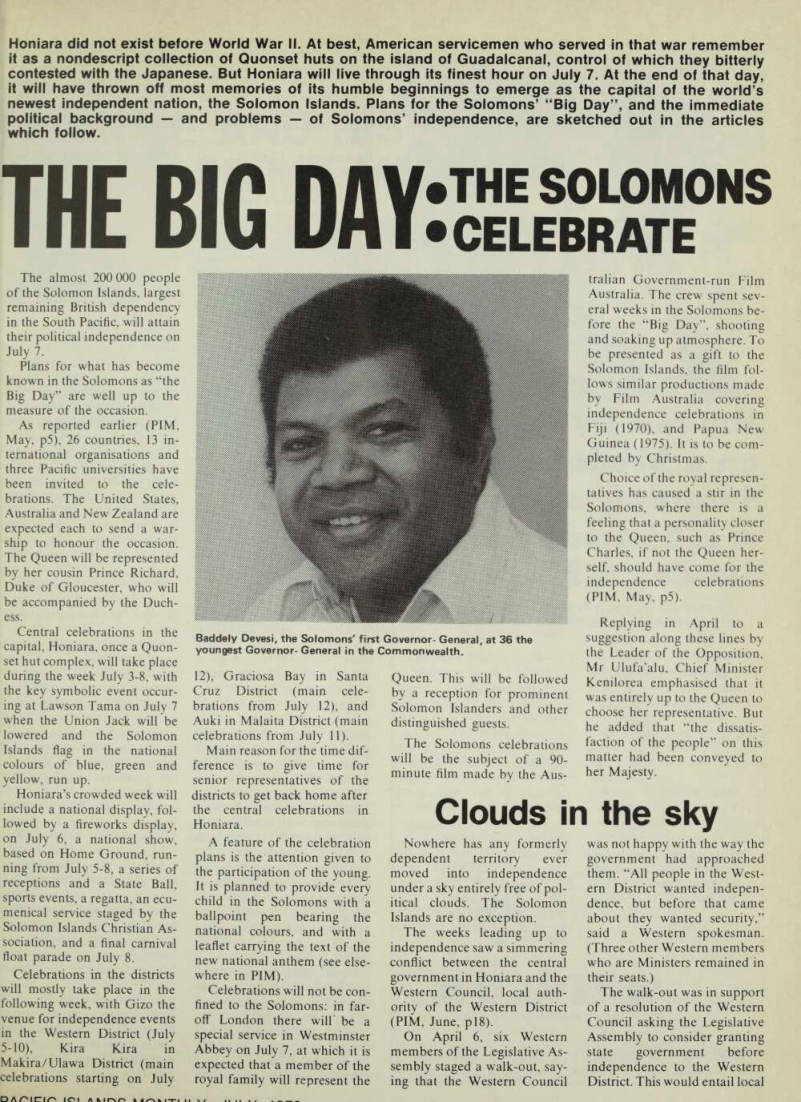
Baddely Devesi, the Solomons' first Governor-General, at 36 the youngest Governor-General in the Commonwealth.