New boats make life
p. 63 · Read in the full issue
easier in Yasawas
From W. J. Beckett
Two new boats put into service in the Yasawa Islands, Fiji, are greatly facilitating travel there.
One, the St John, was built en tirely at Vuaki, on Matacawalevu Island, where there are no power tools. The other, the Barbara-Noela, was built partly in New Zealand.
Their construction is a story of dedication and sheer hard work. At Vuaki it was labouring by hand with saw, plane, hammer, chisel, paint brush, sandpaper, in fine weather, in foul, in rough thatch shelters on the beach.
The two builders, both from Vuaki, which is about 60 miles out from Lautoka on the mainland of Viti Levu, are Aloisio Momo and Vikatore Rakata.
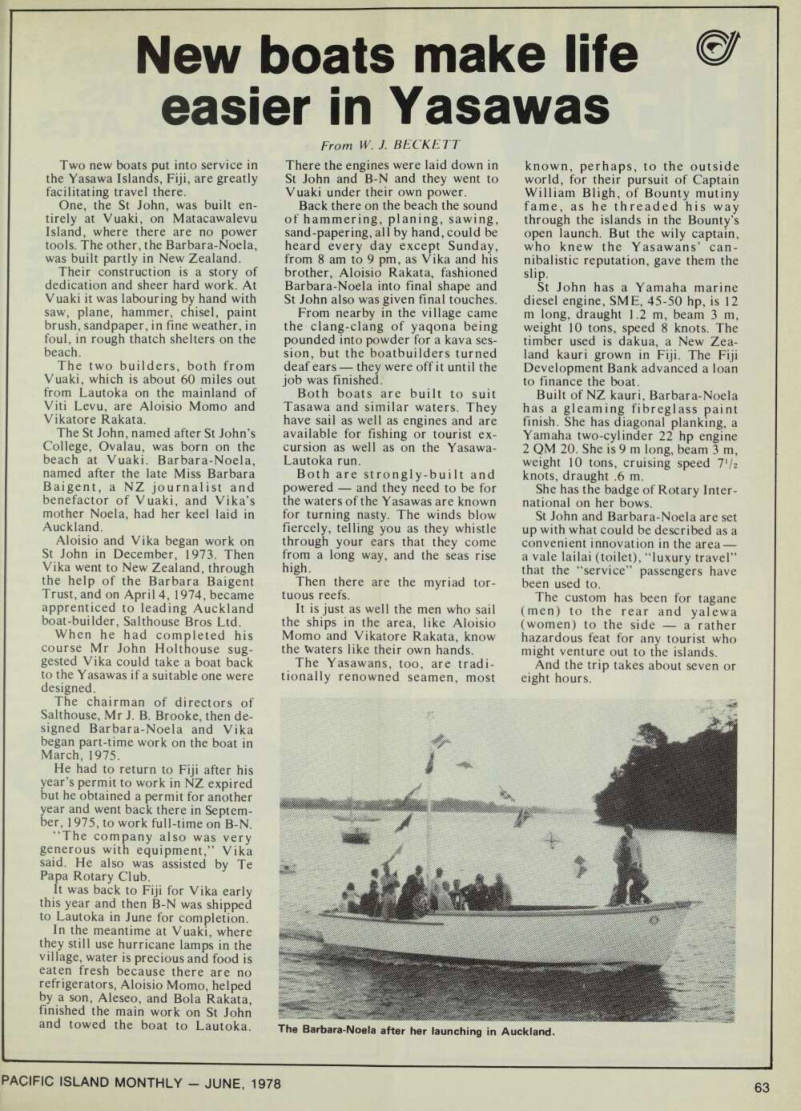
The St John, named after St John’s College, Ovalau, was born on the beach at Vuaki. Barbara-Noela, named after the late Miss Barbara Baigent, a NZ journalist and benefactor of Vuaki, and Vika’s mother Noela, had her keel laid in Auckland.
Aloisio and Vika began work on St John in December, 1973. Then Vika went to New Zealand, through the help of the Barbara Baigent Trust, and on April 4, 1974, became apprenticed to leading Auckland boat-builder, Salthouse Bros Ltd.
When he had completed his course Mr John Holthouse sug gested Vika could take a boat back to the Yasawas if a suitable one were designed.
The chairman of directors of Salthouse, Mr J. B. Brooke, then de signed Barbara-Noela and Vika began part-time work on the boat in March, 1975.
He had to return to Fiji after his year’s permit to work in NZ expired but he obtained a permit for another year and went back there in Septem ber, 1975, to work full-time on B-N.
“The company also was very generous with equipment,” Vika said. He also was assisted by Te Papa Rotary Club.
It was back to Fiji for Vika early this year and then B-N was shipped to Lautoka in June for completion.
In the meantime at Vuaki, where they still use hurricane lamps in the village, water is precious and food is eaten fresh because there are no refrigerators, Aloisio Momo, helped by a son, Aleseo, and Bola Rakata, finished the main work on St John and towed the boat to Lautoka.
There the engines were laid down in St John and B-N and they went to Vuaki under their own power.
Back there on the beach the sound of hammering, planing, sawing, sand-papering, all by hand, could be heard every day except Sunday, from 8 am to 9 pm, as Vika and his brother, Aloisio Rakata, fashioned Barbara-Noela into final shape and St John also was given final touches.
From nearby in the village came the clang-clang of yaqona being pounded into powder for a kava ses sion, but the boatbuilders turned deaf ears they were off it until the job was finished.
Both boats are built to suit Tasawa and similar waters. They have sail as well as engines and are available for fishing or tourist ex cursion as well as on the Yasawa- Lautoka run.
Both are strongly-built and powered and they need to be for the waters of the Yasawas are known for turning nasty. The winds blow fiercely, telling you as they whistle through your ears that they come from a long way, and the seas rise high.
Then there are the myriad tor tuous reefs.
It is just as well the men who sail the ships in the area, like Aloisio Momo and Vikatore Rakata, know the Waters like their own hands.
The Yasawans, too, are tradi tionally renowned seamen, most
known, perhaps, to the outside world, for their pursuit of Captain William Bligh, of Bounty mutiny fame, as he threaded his way through the islands in the Bounty’s open launch. But the wily captain, who knew the Yasawans’ can nibalistic reputation, gave them the
slip.
St John has a Yamaha marine diesel engine, SME, 45-50 hp, is 12 m long, draught 1.2 m, beam 3 m, weight 10 tons, speed 8 knots. The timber used is dakua, a New Zea land kauri grown in Fiji. The Fiji Development Bank advanced a loan to finance the boat.
Built of NZ kauri, Barbara-Noela has a gleaming fibreglass paint finish. She has diagonal planking, a Yamaha two-cylinder 22 hp engine 2 QM 20. She is 9 m long, beam 3 m, weight 10 tons, cruising speed 7Vz knots, draught .6 m.
She has the badge of Rotary Inter national on her bows.
St John and Barbara-Noela are set up with what could be described as a convenient innovation in the area a vale lailai (toilet), “luxury travel” that the “service” passengers have been used to.
The custom has been for tagane (men) to the rear and yalewa (women) to the side a rather hazardous feat for any tourist who might venture out to the islands.
And the trip takes about seven or eight hours.
The Barbara-Noela after her launching in Auckland.