mysterious ‘Lost World’
pp. 65-67 · Read in the full issue

Across the frontier into New Zealand’s mysterious ‘Lost World’
Te Anau, departure point for New Zealand’s fiordland, is so far south it’s almost out of this world and that’s how many people who visit Te Anau feel about the scenery, writes Kendrick Howard. This town (pop 2 300) is in the centre of the Fiordland lakes district where nature has been fantasti cally generous. This wilderness area is a veritable cornucopia of mountains, fiords, secluded trout streams and idyllic lakes.
There are dozens of lakes.
The largest, Te Anau, covers 342 sq km, has a shoreline of 483 km, much of it formed by fiords that reach back into per
petually snow-capped moun
tains. Nearby is Manapouri, a lake of unsurpassed loveliness studded with small islands clad in native bush right to the water’s edge. Many lakes can
be reached only by float-plane
and some, like mysterious Lake Quill high in the clouds, can be seen only from the air.
Tourism is the major indus try in Fiordland and virtually every fourth person you meet has a financial or occupational interest. About the only non tourist personnel are the game hunters and a few public ser
vants and hydro-workers,
though even here it is difficult to draw a line.
The hydro-electric station with its enormous under ground powerhouse on the west arm of Lake Manapouri has itself become a tourist attraction. This plant which has
a generating capacity of 590
megawatts (enough to light up
59 000 000 100-watt lamps) is
this country’s largest power
producer. So many people be came interested in this project when it was being built that a
company now runs guided
tours. Fast luxury cabin
cruisers operate twice-daily
services, a 64 km round-trip that takes four hours.
Te Anau is on the grand stand side of Fiordland National Park. New Zealand
has 10 national parks and Fiordland covers 1 228 348 ha which is larger than the total combined area of the other nine. This green wilderness is the world’s 12th largest national park and is so rugged that much of it is still unex
plored.
The first recorded sighting of Fiordland appears in the log of Captain James Cook’s Endeavour which sailed down this long indented coastline in March, 1770. Cook noted, and named, several harbours, but not until his third visit in 1773 did he set foot on land, at
Pickersgill Harbour in Dusky
Sound.
Cook’s mooring site was dis covered more than 150 years later and a plaque was erected on this spot in 1963. The stumps of the trees can still be seen on ground which he had cleared for refitting his ship.
During his stay, Cook made contact with parties of friendly Maoris, but he did little explor
ing. “From what we could see of the interior,” he wrote in his journal, “it consists entirely of barren rocky mountains which are so crowded together as to leave room for no valleys of extent, nor did we see a single acre of ground fit for a plan tation of any kind ..
The primaeval grandeur of
this park is the aftermath of glacial action. Thousands of years ago rivers of slow
moving ice ploughed down
from vast snow basins bulldoz ing a path on their relentless march to the sea.
A glacier will carve off rocks as big as houses and dump them 20 km away. It will grind granite to gravel and with a shove of its icy snout heap up a wilderness of rubble. Geol ogists say this ice was, in places, thousands of metres thick.
At Lake Manapouri, the ice gouged a basin 32 km long and 10 km wide to a depth of 443 m (1 455 ft). This is New Zealand’s deepest lake. Clin
ton Canyon, another old gla cier trail, has walls rising sheer for 270 m (895 ft). But the most impressive features are the fiords. There are some 16 of these ice-carved canyons which extend inland for up to 48 km.
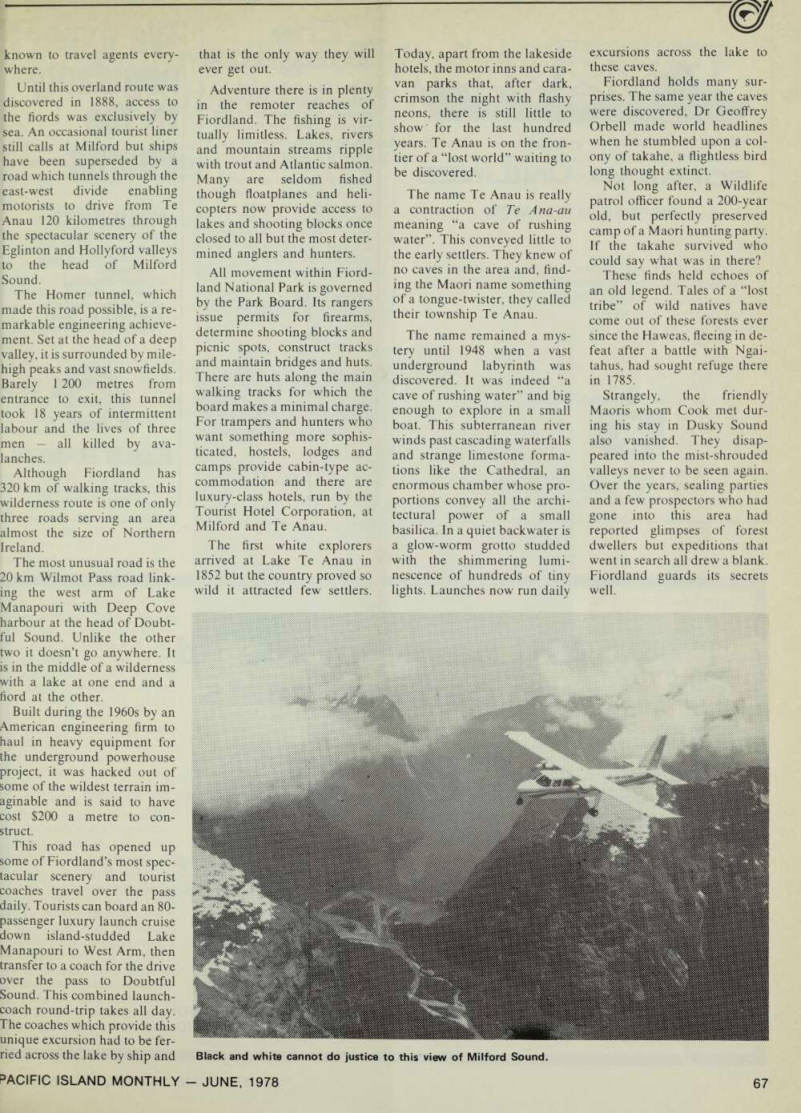
In Milford Sound are the lof tiest sea cliffs in the world.
Mitre Peak which dominates the south end of the sound rises sheer out of the water for more than a mile. The Bowen Falls and the Stirling Falls both plunge more than 160 m (530 ft) and are utterly dwarfed by the enormous rock walls
from which they spring.
Although some 300 000
people visit this park during
the year few do more than take a cruise on a lake, or a ramble along one of the many bush tracks. The track between Te Anau and Milford Sound, a 50 kilometre, three-day ramble aptly described as “the most beautiful walk in the world”, is
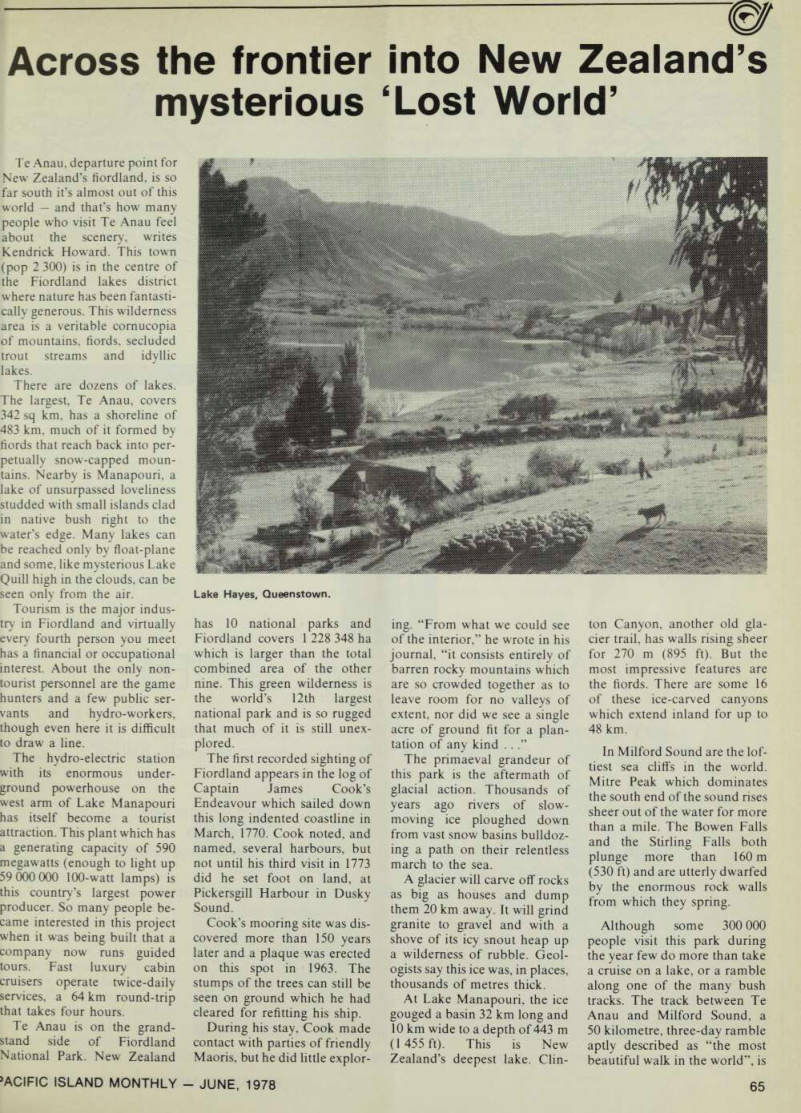
Lake Hayes, Queenstown.
known to travel agents every where.
Until this overland route was discovered in 1888, access to the fiords was exclusively by sea. An occasional tourist liner still calls at Milford but ships have been superseded by a road which tunnels through the east-west divide enabling motorists to drive from Te Anau 120 kilometres through the spectacular scenery of the
Eglinton and Hollyford valleys
to the head of Milford Sound.
The Homer tunnel, which made this road possible, is a re markable engineering achieve ment. Set at the head of a deep valley, it is surrounded by mile high peaks and vast snowfields.
Barely 1 200 metres from entrance to exit, this tunnel took 18 years of intermittent labour and the lives of three men all killed by ava lanches.
Although Fiordland has 320 km of walking tracks, this wilderness route is one of only three roads serving an area almost the size of Northern Ireland.
The most unusual road is the 20 km Wilmot Pass road link ing the west arm of Lake
Manapouri with Deep Cove
harbour at the head of Doubt ful Sound. Unlike the other two it doesn’t go anywhere. It is in the middle of a wilderness with a lake at one end and a fiord at the other.
Built during the 1960 s by an
American engineering firm to
haul in heavy equipment for
the underground powerhouse
project, it was hacked out of some of the wildest terrain im aginable and is said to have cost $2OO a metre to con struct.
This road has opened up some of Fiordland’s most spec tacular scenery and tourist coaches travel over the pass daily. Tourists can board an 80-
passenger luxury launch cruise
down island-studded Lake Manapouri to West Arm, then transfer to a coach for the drive over the pass to Doubtful Sound. This combined launch
coach round-trip takes all day.
The coaches which provide this unique excursion had to be fer ried across the lake by ship and
that is the only way they will ever get out.
Adventure there is in plenty in the remoter reaches of Fiordland. The fishing is vir tually limitless. Lakes, rivers and mountain streams ripple with trout and Atlantic salmon.
Many are seldom fished
though floatplanes and heli
copters now provide access to lakes and shooting blocks once closed to all but the most deter mined anglers and hunters.
All movement within Fiord land National Park is governed by the Park Board. Its rangers issue permits for firearms, determine shooting blocks and picnic spots, construct tracks and maintain bridges and huts.
There are huts along the main walking tracks for which the board makes a minimal charge.
For trampers and hunters who
want something more sophis
ticated, hostels, lodges and
camps provide cabin-type ac
commodation and there are luxury-class hotels, run by the Tourist Hotel Corporation, at Milford and Te Anau.
The first white explorers arrived at Lake Te Anau in 1852 but the country proved so wild it attracted few settlers.
Today, apart from the lakeside hotels, the motor inns and cara van parks that, after dark, crimson the night with flashy neons, there is still little to show' for the last hundred years. Te Anau is on the fron tier of a “lost world’’ waiting to be discovered.
The name Te Anau is really a contraction of Te Ana-au meaning “a cave of rushing water”. This conveyed little to the early settlers. They knew of no caves in the area and, find ing the Maori name something of a tongue-twister, they called their township Te Anau.
The name remained a mys tery until 1948 when a vast
underground labyrinth was
discovered. It was indeed “a cave of rushing water” and big enough to explore in a small boat. This subterranean river winds past cascading waterfalls and strange limestone forma tions like the Cathedral, an enormous chamber whose pro portions convey all the archi tectural power of a small basilica. In a quiet backwater is a glow-worm grotto studded with the shimmering lumi nescence of hundreds of tiny lights. Launches now run daily
excursions across the lake to these caves.
Fiordland holds many sur prises. The same year the caves were discovered, Dr Geoffrey Orbell made world headlines when he stumbled upon a col ony of takahe, a flightless bird
long thought extinct.
Not long after, a Wildlife patrol officer found a 200-year
old, but perfectly preserved
camp of a Maori hunting party.
If the takahe survived who could say what was in there?
These finds held echoes of an old legend. Tales of a “lost tribe’’ of wild natives have come out of these forests ever since the Haweas, fleeing in de feat after a battle with Ngai tahus, had sought refuge there in 1785.
Strangely, the friendly
Maoris whom Cook met dur ing his stay in Dusky Sound
also vanished. They disap
peared into the mist-shrouded valleys never to be seen again.
Over the years, sealing parties and a few prospectors who had gone into this area had
reported glimpses of forest
dwellers but expeditions that went in search all drew a blank.
Fiordland guards its secrets well.
Black and white cannot do justice to this view of Milford Sound.