See-saw across Tasman
p. 61 · Read in the full issue
Measures to loosen trade re strictions between New Zealand and Australia include an expansion of goods on which duties will be phased out over a period of eight years.
Textiles, footwear and clothing will come under special trading arrangements.
The Australian and New Zealand governments have reached agreement on further goods to be included in Sched ule A, of the New Zealand - Australian Free Trade Agree ment.
Under this schedule, any customs duties on the goods in trade between the two coun tries will be phased out up to eight years. The first reductions will operate as from next
January 1.
Goods affected include some plastics, travel goods and cases, stamps, shares and trav ellers cheques, roof tiles, tube
and pipe fittings, lifting and
handling machinery and ve
hicles such as breakdown lor ries, fire engines and snow
ploughs.
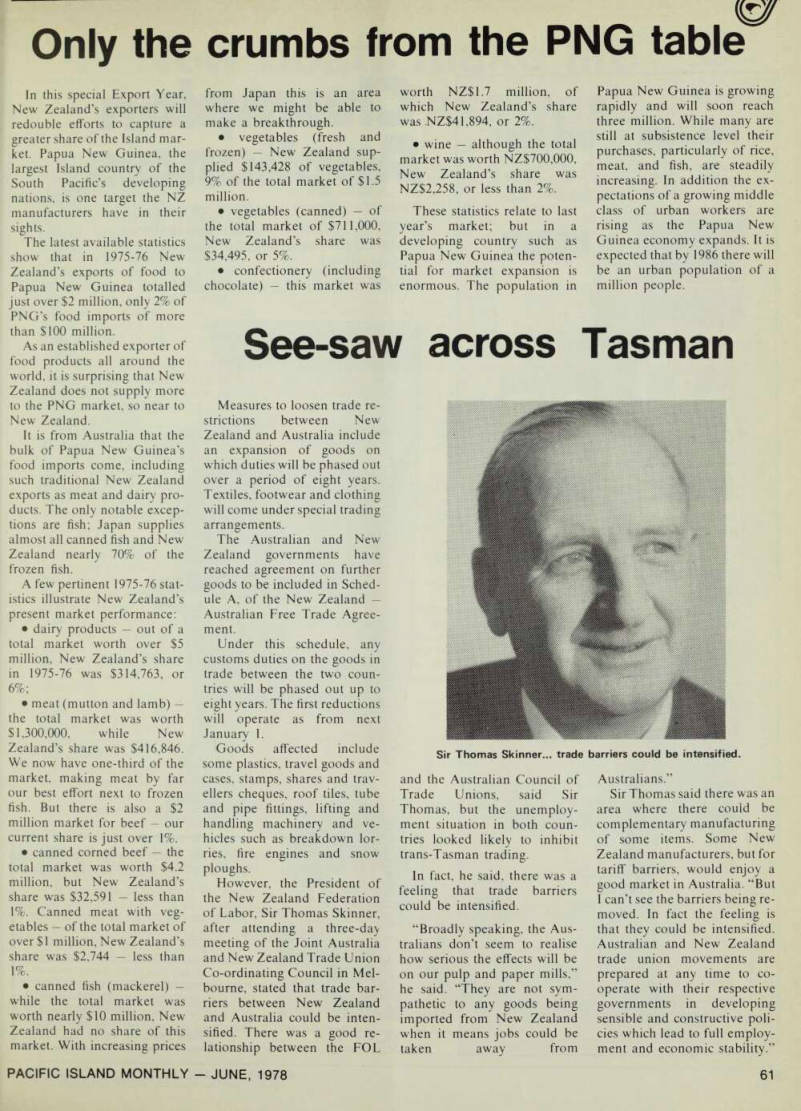
However, the President of the New Zealand Federation of Labor, Sir Thomas Skinner,
after attending a three-day
meeting of the Joint Australia and New Zealand Trade Union Co-ordinating Council in Mel bourne, stated that trade bar riers between New Zealand and Australia could be inten sified. There was a good re lationship between the FOL
and the Australian Council of Trade Unions, said Sir Thomas, but the unemploy ment situation in both coun tries looked likely to inhibit
trans-Tasman trading.
In fact, he said, there was a feeling that trade barriers could be intensified.
“Broadly speaking, the Aus
tralians don’t seem to realise how serious the effects will be on our pulp and paper mills,” he said. “They are not sym
pathetic to any goods being
imported from New Zealand when it means jobs could be taken away from
Australians.”
Sir Thomas said there was an area where there could be
complementary manufacturing
of some items. Some New Zealand manufacturers, but for tariff barriers, would enjoy a good market in Australia. “But I can’t see the barriers being re moved. In fact the feeling is that they could be intensified.
Australian and New Zealand trade union movements are prepared at any time to co operate with their respective governments in developing sensible and constructive poli cies which lead to full employ ment and economic stability.”
Sir Thomas Skinner... trade barriers could be intensified.