New Zealand: A growing effort
pp. 41-43 · Read in the full issue

in the Islands
New Zealand today is putting more and more effort into becoming a genuinely Pa cific nation, writes Bob Thompson of the Asia Pacific Research Unit.
Three per cent of the country’s population is drawn from the Islands. Ten per cent of the population has a Polynesian ancestry. More than 20% of the inner city populations of Auckland and
Wellington is Polynesian.
Auckland today is the world’s
largest Polynesian city.
The social imperatives are strong. So are the economic.
Islands states that are not economically viable are a greater charge on New Zealand aid, and more prone to become politically unstable and unpre dictably active in pursuit of in
ternational options.
Viable Island economies are also growth markets for New Zealand, and with possible in creased emphasis on restruc turing of the New Zealand economy, the Islands can be come suppliers of a specialised range of tropical goods to the New Zealand market.
There are other important
links, especially political co
operation, immigration and
educational and health ser vices, but New Zealand’s situ ation and the aspirations of the Islands press trade and invest ment questions to the top of the list of priorities.
Immigration from countries like Western Samoa and Tonga to Auckland has slowed in re cent times, causing Island ad ministrations to place greater
emphasis on expanding their
own agricultural and manufac
turing bases.
New Zealand’s relatively
high unemployment rate, and
the scarcity of jobs for manual workers, has also slowed immi gration from the Cooks, Niue and Tokelau. While these Islanders are New Zealand citi zens and may freely enter, they tend not to move until relatives
already settled tell them of jobs
arranged.
While immigration will no doubt resume its former levels when the New Zealand econ omy picks up, it will probably do so on a more planned basis, with more specific orientation being provided for new settlers than was the case during the big migrant influx earlier this decade.
In education. New Zealand continues to provide edu cational opportunities for
scholarship and private
students from the Islands.
New Zealand aid provides support for efforts to localise school curricula, to develop technical training in the Islands, and to strengthen the University of the South Pacific as an aid to regional develop ment.
USP is to receive additional New Zealand funds to help it to develop its consultant capabilities. This will enable local and expatriate staff employed not only in Suva but on other campuses throughout the region to tackle develop ment projects for which their
academic training equips
them.
New Zealand research sup port goes into the agricultural research stations in the Cooks and Western Samoa, working toward the evolution of poten tially new Island exports such as dried bananas or a range of coconut-based foods.
Due to the state of New Zealand’s economy there has been a substantial effective reduction in the levels of grant aid through direct cash or tech nical assistance. For several years now, the New Zealand annual aid vote has been held at around SNZSO million a year which, with inflation running at around 17%, means a drastic cut in aid.
But the impact has been least on aid to the South Pacific re gion, which maintains its top priority.
One of the New Zealand Government’s biggest hopes for development assistance to the Islands is vested in the rela tively young Pacific Islands
Industrial Development
Scheme (see story elsewhere in
Pim).
It is true that several Islands have shown no great interest in the PUDS scheme. By com
parison with Samoa, Tonga
and Fiji, the Cook Islands and Niue, for example, have made only a limited response to the scheme and given only limited encouragement to potential New Zealand investors.
But some Island states that are actually outside the scheme’s ambit have put sig nificant pressure on New Zealand to be given advantages at least similar to those enjoyed by the PUDS countries.
Significant among these is the Solomon Islands, whose Labour and Industry Minister, Mr P. Ghemu, is keenly
interested in possible develop
ment of his country’s hard woods and fish resources, and New Zealand investment and
privately operated manage
ment service contracts, to get industrial development mov
ing.
With the Solomons’ independence scheduled for July 7, New Zealand aid and a
diplomatic mission will prob
ably mark the occasion.
New Zealand’s economic ties with Papua New Guinea
are growing, especially as
Papua New Guinea pursues alternatives to an over concentration on the Aus
tralian relationship.
The country is increasingly attractive to New Zealand exporters, and a greater range of products is likely to find a place in that market especially as shipping services between the countries improve. The Pa cific Forum Line, which New Zealand has supported, is likely to launch an early service
between Port Moresby, Honiara and new Zealand ports. This would lead prob ably to more active trade pro motion by Papua New Guinea in the New Zealand market.
Fishing represents a big
potential growth sector for the Islands. As New Zealand puts more emphasis on realising the potential of her own 200-mile economic zone, joint oper ations involving the Islands
may develop.
New Zealand co-operated closely with the South Pacific Forum members in developing a common approach to the for mation of 200-mile zones. If
the same co-operation persists
in their exploitation, some very
large commercial projects
could follow.
There is also an untapped potential in underseas min erals. However, this may re quire the participation of even stronger partners than New Zealand or the Islands can pro vide themselves.
Tuvalu is one Island which demonstrates that one need not be large to have commercial attractions. Chief Minister Lauiti has an interest in
ecouraging foreign vessels to
restock with water and other supplies at the port Tuvalu
wants to upgrade. Similarly,
Niue is looking for growth
through its limes, passionfruit
and tourist resorts.
It is noticeable that New Zealand is becoming more of an information centre for Island affairs than ever before.
Diplomatic missions in
Wellington are taking over
from Canberra the task of
representing foreign interests
in, and monitoring trends in, the economic and political affairs of Island nations.
Similarly, the number of Island diplomatic missions in
Wellington is steadily growing,
with Fiji recently joining West
ern Samoa and Papua New Guinea, while Tonga and the
Cook Islands have a form of representation in Auckland.
Contact is extended and enriched through frequent visits by Island leaders on business, visiting relatives or taking advantage of New Zealand’s generous medical provisions for some Islanders.
The recent heated inter change between Cook Islands Premier Sir Albert Henry and New Zealand Prime Minister Mr Robert Muldoon only serves to show that New Zealand’s intimate relations with the Islands do not prevent it running into problems with nationalist sentiments.
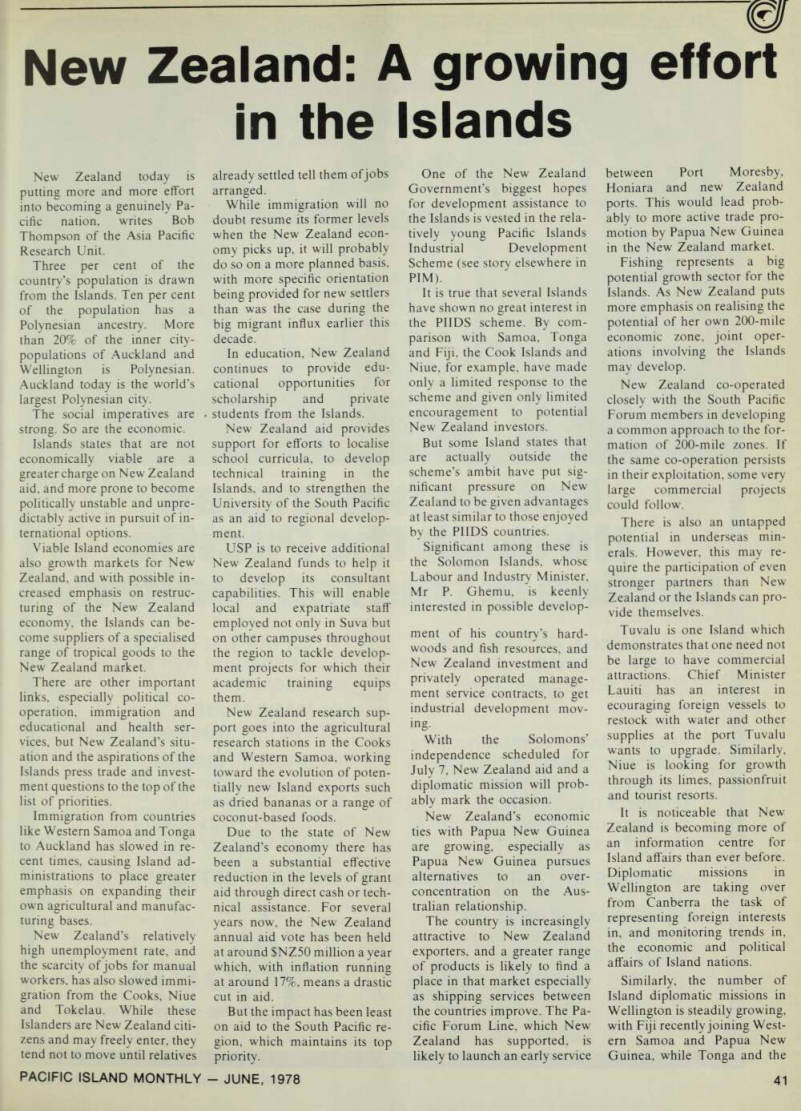
Disputes such as the Henry- Muldoon affair prevent New Zealanders from assuming they know it all. But it is clear that since the late Labour Prime Minister Norman Kirk accentuated New Zealand interest in the Islands, the range of political, economic and social bonds has increased.
It is this growing inter
dependence that sharpens the
interest of policy-makers in
Wellington in fostering greater
economic self-determination, in order to set the seal on the
political self-determination
fostered previously.
• New Zealand has given Tonga better access for tom atoes, capsicums and cabin bis cuits. In 1978-79, New Zealand will allow importers to take another 160 tonnes of tomatoes from Tonga, throughout the year. In the past Tonga has been able to send tomatoes to NZ from June to October only.
The late Norman Kirk... accentuated New Zealand's interest in the Islands.