Zealand’s PUDS
p. 43 · Read in the full issue
A shot in the arm for New Zealand’s PUDS
New Zealand’s somewhat sluggish Pacific Islands Indus trial Development Scheme (PUDS) has received a shot in the arm with the government’s announcement that it is assist
ing new manufacturing indus
tries in the region, writes William Gasson from Welling ton.
“Three ventures assisted by the scheme are now operating in the Islands and assistance has been approved recently for the establishment of a further two ventures which are at the advanced planning stage, and
feasibility study grants have
been given for another six pro jects,” the Minister of Trade and Industry, Mr Lance Adams-Schneider said.
“In all, I am aware of 20 pro jects which are under serious consideration. A large pro portion of these can be expected to materialise into jobs for people in the islands over the next year or two.”
PUDS was introduced on November 30, 1976, to provide financial assistance and incen tives for New Zealand
companies developing ap
proved manufacturing oper
ations in Fiji, Tonga, Western Samoa, the Cook Islands and Niue with the aim of fostering economic development and
employment opportunities
there.
The government provided incentives to companies. These consisted of interest-free loans of up to 30% of capital costs and grants of up to 50% of costs incurred in feasibility studies, the training of local employees, and the transfer of plant and key personnel to the Islands.
Despite some fanfare at the launching, the scheme started
slowly, though Mr Adams-
Schneider now maintains it is
gaining momentum.
“The full potential of the scheme will not be realised for at least five to 10 years and I will be satisfied if steady pro gress is made during the initial
year or two,” he said late last year.
At that time the government gave the scheme a bit of a boost by including assistance to New Zealand firms that planned to process Island farm products into manufactured goods.
Mr Adams-Schneider admits that the scheme is still having only a small impact on the Islands where the need for em ployment is great, “but the gathering of momentum which we are experiencing is most encouraging,” he said.
He then announced yet another extension of the scheme to boost it even more.
“Small venture grants are being introduced to provide a higher level of assistance for the small ventures which form a substantial proportion of the
proposals coming forward,” he
said.
“The grants will be an alternative to the existing suspensory loans for small pro jects. Grants can now be made to cover up to 50% of fixed capital costs of ventures with qualifying assets of up to $2O 000, with a maximum grant of up to $lO 000.
“The idea of these grants was
suggested by Island govern
ment representatives at the suc cessful seminar held on the
PUDS in Auckland late last year,” Mr Adams-Schneider said.
He then gave details of the three Island ventures approved
recently by the government.
An Auckland company has been granted assistance to establish a solar water-heating manufacturing unit in Western Samoa.
Tonga Wire Company is already established and manufacturing chain-link fenc ing in Tonga with assistance from the scheme.
The third company is Dol phin Tanks Ltd, Tonga. This
small operation employing
about eight Tongans on Vava’u, the northernmost island of the group, provides fabricated concrete water tanks and septic tanks.
The operation is to be extended to other parts of Tonga and will manufacture other precast concrete struc
tures required locally.
Mr Adams-Schneider added
that feasibility study assistance
had been given to companies to
examine ginger processing in
Fiji, hand-sewn soccer ball
production in Tonga, cigarette
making in Western Samoa, a maize project in Fiji and a
food-processing plant in Fiji.
• The Papua New Guinea Defence Force is looking to New Zealand to guide it in a programme of internal self reliance. The PNG Defence Minister, Mr Louis Mona, made an official visit to New Zealand in February “to get some ideas”. The Defence Force is trying to become more self-reliant by running its own farms to cut down on the amount of food it has to buy from outside suppliers.
The programme includes the establishment of piggeries and vegetable gardens. Mr Mona hoped to obtain technical as sistance from New Zealand for the project. He also plann ed a brief visit to Australia during his 14-day absence from PNG.
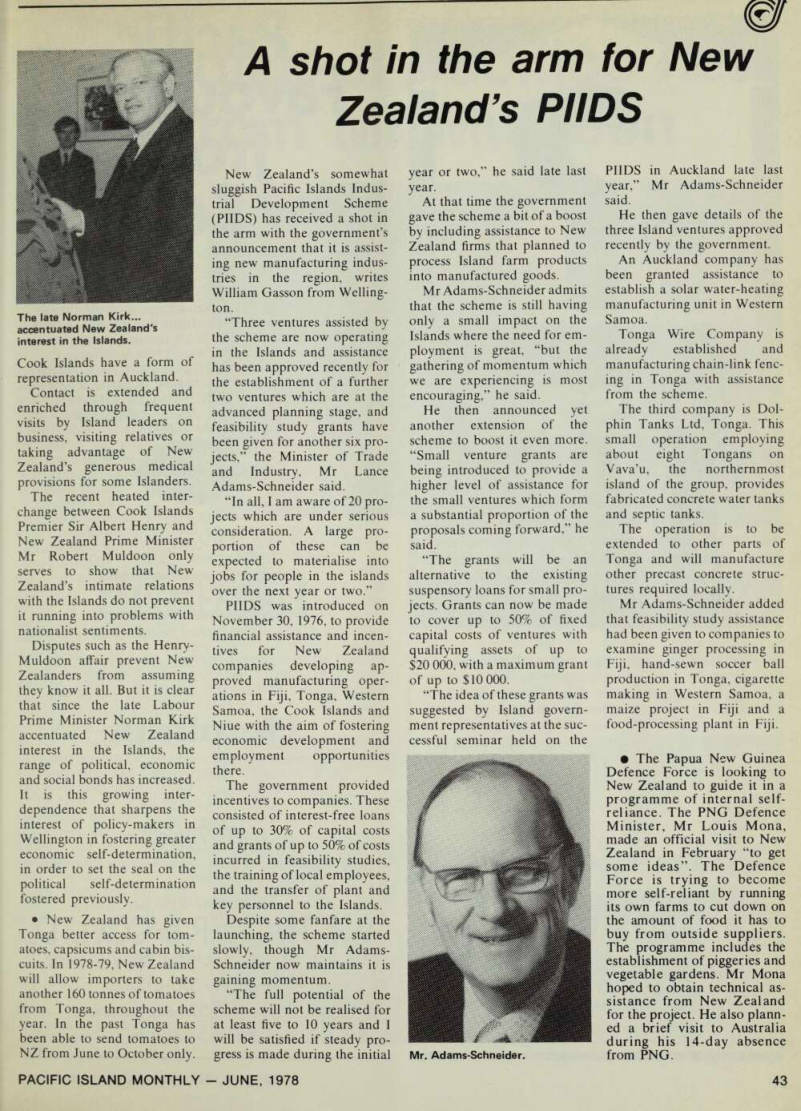
Mr. Adams-Schneider.