Truk airport expansion
p. 29 · Read in the full issue
threatens sacred sites
Planners of the extensions to the Truk International Air port in the Carolines have en countered a problem. No one told them that the extensions would threaten valuable sites of archeological value, or that the sites, an old village in the path of the future runway and ancient ruins on the top of Mt Tonnachau, sacred to the Tru kese people, had been placed on the US National Register of Historic Places.
A 13-hour hearing was held by the US Army Corps of Engineers in January into an application by the Trust Ter ritory Government to dis charge dredged material into Truk lagoon while construct ing the airport.
The project includes a new
1 828 m runway and electric
beacon lights on Mt Ton nachau.
Dr Tom King, head of the Micronesian Archeological Survey, said, according to the Micronesian News Service, that the mountain was nomi nated by the US National Register of Historic Places early in 1976 by the Truk Dis trict Historic Preservation Committee and accepted shortly afterwards. That had been overlooked by the air port planners who had said in their environmental impact statement that the project would not affect historic places.
Dr King said a survey indi cated the likelihood of several
types of destructive effects, The airport itself will be built on the site of pre-World War II Iras village, reputed to be the oldest village in Truk lagoon.
The residents of Iras were removed by the Japanese in 1942 when the original air port was built, and the village destroyed, but it appears that remnants of the village still exist adjacent to the present runway.
The people of Iras returned to their village in 1947-48, and now live in what was once their taro swamp, between the airport and the upper slope of Mt Tonnachau. They oppose expansion of the airport, which they say will subject them to extreme noise pollu tion, cut them off from fishing and shellfishing areas, and commit land improperly taken from them by the government under “indefinite use agreements” early in the US administration, King re ported, Expansion of the quarry, Dr King noted, will destroy World War II Japanese for tifications that should be re corded before they are lost, Most significant, he said, are the upper slopes of Mt Ton nachau, where, according to Trukese tradition the first great chiefs and leaders had their homes and meeting house.
According to translations of Trukese traditions, produced
by Dr King, the culture-hero Sokachau, who came to Truk from Kosrae, held council on the mountains, as did the high chief Souwooniiras.
King reported finding stone walls ana platforms on the mountain, together with some Japanese structures, and sur mised that these might be as sociated with the ancient chiefs. Construction of the warning beacons and their power lines would damage these sites, he said, and asked the Trukese whether construc tion would be compatible with the sacred nature of the moun tain.
Senator Nick Bossy said the historic sites need not be pro tected because his uncle, Moen Mayor Fujita Bossy, ap proved of the project and had given his permission.
Other Trukese testifying did not agree. Nuda Pawe of
Mechitiw village applauded US efforts to protect Microne sian culture and historic sites, contrasting this with the at titude of the Japanese admin istration.
Puun, also of Mechitiw, re ported that the mountain was the ancient Trukese admin istrative centre, and hoped that it would not be disturbed, Others referred to the moun tain as tabu, and reported ad ditional historic and sacred areas at its feet, Nessa of Tunnuk village, identifying herself as the owner of the mountain’s top, agreed that the ancient meet ting house was there and noted that the government had never consulted her about placing beacons on it.
The Corps of Engineers will give their decision later on whether a construction permit will be issued.
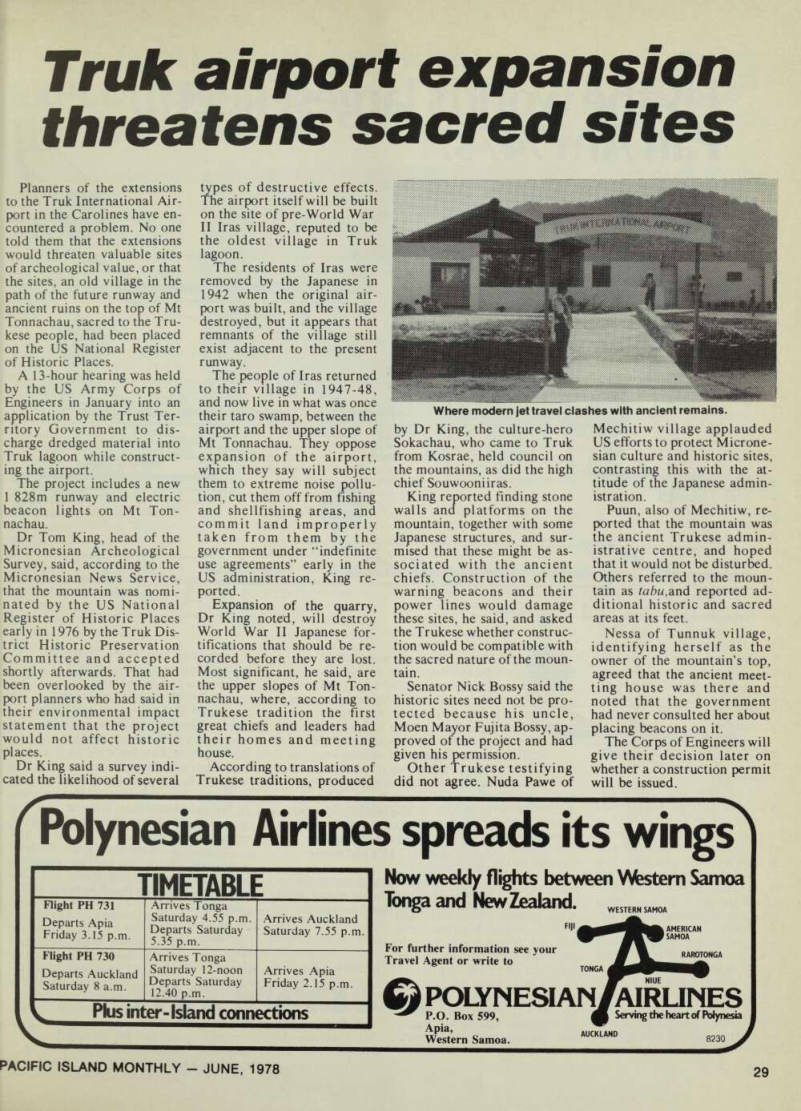
Where modern jet travel clashes with ancient remains.