history in Truk and Saipan
p. 27 · Read in the full issue
Archaeologists uncover ancient history in Truk and Saipan
are discovering more and more about tneir ancestors as archaeologists, digging in various islands in the groups, uncover ancient sites and remains of centuries-old settlements. The Micronesian News Service reports that finds have recently been made in Truk and Saipan.
Lake Susupe, which is now only a small pond surrounded by marshes on the south-west side of Saipan, was probably once an arm of the sea, ac cording to a recent archaeological study, which is part of a survey conducted last (Northern) summer under the auspices of the Trust Ter ritory and Northern Marianas
historic preservation
programmes.
The study was directed by Dean Thompson, a graduate student from the University of lowa, assisted by the Northern Marianas Archaeological So ciety.
Excavations in San An tonio, just southwest of Lake Susupe, revealed a prehistoric village site with abundant fragments of Marianas Red ware, an early pottery type.
Found in a sloping field facing the lake, the pottery was all eroded by wave action. In the level field to the west, at a slight elevation, the same types of pottery were found without evidence of erosion, apparently undisturbed in an ancient village area. Still fur ther to. the west, Marianas Plainware pottery sherds were found, in shall ow archaeological deposits on top of beach sands.
In a report just received by the Northern Marianas and Trust Territory historic preservation offices, Thompson surmises that the area just west of Lake Susupe was once a sandspit, with an estuary between it and the hills to the east.
Silting up caused the estu ary to become sealed off and turn into a marsh, as it is to day. The ocean sand was deposited along the west side of the spit to form the present Saipan shoreline.
Thompson declined to speculate about how long ago the estuary was sealed off.
Charcoal samples from the dig have been submitted to a laboratory for age-determina tion by the radiocarbon method, and another report will be submitted when these and other analyses are com pleted.
According to Dr Tom King, Director of the Micronesian Archaeological survey, Thompson’s information is important for several reasons.
First, says King, “it fills in some gaps in what we know about the prehistory of the Marianas, and enables us to ask better questions about what was going on .
“It helps us predict where certain types of archaeologi cal sites are and are not likely to be we now know not to look for very early sites on the modern coastline west of Lake Susupe, since the coastline was apparently formed only recently.
“It also provides another part of a growing body of data from all over the Pacific Basin concerning changes in sea level. Either the sea was high er or Saipan was lower when the San Antonio site was oc cupied. Either could be the case. We are beginning to be able to sort out answers to these kinds of questions, as we do more and more archaeological research, and this will allow us to predict what the sea may do in the future. These would be pretty valuable predictions, especially in the islands of the Pacific”.
Thompson was again on Saipan in December and January conducting a survey of lands that will soon be homesteaded. The Kobler field area and an area near Garapan were found to lack valuable archaeological sites, but a significant site was
archaeologists on Ponape before World War 11, the Fefan finds are the most easterly-known occurrences of pottery in Micronesia.
The excavations also revealed shell adzes, chisels, and ornaments, stone food pounders, and other artifacts.
Four samples of charcoal and shell, submitted for age determination by the radiocarbon method, indicate that the sites are about 2 000 years old. They appear to have been partly covered by water either as the result of rising sea levels or subsidence of the island.
The artifacts will be return ed to Truk.
According to the TT Historic Preservation Office, many people of Fefan have ex pressed a desire for a museum to house and display them, and a grant proposal is being prepared to help develop such a museum.
Another ancient treasure which is not expected to go back to Truk is the Waharek Maihar, a traditional, inter-is land sailing canoe from Puluwat Atoll in the Truk District.
Plans are almost complete for the restoration, preserva tion and display of the 8metre outrigger canoe, which has been accepted for in clusion in the US National Register of Historic Places, making it eligible for a preser vation grant-in-aid from the National Park Service.
The Waharek Maihar set out in 1976 for the United States to take part in the United States Bi-centennial celebrations, after which it was to be displayed in the Smithsonian Institution. The arrangements fell through and the canoe and its crew were stranded on Guam. It was later shipped to Saipan and has been lying there, unprotected, on a flat-bed trailer.
Craftsmen from Puluwat will repair the canoe on Saipan, using only traditional materials and techniques and it will then be housed on Saipan in a display building.
found on lands to be home steaded near Tanapag. Plans will be made to protect the site, or salvage information from it, prior to homestead ing, King said.
Fefan Island, in Truk Lagoon, is also yielding up its secrets. Reports of excava tions carried out last year have been studied recently and reveal that the island was occupied at least 2 000 years ago.
The report, by Richard Shutler of the University of lowa, Yoshihiko Sinoto of the Bishop Museum in Honolulu and Jun Takayama of Tokai University, Japan, covers “salvage” excavations spon sored by inter-agency archaeological services pro vided by the US National Park Service.
The excavations were or dered after the ancient sites were discovered by a Univer sity of lowa graduate, Mark Borthwick, who happened to be in the area when dredges operated by the Air Force’s civic action team, which was building a road around the is land, ploughed into the sites, which were partially under water in Aikei and Winas lagoons, off Sapota village.
Road work in the area was halted and emergency salvage work was funded by the Na tional Park Service. The sites produced large amounts of pottery never before reported in Truk.
Aside from a few fragments reportedly found by Japanese
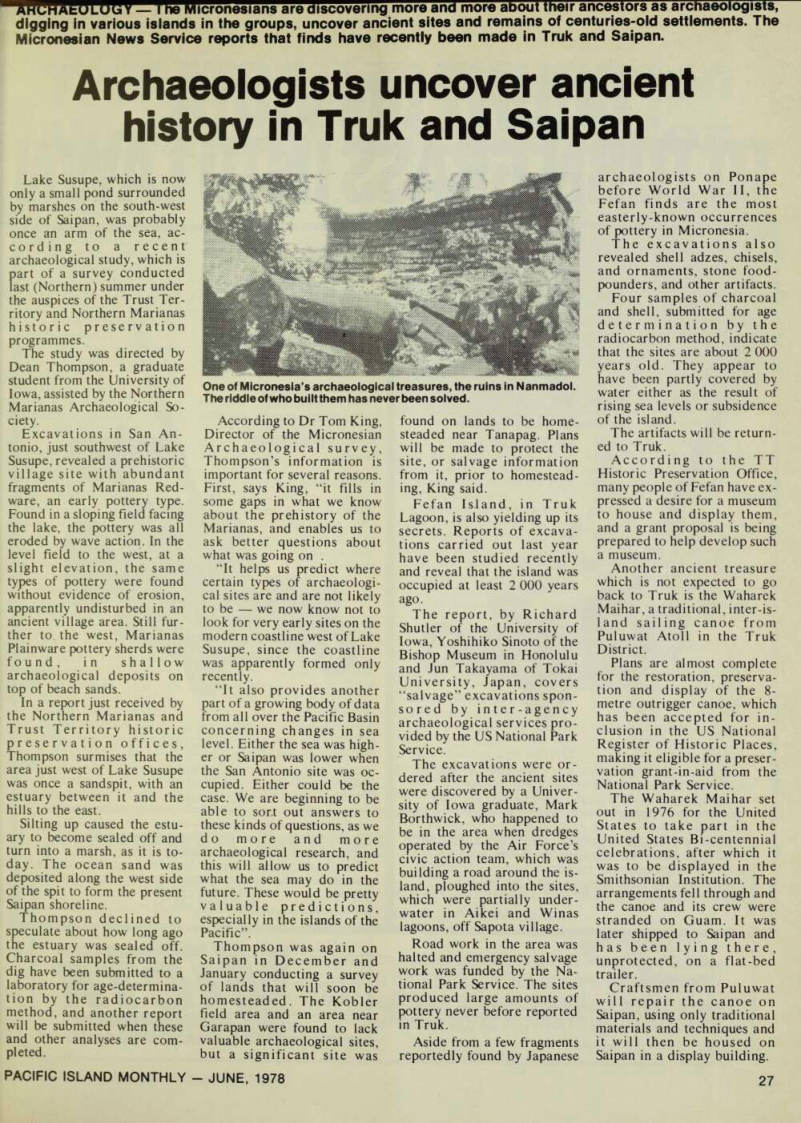
One of Micronesia’s archaeological treasures, the ruins in Nanmadol.
The riddle of who built them has never been solved.