Fingering the
pp. 23-26 · Read in the full issue
Tropicalities
illegal voter
Electors voting for Port Moresby City Councillors in May had the little finger of the left hand marked with indel ible ink.
And if they refused to allow the branding, they were not al lowed to vote. The ink was “Bluish, like a tattoo” and showed up equally well on the fingers of black or white voters.
But the only whites who get votes in Papua New Guinea now are those who have taken Dut citizenship.
PNG authorities used the finger-branding to prevent possible ballot box corrup tion.
Allegations of multiple
voting under assumed names were made after last year’s
parliamentary elections.
The Electoral Commission
ased the finger-branding pro
cedure as a trial run for similar
procedures at future provincial
government and national elec tions.
The Electoral Com
missioner, Mr James Mileng,
said the type of ink used had been tested at Elections in Sri Lanka and India. PNG had drawn on the expertise of those countries to plan its own pro cedures.
The ink left a distinctive mark on the finger for several days, long enough to outlast the two days of the council election.
Mr Mileng described the branding as one of several moves to “tighten the integrity af the ballot box” in PNG.
Another, he said, was prior
enrolment followed by pro
duction of an acknowledge
ment card.
At last year’s National Elec
tions unregistered voters were
permitted to register directly at the polling booth when they came to vote. This led to the possibility of abuse, par ticularly as many Papua New
Guineans sometimes legiti
mately used different names on different occasions.
Any abuse which might have
occurred was not widespread,
but the government has been anxious since then to close
potential loopholes.
The Electoral Commission
published a large newspaper
advertisement assuring electors that the branding ink “is not harmful to the skin, and is well tested”.
The idea is nothing new in Fiji and branding voters has been carried out at elections.
The ink takes weeks to wear off.
Fiji's new
games stadium
A magnificent sporting com
plex at Buckhurst Park, Suva, will serve Fiji for many years after the 1979 South Pacific Games are over. The park will be the headquarters for the Games.
The Fiji Government has allocated more than $3 million for the sports complex. Existing
facilities, including the grand
stand which lost its roof during a hurricane, will be demolished. The new grand stand will have seating for 4 250 spectators and provision has been made to add seating for 750 more.
The grandstand will house changing rooms, showers, com mittee rooms, stores, games control room, toilets, refresh ment areas, police and ambu lance rooms, and radio, television and press facilities.
Included in the project are a gymnasium and tennis court.
The Buckhurst Park set-up will allow the organising com mittee to schedule most of the events at the park. Some of the suggested events, such as golf and yachting, of course, will have to be held at other venues.
At the first SP Games, in 1963, although Buckhurst Park was the headquarters many events were held at other parts of Suva and one rugby match was played at Lautoka.
Although the 1979 Games are still more than 12 months away, the organising com mittee is confident there will be more than 2 000 taking part.
This will create a tremendous strain on accommodation and catering facilities. However, with University of South Pa cific dormitories and back-up accommodation from three
nearby schools there will be room for everybody. All ac commodation will be within walking distance of Buckhurst Park.
Catering will be a tremen
dous problem. Already the
organisers have estimated they
will have to provide more than 100 000 meals. Fortunately, Fiji has set up a hotel and catering school since the 1963 Games, and 146 students from there will be a big help in an enormous task. The cost has not yet been worked out, but it is considered almost certain that it will be more than the $5 a day charged at the Guam Games in 1975.
Naturally, no country or ter ritory has yet picked its teams, but two have given some indi cation of the numbers. Tonga has suggested she will send about 120 - she sent only three to Guam. Western Samoa has indicated something like 300.
The 1963 Games, as a pilot project and with very few ex perienced officials available to get them “off the ground”, proved a huge success. In 1979 they should be even better.
Certainly better than the last Games at Guam.
A guide
to honesty
Ministers of the Crown in Fiji have to be careful about outside financial interests. The Prime Minister, Ratu Sir Kamisese Mara, in a booklet headed Notes for the Guidance of Ministers, sets out the stan dards he expects, and says that ministers are expected to de vote the whole of their time to the duties of office.
Ministers are required to re veal to him, personally, details of all their shareholdings and directorships in Fiji and over seas. They have to confirm they do not hold directorships in corporations, other than those directly connected with their families or with charitable or
ganisations.
Ratu Sir Kamisese, when he receives this information, will decide whether there is a con flict of interest between minis terial duties and business interests. While a minister con
tinues to hold office it is his duty to ensure that a situation does not arise where personal or private interests interfere with the proper performance of his duties.
As the ministers are required to give all their time to their official duties it is necessary for them, when appointed, to di vest themselves of any outside interests which might conflict
with public responsibilities.
That requirement will continue while they hold office.
“As far as private business
and professional practices are
concerned, this ruling should be interpreted as requiring a severance of active connec tion”, the booklet says.
Set out are rules of obli gations which, if breached, may lead to a minister’s re moval from office.
Apart from resigning all directorships, except those in
family or charitable organis
ations, these rules require ministers, on taking office, to resign any posts held in trade unions, not to enter any trans actions in which their pecuni ar}' interests might conflict with their public role, not to use any official information which comes to them as ministers to further their own or their friends’ interests; not to use their position or influence to support private interests; and not to use their influence to admit or promote people in the
public service.
Ministers are also barred from accepting gifts or favours
from people negotiating any
sort of contract with the government. They are pro hibited from practising any
journalism while holding
office, or communicating with the press in anything but their official capacity. Ministers are also advised to use the strictest discretion in deciding, in cir cumstances where their private interests and public duty may conflict, whether to continue
holding any stocks and shares they held before their minis
terial appointments.
It all boils down to an attempt to stop the jiggery pokery which goes on in Fiji
and, probably, every place
under the sun.
Ratu Sir Kamisese’s opposite number in Papua New Guinea, Mr Michael Somare, will applaud. He might even ask for a copy of the booklet!
Vive
le tamoure!
When Tahiti travel agent Gerard Gilloteaux brought the Tahiti Nui dancers to Australia
recently, the islanders brought
a crowd-stopping new rhythm
to the streets of Melbourne and
Sydney.
The 13 dancers and mu
sicians were accompanied by
Miss Tahiti, Therese Amoux.
The Tahitians obviously sent many Australian hearts and feet beating in the right direc
tion: the day they performed in
Sydney’s Martin Plaza there was a stampede to the nearby tourist booking office of the Club Bed oh, pardon!
Club Med. That afternoon the office received a dozen down payments on holidays to the Club Mediterranee resort vil lage off Tahiti. Vive le tamoure!
UFO over
Rarotonga
Two small groups of people stood outside a cinema in Avarua, Rarotonga, on the
warm evening of Sunday, April
16, 1978. It was 7.35 pm. Most of them were standing on the inland side of the coastal road, chatting and waiting to go inside to see a special screening as they were members of a pri vate cinema club. On the opposite side of the narrow road was a smaller group, some seated in cars and others stand
ing and talking.
Maui (Nicky) Teokotai Mataiti, a 14-year-old Cook Islander, was gazing inland
when he saw a bright-coloured
object flashing through the sky
towards them. It seemed to be curved, like a rainbow, but it was npt a rainbow and it was not a shooting star. Nicky had seen plenty of both. It appeared to rise higher in the dark sky and it was blue on top, white in the centre and dark blue to purple below.
He slapped his friend stand ing beside him on the shoulder
and pointed upwards. “Look
there!” he shouted. William Harold Percival, almost 19, stared skywards and saw an object he described as a huge, bottle-green sphere. To him, it
appeared to be travelling
slowly. Suddenly, flames
spurted from it and it disap peared from sight behind the roofs and trees lining the beach side of the road. William said it was on a diving angle and thought that it had crashed into the ocean. He checked his wristwatch. It was 7.35 pm.
Mr Michael Benns, manager of the government-run Cook
Islands Liquor Supplies on
Rarotonga, was standing on the other side of the road with his wife and other members of the cinema club. He glanced up and just had time to see a
greenish flying object pass be
tween the tree tops before it
disappeared from sight.
“It wasn’t just green,” he said. “It had many colours.”
Benns, an ex-RAF fighter pilot, said the object was travel ling much faster than any plane he knew of and, if it were a
plane flying at that speed and
angle, it must have crashed into the ocean.
“But it could have been something else other than we comprehend,” he added. He said that he was the only one of his group to sight the object because the others were look ing the wrong way.
April seems to be one of the
prime months for sighting
UFOs over Rarotonga. Pre vious sightings occurred on April 17, 1977,-and in April, 1975.
Brides in the
market place
Roman Catholic bishops in Papua New Guinea and the Solomon Islands want the governments of their countries to set a limit on what a man pays for his bride.
Women are being bought
and sold like animals and the negotiations have all the trap pings of a market place, the bishops were told at a recent conference.
Bride price is the traditional handing over of gifts and money to the tribe or family of the bride. It was originally part of a ceremonial token of re sponsibility and was not sup
posed to be a purchase price.
But the Archbishop of Port
Moresby, Archbishop Herman
Topaivu, told the Conference of Bishops that the traditional meaning of the bride-price cer emony had been forgotten.
Instead families and tribes were using their young women as a commodity to be sold to the highest bidder. What was once a ceremony with very
deep meaning had become just
another opportunity to make money.
Archbishop Topaivu said he
did not believe the ceremony and the payment of bride-price should be abolished because it could play a valuable part in
strengthening marriage bonds.
But the people should be re educated to give the ceremony its old meaning.
Governments could help by
setting limits on the value of money and goods handed over.
The bishops, who were
meeting on Bougainville
Island, endorsed his remarks.
Some recent bride-price cer emonies in PNG have involved amounts of more than $l2 000.
An El Dorado
for the Tongans
Tongan workers, lucky to
earn about $7 a week in their own country, must regard New Zealand as an El Dorado where they can earn anything between $lOO and $l5O a week.
Tonga has benefited consider ably from the efforts of about 200 Tongans who worked in New Zealand over about four years under a Tongan-Catholic scheme.
They went home with about $BOO 000 in cash, plus a big
quantity of machinery, out
board motors, tools, spray
equipment, building materials,
furniture and, most important, knowhow and experience Sixteen men worked in a
wool-scouring plant in the
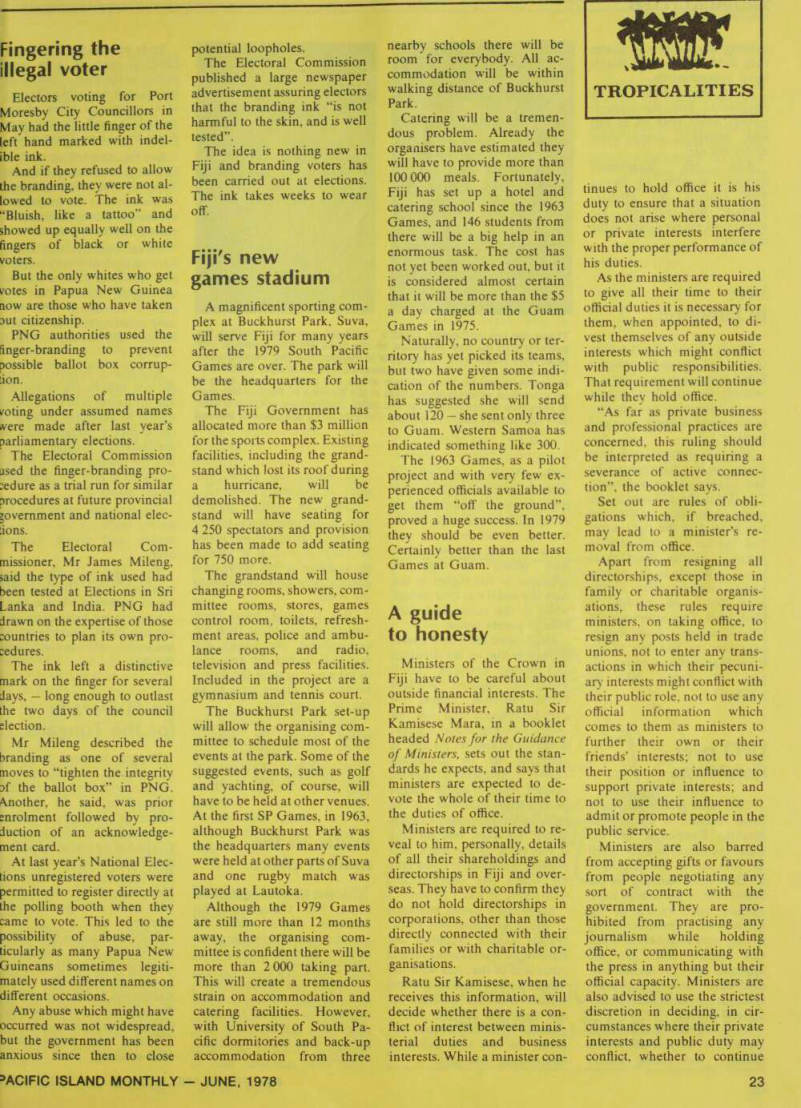
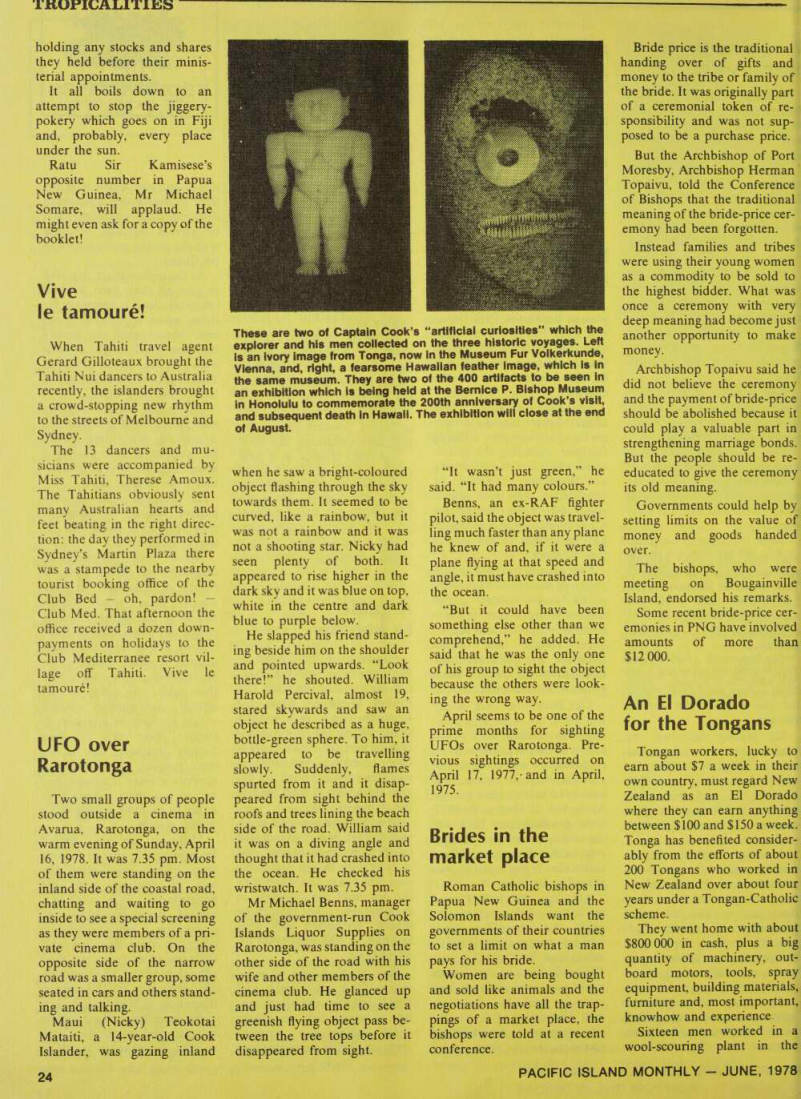
These are two of Captain Cook’s “artificial curiosities” which the explorer and his men collected on the three historic voyages. Left is an Ivory image from Tonga, now in the Museum Fur Volkerkunde, Vienna, and, right, a fearsome Hawaiian feather image, which is in the same museum. They are two of the 400 artifacts to be seen in an exhibition which is being held at the Bernice P. Bishop Museum in Honolulu to commemorate the 200th anniversary of Cook’s visit, and subsequent death In Hawaii. The exhibition will close at the end of August.
Auckland suburb of Onehunga in an 11 months’ stay. It’s a job NZ’s locals don’t like. The fac tory manager of the plant said he had found the Tongans re liable workers, who turned up regularly and did an honest
day’s work. They had a Tongan
permanent resident as foreman so there was no language barrier.
Their jobs were rotated to ensure nobody was stuck with a boring job. In shift work, in which the scour operated 24 hours a day, it was important that every man pull his weight.
The men in the 11 months earned every cent they could.
The success story for the Tongans of working in the wool scour is a positive form of
assistance to a developing
country, according to Mr Basil Hafoka, an Auckland architect, who is in charge of the scheme.
In 1974, he hammered on doors for two weeks before a break through in the wool scour.
The men live at a Catholic liostel about 5 km from their work and they walk to work.
Knock, knock, is
this our 'ouse?
The Papua New Guinea Housing Commission has admitted it is not too sure how many government houses it has an its books. And neither is it too sure who all its tenants are, 3r whether the occupiers of some houses have any right to be there.
The Housing Minister, Mr fCavali, has announced a sur prise stocktake of the Com mission’s houses and flats and
i check on occupancies.
The operation, which he de
icribed as “a complete physical
stocktake” began late in April
n Port Moresby and will spread to other parts of the country.
Investigators will knock on loors, visit offices and make elephone calls in their move to )ring the books up to date.
The Housing Commission las two major functions to )rovide houses for government )fficers and to provide houses or private rental and pur :hase.
It was disclosed that Cabinet had become concerned that there might be misuse of government housing, and had been unable to obtain accurate records.
Mr Kavali said doubt existed about the actual number of houses, their locations and types, the identity of the people occupying them, and tenancy, maintenance and rental re cords. This could allow the misuse of national assets, and for that reason the government had decided to undertake a check.
Moorea's pistol
packin' Momma
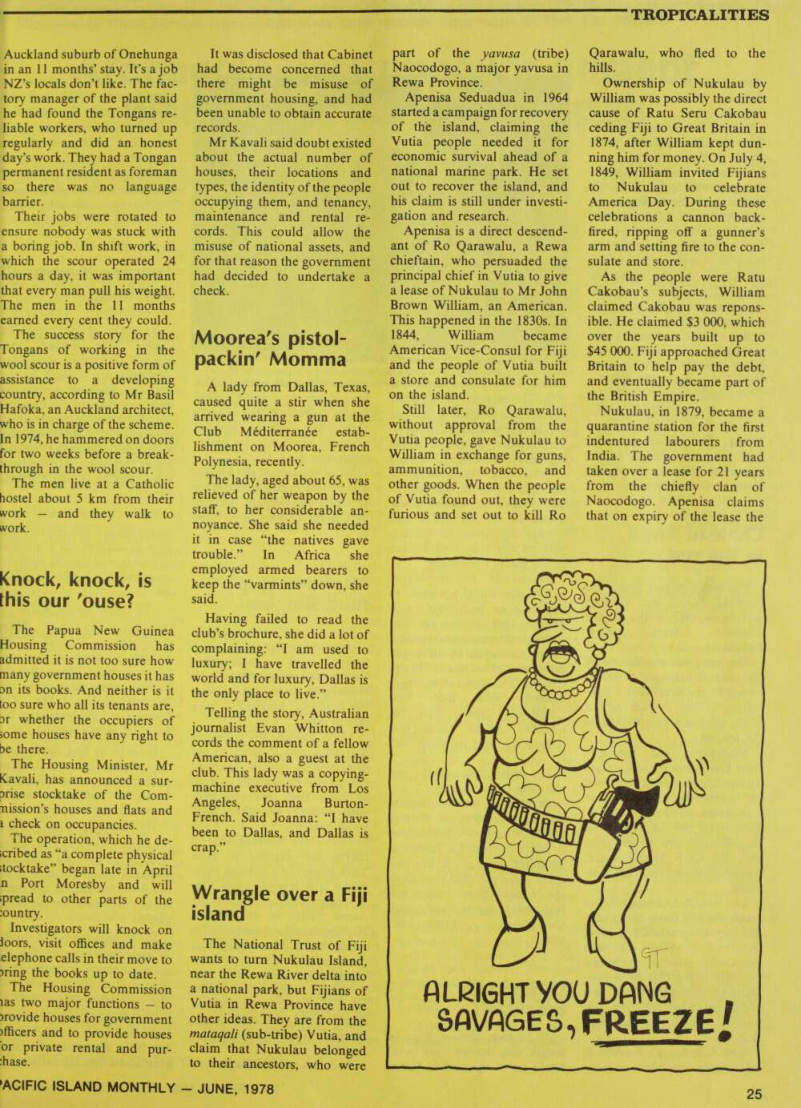
A lady from Dallas, Texas, caused quite a stir when she arrived wearing a gun at the Club Mediterrande estab lishment on Moorea, French Polynesia, recently.
The lady, aged about 65, was relieved of her weapon by the staff, to her considerable an noyance. She said she needed it in case “the natives gave trouble.” In Africa she employed armed bearers to keep the “varmints” down, she said.
Having failed to read the club’s brochure, she did a lot of complaining: “I am used to luxury; I have travelled the world and for luxury, Dallas is the only place to live.”
Telling the story, Australian journalist Evan Whitton re cords the comment of a fellow American, also a guest at the club. This lady was a copying machine executive from Los Angeles, Joanna Burton- French. Said Joanna: “I have been to Dallas, and Dallas is
crap.”
Wrangle over a Fill
Island
The National Trust of Fiji wants to turn Nukulau Island, near the Rewa River delta into a national park, but Fijians of Vutia in Rewa Province have other ideas. They are from the mataqali (sub-tribe) Vutia, and claim that Nukulau belonged to their ancestors, who were
part of the yavusa (tribe) Naocodogo, a major yavusa in Rewa Province.
Apenisa Seduadua in 1964 started a campaign for recovery of the island, claiming the Vutia people needed it for economic survival ahead of a national marine park. He set out to recover the island, and his claim is still under investi gation and research.
Apenisa is a direct descend ant of Ro Qarawalu, a Rewa chieftain, who persuaded the principal chief in Vutia to give a lease of Nukulau to Mr John Brown William, an American.
This happened in the 1830 s. In 1844, William became American Vice-Consul for Fiji and the people of Vutia built a store and consulate for him on the island.
Still later, Ro Qarawalu, without approval from the Vutia people, gave Nukulau to William in exchange for guns, ammunition, tobacco, and other goods. When the people of Vutia found out, they were furious and set out to kill Ro
Qarawalu, who fled to the hills.
Ownership of Nukulau by William was possibly the direct cause of Ratu Seru Cakobau ceding Fiji to Great Britain in 1874, after William kept dun ning him for money. On July 4, 1849, William invited Fijians to Nukulau to celebrate America Day. During these celebrations a cannon back fired, ripping off a gunner’s arm and setting fire to the con sulate and store.
As the people were Ratu Cakobau’s subjects, William claimed Cakobau was repons ible. He claimed $3 000, which over the years built up to $45 000. Fiji approached Great Britain to help pay the debt, and eventually became part of the British Empire.
Nukulau, in 1879, became a quarantine station for the first indentured labourers from India. The government had taken over a lease for 21 years from the chiefly clan of Naocodogo. Apenisa claims that on expiry of the lease the
island was sold to the govern ment “under dubious reasons”.
From what he could gather from his elders another Rewa chief, Ro Rabici, of Lomanikoro, sold the island to the government for £2OO. Ro Rabici gave the money to the principal chief of Vutia, and said it was a goodwill gesture from the government for the lease of Nukulau. The princi pal chief, in turn, gave Ro Rabici £5O of the money. He was unaware of the sale.
Apenisa said the legal docu ments were signed by the provincial administrator, not by Ro Rabici, although Ro Rabici negotiated the sale.
For many years the Royal Suva Yacht Club used Nukulau during weekend racing. The island was also used for picnics and by tourist operators who took tourists there on launch trips.
Chateau Royal
in the red
Noumea’s largest hotel, the Chateau Royal, lost another million in 1977, writes Andre Chaville from New Caledonia.
The news was announced by the general manager of UTH, owner of the hotel and a sub sidiary of the French airline UTA, during a recent visit to
the territory.
Meanwhile the CAFAT, New Caledonia’s social secur ity fund, is busy trying to sell its shares in the Relai de Kanumera, another UTH pro motion on the Isle of Pines.
Negotiations are in progress with the Club MediterranSe, another French tourist organis ation.
Last year the Chateau Royal reached a 55% room occupancy and hopes to reach 65% in 1978.
However, results are not
expected to improve, the major
problem being that most resi dents are coming through on a cheap package tour, and few visitors actually pay the full rate.
New Caledonia’s tourism is still largely dependent on Aus-
tralian visitors who represent 50%. The increase in Japanese visitors has countered the loss on the New Zealand market.
Meanwhile, Australian travel agencies still consider Noumea as “the cheap alternative,” and this does not encourage spend ing. Thus the tourist trade seems to fill the UTA and Qantas flights out of Sydney, without any real contribution to the island’s economy.
Meanwhile, the employees of Chateau Royal are eager to
negotiate an improvement in
salaries. Last year similar talks ended in stalemate and a strike.
There seems to be little en thusiasm behind the UTH op eration. The general manager himself told the New Caledonian press that the Chateau Royal exists and something must be done with it.
“... unless,” he added, “you can help us get rid of it.”
Perhaps the best solution to develop tourism in the territory would be to allow other airlines to come through La Tontouta, including charters. If this sol ution is not adopted very soon, the Noumea hotel-owners will just look at the sky and watch
the planes ... flying else
where.
Dolphin for
breakfast?
A dolphin almost 5 m in length was thrown over coral heads on to the reef at Raro
tonga. Stranded about 50 m from shore, the dolphin wailed
loudly throughout the ensuing
night, but nobody realised
what the noise was. By morn ing it was dead.
Word spread fast after dawn, and people rushed to the scene to chop the dolphin up and take home chunks of its flesh to eat.
Mudmen stop
mud-slinging
The mudmen of Papua New Guinea have agreed to stop slinging mud at each other.
Two village communities, each claiming to be the real home of the mudmen, reached a truce late in April.
They agreed to recognise
that each had a claim to the title. And, as a result, one man from each village will now go to New York in September with a team of other PNG tribal dancers.
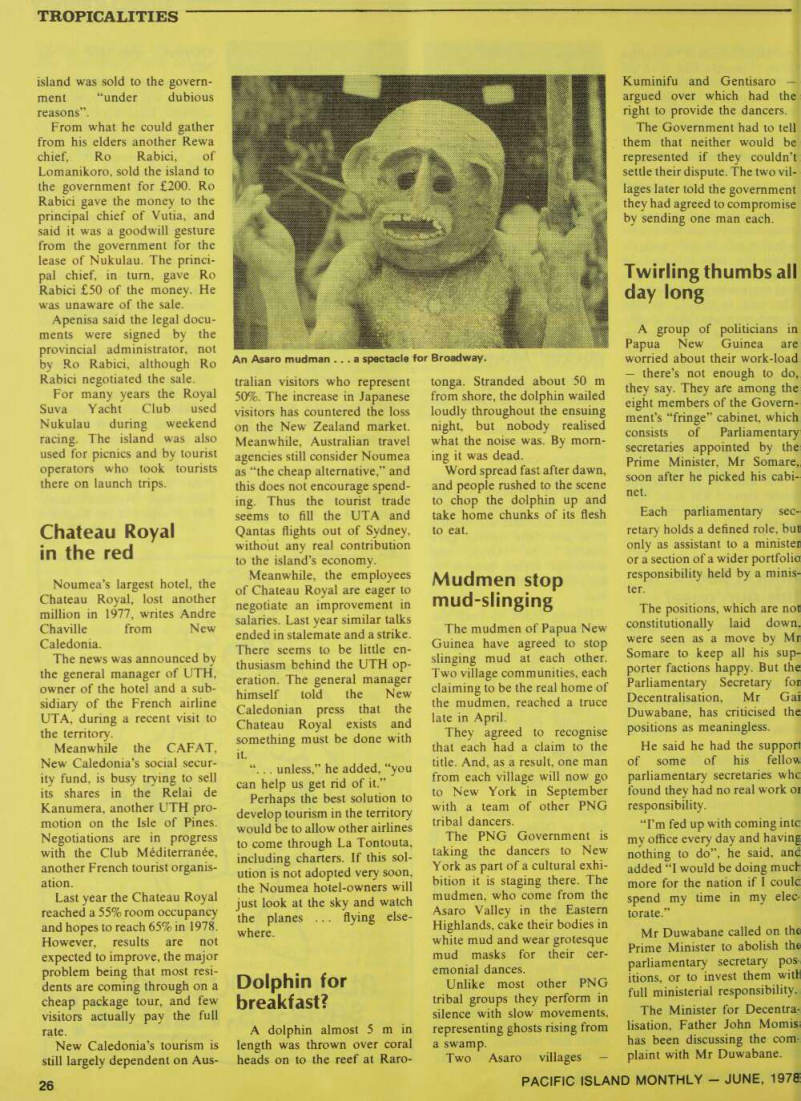
The PNG Government is taking the dancers to New York as part of a cultural exhi bition it is staging there. The mudmen, who come from the Asaro Valley in the Eastern Highlands, cake their bodies in white mud and wear grotesque mud masks for their cer emonial dances.
Unlike most other PNG tribal groups they perform in silence with slow movements,
representing ghosts rising from
a swamp.
Two Asaro villages
Kuminifu and Gentisaro argued over which had the; right to provide the dancers.
The Government had to tell them that neither would be
represented if they couldn’t;
settle their dispute. The two vil lages later told the government they had agreed to compromise by sending one man each.
Twirling thumbs all
day long
A group of politicians in Papua New Guinea are worried about their work-load there’s not enough to do,, they say. They are among the eight members of the Govern ment’s “fringe” cabinet, which i
consists of Parliamentary 1
secretaries appointed by the
Prime Minister, Mr Somare,, soon after he picked his cabi net.
Each parliamentary sec retary holds a defined role, buti only as assistant to a ministen or a section of a wider portfolio responsibility held by a minis ter.
The positions, which are not! constitutionally laid down, were seen as a move by Mn Somare to keep all his sup porter factions happy. But the Parliamentary Secretary fon Decentralisation, Mr Gai Duwabane, has criticised the
positions as meaningless.
He said he had the support of some of his fellow parliamentary secretaries whc found they had no real work oi
responsibility.
“I’m fed up with coming into my office every day and having nothing to do”, he said, and added “I would be doing much more for the nation if I could spend my time in my elec torate.”
Mr Duwabane called on the Prime Minister to abolish the parliamentary secretary pos-. itions, or to invest them with full ministerial responsibility.
The Minister for Decentra lisation, Father John Momis< has been discussing the com plaint with Mr Duwabane.
An Asaro mudman... a spectacle for Broadway.