Exploiters Of
pp. 31-33 · Read in the full issue

Books
The Loyalty Islanders:
The Exploiters
The tension between the stereotypes, naughty native and noble savage have plagued the European writing on the South Pacific since Bougainville’s first reports about the New Cythera he so joyously encountered at Matavai Bay. As a small though excel lently-rep resentative example of Australian National Universi ty style Pacific history, Kerry Howe’s The Loyalty Islands steers a sympathetic course between the two equally treacherous shoals.
Most of the book is a clever mission history, but it is done with such verve and attention to Islander motivation that the reader is scarcely aware of the original sources.
Though not stressed by Howe, the conflicts between the Catholic Marists and the Protestant London Mission ary Society clearly were part of the larger chess game play ed out by France and Britain on the island chessboard that was the South Pacific a cen tury ago. The Loyalty Islan ders, among others, were quick to discover these riva lries and exploit them for their own goals.
If the message of Christiani ty had any intrinsic attraction for Loyalty or other South Pacific peoples in those days it probably lay not with the gen tle New Testament, but with the tribal old one. The similarity between warring Semites and their own frag mented political structure was not lost on the ambitious chiefs of Mare, for example.
The practical and vengeful Jehovah was the focus of at tention, rather than the idealistic and forgiving Jesus.
European Christians, of course, have never dis tinguished themselves as followers of the suffering Nazarene and it was as much what Europeans did as what they said that must have pro voked the initial attraction to Christianity, which led to useful alliances with foreig ners.
Howe’s history has five sec tions. The first part tells about
the pre-1840 world of the Loyalty Islands, while sec tions two and three comprise an examination of the entry of the rival missionary camps, which were adopted by the already quarrelsome in digenous ones. In the section called Adventure and advan tage, Howe details how indi vidual Islanders seized the in itiative from their chiefs and indulged in travel and trade to bolster their home posi tions. The discussion of the competition to acquire and reproduce the missionary message, in Chapter 11, seems to be a continuation of the pre-contact status rivalries.
The final section argues the author’s main contention; that contact in the Loyalty Islands was less of a disaster than many previous writers had supposed.
The fatal impact is a com pact and evocative phrase popularised by Alan Moorehead in a book of the same name, but the argument behind it extends back into the nineteenth century.
Briefly, it is that when a “superior” (ie European) civilisation meets a simpler one, it is the superior which overwhelms the inferior one.
The inevitable diseases, de struction of life and lifeways,
and other depredations brought the hapless natives to their collective knees, re signed in despair to die.
This notion of social evolu tion fitted comfortably with European designs on lands with resources being opened for exploitation in those days.
Howe, with strong support from Norma McArthur and others, argues that this is a ro manticised and simplified version of what was, in reality, a complex process, involving conscious manipulation by both indigenous and foreign actors in the drama of Pacific contact and colonialism.
In his second section, for example, Howe argues that rival chiefs chose rival Euro pean religious institutions as conscious strategies in an on going process of adaptation.
Adaptation and adaptibility figure strongly as the author’s sub-themes.
But I wonder if Howe does not have too much loyalty to his Islanders, stressing their maximising of options without having due regard for the power differential between foreign merchant and Melanesian chief. The key to why the Loyalty Islanders might have been spared the more disastrous excesses of the colonial encounter lies early in Howe’s account.
Lacking in resources, “the is lands were useless for any large-scale economic ex ploitation”.
This special condition means that the people of that fortunate group were sub jected less to contact than was the case elsewhere in the Pacific.
Had some primeval ter restrial cataclysm erupted in another way and left the Loyaltys with minerals, good soil, or protected harbours, Howe’s story would have been a different one.
In the concluding chapter, Howe admits that the selec tive acceptance, adaptation and exploitation of outsiders’ goods and services was due largely to such favourable en vironmental and historical condtions; so favourable, from this point of view, that the small group could be declared a “native reserve” in 1900 without any loss to col onial revenue.
Howe reveals his connec tion with Peter Corns when he comes down on the volun tarist theory for the Queens land Labour Trade. Corris and now Howe argue that it was not slavery, but advan tageous work contracts that prompted Islanders to go to Queensland’s cane fields in the last century; this, in spite of several condemnations to the contrary from many re putable authorities of a cen tury ago.
I do not deny that some Islanders, such as those from the Loyaltys did migrate voluntarily. On the other hand, one should not ignore that excesses through violence and chicanery did exist during the tenure of the trade.
A point I would like to have seen more fully explored was the nexus between trade and travel as a counter-balance to the chiefly strategies, ex emplified in their oppor tunistic dealings with mission aries. Circumscribed by a de scent-based status hierarchy, the individual islander from Uvea, Mare, and Lifu traded avidly with the outsiders who came to his island. Others left
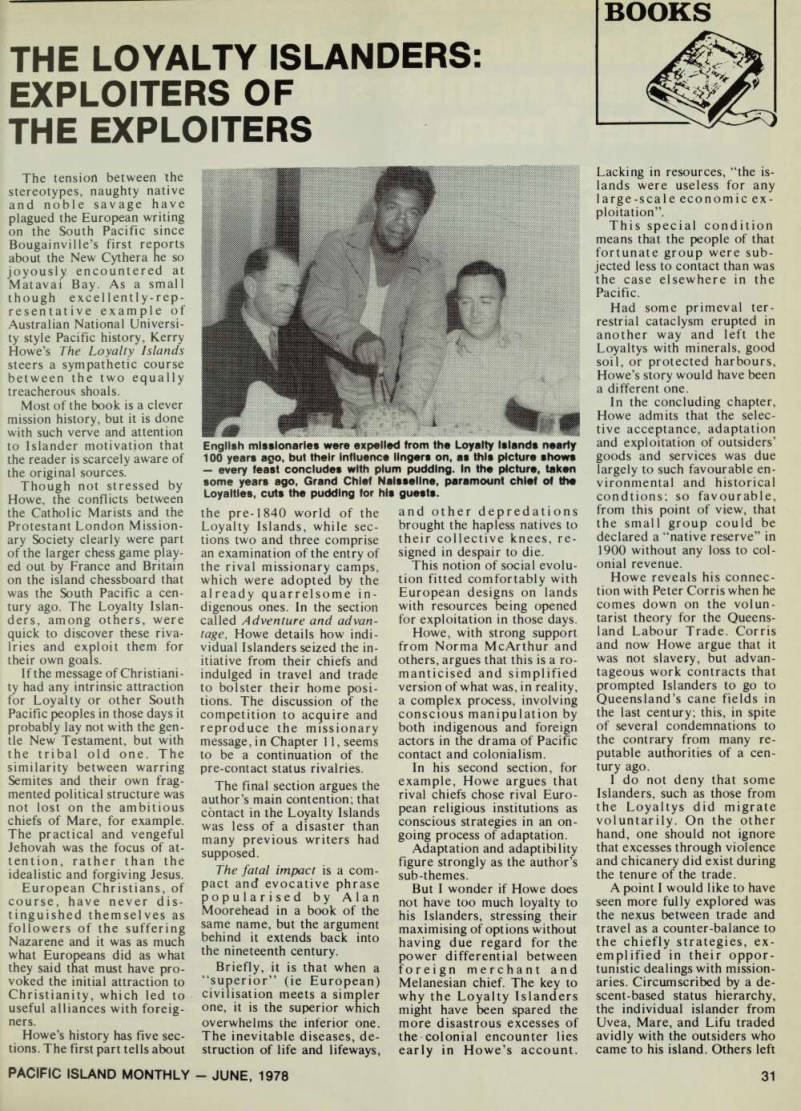
English missionaries were expelled from the Loyalty Islands nearly 100 years ago, but their influence lingers on, as this picture shows - every feast concludes with plum pudding. In the picture, taken some years ago, Grand Chief Nalsseline, paramount chief of the Loyalties, cuts the pudding for his guests.
their isolated villages and worked on trading ex peditions or in cane fields or in mines. Howe writes that at any one time, something like a half of the 12 000 population might be abroad. He does not examine the impact of this mass movement, a charac teristic to some extent of other islands in the present day.
How does this acquisition of material wealth and in fluence affect a supposedly immutable hierarchy? Can the tools, cloth and tobacco ob tained overseas be translated into power at home? Howe only asserts but does not prove his claim that there was no change due to this labour migration.
As one observer in 1894 quoted by Howe noted, the Loyalty Islands are different from other more intensively contacted places in the Pacific. Imported firearms were ineffectual in the guerilla-style internecine war fare and the (again) isolation from continuous European contact meant that few dis eases afflicted the people of the Loyalty group. Depopula tion overall was not a problem and the small size of the is lands meant that indigenous methods of birth control, such as abortion, were prevalent.
Nevertheless, in the figures for the last century only Lifu’s larger population has shown an increase of about 1 000 persons; Mare’s numbers decreased by the same figure for that period, while tiny atoll Uvea dropped by about 400 people. Howe does not explain these different trends.
Howe will not be displeased by my questions for the domi nant theme of his work is that history is a total process and not a singular event. External forces and internal reactions continue to form and shape the development of the South Pacific and Howe’s future work will no doubt continue to document this.
Regrettably, the potential readership for this fine study will not be realised due to its high cost.
The publishers should be aware that anyone with access to bulk photocopy rates will be able to reproduce the book for about half its suggested retail price. Grant McCall
(The Loyalty Islands. A History Of
Culture Contacts 1840-1900. By K. R.
Howi. Published simultaneously by Australian National University Press, Can berra, and University Press of Hawaii, Honolulu, Aug 1977. 115.95.)