Currents
pp. 29-35 · Read in the full issue


Political
New Moves
On Norfolk
A March visit to Norfolk Is land by Australia’s Minister for Home Affairs, Mr Bob Ellicott. and a report on Nor folk Island prepared by the United Nations Association of Australia, have thrown new, volatile elements into the run ning battle over the island’s future.
Mr Ellicott became the Minister responsible for Nor folk Island matters following the most recent Cabinet re shuffle made by Australia’s Fraser Government. The UNAA report was drawn up by the association’s federal media officer, Mr John Bulbeck, following a visit to the island in January.
Mr Ellicott told a meeting of the Norfolk Island Council on March 20 that the island is “part of Australia”. Mr Bulbeck's report declared: “Norfolk Island is most de cidedly not Australian.”
Mr Ellicott said the view that Norfolk Island was a ter ritory to which Chapter XI of the United Nations Charter applied “had no hope of find ing favour with his govern ment”. Mr Bulbeck claimed that Norfolk is “unarguably” a non self-governing territory within the meaning of Chapter XI of the UN charter.
Mr Ellicott told the council that whether or not there would be a referendum on Norfolk to determine its future was a decision for the Australian Cabinet, adding that he did not think there would be such a referendum.
Mr Bulbeck held that the islanders are clearly entitled to determine the direction of their own political future, and that Australia must now develop Norfolk Island and its people towards a “fairly chosen” political future.
The conflicting ideas of the two men are a fair indication of the present battle lines on Norfolk. Piquancy is added to the situation by the fact that the UNAA receives an annual grant of $25 000 from the Australian Government, and that its patron is the
Australian Governor- General.
Mr Bulbeck's report makes the following analysis of the Australian Government’s position on Norfolk's status: the Department of Foreign Affairs clings to the claim that Norfolk Island is not a non self-governing ter ritory, but rather a part of metropolitan Australia, on the rather specious basis that no other member state of the UN has ever proposed that it be otherwise regarded. ‘This sort of rationalising has been reinforced by the un fortunate references to Nor folk Island in the otherwise excellent report in 1975 from the Senate Standing Com mittee on Foreign Affairs and Defence on ‘United Nations Involvement with Australia's Territories . . .' The Senate committee took the misplaced view that ‘a number of factors militate against even the possibility of UN involvement in Norfolk Island ... Such a step is neither justified nor is it likely to occur “Certainly the committee did not have the benefit of any firsthand experience of Nor folk Island (and this is a necessity) but in fairness the committee was primarily oc cupied with developments over one of Australia’s of ficially-declared non-self governing territories, the Cocos Islands.
“Hence it came to conclu sions that are somewhat of a joke on Norfolk Island. The Norfolk Island Council analysis claims nine straight errors of fact or significant distortion in the committee’s report.”
One little-noticed but tell ing piece of evidence in sup port of Mr Bulbeck’s view, and against the Australian Government’s present stand, is provided by the govern ment’s own past behaviour.
Until plurality of voting was abolished by the South Pacific Conference at its meeting in Rarotonga in 1974 member governments had a vote for each of their colonial possessions (“non self-govern ing territories”), in addition to its own vote. Before this change came about Australia regularly exercised three votes; its own, Papua New Guinea’s and Norfolk Is land’s. This is clear proof that, in those days at least, Australia regarded Norfolk
Island as its colony, and not as an integral part of Australia.
Whatever the next moves, it seems they will not be long in coming. Mr Ellicott said dur ing his visit to Norfolk that he was determined not to “sit on”
Norfolk Island matters, but to go forward with proposals to Cabinet during the life of the present parliament. He meant to ensure that they would be an issue in the Norfolk Island Council elections due on July 5.
French Test
Forever?
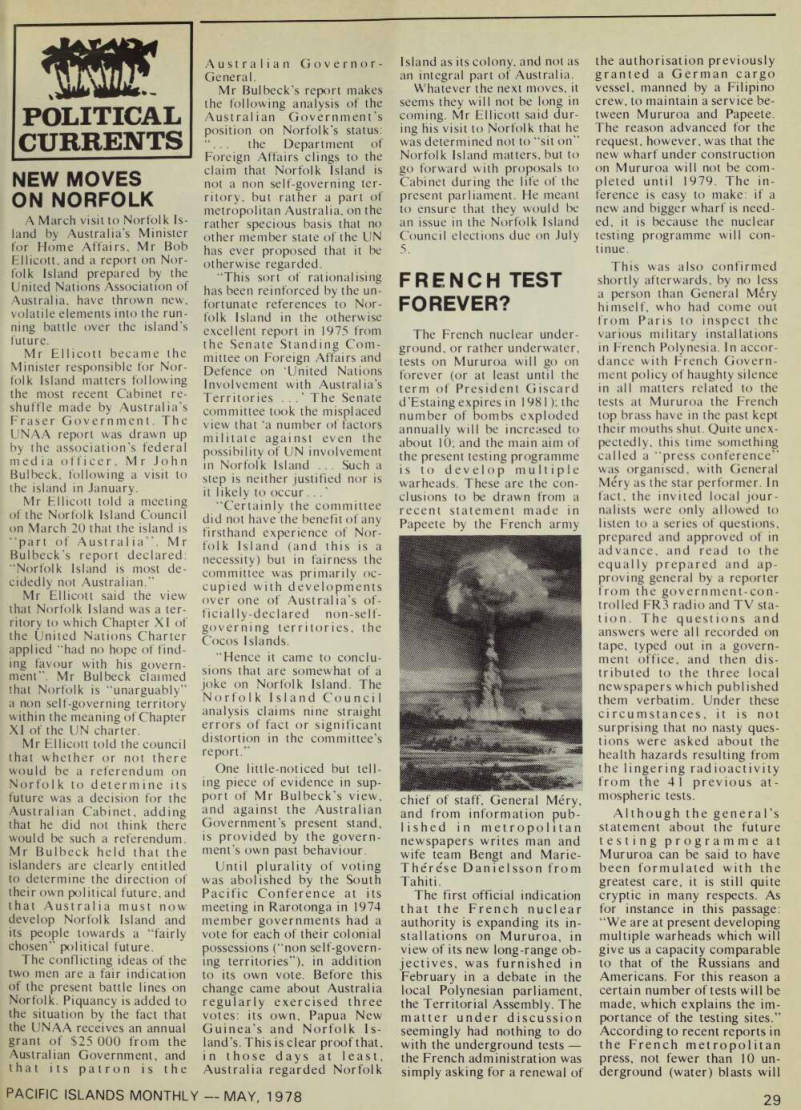
The French nuclear under ground, or rather underwater, tests on Mururoa will go on forever (or at least until the term of President Giscard d’Estaing expires in 1981); the number of bombs exploded annually will be increased to about 10. and the main aim of the present testing programme is to develop multiple warheads. These are the con clusions to be drawn from a recent statement made in Papeete by the French army
chief of staff. General Mery, and from information pub lished in metropolitan newspapers writes man and wife team Bengt and Marie- The're'se Danielsson from Tahiti.
The first official indication that the French nuclear authority is expanding its in stallations on Mururoa, in view of its new long-range ob jectives, was furnished in February in a debate in the local Polynesian parliament, the Territorial Assembly. The matter under discussion seemingly had nothing to do with the underground tests the French administration was simply asking for a renewal of
the authorisation previously granted a German cargo vessel, manned by a Filipino crew, to maintain a service be tween Mururoa and Papeete.
The reason advanced for the request, however, was that the new wharf under construction on Mururoa will not be com pleted until 1979. The in ference is easy to make: if a new and bigger wharf is need ed, it is because the nuclear testing programme will con tinue.
This was also confirmed shortly afterwards, by no less a person than General M6ry himself, who had come out from Paris to inspect the various military installations in French Polynesia. In accor dance with French Govern ment policy of haughty silence in all matters related to the tests at Mururoa the French top brass have in the past kept their mouths shut. Quite unex pectedly, this time something called a “press conference” was organised, with General Mery as the star performer. In fact, the invited local jour nalists were only allowed to listen to a series of questions, prepared and approved of in advance, and read to the equally prepared and ap proving general by a reporter from the government-con trolled FR3 radio and TV sta tion. The questions and answers were all recorded on tape, typed out in a govern ment office, and then dis tributed to the three local newspapers which published them verbatim. Under these circumstances, it is not surprising that no nasty ques tions were asked about the health hazards resulting from the lingering radioactivity from the 41 previous at
mospheric tests.
Although the general’s statement about the future testing programme at Mururoa can be said to have been formulated with the greatest care, it is still quite cryptic in many respects. As for instance in this passage: “We are at present developing multiple warheads which will give us a capacity comparable to that of the Russians and Americans. For this reason a certain number of tests will be made, which explains the im portance of the testing sites.”
According to recent reports in the French metropolitan press, not fewer than 10 un derground (water) blasts will
occur at Mururoa this year.
The general’s only other declaration of general interest concerns the French fleet in the South Pacific which is to be reinforced, so as to be able to supervise the new 200-mile fishing zone. The key passage reads: "If you survey the naval forces in existence in the South Pacific, you will see that those of France represent the preponderant force in this region,” It would be interest ing to hear what Australian, New Zealand, American and Russian generals and ad mirals think about that state ment.
Battle Royal
In Tonga?
The controversial Bank of the South Pacific, which is scheduled to start operations in Tonga (PIM, April, p 6) is fast becoming a political hot potato in its host country.
The officially-sponsored
weekly newspaper, Tonga Chronicle, has carried a long and fiercely critical letter aoout the BoSP project, and a hardly less critical article on the subject which covered well over a page in one issue of the eight-page Chronicle.
The writer of the letter, ’Epeli Hau’ofa, noting newspaper reports that the proposed governor of the BoSP, Mr John Meier, owes his former country, the USA, SUS6.S million in back taxes and penalties, addresses the following question to Australian Mr Arthur John Hepplewhite (the BoSP’s “permanent representative” in Tonga): “Will Mr Hepplewhite ask the lovely Mr Meier to send some roulette tables to Tonga so that we can all gamble here and live happily ever after?
“Will he ask His Excel lency, William Waterhouse, Esq, of Sydney (leading Australian bookmaker and Tonga’s honorary consul in Sydney), to come to the Friendly Islands and teach us how to bet on horses so that we may enjoy ourselves forever at our new and only racecourse at ’Atele?
"If Mr Hepplewhite declines to assist, I shall sub mit to the nation the following proposal. Why don’t we grab Mr Meier next time he comes to Tonga and hand him over to the FBI for half the money he owes to the USA? Why not?
We may as well start earning some honest money for a change . ..
“In the meantime, long live Messrs Meier. Waterhouse and Hepplewhite! Long live the Bank of the South Pacific!
Long live Las Vegas! Long live the Melbourne Cup and Randwick racecourse! And may God save Tonga!”
The 2 500 word article, written by journalist Richard Nathanson, pulls together all that has been published about Mr Meier’s background and the BoSP scheme, and ends on the following note: “A major bone of con tention, indeed, acute conster nation. seems to be the ab sence of a responsible, knowledgeable and credible person in the governor's seat.
"In view of Mr John Meier’s involvement over the last 10 years in matters con cerning the scheming misap propriation of large sums of money his association in any way with the BoSP can only prove to be a deficit.
"John Meier’s current status in the eyes of the law must also be taken into con sideration. Meier, by the ad mission of his own lawyer, faces back taxes, penalties and interest totalling SUS6.S million.
"Indeed, when Meier visited Tonga after obtaining a Canadian passport he Hew a 22 540 km (14 000 mile) roundabout route via Tokyo, Sydney, and Fiji to avoid passing through Honolulu or American Samoa and possible arrest by US authorities.
“If the BoSP is going to ex ist at all, it should be above reproach from the first. There is no point to sowing the seeds of its own destruction so early in the ball game.”
That the Chronicle should ventilate such ideas about the BoSP project, which is believ ed to have had support from the highest levels of authority in the kingdom, points strongly to a battle royal on the issue in the Tongan Estab lishment.
Png: Sir Tei
Steps Down
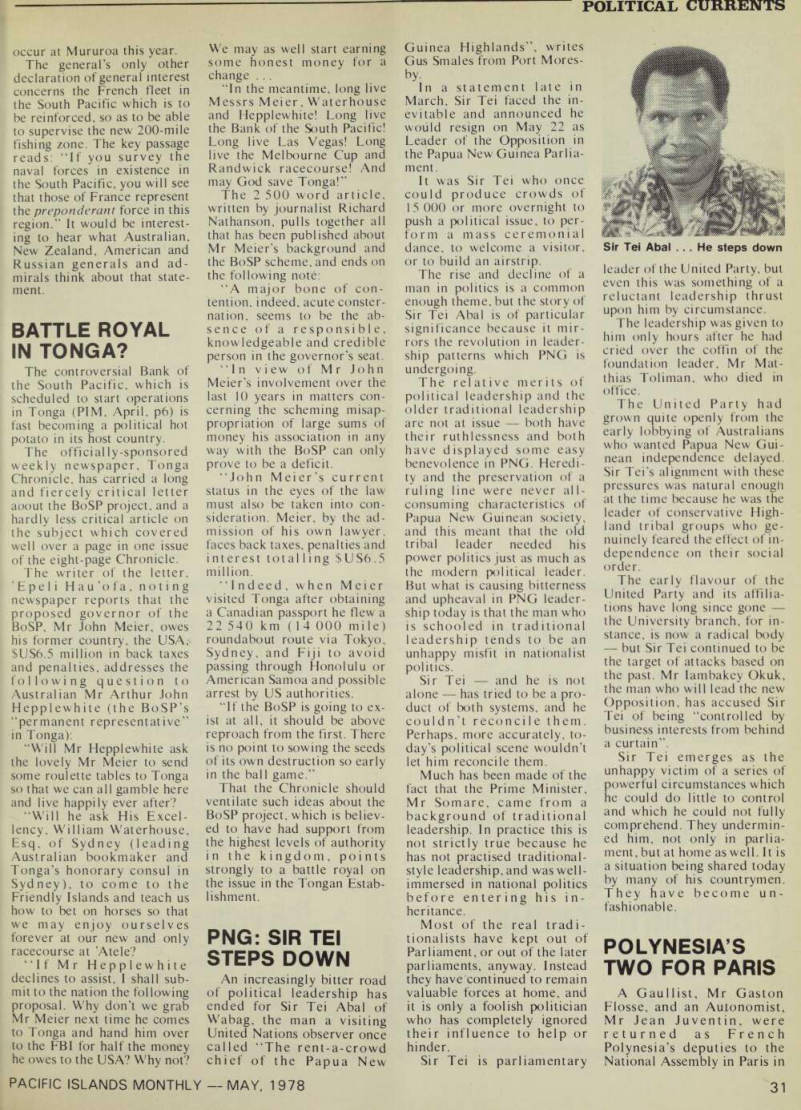
An increasingly bitter road of political leadership has ended for Sir Tei Abal of Wabag, the man a visiting United Nations observer once called "The rent-a-crowd chief of the Papua New
Guinea Highlands”, writes Gus Smales from Port Mores by.
In a statement late in March, Sir Tei faced the in evitable and announced he would resign on May 22 as Leader of the Opposition in the Papua New Guinea Parlia ment.
It was Sir Tei who once could produce crowds of 15 000 or more overnight to push a political issue, to per form a mass ceremonial dance, to welcome a visitor, or to build an airstrip.
The rise and decline of a man in politics is a common enough theme, but the story of Sir Tei Abal is of particular significance because it mir rors the revolution in leader ship patterns which PNG is undergoing.
The relative merits of political leadership and the older traditional leadership are not at issue both have their ruthlessness and both have displayed some easy benevolence in PNG. Heredi ty and the preservation of a ruling line were never all consuming characteristics of Papua New Guinean society, and this meant that the old tribal leader needed his power politics just as much as the modern political leader.
But what is causing bitterness and upheaval in PNG leader ship today is that the man who is schooled in traditional leadership tends to be an unhappy misfit in nationalist politics.
Sir Tei and he is not alone has tried to be a pro duct of both systems, and he couldn’t reconcile them.
Perhaps, more accurately, to day’s political scene wouldn’t let him reconcile them.
Much has been made of the fact that the Prime Minister, Mr Somare, came from a background of traditional leadership. In practice this is not strictly true because he has not practised traditional style leadership, and was well immersed in national politics before entering his in heritance.
Most of the real tradi tionalists have kept out of Parliament, or out of the later parliaments, anyway. Instead they have continued to remain valuable forces at home, and it is only a foolish politician who has completely ignored their influence to help or hinder.
Sir Tei is parliamentary
leader of the United Party, but even this was something of a reluctant leadership thrust upon him by circumstance.
The leadership was given to him only hours after he had cried over the coffin of the foundation leader. Mr Mat thias Toliman, who died in office.
The United Party had grown quite openly from the early lobbying of Australians who wanted Papua New Gui nean independence delayed.
Sir Tei's alignment with these pressures was natural enough at the time because he was the leader of conservative High land tribal groups who ge nuinely feared the effect of in dependence on their social order.
The early flavour of the United Party and its affilia tions have long since gone the University branch, for in stance, is now a radical body but Sir Tei continued to be the target of attacks based on the past. Mr lambakey Okuk, the man who will lead the new Opposition, has accused Sir Tei of being “controlled by business interests from behind a curtain”.
Sir Tei emerges as the unhappy victim of a series of powerful circumstances which he could do little to control and which he could not fully comprehend. They undermin ed him, not only in parlia ment, but at home as well. It is a situation being shared today by many of his countrymen.
They have become un fashionable.
Polynesia’S
Two For Paris
A Gaullist, Mr Gaston Flosse, and an Autonomist, Mr Jean Juventin, were returned as French Polynesia’s deputies to the National Assembly in Paris in
Sir Tei Abal... He steps down
the March general elections, report Marie-Therese and Bengt Danielsson from Papeete.
Both were elected in the first round on March 12, with Mr Flosse receiving 51% of the votes in the eastern constituency. and Mr Juventin 52% in the western.
It was the first election in which French Polynesia has returned two deputies to the Assembly.
The way in which the decision was taken to increase the parliamentary representation of the territory.— the population stands at 140 000 from one to two was a good illustration of where the real power still lies in its affairs, No political bodies or leaders in French Polynesia had anything to do with this “reform" or were even consulted. If they had been asked for their opinion, the Autonomist leaders at least would certainly have objected strongly to the gerrymandering of which the French Government was guilty.
Of the two constituencies created. the first comprised the eastern half of Tahiti plus the Tuamotu and Marquesas Islands, where only 25 154 voters live, whereas the sec-
ond. comprising the western half of Tahiti, plus the Leeward and Austral Islands, had twice as many voters, or 46 817. The explanation for this outrageously unequal way of slicing up the electoral cake was obvious to all. It was made to order for the pro- French Mr Flosse. who has al ways polled a majority of votes in the heavily Roman Catholic Marquesas and Tuamotu groups, as well as on the east coast and the penin sula of Tahiti, In Mr Juventin's consti tuency. on the other hand, Protestant Polynesians make up between and 90 r r of the voters in each and every township and island and rep resent the power base of his Autonomist party, the Pupu here aia.
Voting choices in French Polynesia are still, as in the past, largely determined by membership in religions and ethnic groups, with few can didates bothering to present any political programme at all. relying instead on a single basic slogan, like “indepen dence”. or on personal ap peal. These are combined with vague election promises of the classical pork barrel type: encouragement of local
industries, for example, and higher wages and child allowances.
No fewer than 12 candidates contested the two seats. Five were for independence, two represented the big Autonomist parties (fairly well satisfied with the amount of self-government they have recently been granted), one represented the Gaullist RPR party, two were “Liberal Centrists” (whatever that means), and two were Socialists.
Pro-independence and
Socialist candidates each recorded 7% of the total vote.
That so many candidates cared to stand was surprising, considering the extremely limited possibilities a poor overseas deputy has to make himself heard in or influence the decisions of the French Parliament. There are of course certain material rewards, like many tree trips to Paris, and a monthly salary of about SA2 000.
Formally, the 17 overseas deputies have exactly the same privileges and powers as their metropolitan colleagues.
The trouble is that they are too few to form an influential group. and that the metropolitan members have
no interest in or sympathy with their specific, colonial problems.
Almost the only occasion when a deputy for French Polynesia is allowed to make a speech is during the annual budget debate, and the time alloted to him rarely exceeds seven minutes. If by a stroke of luck he is given a second chance in the same year, he has the privilege of addressing empty benches, The reason why in the past responsible political leaders like Francis Sanford have bothered to occupy this mainly ceremonial office is that by going to the polls and winning, they have been able to claim another, much more important title that of of ficial spokesman for the Polynesian people in all non
parliamentary discussions
with the French Government, Revealingly enough, since the new territorial statute which came into force last year provides for a vice-presi dent of French Polynesia with considerable prerogatives, Francis Sanford has chosen to give up his deputy’s seat in order to occupy this new post, In addition to the gerry mander descri bed above, there were many other, more
subtle ways in which progovernment candidates were favoured in the election. The most universally condemned of these was the complete veto imposed by the French Government on the use of the one and only local TV station for campaign purposes.
No such ban existed, of course, in metropolitan France where, on the contrary, all existing political parties, and a few more ereated especially for the circumstances in order to support a worthy pro-government candidate, were allotted generous radio and TV time every day. What was especially ironic was that all these metropolitan politicians regularly appeared on the TV screens and radio programmes here in French Polynesia, althouth they never had anything to say about local issues, but kept babbling about typically French problems like wine prices, nationalisations, trade union conflicts and export indices.
The TV-radio ban was the more unfair if the special topography of French Polynesia, with more than 100 isolated islands scattered over an area almost as large as Australia, is taken into con-
sideration. The candidates hardest hit were, of course, the poorest, who could not afford expensive island-hop ping operations by plane and boat. Incidentally, these were the ones who were advocating independence, A very special case was that of Charlie Ching whose Inde pendence party made a surprisingly good showing in the poll. As reported earlier (PIM, April, p 16), Charlie Ching was locked up in Sep tember, 1977, accused of con sorting with the Te toto tupuna, political activists who had planted bombs in the Papeete telephone exchange, and murdered a French busi nessman. Ching was still awaiting trial, in prison, and therefore unable to appear at his own campaign meetings, although nothing legally pre vented him from standing as a candidate, The election campaign’s most ambitious effort in the elaboration of a political programme for French Polynesia came from a new local party, the la mana to nunaa (Power to the People), which is made up mostly of young Polynesian intellec tuals. They produced an ex tremely detailed blueprint for
a Socialist society, whose salient characteristic was that it was not merely a slavish copy of the French Socialist Party's programme, but an earnest attempt to devise solu tions to specific local problems and needs.
It might have been expected that such a programme would appeal to all those young Polynesian men and women who are becoming in creasingly disgusted by the continued inflow of French settlers, and the firm deter mination of the French Government to maintain its domination and pursue its nuclear-testing programme.
There is little doublt, however, that these young voters found the programme proposed by the la mana te nunaa so theoretical and ab stract in other words, so unintelligible that they chose instead to vote for can didates who were preaching independence.
Across The
Hebrides Gap
Stalemate continues be tween the two centres of Melanesian political power now existing in the New Hebrides: on the one hand the new government of Chief Minister George Kalsakau and the Representative As sembly from which it sprang, and on the other the People’s Provisional Government sponsored by the Vanuaaku Party.
The small hope there was for a measure of re conciliation disappeared with the flat rejection by the February meeting of the Vanuaaku Party’s Council of Political Commissars (PIM, April, p 6) of an offer by Chief Minister Kalsakau of three seats in his Cabinet for VP
Gaston Flosse
nominees. The council de cided the offer was unaccepta ble on a number of grounds, including the fact that the Representative Assembly and the ministers, were not elected, that the assembly in cluded “terrorist elements”, and that it did not in any case possess “true powers of self government”.
The issue was clearly the subject of heated debate at the VP meeting.
A VP press release on the meeting went out of its way to point out that the decision taken was “more forthright than previous responses to the same invitation forwarded to the Condominium Chief Minister by the president of the VP, Fr Walter Lini”. This refers to relatively conciliato ry replies sent earlier by Fr Lini.
Commenting on the obvious divergence of views within the VP, a well-informed Australian source speaks of Fr Lini as representing the “moderate church group" in the party, as against “the radi cal faction”.
The same source says that Fr Lini made a specific pro posal at the February meeting that the VP agree to join the Cabinet on condition that it be given five out of 10 portfolios, but that the meet ing rejected this idea. The of ficial VP releases make no reference to such a proposal.
The meeting decided that “the only proper way to set Vanuaaku (the New Hebrides) on the road to a peaceful independence is to hold new elections as soon as possible”. It branded as “a mere excuse” Mr Kalsakau’s view that a census was necess ary before elections could be held. It was claimed in dis cussion that the real reason for Mr Kalsakau’s refusal of elections was because he knew that with an election he him self would not be Chief Minister and would probably not even be in the Cabinet.
The VP press release said: “Although the meeting had a lot to say about the present unelected minority asserhbly, in fact most of its time was spent on looking at ways to es tablish the People’s Govern ment on a stronger footing.
“Particular attention was given to the establishment of ‘village courts’ on the lines of
previous VP proposals . . .
“Special attention was also given to the build-up of self
defence groups in the islands and districts. Specific pro posals were also outlined in the area of foreign investment, and, in this respect, the meet ing agreed that all indepen dent sources of help and aid should be pursued vigorously.”
It was not only the VP which was having problems with differences of opinion among its members: as early as January, Jimmy Moli Stevens, whose Na-Griamel Movement, with seven mem bers in the assembly, was the second biggest group in that body, declared that he was pulling his members out.
He was understood to be upset that Chief Minister Kalsakau had not seen fit to allocate a portfolio to Na- Griamel.
Mr Stevens refused to meet Mr Kalsakau when the Chief Minister visited the island of Santo in February.
Png Province
Set-Up Rapped
Papua New Guinea’s pro vincial government system came under strong fire in March as a potential source of
national disunity.
In separate developments; a report from the subsidiary of the Australian Bank of New South Wales warned of the need for the central govern ment to contain developments in provincial administration; a parliamentary Opposition front-bencher indicated he would move for the abolition of provincial governments; and other members of the Op position expressed concern in parliament at the speed and
trend of political devejop
ments in provincial govern ments.
The Somare government es tablished a provincial govern ment structure in a direct at tempt to counter regional pressures which were
threatening national unity.
Regions were given the option of a degree of autonomy which falls short of statehood, but involves an elected government under a premier and with some taxing powers.
Almost all of the 19 regions now have provincial govern ments, or are in the process of getting them.
In his annual report to shareholders, the chairman of the Bank of NSW (PNG) Ltd,
Sir John Cadwallader, said there was a need to safeguard national unity as the system developed. The bank is a wholly-owned subsidiary of the Australian parent com pany and is PNG’s biggest pri vate bank.
Sir John said that although the provincial governments were established to safeguard regional interests, a need ex isted to safeguard national uni ty- The avoidance ot political fragmentation could present one of the greatest challenges to the Somare government, he said. Regional interests had to be contained and regulated.
Sir John predicted five years of stable central govern ment provided the Somare coalition held firm.
The Opposition spokesman on finance, Mr John Jaminan, told parliament he believed any more moves towards de centralisation would “pitch the country into turmoil”.
The Decentralisation Min ister, Father John Momis, fac ed a series of criticisms from members of the Opposition.
Mr Parua Kuri, a Highlands member, claimed that the central government and its members were being in creasingly cold-shouldered as provincialism gained momen tum.
Fr Momis told the House he was well aware of the fears which existed. He believed however that the country could no longer be run on a highly-centralised basis with out risking opposition close to rebellion.
Us Upgrades
Its Fiji Post
It might be because Soviet Russia and Red China, West Germany and others are mak ing overtures to the South Pacific Islands. It might be because all the Island states are declaring 200-mile econ omic zones, or , maybe, because Fiji is growing in im portance in world affairs.
Whatever the reason, the United States has decided to upgrade its diplomatic mis sion in Fiji from a Charge d’Affaires to a full embassy.
The first US Ambassoador to Fiji will be Mr John P. Con don, aged 58 and, until re cently on the faculty of one of
the military colleges in
Washington.
Vote Splits
Caledonia
The March elections left New Caledonia, like France itself, split down the middle, writes Andre Chaville from Noumea.
New Caledonia’s two depu ties will face each other across the floor of the Palais Bour bon in Paris, Mr Lafleur on the government benches, and Mr Pidjot with the opposition.
The second round of voting for the electorate representing the East Coast, the Loyalty Is lands and French residents of the New Hebrides, was fought out between Mr Rock Pidjot of Union Caledonienne, and Mr Dick Ukeiwe of the “na tional majority”.
The other candidates who had taken part in the first round Messrs Naisseline and Uregei, who favoured im mediate independence, and Mr Goupea, independence in the longer term had with drawn. Mr Naisseline specifically asked his sup porters to abstain from voting in the second round.
In the light of the election result, with Mr Pidjot polling 8 416 votes to Mr Ukeiwe’s 5 732, it seems clear that sup porters of Mr Naisseline did not unanimously respect his instructions. Mr Pidjot is a supporter of independence for New Caledonia, but in the longer term, rather than im mediately, as advocated by Mr Naisseline.
Already Mr Lafleur is mak ing public suggestions in favour of close co-operation between the two members in the overall interests of the Territory. Obviously the West Coast member is eager to bring about some re conciliation between the diverse political movements, and is happy not to have to face a more radical member from the East Coast.
Mr Naisseline is the son of one of the most important tra ditional leaders on the island of Mare in the Loyalty group.
The voting patterns in the two rounds on that island sug gest that Uregei voters backed Pidjot in the second round, while the fans of Mr Naisseline refused to vote, in accordance with his request.
A general analysis also seems to indicate that Naisseline’s influence, like that of Uregei, is very much confined to the Loyalty Is lands.