Afterthoughts
p. 27 · Read in the full issue
One of the highlights of my uneventful existence since I retired from politics in 1972 has been the reading of the late Dr E. F. Schumacher's now famous book Small is Beautiful. Dr Schumacher was the originator of the concept of “intermediate technology”, and his book is one which every politician and public servant in Papua New Guinea should read. 1 myself read it with a mixture of delight and chagrin.
For here, expressed clearly and authoritatively by a front-rank economist, were the kind of things which I had tried inexpertly and fumblingly to say during my eight years in the House of Assembly, when 1 had ventured out of my own field of education and social welfare into the. to me. strange terrain of economics.
If only this book had been published sooner. I thought.
I could have said what I felt impelled to say so much better, and perhaps it would have made more impact. But probably it wouldn't, remembering the extent to which at that time the House was dominated by the 10 senior public servants who were its official members and the illiterate sector of the elected membership which provided them with their yes-men.
Anyway, a recent re-reading of Small is Beautiful sent me back to Hansard and to some words I used in 1968 which are perhaps worth repeating. After suggesting that it was doubtful whether Papua New Guinea would benefit by exchanging political for economic colonialism. I went on: “I think that perhaps the present generation of Papuans and New Guineans has to make a rather hard choice. Do they want to get rich quick in their generation, realising that this means that the overseas investors who make it possible for them to do so will get richer quicker, or are they prepared to remain comparatively poor so that their children and grandchildren may secure a larger share in the economic cake when it is baked?”
I then quoted the then Professor of Economics at the University of Papua New Guinea, Professor J W Williams, who had said in his inaugural lecture; “There are two methods by which one can satisfy one’s wants.
One can increase one’s resources so as to keep pace with expanding wants, or reduce one’s wants to the level at which they can be satisfied with existing resources. It is not certain that the first is the more desirable method.”
After commenting that, as a missionary. I had had no choice but to adopt the second method I continued: “1 think that it is worth while Papuans and New Guineans of this generation pondering on the advantages of restricting their wants so that their children and grandchildren will have a better chance of expanding theirs.”
These words were spoken in colonial times, but I think that they are just as relevant today as they were when they were spoken. For there are not wanting signs that some of the nation’s leaders are more interested in getting rich quick, both individually and nationally, than in the welfare of future generations of their countrymen. For example one may cite the Purari scheme, which is still the subject of large-scale feasibility studies. Is this really the sort of development that Papua New Guinea needs?
The Purari scheme is a multi-million kina project for harnessing the waters of the Purari River in western Papua for a jumbo size hydro-electric complex. The quantity of electricity which would be produced would be far in excess of Papua New Guinea’s domestic requirements, and the viability of the project would depend on building a port and attracting to the area overseas industries needing cheap power. The processing of bauxite and the enrichment of uranium have been mentioned as possibilities.
Such a development would put a lot of money into the pockets of overseas investors; and, of course, from the point of view of Australia and other overseas countries it would be very nice if potentially environment-polluting industries could be off-loaded on Papua New Guinea.
True, it would also put some very welcome kina into Papua New Guinea’s Treasury. But at what cost to their
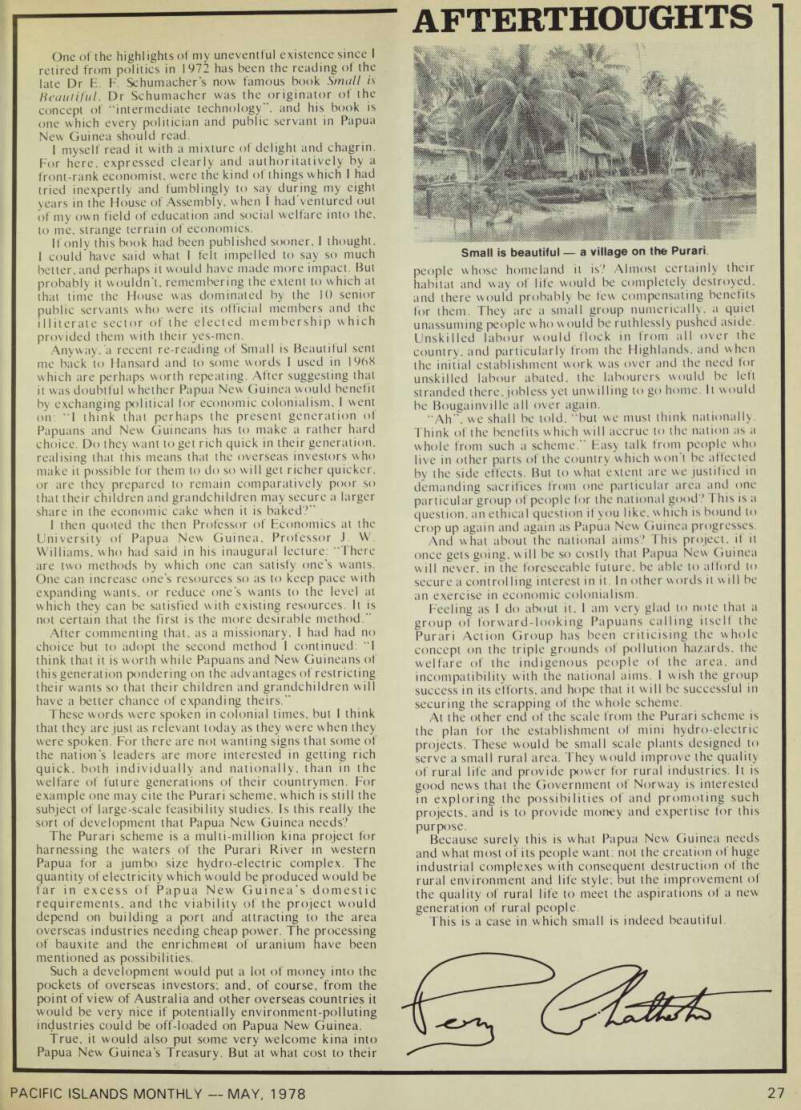
people whose homeland it is? Almost certainly their habitat and way of life would be completely destroyed, and there would probably be tew compensating benefits for them. They are a small group numerically, a quiet unassuming people who would be ruthlessly pushed aside.
Unskilled labour would flock in from all over the country, and particularly from the Highlands, and when the initial establishment work was over and the need tor unskilled labour abated, the labourers would be left stranded there, jobless yet unwilling to go home. It would be Bougainville all over again.
“Ah”, we shall be told, “but we must think nationally.
Think of the benefits which will accrue to the nation as a whole from such a scheme." Easy talk from people who live in other parts of the country which won't be affected by the side effects. But to what extent are we justified in demanding sacrifices from one particular area and one particular group of people for the national good? This is a question, an ethical question it you like, which is bound to crop up again and again as Papua New Guinea progresses.
And what about the national aims? This project, if it once gets going, will be so costly that Papua New Guinea will never, in the foreseeable future, be able to afford to secure a controlling interest in it. In other words it will be an exercise in economic colonialism.
Feeling as I do about it. 1 am very glad to note that a group of forward-looking Papuans calling itself the Purari Action Group has been criticising the whole concept on the triple grounds of pollution hazards, the welfare of the indigenous people of the area, and incompatibility with the national aims. 1 wish the group success in its efforts, and hope that it will be successful in securing the scrapping of the whole scheme.
At the other end of the scale from the Purari scheme is the plan for the establishment of mini hydro-electric projects. These would be small scale plants designed to serve a small rural area. They would improve the quality of rural life and provide power for rural industries. It is good news that the Government of Norway is interested in exploring the possibilities of and promoting such projects, and is to provide money and expertise for this purpose.
Because surely this is what Papua New Guinea needs and what most of its people want; not the creation of huge industrial complexes with consequent destruction of the rural environment and life style: but the improvement of the quality of rural life to meet the aspirations of a new generation of rural people.
This is a case in which small is indeed beautiful.
Small is beautiful-a village on the Purari.