Pineapples, and
pp. 23-26 · Read in the full issue
Tropicalities
Pacific tourism:
Virgins, whores
John Rayner, under-gra duate student at Sydney's University of New South Wales, has just completed an assignment on the subject of tourism in the Pacific Islands.
His controversial conclusion: Throughout this paper it has been stressed that the ma jor problems arising from tourism are mostly caused by foreign ownership and con trol. While this may be so, the Pacific Islands have little choice in the matter because they themselves have not the funds to sel up their own tourist trade. Hence they are dependent on foreign invest ment to set up the trade, and they presumably hope to gain from this foreign investment.
The only feasible way for a Pacific Island nation to join the tourist trade and still have vested interest and control over it is by government legislation to ensure this. This has happened to the Cook Is lands where the government, under agreements concluded by it. owns a substantial per centage of some major accom modation and transport facili ties in the tourist trade, and has a controlling voice in the trade as a whole.
This would seem an ade quate solution, but it does to a certain extent discourage foreign investment. If a foreign company has a choice of investing in two Island countries, one of which re quires a percentage of the profits and the other does not, then the company will naturally choose the other is lands to establish its business on. Despite this, the Cook Is lands solution is probably still the most desirable because although their tourist trade may be less than in other is
lands, they will probably
make more money out of it in
the long run.
Generally then, tourism in the Pacific Islands in its pre sent form is merely a per petuation of the colonial system, with its economic and
cultural exploitation. Many
Island governments are
pecoming increasingly aware
Pf this and some, like the -ooks, are taking steps to end he exploitation. The philoso phy of the Cook Islands government states that “tour sm should not be the means or us to change our way of
life, but an incentive to make us become aware of who and what we are in terms of our culture, customs and tradi tions". Perhaps the Cook Is lands can resist the already es tablished pattern. But then, as B. Hoad so aptly puts it in an article in an Australian magazine, “they are the virgins of the tourist game, while in Tahiti, the grand old whore of the region, it has been declared with re signation that it is necessary that Tahiti should die that Tahitians may live".
In conclusion it can be seen that tourism could have beneficial effects, both econ omically and culturally, on an island nation (provided of course that the government makes the right decisions).
Tourism itself is not de structive, if controlled. But the manner in which it has been set up in the Pacific Is lands is hardly in the best in terests of the Pacific Island nations.
PNG 'cowboy'
takes on 'lawmen'
Police in the Papua New Guinea Highlands are search ing for a self-styled “cowboy" who broke into a government office and stole two guns and ammunition.
The man took a shotgun and rifle from the government of fices at Wapenamanda. leav ing behind a note in which he gave a name and described himself as “a real cowboy".
Police said they believe the name was genuine, and that the man they want is a former government officer wanted for questioning on stealing, passing valueless cheques and illegal use of motor vehicles.
They are concerned because of reports reaching them from village leaders that the man has gone into hiding boasting he will use the guns to "kill lawmen".
The senior government of ficer in Wapenamanda and several police have been nam ed in the threats.
The man is also believed to be armed with a pistol stolen in Lae 450 km away.
A constable sighted him soon after the break-in at the government offices, but lost him in the darkness.
Police guards have been
posted outside the houses ot government officers and police in Wapenamanda.
The note left behind by the man was; “Ah ah ah. The cowboy has taken two of your guns. How are you going to gel them again? You have police ...! Have police. You have guns I have guns. Ah ah ah. Real cowboy. Thank you indeed."
The skin
game in Fiji
The question of inade quately-clad female visitors had again raised its head in Fiji. The Minister for Tour ism. Mr Tomasi Vakatora.
“distressed" at the sight of tourists showing large ex panses of skin, has asked the Fiji Visitors Bureau to do something about telling them how to dress, when ashore in Fiji.
The FVB board, reluctant to grasp the nettle, eventually decided to write to shipping lines about dress for tourists of the female kind. The board manager. Mr Paddy Doyle, said that stopping people get ting off at the gangplank was probably looking for trouble.
Two other members took the view that as local newspapers published pictures of models without clothes there could be little criticism of tourists' dress.
Adi Sadaki. a member of the board, said Mr Vakatora was expressing a Fijian point of view. If he was a European he would not say anything.
She obviously overlooked the fact that Mr Charles Stinson, a European and a fellow minister of Mr Vakatora, is on record as having expressed similar views to Mr Vakatora, only in stronger Stinson-like terms.
Pineapples, and
passengers
A reporter on the Cook Is lands News certainly has very clear priorities. Recording a mishap on a barge taking passengers and cargo out from the island of Mangaia to the MV Mataora for a trip to Rarotonga, the reporter wrote: “The barge was loaded with passengers, cartons of pine apples. luggage and other
foodstuffs . . . Rough seas threw a carton of pineapples, personal belongings and some of the passengers into the sea outside the passage. No lives were lost but two of the passengers on arrival at Rarotonga were taken to the hospital for medical at tention ..."
In view of the order in which the items were first listed, it seems strange the re porter didn't tell readers what happened to the carton of pineapples.
A brochure
of errors
The United Nations is con sidering sites in three coun tries Fiji, Malta and Jamaica for the headquar ters of a proposed Interna tional Seabed Authority.
Fiji’s chances of selection are good, but they have not been helped by a brochure which is intended to state the arguments in favour, writes L.
G. Usher of Suva.
The presentation of the brochure is excellent, with
wel 1 -selected photographs
effectively arranged, an un
dersea map showing Fiji's
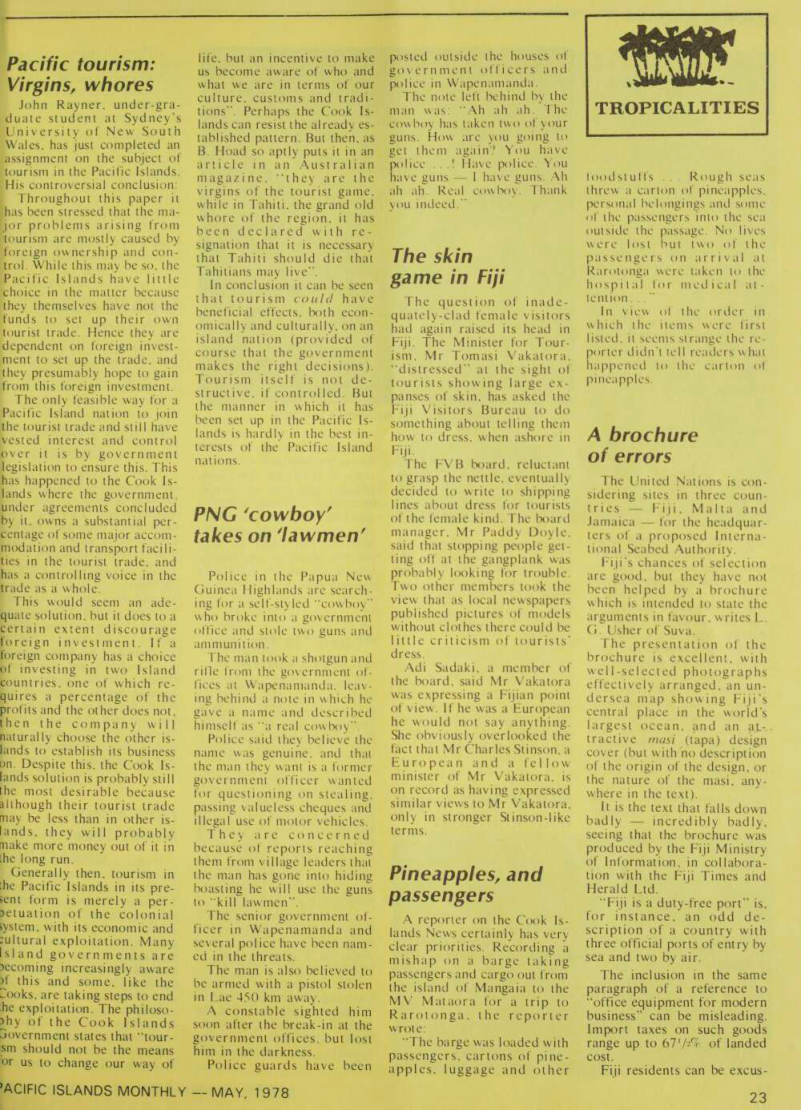
central place in the world’s largest ocean, and an at tractive masi (tapa) design cover (but with no description of the origin of the design, or the nature of the masi, any where in the text).
It is the text that falls down
badly incredibly badly,
seeing that the brochure was produced by the Fiji Ministry of Information, in collabora tion with the Fiji Times and Herald Ltd.
“Fiji is a duty-free port" is, for instance, an odd de scription of a country with three official ports of entry by sea and two by air.
The inclusion in the same paragraph of a reference to “office equipment for modern business” can be misleading.
Import taxes on such goods range up to 67 1 of landed cost.
Fiji residents can be excus
ed a degree of surprise when they read that “pine harvest ing" and "beef production" are "recent industries".
If the first reference is to the rapidly-expanding, but still, mainly young pine forests, then "harvesting" is not yet the word to use. And, although fortunes of the in dustry have fluctuated. Fiji has been producing beef for many years.
Another claim is that "in tensive mineral exploration is being undertaken in shallow off-shore areas of the islands, searching for deposits of mineral-rich manganese nodules'.
People living in Fiji have not been made aware that this "intensive exploration" is now "being undertaken".
They are likely to be still more surprised by a bald claim that in Fiji “the Government provides free schooling".
The advance towards fully subsidised education has been commendably rapid, especially in recent years, but as government speakers acknowledged in a parliamen tary debate early in March, there is still a long way to go.
But it is in the political sec tion of the brochure that the most glaring inaccuracies occur.
A paragraph on Fiji's Parliament says. "The 20member Senate is a house of review with powers to delay but not to block legislation".
The Senate in fact has 22 members, and an essential feature of the constitutional protection of Fijian rights and customs is an absolute veto power placed in the hands of a majority of the eight Senators nominated by the Great Council of Chiefs.
This power applies to any propsals to change nine nam ed laws if those proposals "affect Fijian land, customs or customary rights".
A further constitutional provision requires amend ments of any sort to these nine laws, or to the constitution it self. to be approved by at least three-quarters of the members of both the Senate and House of Representatives.
So in some highly im portant, even if limited areas the Senate most certainly does have power to block legisla tion.
In the same political section of the brochure comes the
remarkable claim that Fiji was "the first country in the South Pacific region to attain na tionhood".
This will cause raised eyebrows in Western Samoa and Nauru, both of which became independent before Fiji, and perhaps also in the Kingdom of Tonga. For that matter, "South Pacific region" could be held to include the
long-standing independent
nations of Australia and New Zealand.
Fiji has an excellent case for being chosen as the home of any international body con cerned with the sea. It is a pity that in this instance the case has been put so poorly, in a document marred by such in excusable inaccuracies.
Rabaul gets tough
with graffiti st
In a public punishment police marched two handcuff ed teenage gang members through the streets of Rabaul and forced them to remove scrawled words from the walls of buildings.
The two said they belonged to a gang called Kave "The Dogs of Kerema". Kerema is a town on the Papuan coast, on the opposite side of PNG to Rabaul.
Big crowds watched the event.
A magistrate. Mr Natanais Marum. ordered the punish
ment after finding the words "grossly offensive".
Kori Ho pah a. 18. who pleaded guilty to 11 charges of writing a grossly indecent word in a public place, was also fined the equivalent of S2OO. Steven Tom. 15. who pleaded guilty to one similar offence, was lined the equivalent ot S3B.
"Cash" is the cry
of PNG youth
Papua New Guinea’s old style village life is not at tractive enough for modern youngsters, a study has found.
One of the biggest problems is lack of opportunity to earn cash.
A national conference on youth development at Goroka, in the PNG High lands, issuing its findings in March, said that younger villagers want to earn cash, despite the fact that the village can provide adequate food, shelter and com panionship for its people.
The conference ascribed the increasing drift of young people from villages to the towns to a growing lack of satisfaction with village life.
The extension of a wage earning economy within village societies, replacing the existing traditional econ omies, could help to ease the situation, the conference de cided.
Although many village j communities at present have a cash income from their crops, the money does not circulate ' as wages to the people who produce the crops.
The conference questioned the work of many vocational schools on the grounds that the skills passed on were not necessarily of value to village communities. It re commended the extension of a village development training scheme now being sponsored in PNG by the World Bank.
Softball scores
in Nauru
An international women's softball tournament in Nauru as part of the island's 10th in dependence anniversary celebrations was so successful that as soon as it was over the organisers decided to ask that the sport be included in the next South Pacific Games.
Teams taking part, apart from Nauru, were Guam, the Gilbert Islands. Papua New Guinea and Tuvalu. The Gilbert Islands and Tuvalu teams were selected from players living on Nauru.
The tournament was a first for Nauru the first time an international sports event in volving several groups was staged. The games were play ed on a well-grassed field, surrounded by remarkably good amenities for spectators.
Guam won the tournament, beating Nauru in the grand final. Tuvalu came third, PNG fourth and the Gilbert Islands fifth. Juliet Cain.
Nauru, was named the best and fairest player.
Fiji's thirsty
North-West
Nadi, Lautoka and Ba, three of the main centres in the north-west of Viti Levu, Fiji, have an average rainfall ranging from 1 800 mm to 2 300 mm, yet are facing grave water restrictions. The position is so bad at Lautoka that all land subdivision and building works have been banned for five to seven years.
Lautoka has not long been a city. The ban will have a serious effect on housing and general development there.
Many hundreds of people
The striking cover of the Fiji Government’s brochure.
waiting for houses will have to wait longer, while commercial building is grinding to a halt.
The area is on the brink of the worst drought since 1969.
Schools, provincial councils, rural local authorities and hotels have been warned to conserve and find alternative j sources of water. Water tanks [ have been pressed into service I to deliver emergency supplies to some hospitals and schools.
Hydrological data forewarned of a long drought in 1978 and 1979, the Western Commissioner, Mr Narsi Raniga, announced in March. The data showed that the water table was very low, and the pattern over the years suggested that such droughts occurred every 10 years. The last such drought was in 1969.
Tokelau's first
silver dollar
The first Tokelauan coin is expected to be released later this year. Arrangements are being made in Wellington, (NZ). for the first issue which will feature a portrait of Queen Elizabeth. On the ob verse side will be a Tokelauan scene designed by the Tokelauan artist, Farairno Paulo.
The coin is a com memorative silver dollar and will be 1 egal tender in Tokelau, but it is not expected to have wide usage there. At present both New Zealand and Western Samoa currency is used in Tokelau, although Samoan currency is most com monly used since Tokelau buys large quantities of goods from Western Samoa.
Design for
the Games
The emblem for the 6th South Pacific Games, which will be held in Fiji in 1979, was designed by Tom Yagle, a graphic artist and Peace Corps volunteer. More than 450 entries were submitted and judged by an independent panel drawn from artistic and cultural bodies in Fiji. The design will be seen on Games programmes, souvenirs, sports clothing and other pro motional material. Mr Yagle’s design won him a prize of
$5OO worth of travel by Air Pacific.
The emblem consists of three running tracks meeting a circle, similar to a circle used for the hammer throw or dis cus, inside a bigger circle.
Superimposed are the words
Fiji, 6Th South Pacific
Games.
-I- and of two
health scenes
Two Australian doctors have compared the disease and health levels of residents of a Papua New Guinea high land village and an urban Australian community to find out if lifestyle is a major determinant of community health.
Dr Peter Sinett and Dr Malcolm Whyte, both of the Australian Capital Territory Health Commission, found sharp contrasts between the lifestyles and types of disease suffered by the two com munities and warned that social and economic develop ment in PNG could lead to an increase in disease.
They found the PNG com munity, living in the Western Highlands, to be a self-reliant, self-contained and socially cohesive subsistence society whose members were well adapted, in biological terms, to their physical and social environment.
By contrast, the Australian community lacked social cohesion, was far from being self-contained and self reliant, depended heavily on the technologies of pro duction and consumption, and discouraged direct relation ships between its members and the physical environment.
Writing in the Medical Journal of Australia, the two doctors said the PNG people were free from any major degenerative cardiovascular diseases and had little psy chological illness, but the so ciety was far removed from any
"Rousseau-style paradise”.
It had a high rate of infec tious disease which, in com bination with poor nutrition, resulted in high infant and childhood mortality and a short life expectancy.
The Australian community had higher levels of degenera tive disease and psychological illness, but lower infant mor tality and extended life ex pectancy.
Searching for a slit
drum orchestra
The painting above. Drum Grove at Mele. is the work of the English artist. Norman H Hardy, a reporter-illustrator with the Sydney Morning Herald. He painted it during a visit to the New Hebrides in 1894-95.
Twenty-one of Hardy's New Hebrides paintings were pub lished in E. Way Elkington's The Savage South Seas (Lon don. 1907). Although most of his original paintings have now been lost, some of the ar tifacts collected by Hardy, and some of his paintings, are
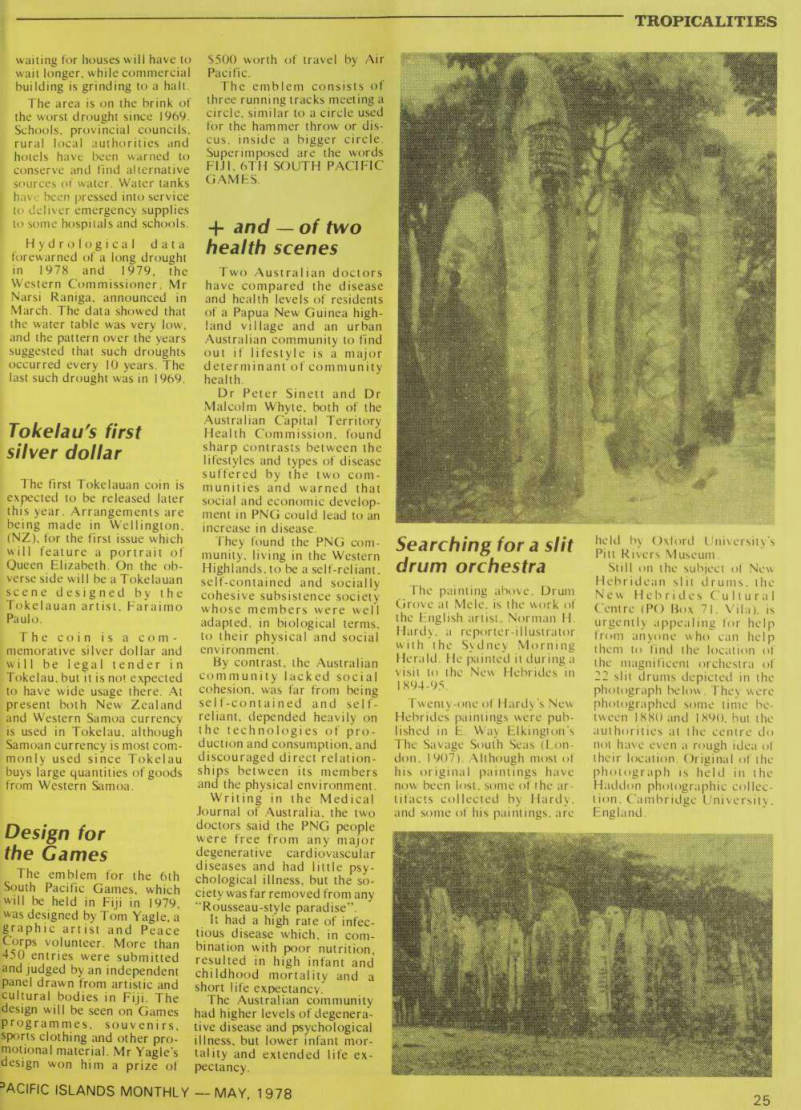
held by Oxford University's Pill Rivers Museum Still on the subject of New Hebridean slit drums, the New Hebrides Cultural Centre (PO Box 71. Vila), is urgently appealing for help from anyone who can help them to find the location of the magnificent orchestra of 22 slit drums depicted in the photograph below. They were photographed some time be tween 1880 and 1890. but the authorities at the centre do not have even a rough idea ot their location. Original of the photograph is held in the Haddon photographic collec tion. Cambridge University.
England.
White men gave
licence to kill?
The former White admin istration of Papua New Guinea had accepted the prin ciple that Highlanders could kill Bougainville Islanders, according to a written threat which is being investigated by PNG police.
Government officers have described the threat as “one of the ugliest and most poten tially dangerous racist docu ments ever to surface in
Png'
The document, sent unsign ed in February to the North Solomons Provincial Govern ment of Bougainville Island, threatens violence and death to Bougainville Islanders who live in the Highlands of the PNG mainland Although both arc parts of PNG. the document draws a racist line between the High landers who sec themselves as brown- skinned and the Bougainville Islanders as "un wanted black faces”.
The threat became known after a Bougainville-born policeman stationed in the Highlands was attacked in his home.
It threatens the lives of Bougainville-born police, health workers, teachers and others now living in Goroka. the main town in the High lands.
It claims the "White man's law” of 1972 when Aust ralia was administering PNG before independence had accepted “kill. kill. kill, the Highlanders' custom”.
This is a reference to a 1972 incident in Goroka which began when two Bougainville born senior public servants were travelling in a car which struck and killed a six-year old girl.
An angry crowd of Highlan ders killed the two Bougain ville men on the spot by knif ing and strangulation, but the three men subsequently charg ed with murder were acquit ted.
In his acquittal judgment.
Mr Justice Frost said he was satisfied the three men had participated in the attack, but he couldn't legally sheet home the murder blame because 15 men appeared to have been involved, and ““the full story hadn't been told”.
Many Highlanders have since believed, or pretended
to believe, that the judgment was an acknowledgment that the> could legally kill “foreig ners".
The letter, mailed to Bougainville from Goroka, refers to an organisation call ed GAG taken to stand for Goroka Action Group. It says in part; I'm the son of a High lander who was sent home from your province. Time is running out for the black faces residing here in this Goroka town.
“Set the alarm to return their belongings before the sun sets.
"Remember: Kill. kill. kill, ha. ha the Highlanders' custom accepted by the While man's law in the 1972 killings here in the Eastern Highlands.
“GAG was formed by High landers to operate in this town to remove unwanted faces.”
The Ombudsman
asks questions
Most complaints dealt with by the Fiji ombudsman, Mr Justice Moti Tikaram, in 1976-77 related to the police.
Of 470 cases referred to him, 203 concerned the police. He disposed of 145 of the police cases and found that 40 were either justified, partially justified or rectified. Twenty seven cases required some sort of explanation, while 21 were either not justified or not sustained.
The second largest number of complaints was against the Justice Department. Sixty cases were reported, but a number were inquiries, rather
than specific complaints,
about delays by bailiffs or police in executing warrants.
Unfortunately, lapses by some clerical officers were re
sponsible for some justified complaints, Mr Justice Moti Tikaram said.
He reported that some government officers resented inquiries by his staff. Some permanent secretaries and departmental heads still tend ed to leave queries to relatively junior officers. He regarded resentment by cer tain officers as part of an oc cupational hazard.
He suggested a permanent law reform body should be set up. Such a body would go a long way towards improving not only the quality of law by modernising its language, but also towards infusing social conscience in the law. He was critical of the “amazing num ber” of amendments made to recently-passed laws. Could some of those amendments have been avoided if the origi nal laws had been scrutinised by a law reform body? Was Fiji passing too many laws too quickly? Amendments could often cause more difficulties than they solved and multiplied the problems of both access to the law and the interpretation of it, he said.
"Mafia threat" in
PNG betting law?
Government approval of betting shops and bookmakers in Papua New Guinea may at tract “the mafia and foreign gangs”, the Opposition in the PNG parliament believes.
Mr John Jaminan, Opposi tion spokesman on finance, commenting in March on the government’s budget, referred to its licensing of 18 betting shops which have established a huge turnover, mainly from bets on Australian gallopers, trotters and dogs.
The budget changed the taxing arrangements for the shops to a turnover tax instead of a ticket tax, promising higher government revenue.
Several bookmakers immedi ately began crying poor in the wake of the change.
Mr Jaminan, tongue in cheek, said in the House; “I like gambling of this type because lots of money can be made for government pur poses".
Those beetles
ain't so cute
Travelling New Zealanders who find Asian and Pacific beetles cute and bring them home as souvenirs are causing agricultural officials big headaches.
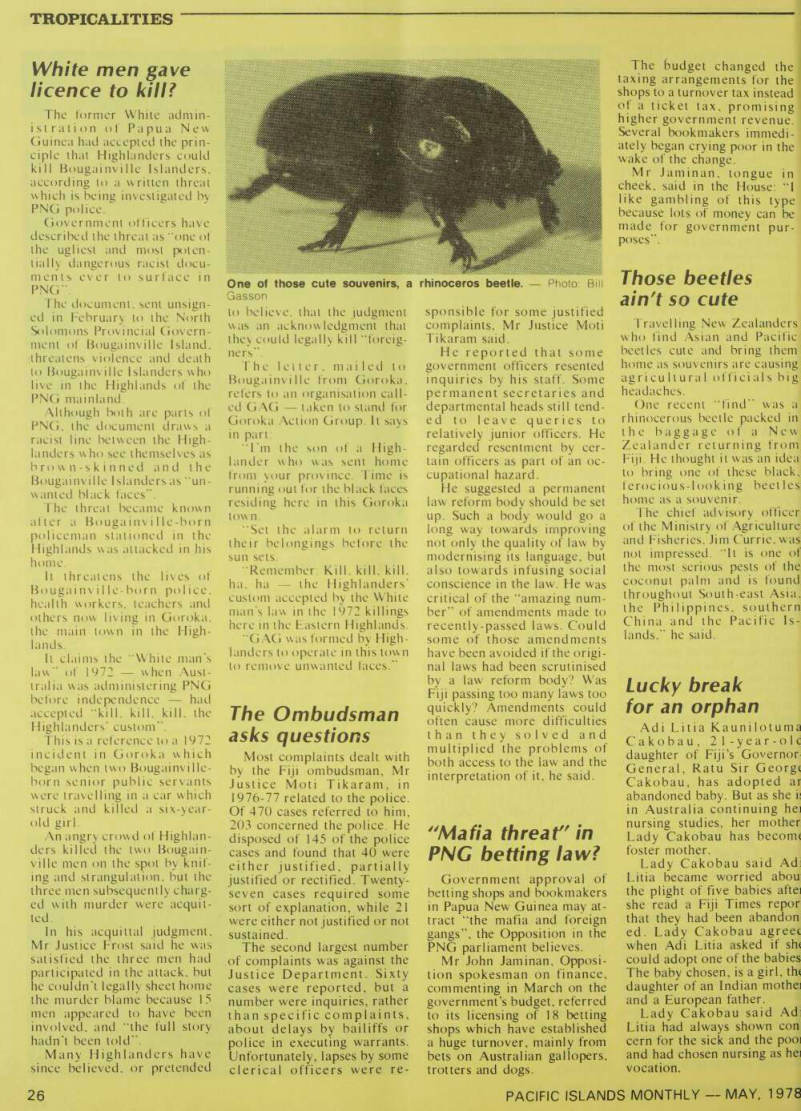
One recent ‘find" was a rhinocerous beetle packed in the baggage of a New Zealander returning from Fiji. He thought it was an idea to bring one of these black, ferocious-looking beetles home as a souvenir.
The chief advisory officer of the Ministry of Agriculture and Fisheries. Jim Currie, was not impressed. “It is one of the most serious pests of the coconut palm and is found throughout South-east Asia, the Philippines, southern China and the Pacific Is lands." he said.
Lucky break
for an orphan
Adi Litia Kaunilotuma
Cakobau, 2 1 -year-old
daughter of Fiji’s Governor- General, Ratu Sir Georgt Cakobau. has adopted ar abandoned baby. But as she i: in Australia continuing hei nursing studies, her mother Lady Cakobau has becorm foster mother.
Lady Cakobau said Adi Litia became worried abou the plight of five babies aftei she read a Fiji Times repor that they had been abandon ed. Lady Cakobau agreec when Adi Litia asked if sh< could adopt one of the babies The baby chosen, is a girl, the daughter of an Indian mothei and a European father.
Lady Cakobau said Adi Litia had always shown con cern for the sick and the pool and had chosen nursing as hei vocation.
One of those cute souvenirs, a rhinoceros beetle. Photo Bill Gasson