People
pp. 20-21 · Read in the full issue
Captain John Francis O’Connor, 55, well-known ship’s master in the South Pacific, has retired after 29 years with China Navigation and associate companies. He was born in Portsmouth, Eng land, and joined China Navigation in Hong Kong in 1949. He was transferred to Australia in 1958, and cap tained China Navigation, NGAL and Swire ships on many routes in the South Pacific and Far East. His work took him to Papua New Guinea ports, the Solomons, Nauru, and the Gilbert and Ellice Islands in ships carry ing cargo and/or passengers.
He saw the transition of cargo from break bulk to pallets and containers. His last command was the NGAL container ship, Papuan Chief, which went into service in 1977. He speaks of good-natured rivalry with masters of other lines, and delights in telling a story about Captain Bill Wilding, who was once master of the Bulolo. If the Bulolo happen ed to arrive at Port Moresby and found a China Navigation ship at the dock, he would call out “Get off the wharf, you pirates”. Captain O’Connor is now living at Roseville, Sydney, doing a “bit of gar dening”. He does not intend to think of another sort of job for a couple of years.
David Aingamea. 20, is the youngest postmaster ever on Nauru. He qualified as an ac countant at the Gordon In stitute in Australia and work ed in the Nauru Treasury before becoming acting depu ty postmaster in 1976. He has just completed several months in Fiji working in the data processing computer centre under the South Pacific Bureau for Economic Co-op eration fellowship scheme.
While in Fiji he learned three “computer” languages.
Two new overseas diplomats have been ap pointed to represent their countries in Papua New Guinea. They are Mr Othman Wok, as High Commissioner
for Singapore, and Mr Jose Bazan. as Ambassador for Mexico. PNG only recently entered into diplomatic rela tions with Mexico.
Mr Justice Raine, a former New South Wales barrister, has been appointed Deputy Chief Justice in Papua New Guinea. He was appointed to the PNG Supreme Court as a puisne judge in 1970. In his new post he succeeds Sir William Prentice, who was appointed PNG Chief Justice in 1977.
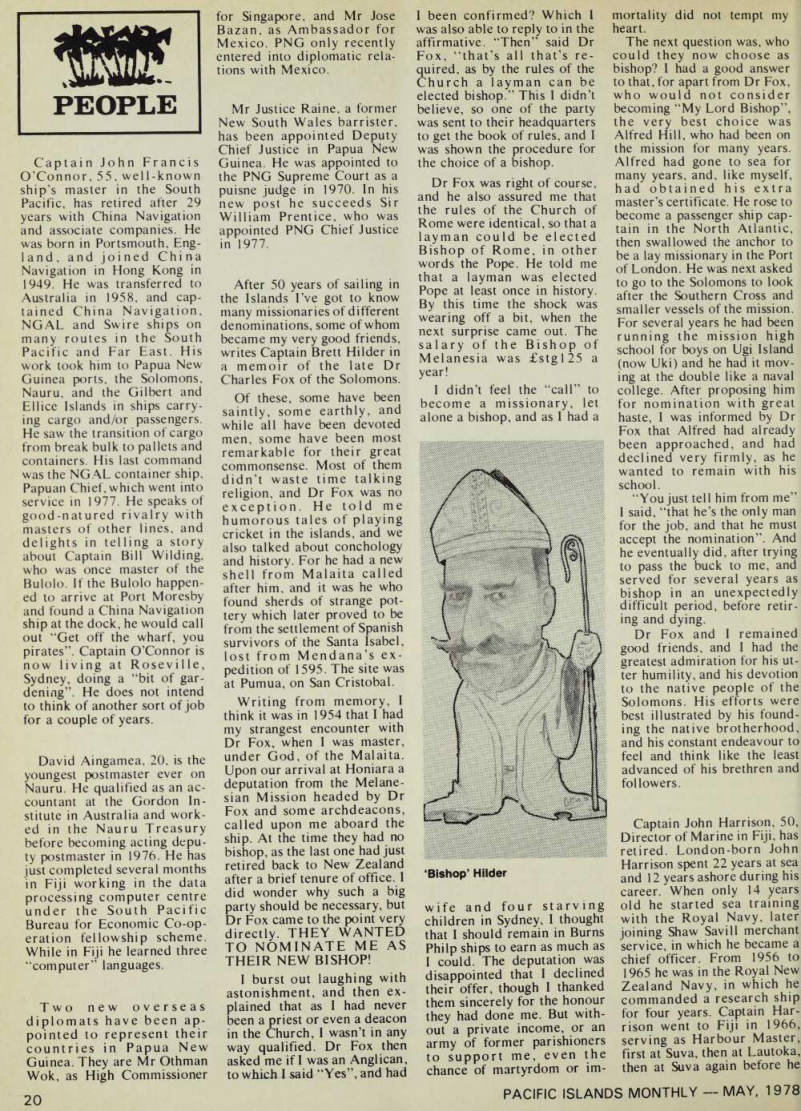
After 50 years of sailing in the Islands I’ve got to know many missionaries of different denominations, some of whom became my very good friends, writes Captain Brett Hilder in a memoir of the late Dr Charles Fox of the Solomons.
Of these, some have been saintly, some earthly, and while all have been devoted men, some have been most remarkable for their great commonsense. Most of them didn’t waste time talking religion, and Dr Fox was no exception. He told me humorous tales of playing cricket in the islands, and we also talked about conchology and history. For he had a new shell from Malaita called after him, and it was he who found sherds of strange pot tery which later proved to be from the settlement of Spanish survivors of the Santa Isabel, lost from Mendana’s ex pedition of 1595. The site was at Pumua, on San Cristobal.
Writing from memory, I think it was in 1954 that I had my strangest encounter with Dr Fox, when 1 was master, under God, of the Malaita.
Upon our arrival at Honiara a deputation from the Melane sian Mission headed by Dr Fox and some archdeacons, called upon me aboard the ship. At the time they had no bishop, as the last one had just retired back to New Zealand after a brief tenure of office. I did wonder why such a big party should be necessary, but Dr Fox came to the point very directly. THEY WANTED
To Nominate Me As
Their New Bishop!
I burst out laughing with astonishment, and then ex plained that as I had never been a priest or even a deacon in the Church, I wasn’t in any way qualified. Dr Fox then asked me if I was an Anglican, to which 1 said “Yes”, and had
I been confirmed? Which I was also able to reply to in the affirmative. “Then” said Dr Fox, “that’s all that’s re quired, as by the rules of the Church a layman can be elected bishop.” This 1 didn’t believe, so one of the party was sent to their headquarters to get the book of rules, and I was shown the procedure for the choice of a bishop.
Dr Fox was right of course, and he also assured me that the rules of the Church of Rome were identical, so that a layman could be elected Bishop of Rome, in other words the Pope. He told me that a layman was elected Pope at least once in history.
By this time the shock was wearing off a bit, when the next surprise came out. The salary of the Bishop of Melanesia was £stgl2s a year! 1 didn’t feel the “call” to become a missionary, let alone a bishop, and as I had a
wife and four starving children in Sydney, I thought that I should remain in Burns Philp ships to earn as much as I could. The deputation was disappointed that 1 declined their offer, though I thanked them sincerely for the honour they had done me. But with out a private income, or an army of former parishioners to support me, even the chance of martyrdom or im
mortality did not tempt my heart.
The next question was, who could they now choose as bishop? I had a good answer to that, for apart from Dr Fox, who would not consider becoming “My Lord Bishop”, the very best choice was Alfred Hill, who had been on the mission for many years.
Alfred had gone to sea for many years, and, like myself, had obtained his extra master’s certificate. He rose to become a passenger ship cap tain in the North Atlantic, then swallowed the anchor to be a lay missionary in the Port of London. He was next asked to go to the Solomons to look after the Southern Cross and smaller vessels of the mission.
For several years he had been running the mission high school for boys on Ugi Island (now Uki) and he had it mov ing at the double like a naval college. After proposing him for nomination with great haste, 1 was informed by Dr Fox that Alfred had already been approached, and had declined very firmly, as he wanted to remain with his school.
“You just tell him from me”
I said, “that he’s the only man for the job, and that he must accept the nomination”. And he eventually did, after trying to pass the buck to me, and served for several years as bishop in an unexpectedly difficult period, before retir ing and dying.
Dr Fox and I remained good friends, and I had the greatest admiration for his ut ter humility, and his devotion to the native people of the Solomons. His efforts were best illustrated by his found ing the native brotherhood, and his constant endeavour to feel and think like the least advanced of his brethren and followers.
Captain John Harrison, 50, Director of Marine in Fiji, has retired. London-born John Harrison spent 22 years at sea and 12 years ashore during his career. When only 14 years old he started sea training with the Royal Navy, later joining Shaw Savill merchant service, in which he became a chief officer. From 1956 to 1965 he was in the Royal New Zealand Navy, in which he commanded a research ship for four years. Captain Har rison went to Fiji in 1966, serving as Harbour Master, first at Suva, then at Lautoka, then at Suva again before he
'Bishop’ Milder
became Assistant Director of Marine. He became head of his department in 1972. He will live about 30 km from Suva in his retirement. Once a quarter he will attend meet ings of the Pacific Forum Line of which he is a director.
Papua New Guinea’s Governor-General, Sir Tore Lokoloko, paid an official visit to Australia in March.
He was able to relax within a short time of his arrival when the PNG Consul-General in Sydney, Mr Austin Sapias, put on a welcome barbecue for him at his attractive home in the Sydney suburb of Gordon.
Sir Tore was able to let his hair down surrounded as he was by some old friends.
Among them were Sir “Hor rie” Niall, ex-speaker of PNG’s House of Assembly and now living retired in Sydney, and Fred Kaad, a familiar figure at all functions where old PNG hands foregather. But Sir Tore was not able to shed his important role all the time. He had an investiture in the garden while the odour of sizzling steaks wafted around. A surprised guest, ex-PNG hand Mr Harry Jackman, found himself on the receiving end when the Governor-General pinned on to him the insignia of the MBE which Harry was award ed in the Queen’s New Year’s Honours list. Harry was one of the people responsible for
the now flourishing co-op
erative movement in Papua New Guinea. The tears weren’t far away from Harry’s eyes when Sir Tore did the job.
In many of the more developed countries there is still a great deal of debate going on about ways and
means of introducing FM
radio, which gives a far superior level of musical rep roduction than the older AM system. In his electrical workshop at Avarua, Rarotonga, Gordon Brereton has set up his own FM station.
Gordon for many years was a technician with the radio sec tion of the Post Office in the Cook Islands and at one time fell foul of the New Zealand authorities for operating an unlicensed transmitting sta tion.
The Cook Islands Govern ment has now given Gordon permission to broadcast in the FM band so long as he does not operate for commercial returns. The station provides a very useful service for the duty-free shops which wish to demonstrate the FM capacity of the radios they sell.
This FM station is pro viding a musical fare that is new to listeners in the Cook Islands, who have been limited in the past to the programmes provided by Radio Cook Islands. Now, for those who prefer it, there is the opportunity to listen to modern jazz, the classics, or musical comedy. And at times Gordon has added to the spice of the Cook Islands air waves by broadcasting segments of “Steptoe and Son”.
Duncan Justus Seko, 27, is believed to be the youngest secondary school inspector in Papua New Guinea. He is also a phenomenally good golfer.
Mr Seko had the first golf game of his life just two years ago. He now plays off a han dicap of seven.
For the uninitiated, it is considered very good for a golfer of such short ex perience to have a handicap in the 20s. To get down to be tween 20 and 10 in such a short time is rare. To get under 10, and closer to five, is astounding.
Now based at Madang, Duncan says: “Although I still haven’t had any lessons, I did have the good luck to be able to attend a clinic conducted by John Sullivan, the Australian professional who won the 1977 Rabaul Open.”
His success, like success in any field, called for hard work. “When I am in town, which is only every second week because of my school duties, I play at least nine holes three times during the week and 18 on Saturdays. I always carry 100 balls in my bag and hit 250 practice shots twice a week.
“My only regret is that I do not have more time to play and practise, as I would dearly like to represent PNG in the next South Pacific Games. I would also like to get my handicap down to two or three by the end of this year.”
Mr Seko has another hope: he would like to see golf in troduced into the schools.
“Golf is a game that assists character development, is challenging and requires hard work,” he says. “All these things are necessary for our youth.
“Papua New Guineans are naturally athletic. I have seen 10 and 1 1-year-olds in Goroka, Lae and Madang swinging naturally and sweetly with ‘clubs’ they’d made from limbs of trees.
“There is, at least, one of these youngsters who could go on and become a successful professional on the interna tional circuit if given the op portunity.”
Although he is well aware of the problems partic ularly the cost of golfing equipment Mr Seko is op timistic about the growth of the game in PNG. Says he: “When Papua New Guinea produces an international, the game will start booming throughout the country.”
Two years ago Hyan Sirrup, 28, a charge hand operator at Madang, Papua New Guinea, was cutting down a tree. The
tree veered as it fell. As a re sult, Hyan had both legs am putated.
Hyan, in due course, re ceived compensation of K 5 000. This amount soon shrank to K 2 000. John Pur vis, the then manager of the local branch of the PNG Banking Corporation, agreed to grant Hyan a loan to buy a truck, provided someone at Jants, the woodchip indus trialists, would supervise the truck’s operation.
Jants not only agreed, they gave Hyan a contract to con vey employees to and from logging sites.
Today, with the aid of wan toks (relatives and friends) as drivers, Hyan is surviving
financially.
Industrialists and bankers are not always associated with humanitarian attitudes. But there are cases . . .
Despite an appeal from Gilbert Islanders to the Bri tish Government to allow retiring Governor Mr John Smith to stay until after Inde pendence this year, Mr Smith has to leave in May. London turned down the appeal. His successor will be Mr R. O.
Wallace, who has been dog
ging Mr Smith’s footsteps
somewhat. Mr Smith was Financial Secretary in the Solomons until his ap pointment as Governor of the Gilberts. Mr Wallace has also served in the Solomons as Financial Secretary.
Harry Jackman MBE
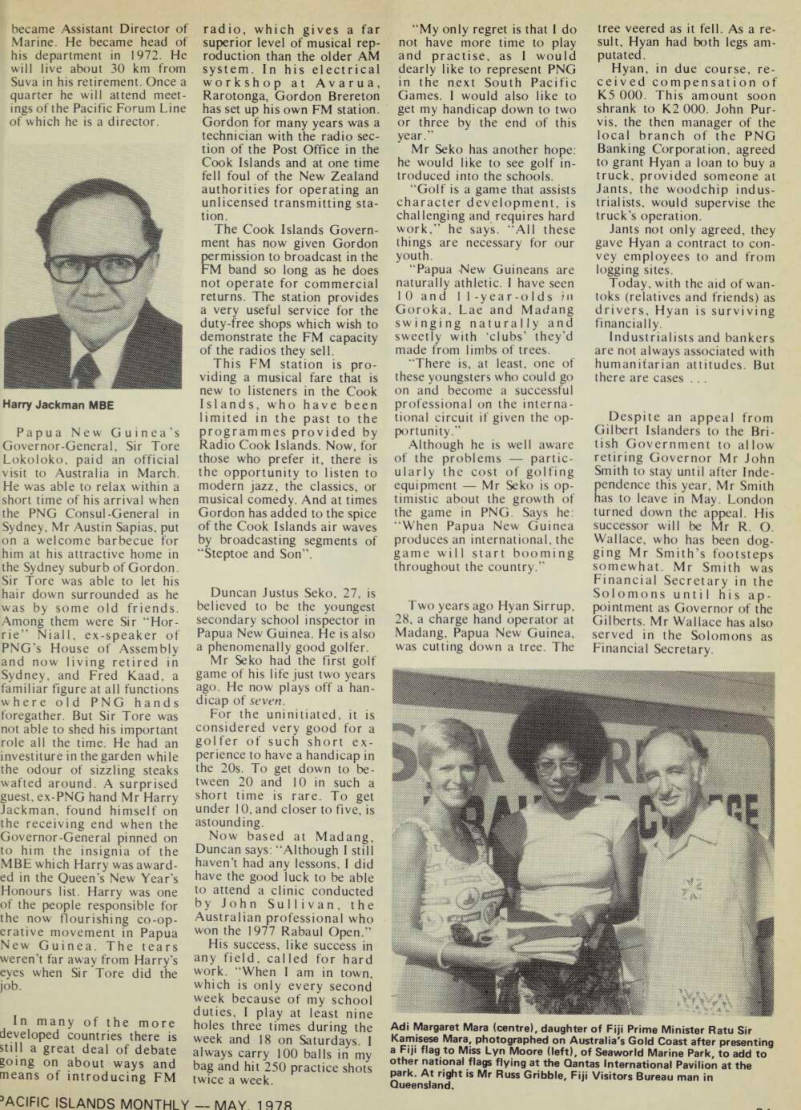
Adi Margaret Mara (centre), daughter of Fiji Prime Minister Ratu Sir Kamisese Mara, photographed on Australia's Gold Coast after presenting a Fiji flag to Miss Lyn Moore (left), of Seaworld Marine Park, to add to other national flags flying at the Qantas International Pavilion at the park. At right is Mr Russ Gribble, Fiji Visitors Bureau man in Queensland.