Pants for penis gourds: Indonesia’s
pp. 16-19 · Read in the full issue

cultural plan for West Irianese
IRIAN JAVA The Indonesian’s plan to bring the people of Irian Jaya into the 20th century is meeting with several obstacles. Dr R. S. Roosman, senior lecturer in Indonesian Studies at the University of Papua New Guinea, gives the background to events of the last few years.
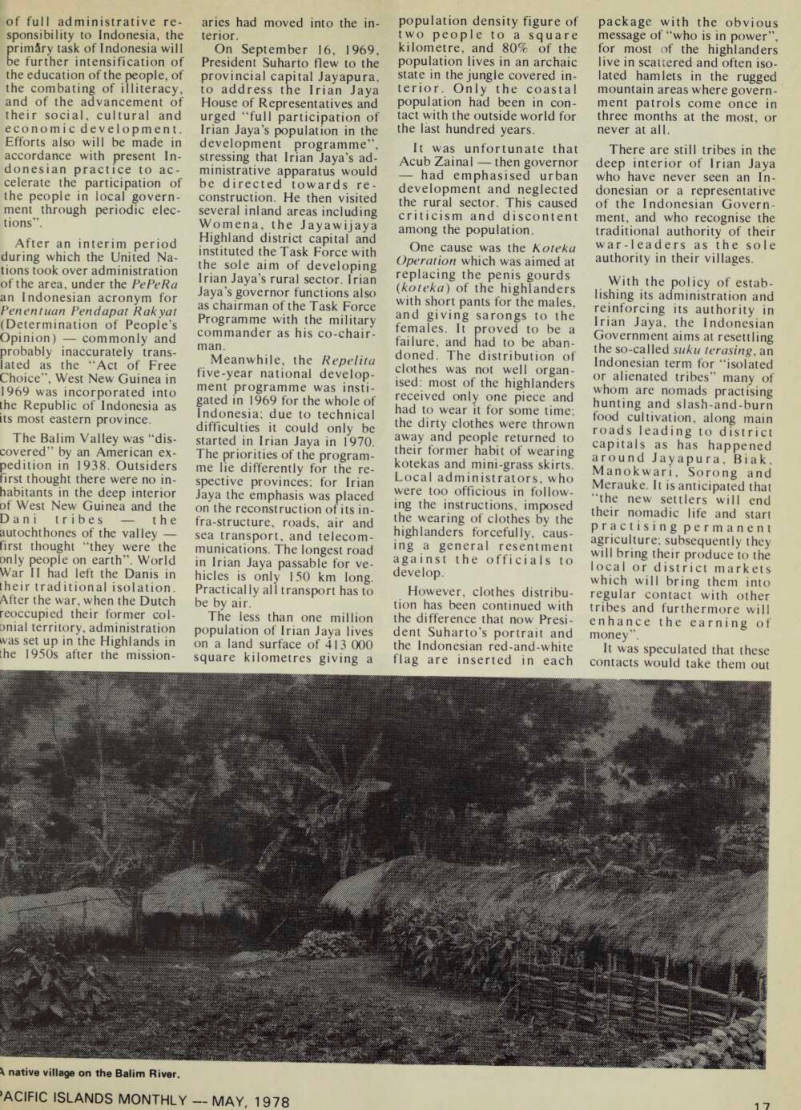
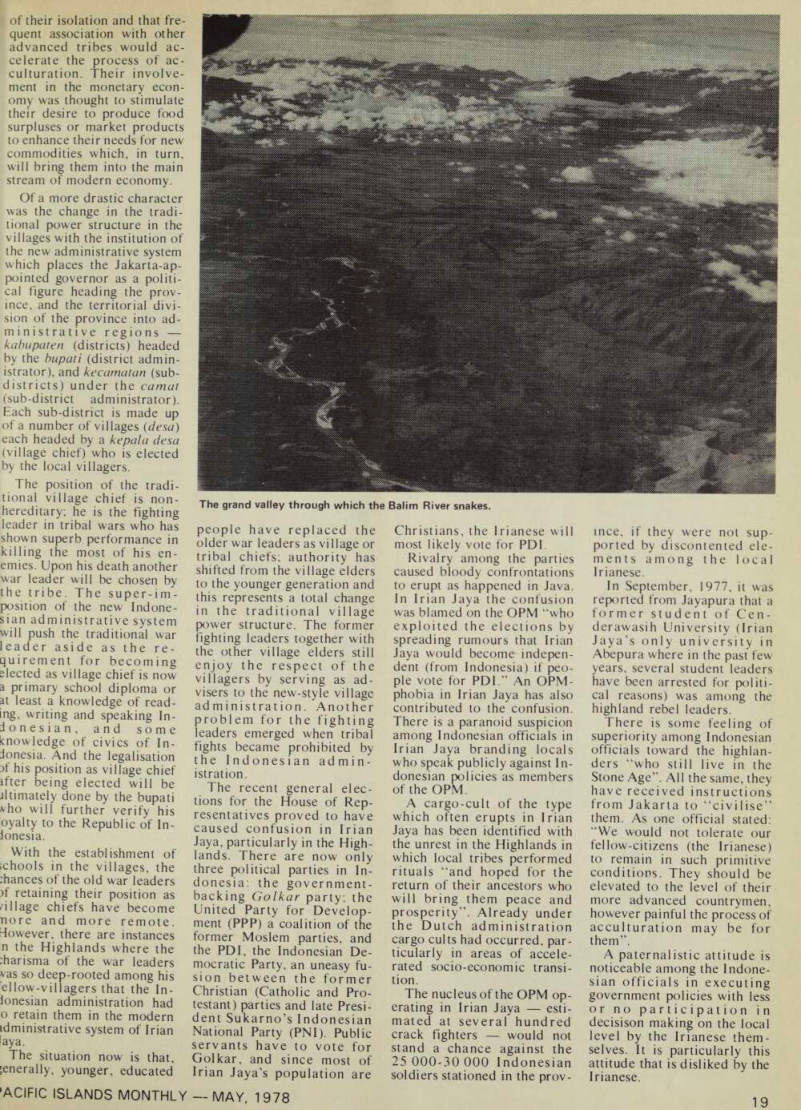
The first disaster was in mid-1976 when a severe tremor rocked Irian Jaya’s Highlands causing massive landslides along the Balim (formerly spelled Baliem) valley, burying villages and killing an estimated 2 000 people. In less than a year another disaster of a different character and magnitude struck the area taking an even heavier toll among its inhabi tants.
On the eve of the Indone sian general elections in March, 1977, warriors of the local Dani tribes the in habitants of the Balim valley armed with axes, spears, bows and arrows went on a rampage, destroying air strips, schools, polyclinics and government offices, kill ing or wounding a number of Indonesian police, military and administrative personnel.
One foreign missionary was severely wounded.
All this happened i n Karubaga, Bokondini, Kelila, Asologima, Tiom, Magi and Kurulu villages or hamlets in the Jayawijaya district bor dering Papua New Guinea.
And 547 Indonesian officials together with their families fled to the district capital of Wamena, leaving everything behind. The rebellion spilled over to neighbouring Paniai district to the West. The mili tary retaliated with planes, rockets and other modern weapons.
One June 6, 1977, an eight man team flew from the prov incial capital Jayapura to Wamena and some other trou ble spots to assess the situ ation. They produced a first hand report for the governor.
Despite the carefully formu lated phrases commonly used in Indonesian official newscoverage this report unmistakeably disclosed a political tragedy which had befallen one of the most pri mitive tribes on earth.
According to the report, the troubles started at the begin ning of 1976 when a break down of authority occurred
after Indonesian authorities hesitated to take firm steps to contain a series of incidents taking place in the area a tribal war between the Kimbin and Piramid clans; an attempt of local villagers to cross the Papua New Guinea-Indone sian border, during which some of them were caught at Lereh near the border; the en tering of the rebel leader Marthen Tabu of the OPM (an Indonesian acronym for “Free Papua Movement”) into the Highland area; the opposition of local villagers to tactless policies imposed by civilian and military authorities and clashes over the selection of local representatives during the general election campaign which was used by the OPM to provoke incidents.
On April 7 a large number of villagers under Marthen Tabu, armed with spears, bows and arrows, attacked the
spread over an extensive area and involved numerous tribes, the government’s statemement proved to be too simplistic. Meanwhile,several hundred Irianese villagers at tempted to cross the border into Papua New Guinea but were halted by the Papua New Guinea border authorities.
The United Nations Rep resentative for Refugee Affairs flew in from Port Moresby for a first-hand look into the troubles. After reassurances of a safe passage home, the villagers were ad vised to return to their villages.
Political developments in Irian Jaya and government policies for in the area over the last seven years lead us to believe that the cause of the rebellion in the Jayawijaya Highland district is of a more complex character than sug gested initially.
The practice of Indonesian government policies in Irian Jaya dated back to the early 1960 s when a confrontation occurred between the Nether lands, which, at the time, held West New Guinea, now Irian Jaya, and Indonesia, which claimed the territory was an integral part of the country.
To pave the way for transfer of West New Guinea to In donesia, an agreement be tween Indonesia and the Netherlands on West New Guinea was signed on August 15, 1962.
Under the chapter “Indone sian Administration and Self Determination” Article XIV which is of significance for understanding further In donesian policies in Irian Jaya, says, “After the transfer of full administrative re sponsibility to Indonesia, In donesian national laws and regulations will, in principle, be applicable in the territory, it being understood that they be consistent with the rights and freedoms guaranteed to the inhabitants under the terrm of the present Agreement”, and also: “After the transfer
Pagai police post, snatched their firearms and incited people to rebel against the In donesian Government. On April 20, about 800 OPM followers attacked the Kobak ma post killing three soldiers; in the melee 10 civilians died, and a missionary was severely wounded. As soon as the troops were called in, people fled into the bush. They dare not return to their villages for fear that they would be suspected of “being a spy for or collaborating with the rebels”.
The cause of the unrest, said the Indonesian Government was “a soccer match which developed into a tribal war”.
Since there have been no tribal wars in the Highlands for the last five years as they are prohibited by the In donesian administration and judging from the mag nitude of the unrest which
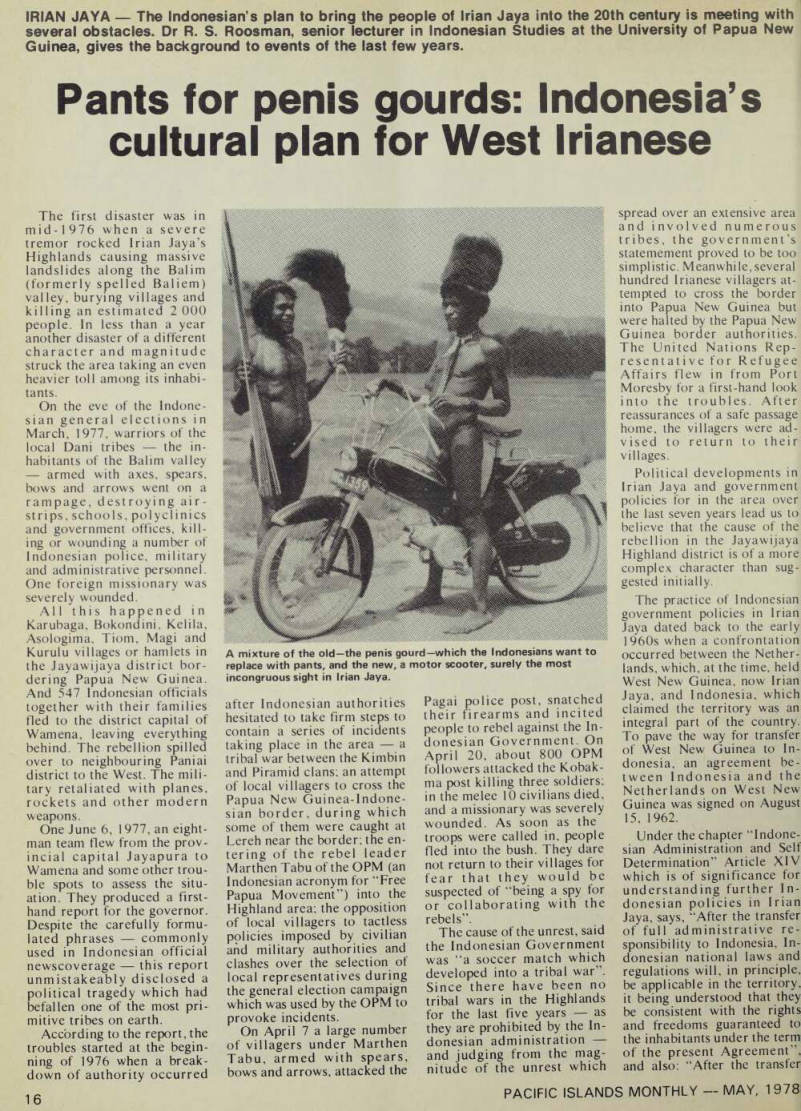
A mixture of the old—the penis gourd—which the Indonesians want to replace with pants, and the new, a motor scooter, surely the most incongruous sight in Irian Jaya.
of full administrative re sponsibility to Indonesia, the primary task of Indonesia will be further intensification of the education of the people, of the combating of illiteracy, and of the advancement of their social, cultural and economic development.
Efforts also will be made in accordance with present In donesian practice to ac celerate the participation of the people in local govern ment through periodic elec tions”.
After an interim period during which the United Na tions took over administration of the area, under the PePeßa an Indonesian acronym for Penentuan Pendapat Rakyat (Determination of People’s Opinion) commonly and probably inaccurately trans lated as the “Act of Free Choice”, West New Guinea in 1969 was incorporated into the Republic of Indonesia as its most eastern province.
The Balim Valley was “dis covered” by an American ex pedition in 1938. Outsiders first thought there were no in habitants in the deep interior of West New Guinea and the Dani tribes the autochthones of the valley first thought “they were the only people on earth”. World War II had left the Danis in their traditional isolation.
After the war, when the Dutch reoccupied their former col
onial territory, administration
was set up in the Highlands in the 1950 s after the mission
aries had moved into the in terior.
On September 16, 1969, President Suharto flew to the provincial capital Jayapura, to address the Irian Jaya House of Representatives and urged “full participation of Irian Jaya’s population in the development programme”, stressing that Irian Jaya’s ad ministrative apparatus would be directed towards re construction. He then visited several inland areas including Womena, the Jayawijaya Highland district capital and instituted the Task Force with the sole aim of developing Irian Jaya’s rural sector. Irian Jaya’s governor functions also as chairman of the Task Force Programme with the military commander as his co-chair man.
Meanwhile, the Repelita five-year national develop ment programme was insti gated in 1969 for the whole of Indonesia; due to technical difficulties it could only be started in Irian Jaya in 1970.
The priorities of the program me lie differently for the re spective provinces; for Irian Jaya the emphasis was placed on the reconstruction of its in fra-structure, roads, air and sea transport, and telecom munications. The longest road in Irian Jaya passable for ve hicles is only 150 km long.
Practically all transport has to be by air.
The less than one million population of Irian Jaya lives on a land surface of 413 000 square kilometres giving a
population density figure of two people to a square kilometre, and 80% of the population lives in an archaic state in the jungle covered in terior. Only the coastal population had been in con tact with the outside world for the last hundred years.
It was unfortunate that Acub Zainal —then governor had emphasised urban development and neglected the rural sector. This caused criticism and discontent among the population.
One cause was the Koteka Operation which was aimed at replacing the penis gourds (koteka ) of the highlanders with short pants for the males, and giving sarongs to the females. It proved to be a failure, and had to be aban doned. The distribution of clothes was not well organ ised: most of the highlanders received only one piece and had to wear it for some time; the dirty clothes were thrown away and people returned to their former habit of wearing kotekas and mini-grass skirts.
Local administrators, who were too officious in follow ing the instructions, imposed the wearing of clothes by the highlanders forcefully, caus ing a general resentment against the officials to
develop.
However, clothes distribu tion has been continued with the difference that now Presi dent Suharto’s portrait and the Indonesian red-and-white flag are inserted in each
package with the obvious message of “who is in power”, for most of the highlanders live in scattered and often iso lated hamlets in the rugged mountain areas where govern ment patrols come once in three months at the most, or never at all.
There are still tribes in the deep interior of Irian Jaya who have never seen an In donesian or a representative of the Indonesian Govern ment, and who recognise the traditional authority of their war-leaders as the sole authority in their villages.
With the policy of estab lishing its administration and reinforcing its authority in Irian Jaya, the Indonesian Government aims at resettling the so-called suku terasing , an Indonesian term for “isolated or alienated tribes” many of whom are nomads practising hunting and slash-and-burn food cultivation, along main roads leading to district capitals as has happened around Jayapura, Biak.
Manokwari, Sorong and Merauke. It is anticipated that “the new settlers will end their nomadic life and start practising permanent agriculture; subsequently they will bring their produce to the local or district markets which will bring them into regular contact with other tribes and furthermore will enhance the earning of money”.
It was speculated that these contacts would take them out
A native village on the Balim River.
of their isolation and that fre quent association with other advanced tribes would ac celerate the process of ac culturation. Their involve ment in the monetary econ omy was thought to stimulate their desire to produce food surpluses or market products to enhance their needs for new commodities which, in turn, will bring them into the main stream of modern economy.
Of a more drastic character was the change in the tradi tional power structure in the villages with the institution of the new administrative system which places the Jakarta-ap pointed governor as a politi cal figure heading the prov ince, and the territorial divi sion of the province into ad ministrative regions kabupaten (districts) headed by the bupati (district admin istrator), and kecamatan (sub districts) under the camat (sub-district administrator).
Each sub-district is made up of a number of villages ( desa) each headed by a kepala desa (village chief) who is elected by the local villagers.
The position of the tradi tional village chief is non hereditary; he is the fighting leader in tribal wars who has shown superb performance in killing the most of his en emies. Upon his death another war leader will be chosen by the tribe. The super-im position of the new Indone sian administrative system will push the traditional war leader aside as the re quirement for becoming sleeted as village chief is now a primary school diploma or at least a knowledge of read ing, writing and speaking In- Jonesian, and some knowledge of civics of In donesia. And the legalisation af his position as village chief ifter being elected will be iltimately done by the bupati vho will further verify his oyalty to the Republic of In lonesia.
With the establishment of ichools in the villages, the Tiances of the old war leaders )f retaining their position as dllage chiefs have become nore and more remote, however, there are instances n the Highlands where the diarisma of the war leaders vas so deep-rooted among his ellow-villagers that the In lonesian administration had o retain them in the modern idministrative system of Irian [ aya.
The situation now is that, generally, younger, educated
people have replaced the older war leaders as village or tribal chiefs; authority has shifted from the village elders to the younger generation and this represents a total change in the traditional village power structure. The former fighting leaders together with the other village elders still enjoy the respect of the villagers by serving as ad visers to the new-style village administration. Another problem for the fighting leaders emerged when tribal fights became prohibited by the Indonesian admin istration.
The recent general elec tions for the House of Rep resentatives proved to have caused confusion in Irian Jaya, particularly in the High lands. There are now only three political parties in In donesia: the government backing Golkar party; the United Party for Develop ment (PPP) a coalition of the former Moslem parties, and the PDI, the Indonesian De mocratic Party, an uneasy fu sion between the former Christian (Catholic and Pro testant) parties and late Presi dent Sukarno’s Indonesian National Party (PNI). Public servants have to vote for Golkar, and since most of Irian Jaya’s population are
Christians, the Irianese will most likely vote for PDI.
Rivalry among the parties caused bloody confrontations to erupt as happened in Java.
In Irian Jaya the confusion was blamed on the OPM “who exploited the elections by spreading rumours that Irian Jaya would become indepen dent (from Indonesia) if peo ple vote for PDI ” An OPM phobia in Irian Jaya has also contributed to the confusion.
There is a paranoid suspicion among Indonesian officials in Irian Jaya branding locals who speak publicly against In donesian policies as members of the OPM.
A cargo-cult of the type which often erupts in Irian Jaya has been identified with the unrest in the Highlands in which local tribes performed rituals “and hoped for the return of their ancestors who will bring them peace and prosperity”. Already under the Dutch administration cargo cults had occurred, par ticularly in areas of accele rated socio-economic transi tion.
The nucleus of the OPM op erating in Irian Jaya esti mated at several hundred crack fighters would not stand a chance against the 25 000-30 000 Indonesian soldiers stationed in the prov
mce, if they were not sup ported by discontented ele ments among the local Irianese.
In September, 1977, it was reported from Jayapura that a former student of Cen derawasih University (Irian Jaya’s only university in Abepura where in the past few years, several student leaders have been arrested for politi cal reasons) was among the highland rebel leaders.
There is some feeling of superiority among Indonesian officials toward the highlan ders “who still live in the Stone Age”. All the same, they have received instructions from Jakarta to “civilise” them. As one official stated; “We would not tolerate our fellow-citizens (the Irianese) to remain in such primitive conditions. They should be elevated to the level of their more advanced countrymen, however painful the process of acculturation may be for them”.
A paternalistic attitude is noticeable among the Indone sian officials in executing government policies with less or no participation in decisison making on the local level by the Irianese them selves. It is particularly this attitude that is disliked by the Irianese.
The grand valley through which the Balim River snakes.