The good life for Samoans
pp. 14-15 · Read in the full issue
in a “rather special place”
TRAVEL- When people talk about “going to Samoa” they usually mean to Apia or to Pago Pago. Few people spare a thought for Western Samoa’s “big island ”, little-known Savai’i, nearly twice the size of the main island of Upolu and with less than half the population. Recently, Mike Field, of Apia, spent three weeks sampling the quiet life on Savai’i. This is his story.
The roads are not very good, the bus service is preposterous, the mosquitos bile like sharks and such luxuries as piped water and electricity are received by only a lucky few. But for all that, Savai’i.
Samoa's biggest island, is a rather special place and. as a
purely subjective judgment,
the better half of Western Samoa.
Savai'i is considerably less "developed” than its sister island of Upolu, although this year should see the start of major road improvements. making life easier for people.
But then life on Savai'i is not all that hard anyway.
Savai’i is 1 820 square kilometres with a population of 40 572 people. Upolu is 1 100 square kilometres with a population of 106 063.
The origins of the Polynesian people are still the subject of much debate and many scholars believe that Savai’i is the Hawaiki of Polynesian
legends. “The cradle of Polynesia” as one expression has it.
Most people in Savai’i live on the coast and cultivate the flat land which, because of its volcanic origins, is very rich.
With little effort taro and ta'amu can be grown in quan tity enough to feed an aiga (extended family). This can be supplemented with breadfruit. coconuts, pork and fish. And for those who like struggling through bush there are tasty wild pigeon. Flying foxes, which some people eat. can be had any evening by casually pointing a shotgun in the general direction of the sky.
Chances are a flying fox. which looks like a rat with wings, will head towards the
ground.
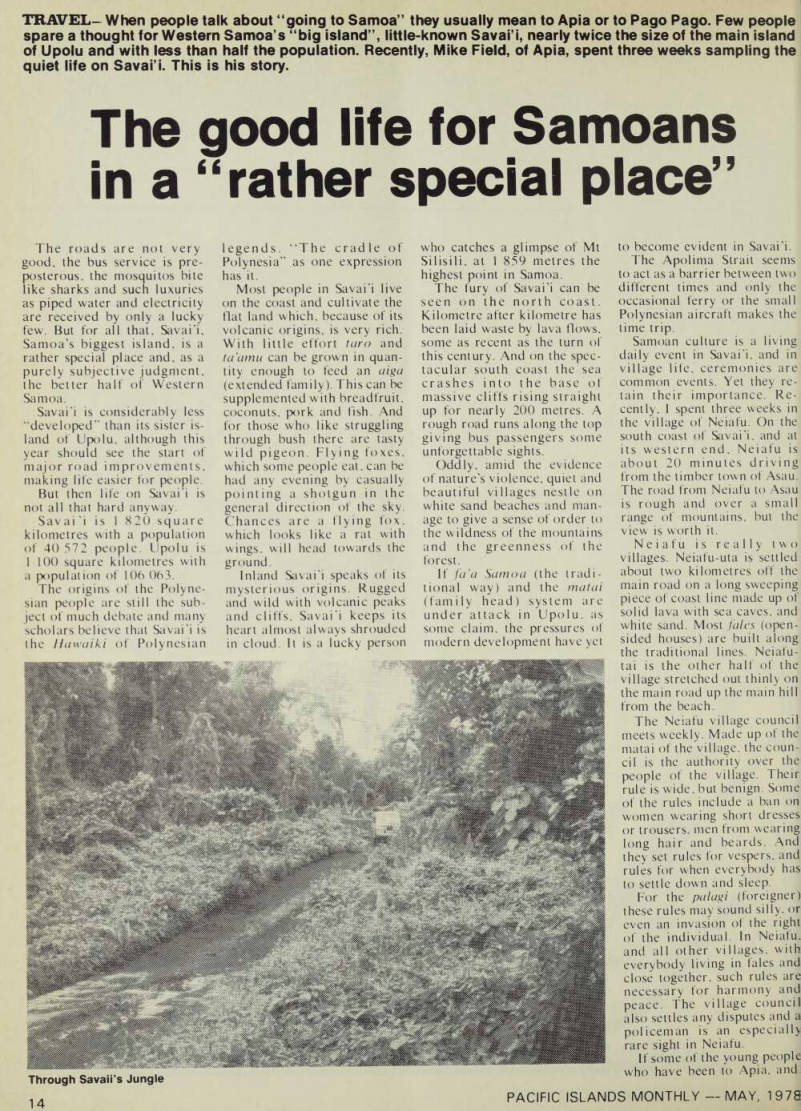
Inland Savai'i speaks of its mysterious origins. Rugged and wild with volcanic peaks and cliffs, Savai'i keeps its heart almost always shrouded in cloud. It is a lucky person
who catches a glimpse of Mt Silisili. at 1 859 metres the highest point in Samoa.
The fury of Savai’i can be seen on the north coast.
Kilometre after kilometre has been laid waste by lava flows, some as recent as the turn of this century. And on the spec tacular south coast the sea crashes into the base of massive cliffs rising straight up for nearly 200 metres. A rough road runs along the lop giving bus passengers some unforgettable sights.
Oddly, amid the evidence of nature’s violence, quiet and beautiful villages nestle on white sand beaches and man age to give a sense of order to the wildness of the mountains and the greenness of the forest.
If fa’a Samoa (the tradi tional way) and the matai (family head) system are under attack in Upolu. as some claim, the pressures of modern development have yet
to become evident in Savai’i.
The Apolima Strait seems to act as a barrier between two different limes and only the occasional ferry or the small Polynesian aircraft makes the time trip.
Samoan culture is a living daily event in Savai'i. and in village life, ceremonies are common events. Yet they re tain their importance. Re cently. I spent three weeks in the village of Neiafu. On the south coast of Savai’i. and at its western end. Neiafu is about 20 minutes driving from the timber town of Asau.
The road from Neiafu to Asau is rough and over a small range of mountains, but the view is worth it.
Neiafu is really two villages. Neiafu-uta is settled about two kilometres off the main road on a long sweeping piece of coast line made up of solid lava with sea caves, and white sand. Most fates (open sided houses) are built along the traditional lines. Neiafu tai is the other half of the village stretched out thinly on the main road up the main hill from the beach.
The Neiafu village council meets weekly. Made up of the matai of the village, the coun cil is the authority over the people of the village. Their rule is wide, but benign. Some of the rules include a ban on women wearing short dresses or trousers, men from wearing long hair and beards. And they set rules for vespers, and rules for when everybody has to settle down and sleep.
For the palagi (foreigner) these rules may sound silly, or even an invasion of the right of the individual. In Neiafu. and all other villages, with everybody living in tales and close together, such rules are necessary for harmony and peace. The village councill also settles any disputes and a policeman is an especially rare sight in Neiafu.
If some of the young people who have been to Apia, and.
Through Savaii’s Jungle
perhaps, even New Zealand, resist the rules a bit. as they grow older they conform. On assuming a title they may even see the value of such order.
For people in the villages one day can be fairly much like the next.
People rise early, around six, when it is not so hot. The women do the usual sort of housekeeping work while the men go off to tend the taro, cocoa or whatever. Pigs need to be fed, or perhaps a new fale is to be built.
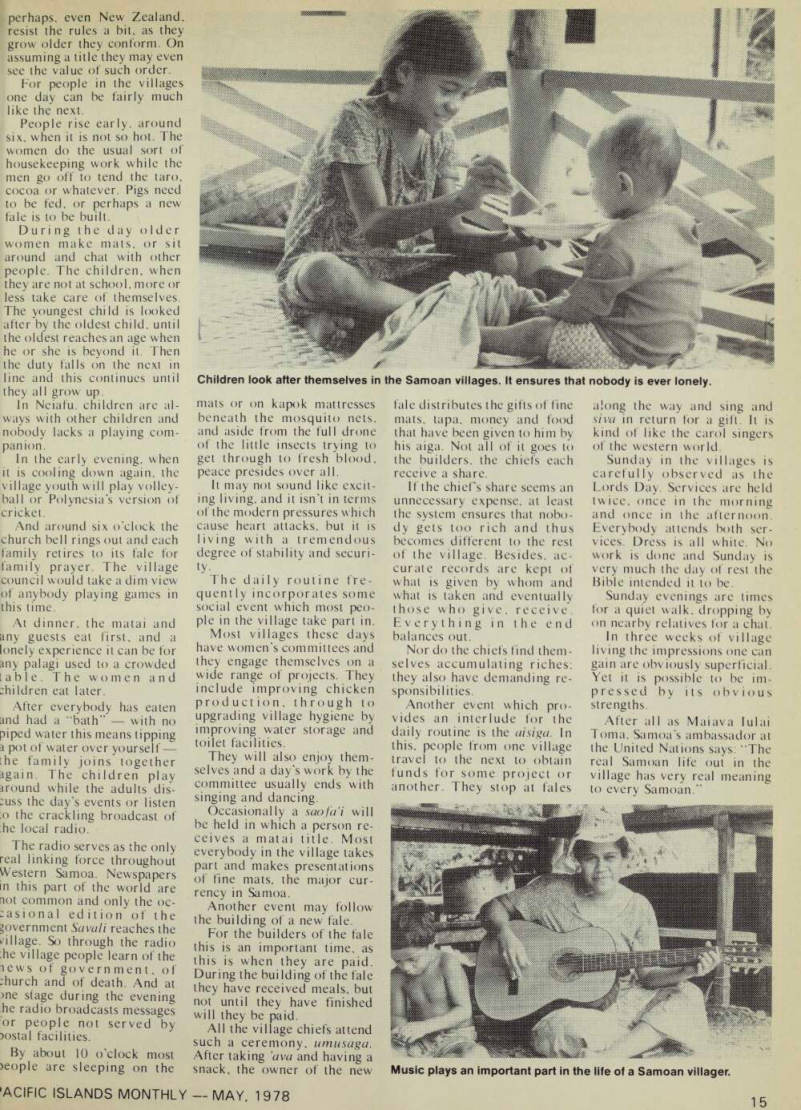
During the day older women make mats, or sit around and chat with other people. The children, when they are not at school, more or less take care of themselves.
The youngest child is looked after by the oldest child, until the oldest reaches an age when he or she is beyond it. Then the duty falls on the next in line and this continues until they all grow up.
In Neiafu. children are al ways with other children and nobody lacks a playing com panion.
In the early evening, when it is cooling down again, the village youth w ill play volley ball or Polynesia's version of cricket.
And around six o'clock the church bell rings out and each family retires to its fale for family prayer. The village council would take a dim view of anybody playing games in this time.
At dinner, the matai and any guests eat first, and a lonely experience it can be for any palagi used to a crowded table. The women and children eat later.
After everybody has eaten and had a “bath” with no piped water this means tipping a pot of water over yourself
the family joins together
again. The children play around while the adults dis cuss the day’s events or listen to the crackling broadcast of he local radio.
The radio serves as the only
real linking force throughout
Western Samoa. Newspapers
in this part of the world are not common and only the oc casional edition of the government Sava I i reaches the tillage. So through the radio the village people learn of the aews of government, of church and of death. And at )ne stage during the evening .he radio broadcasts messages or people not served by )ostal facilities.
By about 10 o’clock most )eople are sleeping on the
along the way and sing and siva in return tor a gill. It is kind of like the carol singers of the western world.
Sunday in the villages is carefully observed as the Lords Day. Services are held twice, once in the morning and once in the afternoon.
Everybody attends both ser vices. Dress is all white. No work is done and Sunday is very much the day of rest the Bible intended it to be.
Sunday evenings arc times tor a quiet walk, dropping by on nearby relatives for a chat.
In three weeks of village living the impressions one can gain are obviously superficial.
Yet it is possible to be im pressed by its obvious strengths.
After all as Maiava lulai Toma, Samoa's ambassador at the United Nations says; "The real Samoan life out in the village has very real meaning to every Samoan."
mats or on kapok mattresses beneath the mosquito nets, and aside from the full drone of the little insects trying to gel through to fresh blood, peace presides over all.
It may not sound like excit ing living, and it isn't in terms of the modern pressures which cause heart attacks, but it is living with a tremendous degree of stability and securi ty- The daily routine fre quently incorporates some social event which most peo ple in the village take part in.
Most villages these days have women’s committees and they engage themselves on a wide range of projects. They include improving chicken production, through to upgrading village hygiene by improving water storage and toilet facilities.
They will also enjoy them selves and a day’s work by the committee usually ends with
singing and dancing.
Occasionally a saofa’i will be held in which a person re ceives a matai title. Most everybody in the village takes part and makes presentations of fine mats, the major cur rency in Samoa.
Another event may follow the building of a new fale.
For the builders of the fale this is an important time, as this is when they are paid.
During the building of the fale they have received meals, but not until they have finished will they be paid.
All the village chiefs attend such a ceremony, umusaga.
After taking ’ava and having a snack, the owner of the new
tale distributes the gifts of fine mats. tapa. money and food that have been given to him by his aiga. Not all of it goes to the builders, the chiefs each receive a share.
If the chiefs share seems an unnecessary expense, at least the system ensures that nobo dy gets too rich and thus becomes different to the rest of the village. Besides, ac curate records are kept of what is given by whom and what is taken and eventually those who give, receive.
Everything in the end balances out.
Nor do the chiefs find them selves accumulating riches, they also have demanding re sponsibilities.
Another event which pro vides an interlude for the daily routine is the aisiga. In this, people from one village travel to the next to obtain funds for some project or another. They stop at tales
Children look after themselves in the Samoan villages. It ensures that nobody is ever lonely
Music plays an important part in the life of a Samoan villager.