Micronesia:
pp. 11-13 · Read in the full issue
Superport Plan A
Threat To Unity?
PIM staff writer Malcolm Salmon reviews recent developments in the long-running story of Palau’s proposed superport, including the sacking of a Palauan senator by the Congress of Micronesia, the emergence of new facts on the background of the superporf s most active American promoter, and the interplay between the superport plan and the delicate question of Micronesia’s future political unity.
Before it is even in ex istence, Palau’s proposed new superport. Port Pacific, has had its first “oil spill”: the political “spill” has seen the superport’s most ardent Micronesian advocate, Palau Senator Roman Tmetuchl, poured out of the Senate of the Congress of Micronesia.
The Senate has voted 8-2 to “censure and expel’’ Mr Tmetuchl. The expulsion re solution, the first of its kind in the history of the Congress of Micronesia, high lighted Tmetuchl’s consistent failure to attend Congress sessions, and charged him with “neglecting and violating his oath of office”, thus “denying the people of Palau full rep resentation in the Senate at this critical period of our history”.
In the hour-long debate on the resolution, Senator Hirosi Ismael of Kosrae said that while he respected Tmetuchl, “I’m swayed to cast an affir mative vote by the many messages I have received”, especially a cable sent by the two paramount chiefs of Palau.
The chiefs, Ibedul and Rekali, said in their message: “We fully concur that the peo ple of Palau are unjustly deprived of representation in the Congress of Micronesia . . . We guarantee the unanimous support of the peo ple of Palau.”
Only Senators Kaleb Udui of Palau and Wilfed Kendall of the Marshalls voted against the resolution.
For his part, Mr Tmetuchl, in a long open letter to Senate President Tosiwo Nakayama, branded his sponsorship of the expulsion resolution “ir responsible and illegal”.
He said: “While I continue daily in my duties as chairman of the Palau Political Status Commission to prepare and expedite a just termination of the trusteeship agreement for my people, you have the ar rogance to state that my first responsibility lies in Ponape (seat of the COM), not in Palau.”
Perhaps it was congres sional convention that led members to tread lightly in debate on the issue of the superport. But it was well and truly in the back of their minds, and certainly looms
large in the thinking of Palauans whenever the name of Roman Tmetuchl comes up.
A few days before the para mount chiefs took their stand against Tmetuchl, 32 promi nent Palauan citizens, in an open letter to CCKM House Speaker, Mr Bethwel Henry, had tied together some politi cal events of 1974, the super port project, and the separate status negotiations to mount a withering attack on Tmetuchl and his Palauan colleague in the House of Representatives, Polycarp Basilius.
Published in the Microne sian Independent, the letter said in part: “The rhetoric of separatism on the part of our delegation began to be heard in the COM’s councils after the congressional election of 1974 when the Liberal Party of Palau lost all seats in the House and one seat in the -Senate.
“This configuration within the Palauan delegation left the Liberal Party, in the person of Senator Roman Tmetuchl practically powerless in in fluencing Palau’s programmes and goals in the Congress.
“By then the proposed oil facility for Palau known as Port Pacific was meeting serious public opposition in side and outside Palau. It should be said here that no leader in Palau is more closely associated with this proposal than the good sena tor. Certainly no one stands to profit more from the success of this venture.
“Unable to push this oil project through the Congress, Senator Tmetuchl, through means highly suspected of
seriously abusing public of fice, manipulated other mem bers of Palau’s delegation, notably Congressman Polycarp Basilius, to come out openly against Micronesian unity in favour of separate political status for Palau.
Thus it was no accident when Basilius stood on the floor of the House and made certain utterances to the effect that Palau would get out of the Congress of Micronesia with in 18 months ...
“The idea of separate political status for Palau as we have said is clearly tied with the proposed oil facility for Palau.
“Tmetuchl and Basilius pushed for separation because in Palau Tmetuchl and his Liberal Party control the dis trict legislature where such a project meets no opposition.
“Thus the just right and aspiration of the Palauans for a political future in unity with their brethren Micronesian people were blunted and otherwise jeopardised in favour of oil interests whose chief beneficiaries would be Tmetuchl, his political mouthpiece Basilius, and others.”
The American conservation magazine, Audubon, in a re cent study of the superport proposal, presented Roman Tmetuchl as the wealthiest in habitant of Palau, and re putedly the most important.
“When Roman moves, the earth shakes,” the magazine said. Tim e will tell whether it will shake quite as much as before following Roman’s sacking from the Senate.
While new light was being shed on the superport scheme
and its political background in Micronesia, something similar was happening to the United States side of the op eration.
To the names of Messrs Oliver, Peacock and Meier (of Bank of the South Pacific fame), connoisseurs of the ac tivities of energetic (if some times dubious) American entrepreneurs in the Pacific can now add another one, and he may well turn out to be the daddy of them all. He is Mr Robert B. Panero, and his giant “baby” is nothing less than the proposed “Port Pacific” plan for Palau.
Writing from San Francisco recently, jounal ist Roger Allebone said: “It was Panero who first conceived the ‘Port Pacific’ scheme in 1974 after concluding that Palau’s natural deepwater harbour would be ideal for an oil transhipment port.
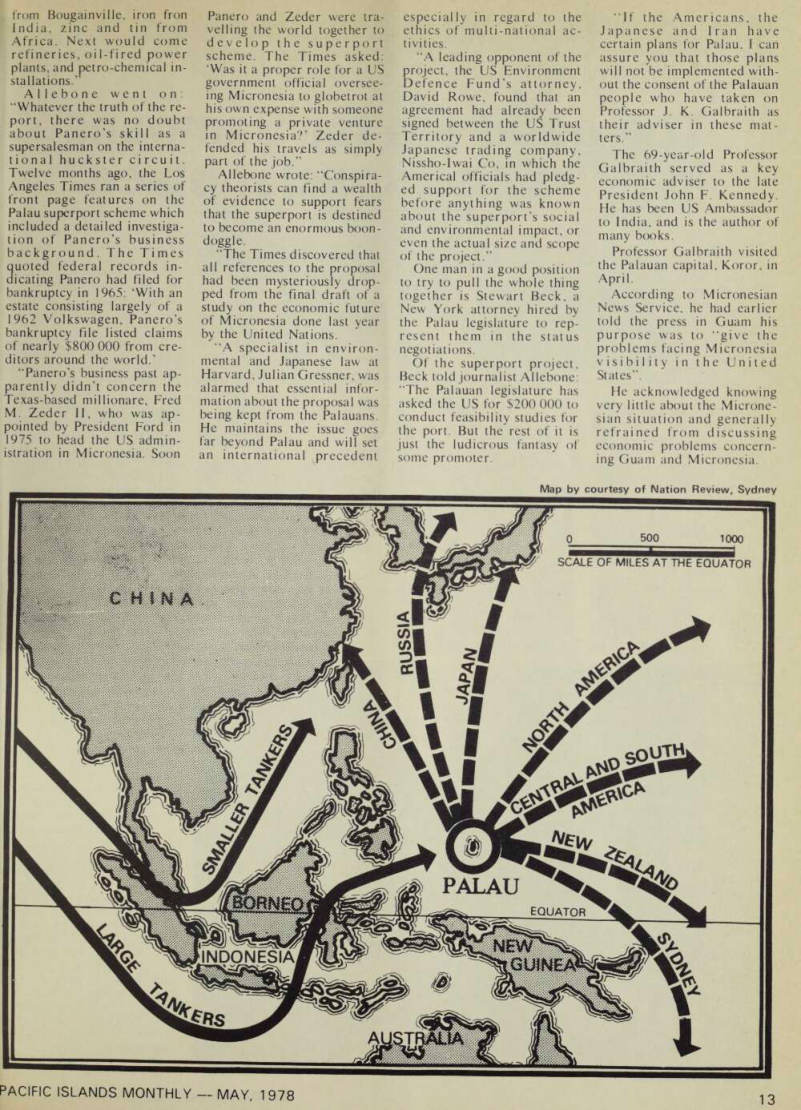
“In May 1975, Panero in formed the Pacific newspapers that Palau was a natural crossroads of the western Pacific. It offered a ‘wide vaiety of port facility alternatives, including subs tantial land areas, offshore platforms, which are among the world’s broadest and strongest reefs, shoal areas which can be filled with dredged material from the lagoon bottoms or crushed rock from the limestone hills of Babelthuap island’ ...
“According to the American businessman’s plan, initial construction of the port would cost $3OO million but Palau would then be ready to take advantage of the trade routes carrying iron ore from Western Australia, copper
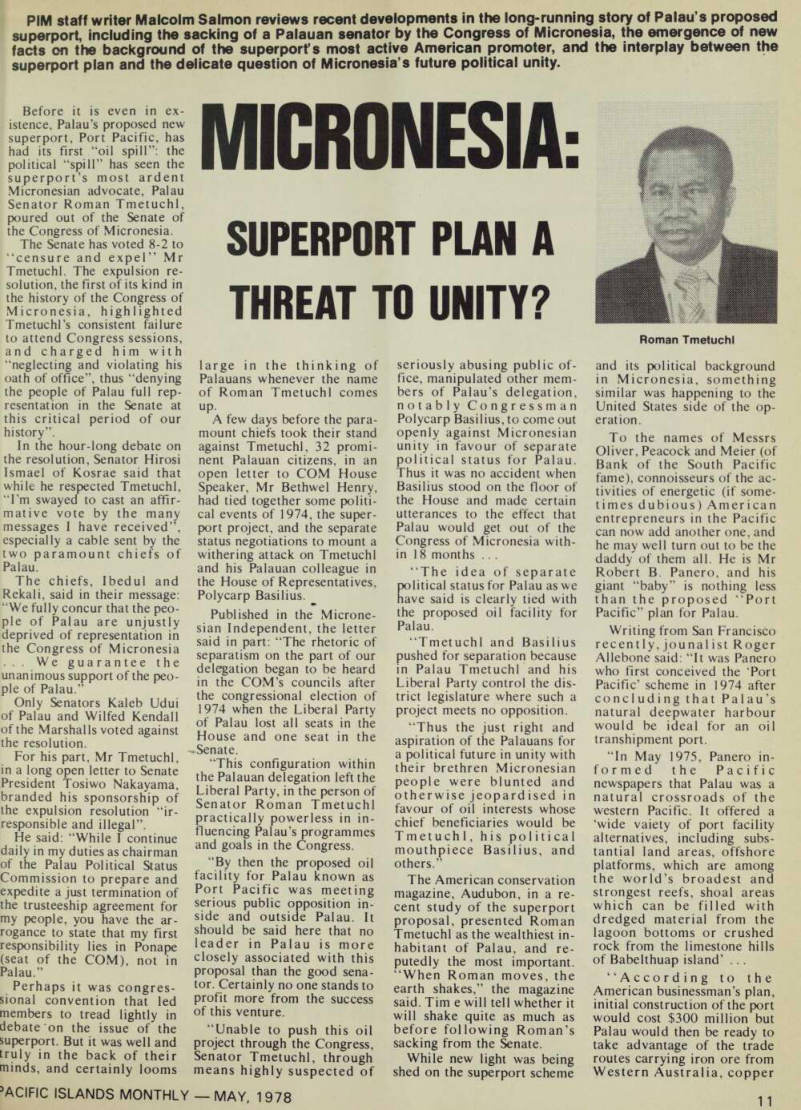
Roman Tmetuchl
from Bougainville, iron fron India, zinc and tin from Africa. Next would come refineries, oil-fired power plants, and petro-chemical in stallations.”
Allebone went on: “Whatever the truth of the re port, there was no doubt about Panero’s skill as a supersalesman on the interna tional huckster circuit.
Twelve months ago, the Los Angeles Times ran a series of front page features on the Palau superport scheme which included a detailed investiga tion of Panero’s business background. The Times Quoted federal records in icating Panero had filed for bankruptcy in 1965; ‘With an estate consisting largely of a 1962 Volkswagen, Panero’s bankruptcy file listed claims of nearly $BOO 000 from cre ditors around the world.’
“Panero’s business past ap parently didn’t concern the Texas-based millionare, Fred M. Zeder 11, who was ap pointed by President Ford in 1975 to head the US admin istration in Micronesia. Soon
Panero and Zeder were tra velling the world together to develop the superport scheme. The Times asked: ‘Was it a proper role for a US government official oversee ing Micronesia to globetrot at his own expense with someone promoting a private venture in Micronesia?’ Zeder de fended his travels as simply part of the job.”
Allebone wrote: “Conspira cy theorists can find a wealth of evidence to support fears that the superport is destined to become an enormous boon doggle.
“The Times discovered that all references to the proposal had been mysteriously drop ped from the final draft of a study on the economic future of Micronesia done last year by the United Nations.
“A specialist in environ mental and Japanese law at Harvard, Julian Gressner, was alarmed that essential infor mation about the proposal was being kept from the Palauans.
He maintains the issue goes far beyond Palau and will set an international precedent
especially in regard to the ethics of multi-national activities.
“A leading opponent of the project, the US Environment Defence Fund's attorney, David Rowe, found that an agreement had already been signed between the US Trust Territory and a worldwide Japanese trading company, N.ssho-Iwail Co in which the Americal officials had pledged^ support for the scheme before anything was known about the superport s social and environmental impact, or even the actual size and scope of the project ”
One man in a good position to try to pull the whole thing together is Stewart Beck, a New York attorney hired by the Palau legislature to represent them in the status negotiations.
Of the superport project, Beck told journalist Allebone: “The Palauan legislature has asked the US tor $2OO 000 to conducl feasibility studies tor the port. But the rest of it is just the ludicrous fantasy of some promoter.
“If the Americans, the Japanese and Iran have certain plans for Palau, I can assure you that those plans will not be implemented with out the consent of the Palauan people who have taken on Professor J. K. Galbraith as their adviser in these mat ters.”
The 69 . y e ar-old Professor Galbraith served as a key economic adviser to the late President John F. Kennedy, n e has been US Ambassador to ndia and is the author of books, „ „ . , Professor Galbraith visited P a l aua n capital, Koror, in April.
According to Micronesian News Service, he had earlier told the press in Guam his purpose was to “give the problems facing Micronesia visibility in the United States”.
He acknowledged knowing very little about the Microne sian situation and generally refrained from discussing economic problems concern ing Guam and Micronesia.
Map by courtesy of Nation Review, Sydney