Oceanic art: Experts find bright
pp. 36-37 · Read in the full issue
spots in PNG, New Zealand
THE ARTS The arts of Oceania came under the microscope at an international symposium held recently in New Zealand. William Gasson reports from Wellington.
Oceanic art came under in tense scrutiny in Wellington in February. Some 40 delegates from Pacific, Euro pean and American countries attended the second interna tional symposium on the Art of Oceania to exchange views and study all the arts of the region past, present and future.
Informative papers ranged from Tokelauan cuisine and songsmiths of the New Hebrides, to wood-carving styles of the Maori and changes in Tongan art.
Other speakers looked at the problems facing the region’s artists as they tried to re-emerge from the tidal wash of European colonisers and establish new artistic forms which are not simply a re petition of traditional styles.
Coupled with that develop ment was the need to raise standards in the observation and reporting of Oceanic arts.
“In my opinion we tolerate too many well-meaning fools in the study of Oceanic art,” said the symposium’s organ iser Professor Sidney Mead.
“There are, I suggest, too many people who feel that Oceanic art is simple stuff which any resourceful beach comber can handle.”
Quite as bad was the at titude that because a person was a native son of the Islands or a practising artist of Oceania then he, too, could cope adequately with the task of studying Oceanic art.
“I suggest to you,” Pro fessor Mead told delegates, “that the people of Oceania and their art deserve some thing better than the bumbling amateur.”
People really interested in Oceanic art should get them selves trained to do the job properly in the same way that an artist trained himself in the techniques of his craft.
He addressed his remarks to a diverse collection of art ists, art historians, museum curators, ethnologists and anthropologists, and later ex plained that the aim of the symposium was to exchange ideas and to give some direc
tion to study and research in the field of the arts of Oceania.
“We also want to encourage teaching and courses on the arts of Oceania and to make the world community aware of this art. Apart from the professionals, this art is not widely known or ap preciated.’’
Professor Mead is with Victoria University in Wellington and, while he
questioned “bumbling
amateurs” studying Oceanic art, another delegate attacked the debilitating influence of tourism on Oceanic art.
For Albert Wendt, a Sa moan attached to the Univer sity of the South Pacific Centre at Apia, Western Samoa, his interest in the arts of the region was how they could be used to heal and re store pride, self-confidence and self-respect in the peoples of the area and in how the arts “can reshape, re-defme, dis cover and re-discover our cultures and help to give birth to new cultures and a new Oceania”.
Traditional arts were just beginning to recover from the decline that resulted from the impact of colonialism which killed the inspiration of much of Oceanic art, Wendt said.
Now tourism and weekend
art were the major barriers to the emergence of a vital Oceanic art that reflected the realities of the region’s socie ties in unique Oceanic ways.
“You can travel through Oceania including New Zealand and Australia and find, mushrooming and proliferating everywhere, an international arts and crafts geared to the palates of out siders, especially tourists,”
Wendt said.
Even dance, music, architecture and food were affected.
The promoters claimed that this art was solid proof of an artistic revival and of how the “generous” and “saintly” tourist industry was reviving Oceanic arts.
But the clients neither un derstood nor cared about the traditional functions of the traditional object of Oceania they wanted what they deemed to be “authentic tra ditional art’’.
“And the more sensational and grotesque and exotic they are, the better,’’ Wendt, com
plained.
“So to stay alive, our artists and craftsmen produce life less imitations and much in ferior art. This fake tradition has become a straitjacket for most of our art. And, because in most of our countries there
are no alternative clients to tourists, this tradition is inten sifying.
“They are even giving the tourists the exaggeratedly ‘primitive’ items that they look for: fornicating pigs, out sized penises, more ferocious grimaces and teeth.’’
The other barrier to an emerging Oceanic art was the weekend and evening classes of painters who produce polite exhibitions of their work peddled as good art.
“The same paintings keep
appearing year after year, ex hibition after exhibition. Only the artists’ names may be dif ferent. Cliched seas and shores, corny palmtrees, or derly unlived-in native huts, blazing orange and pink sun sets, nobly-shaped maidens and warriors. All so tame, and nice, and lifeless,” Wendt said.
But while colonialism shat tered the world of the tradi tional artist on Oceania it also broke open the way for a new type of artist not bound by tra ditional styles, Wendt added.
This was happening in some parts of Oceania, and the most exciting developments were in Papua New Guinea and New Zealand.
Papua New Guinea had developed perhaps the richest and most diverse art in the
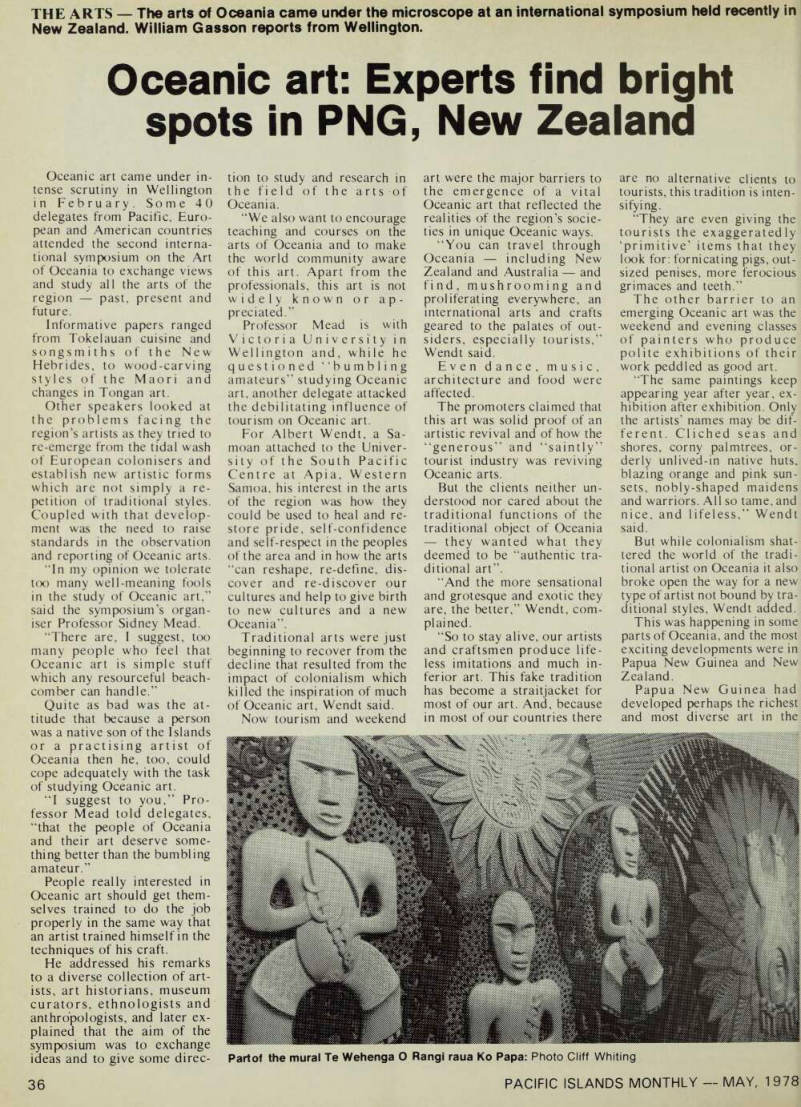
Partof the mural Te Wehenga O Rangi raua Ko Papa: Photo Cliff Whiting
world, Wendt said. The num ber of artists was growing.
Most had little formal educa tion and knew little of Western art or art history.
“A rich and distinctively Papua New Guinea imagery and symbolism, which trans cends the hundreds of indi vidual PNG cultures, has emerged,” he said. “The new artist is Papua New Guinea,”
Apart from the Australian Aborigines, he believed that the Maori people had suffered more from colonialisation than other Oceanic peoples.
Maori art had declined but, since World War 11, there had seen a dynamic rebirth of Maori art “a flowering of major talent using both tradi ional and new media and ex jloring themes, ideas and ityles”.
He spoke of the work of Cliff Whiting whose mural Te Wehenga o Rangi raua Ko
Papa took pride of place in a National Art Gallery exhibi tion of contemporary Maori artists while the symposium was on.
Whiting took more than three years to construct the mural, which is taken from a Maori myth. He developed it with the aid of his local Maori community, using tra ditional and new materials.
Whiting saw himself as a catalyst to inspire and guide the community which was directly involved in creating the mural.
He said; “The theme was selected because it is known and accepted by all tribes in New Zealand and by many of our Pacific neighbours. It is also the base of all things Maori; The Beginning’.”
Three artists working out side New Zealand and PNG to whom Wendt drew attention were: Aloi Pilioko of Wallis,
working in New Hebrides; losau Toafa of Western Samoa; and Kuai Maueha of the Solomons.
Pilioko’s most striking works are his needlework tapestries. He was discovered by the Russian artist Nikolai Michoutouchkine. Wendt said it was doubtful whether Pilioko, the artist, would have existed without the friendship of the Russian.
Toafa was the only Samoan artist who had developed a contemporary style of his own.
“The flavour of his work is Samoan: his artistic language heralds the start of a new Samoan imagery,” said Wendt.
However, rather than work ing on a major exhibition as he should be doing now, money pressures kept him selling his works as he pro duced them to supplement his
meagre teaching salary to feed his wife and three children.
Maueha, a carver, was one of the most remarkable per sonalities in Oceania, Wendt said. He also considered him one of the region’s major art ists.
“He has, through the un tutored simplicity of his genius, taken Solomon Is lands’ sculpture into the realms of the purely imagina tive, from the stale, stereotyped known into the unknown.”
The Betikama Carying Centre near Honiara is Maueha’s patron but in Wendt’s view it was vitally important that he be accorded a wider patronage.
“The art of our forefathers was for a time past; it is not and should not be the art of today. Let us study it as that, and not use it to dismiss to day’s art,” Wendt concluded.