Or Fallout Over Mururoa
p. 47 · Read in the full issue
Polynesians And The Bomb -
Nuclear tests, fallout cancer, and radiation sickness seem to have fallen out of the Australian consciousness, after the decisive election and during the summer heat, Moruroa mon amour, purposely reminiscent in title of the anti-bomb film Hiroshima mon amour, has not been reviewed in any major Australian periodical and. with Penguin’s usual careless publicity, the book’s publication has gone almost unnoticed, even though it is in an exclusively Australian series, Bengt and Danielsson have not published simply a translation of their 1974 original book of the same title; they have rewritten and re-shaped almost
all of the long manuscript.
They cut the original 140 000 words in French down to just over 90 000 in English, omit ting much of the fine detail that so reveals the Danielsson’s intimate in volvement with life in Tahiti.
On the other hand, they have included a fine first chapter with the most concise seven page history of French Polynesia 1 have ever seen.
The book takes events up to February, 1977, with a con cern for official pronounce ment and a keen eye for behind-the-scenes observa tion. They must have some very well-placed friends to obtain the kind of information they analyse and present, for the book is a minute exam
ination, under a very well ground Swedish microscope, of the progress of colonialism in French Polynesia. The of ficial lies, the metropolitan disregard for Polynesian dig nity, the sad tale of the patriot Pouvanaa; all these elements make up an absorbing tale of deception and conceit.
The reader unfamiliar with French Polynesia may find the text hard going at times, being as it is the account of ex tremely perspicacious in siders, which the Danielssons
clearly are.
Governors, shopkeepers,
petty officials, and military men flash across the pages as the story is unfolded, rather like one of those automobile club road maps of bewildering
complexity. But the Danielssons do not confine themselves to mere political intrigue. For example.
Chapter 36 is perhaps a key one to support their anti-test ing case, with much scientific detail. The summary for the Polynesian prosecution is sim ple; if nuclear bomb testing is so safe, why don’t the French save themselves a lot of money and carry out the detonations nearer to home in France itself?
Apart from the detail, the reader will also have to ac commodate the still French style of the book. Chapters may be less than four pages and sentences sometimes seem eliptical. Chapter titles, about a dozen of the 43 present sur vive from the French edition, are conversational, such as “Mr President!”, “Happy Tureians, Happy Galley”, “Nothing to worry about”, and so on. The Danielssons are also fond of simile and metaphor and their book abounds with these Polyne sian-flavoured devices. In the first chapter, the authors liken the European invasion of Tahiti to the fearsome, engulf ing tsunami, while a chapter shortened from the French version uses elephantiasis to portray economic inflation in wages and prices in French Polynesia.
Colonialism and the dialec tic between conquered and conqueror is not unique to French Polynesia. The story, pivoting on another issue, with only the names changed to protect the innocent, could be anywhere in the Pacific.
Even those readers without an interest in the nuclear issue will find the Danielssons’ ac count of the development of the French territory fascinat ing reading. Old colonial hands will be amused by the similarity of tactics they knew and those employed by the French in Papeete.
Moruroa mon amour is the background dossier, the con tinuing saga appears monthly
in PIM
Grant McCall
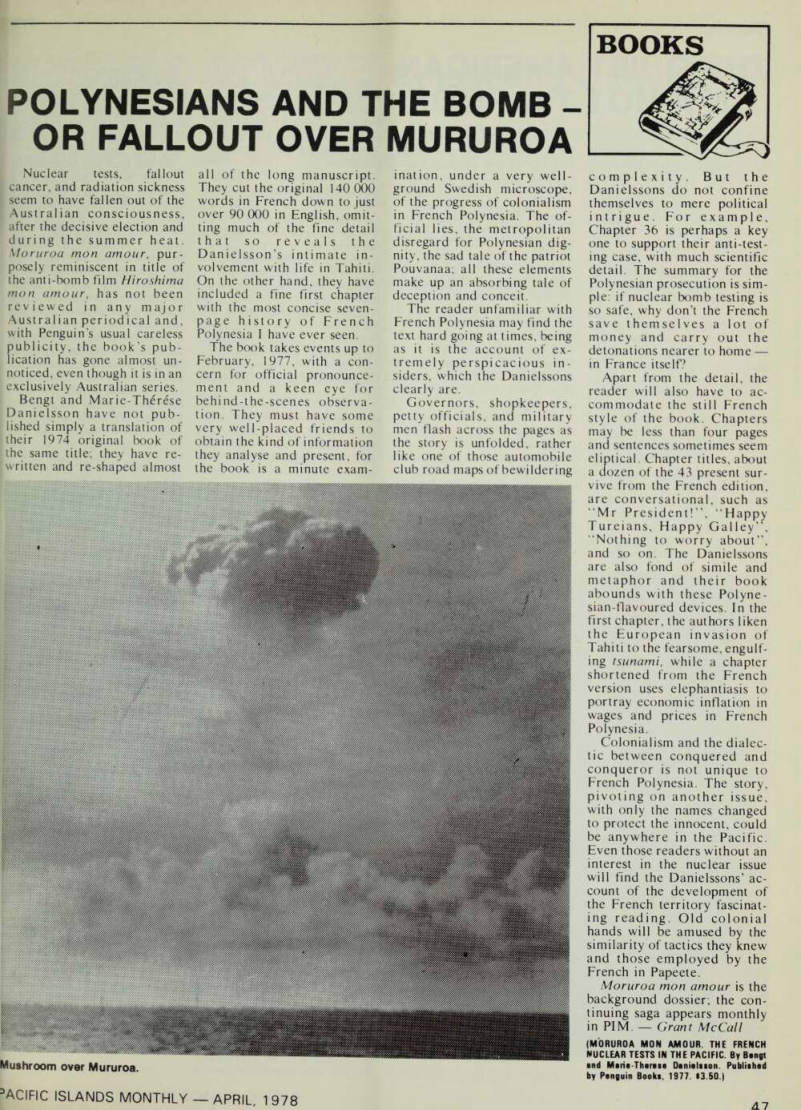
Mushroom over Mururoa.
(Moruroa Mon Amour. The French
NUCLEAR TESTS IN THE PACIFIC. By Bengt and Marie-Theraaa Danielsson. Published by Penguin Books, 1977. $3.50.)