At Amboin, On The Karawari, You
pp. 37-39 · Read in the full issue

Can (Nearly) See For Ever
TRAVEL- Half a century ago, Papua and New Guinea were as dark and mysterious as Darkest Africa had been 50 years before that. Few had ventured beyond the main centres of civilisation. Today, even the tourist goes where “whitemen have never trod” to use an old-time phrase. Bob Hawkins has just been “there”. Hewrites of a trip along the Karawari River.
At Amboin, on a clear day, it seems you can see for ever.
Sure, there's a horizon. But it’s difficult to decide if it is only a modest 100 kilometres or so away at Wewak or if it's just a figment and you are, in fact, looking into eternity.
That’s the sort of feeling you get at Amboin, an East Sepik Province administrative post on the Karawari River, a tributary of the fabled Sepik.
There you are, sitting on the toes of the foothills which mark the beginning of the as cent to the heights of New Guinea's tortured, towering spine. Your exact spot is on the verandah of the haus tam baran (spirit house) dining room and bar of Karawari Lodge. West, north, east, the jungle stretches away, as even as a plush multi-greened eiderdown. Exceptions prove the rule. To the west Murder Mountain broodily shadows Kuvenmas Lake, perhaps 30 kilometres distant. To the northwest a puny knob or two try, but fail, to distract you from the immensity of the swampy, forested flatness. To the north there is not as much as a molehill between you and the Alexander Range, hard up against Wewak on the coast.
Eastward? There’s really
nothing for 150 kilometres before the Adelbert Range in
Madang Province.
Hotel is not an apt de scription for Karawari Lodge.
Motel certainly isn't. Perhaps
“boatel” comes nearest, the only access being by river from Amboin “international" airport, 20 minutes steady outboard motoring up-river.
The Lodge was conceived some time in the 60s and built nearly 10 years ago under the direction of John Pasquarelli, a member of Papua New
Guinea’s pre-independence
House of Assembly. In the years since it has been op erated by Talair and is now run by Peter Spencer, proprie tor of Kundu Tours.
Improvements and ad ditions over the past 1 8 months have provided com
forts which the “intrepid" tourist-explorer in the care of Lodge guides will ap preciate after their days out along the waterways, soaking up local culture and custom.
Today the Lodge has a smooth, modern interior, a dining room which would much more deserve the title ‘‘banqueting hall" even though the decor has a modest element of Sepik carved erotica about it. enormous, heavy carved bar “stools" which no one could fall out of; simply, yet adequately-ap pointed sleeping quarters, two beds to a room, ceiling fans (air conditioning not re quired) and individual shower/toilets.
The overall Lodge scene comprises the haus tamharan, 10 double-roomed sleeping quarters (bedding for 40), the manager's residence and staff quarters, all built from bush materials. There are back-up pumps and generators to maintain water and power supplies and an incredibly low-geared International
Cl3oo truck which brings a party of 40 in three trips up the steep track from the river jetty to the Lodge's ridgetop vantage point. Transport along the river is provided by twin 40-horse Johnson out boards pushing Australian made flat-bottomed River Trucks. At one stage, some years ago, jet-boats were in troduced but the effect of the wash on the river bank and the lives of the local people led to their abandonment on this section of the river.
But the Karawari trump lies not in its simple existence or the comforts it offers. The big drawcard is that within perhaps a dozen miles of Am boin, a visitor can view in a
days a fascinating
'microcosm of Sepik life and still be able to retreat to the cool of a ridgetop resting place each night.
Probably the most critical element in the Lodge project is the co-operation of the Karawari people. Without it, Karawari Lodge as an off-the bealen-track attraction can
have no future. Peter Spencer makes no bones about being acutely sensitive to this factor.
He says he has attempted in various ways to spread the benefits of this embryo tourist industry as evenly as possible among surrounding villages.
Most of the staff at the Lodge are from Yimas village which lies upstream, along a narrow tributary to the Karawari, and near the Yimas Lakes, preserve of waterbirds in their thousands. Yimas villagers also sell their handcrafts to visitors.
Kuvenmas village is too far away to easily fit into a short stay at Amboin. But the Kuvenmas people have their way of sharing in the indus try's rewards. Kuvenmas is the home of the Blackwater car vers whose mark has been left on the interior of the haus tamharan. The main pillars and the bar “stools" along with a variety of other objets ci'art are monuments to Black water magic.
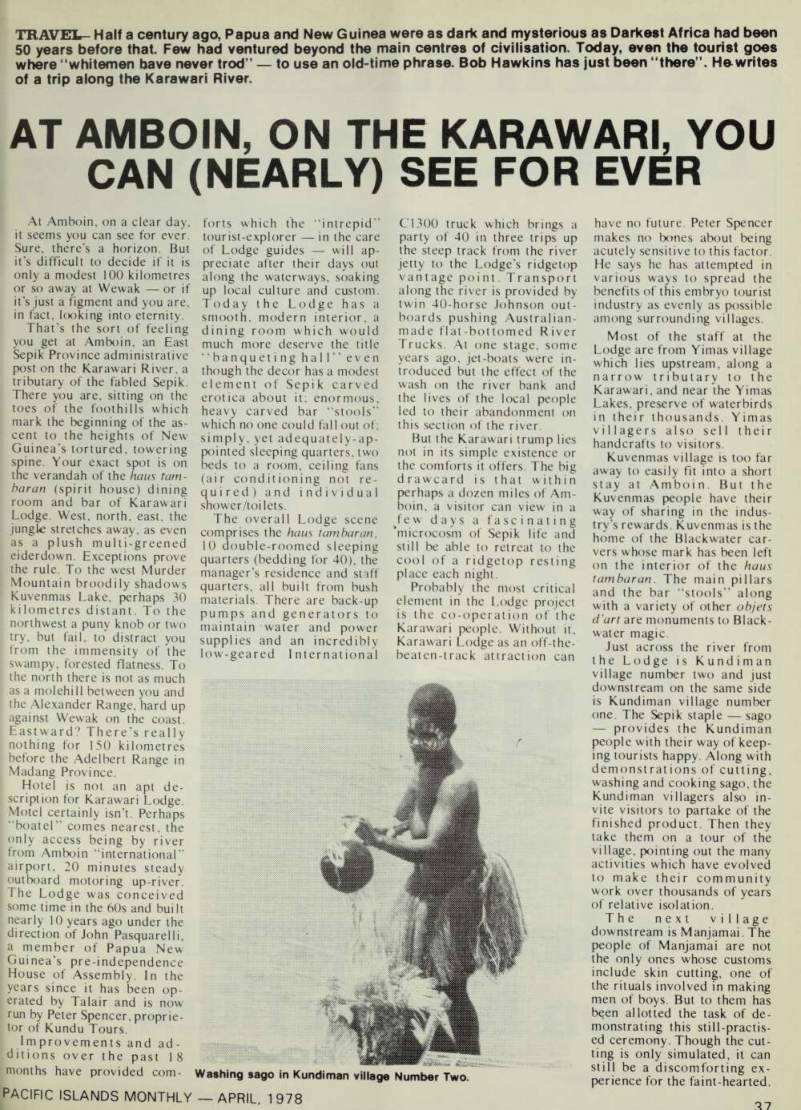
Just across the river from the Lodge is Kundiman village number two and just downstream on the same side is Kundiman village number one. The Sepik staple sago provides the Kundiman people with their way of keep ing tourists happy. Along with demonstrations of cutting, washing and cooking sago, the Kundiman villagers also in vite visitors to partake of the finished product. Then they take them on a tour of the village, pointing out the many activities which have evolved to make their community work over thousands of years of relative isolation.
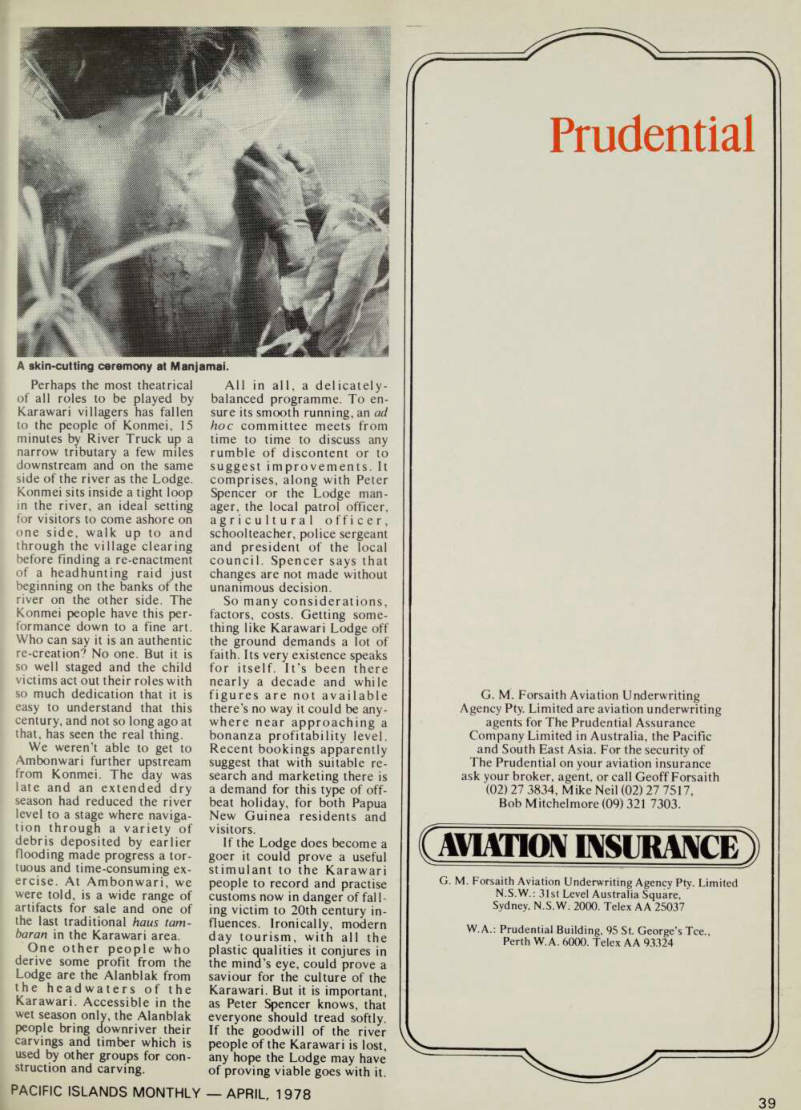
The next village downstream is Manjamai. The people of Manjamai are not the only ones whose customs include skin cutting, one of the rituals involved in making men of boys. But to them has been allotted the task of de
monstrating this still-practis
ed ceremony. Though the cut ting is only simulated, it can still be a discomforting ex perience for the faint-hearted.
Washing sago in Kundiman village Number Two.
Perhaps the most theatrical of all roles to be played by Karawari villagers has fallen to the people of Konmei, 15 minutes by River Truck up a narrow tributary a few miles downstream and on the same side of the river as the Lodge, Konmei sits inside a tight loop in the river, an ideal setting for visitors to come ashore on one side, walk up to and through the village clearing before finding a re-enactment of a headhunting raid just beginning on the banks of the river on the other side. The Konmei people have this performance down to a fine art.
Who can say it is an authentic re-creation? No one. But it is so well staged and the child victims act out their roles with so much dedication that it is easy to understand that this century, and not so long ago at that, has seen the real thing.
We weren’t able to get to Ambonwari further upstream from Konmei. The day was late and an extended dry season had reduced the river level to a stage where navigation through a variety of debris deposited by earlier flooding made progress a tortuous and time-consuming exercise. At Ambonwari, we were told, is a wide range of artifacts for sale and one of the last traditional haus tambaran in the Karawari area.
One other people who derive some profit from the Lodge are the Alanblak from the headwaters of the Karawari. Accessible in the wet season only, the Alanblak people bring downriver their carvings and timber which is used by other groups for construction and carving.
All in all, a delicately balanced programme. To en sure its smooth running, an ad hoc committee meets from time to time to discuss any rumble of discontent or to suggest improvements. It comprises, along with Peter Spencer or the Lodge man ager, the local patrol officer, agricultural officer, schoolteacher, police sergeant and president of the local council. Spencer says that changes are not made without unanimous decision.
So many considerations, factors, costs. Getting some thing like Karawari Lodge off the ground demands a lot of faith. Its very existence speaks for itself. It’s been there nearly a decade and while figures are not available there’s no way it could be any where near approaching a bonanza profitability level.
Recent bookings apparently suggest that with suitable re search and marketing there is a demand for this type of off beat holiday, for both Papua New Guinea residents and visitors.
If the Lodge does become a goer it could prove a useful stimulant to the Karawari people to record and practise customs now in danger of fall ing victim to 20th century in fluences. Ironically, modern day tourism, with all the plastic qualities it conjures in the mind’s eye, could prove a saviour for the culture of the Karawari. But it is important, as Peter Spencer knows, that everyone should tread softly.
If the goodwill of the river people of the Karawari is lost, any hope the Lodge may have of proving viable goes with it.
A skin-cutting ceremony at Manjamai.