People
pp. 34-35 · Read in the full issue
A simple desire to do some thing different 16 years ago brought Percy McSweeney to the Solomon Islands. Today this immensely popular New Zealander is totally dedicated to working with the village people of these tropical is lands.
Percy McSweeney— known now throughout Guadalcanal as Father Percy left his clerical job in an Auckland shipping office in 1961 to become a lay missionary in the Solomons. Seeking greater involvement in his work, he returned to New Zealand in 1966 and studied for the priesthood at the Holy Name seminary in Christchurch and the Holy Cross seminary in Mosgiel. He was ordained and returned to the Solomons as Catholic diocesan priest.
The appearance of this slightly built and bearded 43year-old gives no clue to his role in the life of the Solomon Islanders. Shorts and plastic sandals are his robes. The cross around his neck is tor toise shell inlaid with white shell. It hangs from a string of small red shells used in these islands to purchase wives and pigs.
In 1975 Father Percy mov ed to Avu Avu, an isolated mission station on the aptly named weather coast on the southern side of Guadalcanal.
The parish he came to covers
a third of the island a
parish now deeply scarred
and full of uncertainty from a series of earthquakes that were centred on the weather coast in 1977. The earth tre mors, which reached a force of 7.7 on the Richter Scale, gave Father Percy his greatest challenge.
He was in Honiara, capital of the Solomons, when the first destructive tremor struck. Within hours he was back among his people organ ising the evacuation of those whose villages and lives were threatened by landslide.
With his broad and intimate knowledge of the area, accumulated in the months he had spent walking over rough bush tracks visiting his people, he joined the Guadalcanal earthquake relief committee. He became involved in organising the evacuation of villages and the distribution of food to those whose gardens their only source of food were
destroyed by landslides.
His work with the Royal New Zealand Air Force detachment in Guadalcanal at this time gave Father Percy the chance to be with New Zealanders again. He was among the first seeking news of rugby league matches from home (he had been a senior Marist league player) and the tropical evenings in Honiara were spent catching up with events at home over a couple of beers.
With relief operations over, Father Percy is now back among his people at Avu Avu striving to repair what the earthquake has undone. He will continue to walk up to nine hours each day talking to the villagers of his parish on the weather coast and in the
rugged and landslide-scarred hills of the Guadalcanal high lands.
Father Percy moves fast, sometimes in bare feet, talking to his people, sharing their simple food and resting at night in their attap huts.
A small jeep purchased six months ago gives quick access along the 30 miles of beach to coastal villages. There are no roads. A light aircraft makes a weekly visit from Honiara, and coastal ships call.
Often he will walk across the island from Avu Avu to Honiara a distance of 20 miles as the crow flies— call ing at villages along the tracks on the four-day stop. It is now a journey that will have to wait, for each of the four tracks he uses were destroyed in the earthquake.
Squadron-Leader Chris Cole,
Rnzaf.
Christmas, 1977, is likely to be a lasting and happy mem ory for 22-year-old Gilbertese seaman Teangaua Tenanorake of Tarawa. For he spent it among the snowclad forests and fairyland castles of Bavaria, southern Germany.
Teangaua had just completed his contract with the Ham burg-based Bernhard Schultze shipping line. The company kindly made it possible for him to fly south to Bavaria to spend Christmas with his sister Aborina and her husband, the film pro ducer Karl-Heinz von Stellmach, who are no strangers to regular readers of PIM. Brother and sister were delighted to get together after
not seeing each other for five years. The Stellmachs have followed up the considerable success of Karl-Heinz’s film, Sailing in the Trade Winds, made in the Gilberts in 1972-73, with an active cam paign to promote German in terests in the Gilberts and Tuvalu. Due largely to their activities, a “pioneering tour’ to the Gilberts, Nauru and Tuvalu has been incorporated in the Pacific schedule of one of Germany’s largest tour op erators. The first such tour scheduled for March, 1978 was to use the Air Nauru link from Hong Kong. The hope ol the Stellmachs is that the Islanders will realise that nol all “Europeans” are rich folk at home. Many of them, the) point out, will have been sav ing for years to make their ex pensive dream of visiting the atolls of the Pacific come true So, they say; “When these strangers arrive on youi shores, remember that theii status in their own societies ai home is not so much different from yours in your Pacific societies. Make them welcome in traditional Gilbert-Tuvah style: ‘ Karri n a mauri’ ‘Talofa Taniela Veitata, industria adviser for Fiji stevedores anc seamen, is out of gao breathing fire. He had servec a six months’ sentence fo: violating the Trade Dispute Act during wharf strikes ii 1977. His main target is th« Ports Authority of Fiji, saying the refusal of that body to re employ deregistered dockers
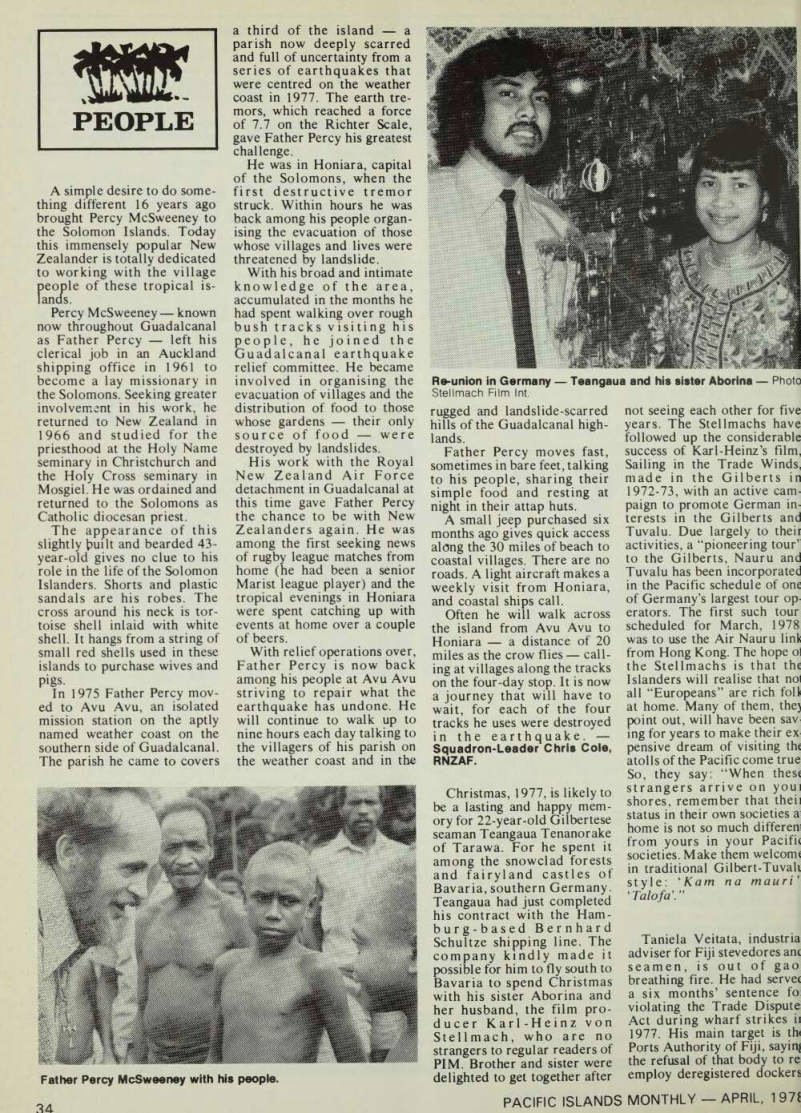
Father Percy McSweeney with his people.
Re-union in Germany Teangaua and his sister Aborina- Photo Stellmach Film Int.
union executives after their release from prison had lit the fuse for another confrontation on the waterfront. He also in tended to pursue two other issues bulk loading of sugar and registration of his union.
Taniela also called for an in dependent commission to look into the alleged ill-treat ment of six dockers’ union men in prison. He had been fortunate, Taniela said, but the treatment of the others was a remarkable parallel to World War II Japanese tour ture.
PIM is sure Fiji’s Prime Minister, Ratu Sir Kamisese Mara, meant no offence to the proceedings of the Com monwealth Heads of Govern ment Regional Meeting which he had just attended in Sydney in February.
But he did describe as “the f highlight” of his visit to Australia something which had nothing at all to do with
I Chogrm
It was a visit to a macadamia-nut plantation at Dunoon,near Lismore in New South Wales.
The PM was enthusiastic.
He said Fiji could benefit greatly from a macadamia in dustry. He pointed out that i four hectares (10 acres) of sugar cane supported one Fi jian family. Macadamia nuts gave a much higher return (by $5 000 per 0.405 ha. or one i acre, from mature trees).
He said he had obtained 15 ! trees from Hawaii seven years I ago, and they were now bear ing nuts, although they had not been tended.
He said a 20 ha trial planta tion would be established soon in Fiji with trees from Hawaii and Australia.
Not every retired British army colonel would bear the title “midwife” with pride, but that is the case with Colonel Eric Hefford. For more than 15 years Colonel Hefford has been travelling the world or ganising ceremonies, and celebrations, for the queue of British colonies who have severed their connections with the Motherland. This former regular soldier of the Royal Lincolnshire Regiment is proud to see himself as the ‘‘midwife of evolving na tions”, rather than as an un dertaker of colonialism. Col onel Hefford’s next major as signment is to oversee the in dependence celebrations of the Solomon Islands, due on
July 7, 1978. For this purpose he has already moved into a refurbished office in the old Information building off Honiara’s Mendana Avenue.
Exactly what form the celebrations will take is a mat ter for the Solomon Islanders themselves. Colonel Hefford will work closely with their
independence celebrations
committee. He always pays great regard to custom and traditions.
He quietly insists, however, on one condition: that he is allowed to retain executive power. Important decisions need to be taken constantly.
The celebrations would never gel off the ground if every thing had to be referred to a committee.
In planning the big event, the colonel’s big headache is to see that the many ideas put forward can be translated into practice. If it is agreed to have tribal or custom dancing, he holds auditions to see if the dances are suitable. He cheer fully admits he doesn’t know much about custom dancing, but he does claim to know something about showman ship.
If it has been decided to have hundreds of school children cheering in one place, he points out that they would need to have lavatories built for them.
Colonel Hefford organised his first independence day celebrations for Nigeria in 1960. Things went so well that other offers followed thick and fast: Sierra Leone, Tanzania, Jamaica, Malta, Guyana, Barbados, Mauritius and Seychelles.
Two years ago, his fame having spread, he was invited by the Dutch Government to launch Surinam, the former Dutch Guiana, into full sovereignty. It was the first celebration he’d organised outside the Commonwealth.
Arrangements for the Solomons’ big July day are
certainly in experienced
hands. % Mr Stanley Arthur, after four years in Fiji as the UK High Commissioner, has been transferred to a similar post in Barbados. He took a keen in terest in Fiji library services and education, and helped to secure UK grants to help them develop. He became involved in the Banaban dispute over compensation for mining of phosphate on Ocean Island because he was the UK spokesman in the area.
Viscount Dunrossil, who succeeds Mr J. S, Arthur, is aged 52. He is a son of the first Viscount Dunrossil, who died in 1961 while Governor- General of Australia, and was Speaker of the House of Com mons as Mr W. S. Morrison, from 1951 to 1959.
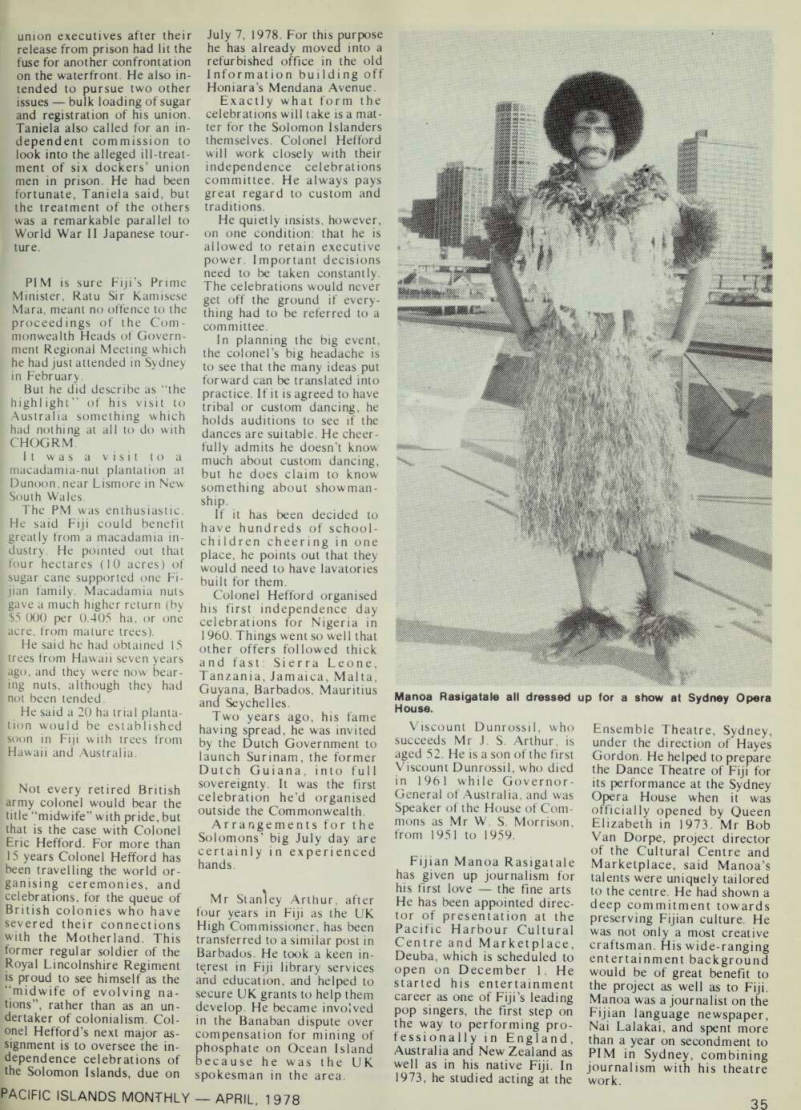
Fijian Manoa Rasigatale has given up journalism for his first love the fine arts He has been appointed direc tor of presentation at the Pacific Harbour Cultural Centre and Marketplace, Deuba, which is scheduled to open on December 1. He started his entertainment career as one of Fiji’s leading pop singers, the first step on the way to performing pro fessionally in England, Australia and New Zealand as well as in his native Fiji. In 1973, he studied acting at the
Ensemble Theatre, Sydney, under the direction of Hayes Gordon. He helped to prepare the Dance Theatre of Fiji for its performance at the Sydney Opera House when it was officially opened by Queen Elizabeth in 1973. Mr Bob Van Dorpe, project director of the Cultural Centre and Marketplace, said Manoa’s talents were uniquely tailored to the centre. He had shown a deep commitment towards preserving Fijian culture. He was not only a most creative craftsman. His wide-ranging entertainment background would be of great benefit to the project as well as to Fiji, Manoa was a journalist on the Fijian language newspaper Nai Lalakai, and spent more than a year on secondment to PIM in Sydney, combining journalism with his theatre work.
Manoa Rasigatale all dressed up for a show at Sydney Opera House.