Currents
pp. 29-33 · Read in the full issue

Political
under-developed countries.
Problems at village level in India, by far the largest nation represented at the meeting, were similar to problems en countered in villages in the Is lands, they said.
Prime Minister Tupuola Efi of Western Samoa told PIM he valued the meeting as an occasion for discussion which had importance for Island countries who lacked embas sies in the countries rep resented. What better way was there to make contact than with the leaders of these coun tries themselves, he said.
He said that apart from items on the formal agenda, he had been able to talk to the Australian and New Zealand Prime Ministers about air transport and shipping.
Papua New Guinea’s Prime Minister, Mr Michael Somare, saw the meeting as of greater value than the bigger, all-in Commonwealth con ferences. “At the big con ference we talk about interna tional matters which don’t really concern our region, but here there were many things we could learn from with regard to the development aspects of other countries with similar problems to our own,” he said.
He refuted the claim that the meeting overlapped with the work of the South Pacific Forum, saying: “There were points of view on some aspects of trade put at this conference which can be of great value to us in the Forum.”
Fiji’s Prime Minister, Ratu Sir Kamisese Mara, also un derlined the value of the meeting to the Islands. Com menting on Mr Muldoon’s remark about there being “nothing in it” for New Zea land, Ratu Mara said: “Mr Muldoon is always ready to disagree with everyone else. I am quite prepared to disagree with him on this occasion. For instance, the paper by Mr Lee Kuan Yew of Singapore on the subject of world trade was a
particularly important one, as
it comes within the framework of the regional group.”
Among practical steps agreed by the meeting were the establishment of consulta tive groups on trade (Australia convenor), energy (India convenor), terrorism (Singapore convenor) and il licit drugs (Malaysia con venor).
While some observers originally predicted that the
Assessing
Chogrm
A question under debate in Australia is whether the most enduring effects of the Com monwealth Heads of Govern ment Regional Meeting (CHOGRM) held in Sydney in February were on the political relationships be tween the 12 participants, or on the political climate in the host country.
A bomb explosion outside the conference venue, the Hilton Hotel, in the early morning of February 13, opening day of the meeting, caused the immediate deaths of two garbage collectors, and the death a fortnight later of a policeman wounded in the blast. A larger number of peo ple were injured.
These events tended to overshadow proceedings from the start, especially for the
Australian public.
Prime Minister Fraser’s controversial move in calling in the army to protect his CHOGRM guests, and many aspects of the handling of the still unsolved crime by police and security forces, will be the stuff of political debate in Australia for months, if not years, to come.
But it would be wrong to as sume that the meeting was en tirely without consequence in terms of its stated purposes.
Leaders of the Pacific Is land nations who took part
Papua New Guinea, Fiji,
Western Samoa, Tonga and Nauru were restrained in their comments on the achievements of CHOGRM,
though they showed more
enthusiasm than New Zea land’s Mr Muldoon, whose parting shot as he abruptly left the meeting before it ended was reported as: “There’s nothing in it for us.”
In comments to PIM, Island leaders agreed that the meet ing was of value as a platform for their views, as a medium for contact with the leaders of the bigger nations, and as a clearing house for infor mation on dealing with problems common to all the
meeting would be a “oncer”, and that no similar gathering would be planned as a sequel to it, events proved them wrong. It is planned that the 12 governments represented will be getting together again in Delhi in 1980.
Why Somare
Hit Back
There was more than met the eye to the sharp reaction of Papua New Guinea’s Prime Minister, Mr Michael Somare, when a Sydney TV station in February labelled him as one of three Com monwealth heads of govern ment marked down for death by terrorists at home, writes Gus Smales in Port Moresby.
In a press statement releas ed in Sydney, where he was at tending the Commonwealth Heads of Government Regional Meeting, Mr Somare said; “I want to make it clear to the Australian media that I am Prime Minister of Papua New Guinea and journalists should not use me to suit their own needs.
“My country has been an in dependent nation for more than three years and despite their differing cultural back grounds, the people have al ways respected their leaders.
“Papua Besena (named by the channel as the body out to ‘get’ Mr Somare) is a small, peaceful organisation whose aim is economic development for the southern part of Papua New Guinea and does not like violence.
“I am very disappointed at Channel 10 over the way it re ported my presence at the regional meeting. This kind of irresponsible reporting always projects a bad image of Papua New Guinea in the eyes of the
Australian public.”
A few background com ments might be useful.
When Mr Somare became Chief Minister of Papua New Guinea in the transitional period before independence he set off on what had all the earmarks of a giant barnstorming tour —a “meet the people programme” was Mr Somare’s official de
scription.
What grew out of those weeks was a serious pilgrimage, bordering some times on the reverential.
It was a journey where old men with white beards offered solemn handshakes, where schoolchildren held out flowers and leaves, and where self-sufficient Whites came to stare and stayed to talk. Deco rated bowers laced across roadways in unexpected places, people lined the walk ing tracks and the new bird of paradise flag was everywhere in evidence.
In the thrust of today’s more formal PNG politics, often ineffectual and vigorously aimless, and often devious, the sort of attitude demonstrated during that tour is still representative of the country at large.
It is an attitude which
acknowledges national
leadership from a personal point of view, and which relies on consensus and hard
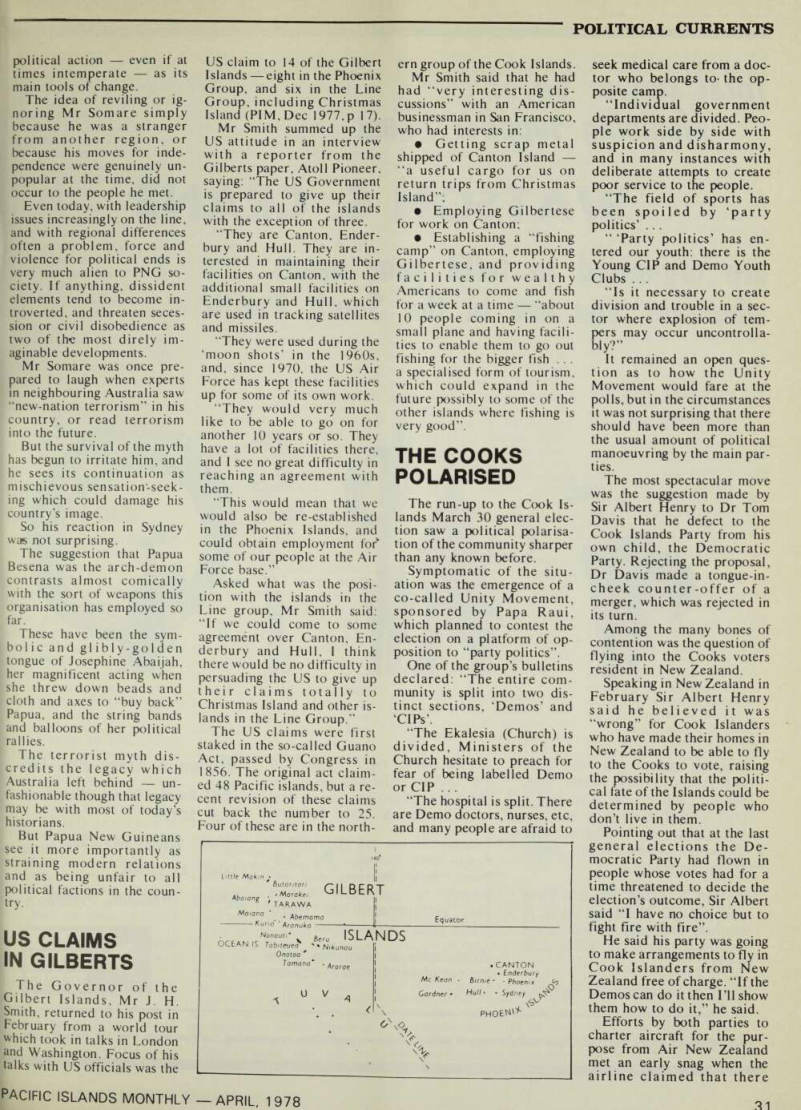
Nauru’s President Bernard Dowlyogo (second right) arrives at the Hilton Hotel to be greeted by Australian Foreign Minister Andrew Peacock while at right Australian Prime Minister, Malcolm Fraser, looks on.
political action even if at times intemperate as its main tools of change.
The idea of reviling or ig noring Mr Somare simply because he was a stranger from another region, or because his moves for inde pendence were genuinely un popular at the time, did not occur to the people he met.
Even today, with leadership issues increasingly on the line, and with regional differences often a problem, force and violence for political ends is very much alien to PNG so ciety. If anything, dissident elements tend to become in troverted, and threaten seces sion or civil disobedience as two of the most direly im aginable developments.
Mr Somare was once pre pared to laugh when experts in neighbouring Australia saw “new-nation terrorism” in his country, or read terrorism into the future.
But the survival of the myth has begun to irritate him, and he sees its continuation as mischievous sensation-seek ing which could damage his country’s image.
So his reaction in Sydney was not surprising.
The suggestion that Papua Besena was the arch-demon contrasts almost comically with the sort of weapons this organisation has employed so far.
These have been the sym bol ic and glibly-golden tongue of Josephine Abaijah, her magnificent acting when she threw down beads and cloth and axes to “buy back”
Papua, and the string bands and balloons of her political rallies.
The terrorist myth dis credits the legacy which Australia left behind un fashionable though that legacy may be with most of today’s historians.
But Papua New Guineans see it more importantly as straining modern relations and as being unfair to all political factions in the coun try.
Us Claims
In Gilberts
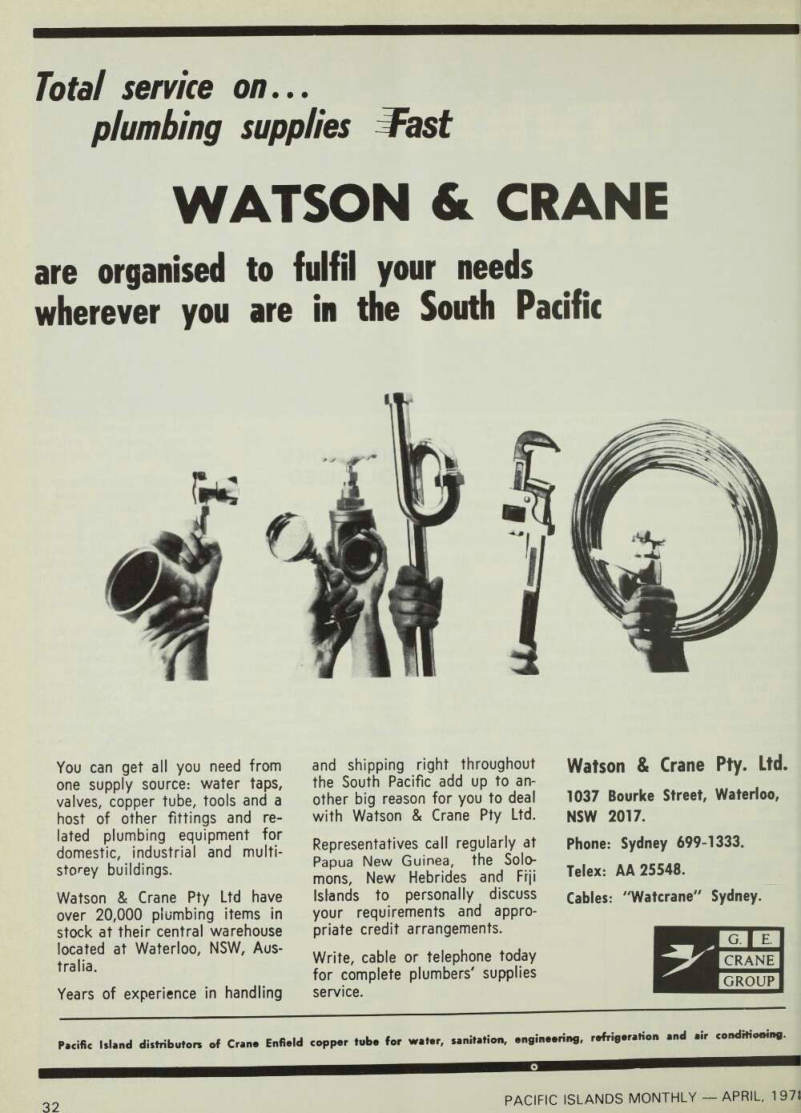
The Governor of the Gilbert Islands, Mr J. H.
Smith, returned to his post in February from a world tour which took in talks in London and Washington. Focus of his talks with US officials was the
US claim to 14 of the Gilbert Islands— eight in the Phoenix Group, and six in the Line Group, including Christmas Island (PIM, Dec 1977, p 17).
Mr Smith summed up the US attitude in an interview with a reporter from the Gilberts paper. Atoll Pioneer, saying: “The US Government is prepared to give up their claims to all of the islands with the exception of three, “They are Canton, Ender bury and Hull. They are in terested in maintaining their facilities on Canton, with the additional small facilities on Enderbury and Hull, which are used in tracking satellites and missiles, “They were used during the ‘moon shots’ in the 19605, and, since 1970. the US Air Force has kept these facilities U p for some of its own work, “They would very much like to be able to go on for another 10 years or so. They have a lot of facilities there, and I see no great difficulty in reaching an agreement with them.
“This would mean that we would also be re-established in the Phoenix Islands, and could obtain employment for* some of our people at the Air Force base.”
Asked what was the posi tion with the islands in the Line group, Mr Smith said: “If we could come to some agreement over Canton, En derbury and Hull, I think there would be no difficulty in persuading the US to give up their claims totally to Christmas Island and other is lands in the Line Group.”
The US claims were first staked in the so-called Guano Act, passed by Congress in 1856. The original act claim ed 48 Pacific islands, but a re cent revision of these claims cut back the number to 25.
Four of these are in the north
ern group of the Cook Islands.
Mr Smith said that he had had “very interesting dis cussions” with an American businessman in San Francisco, who had interests in: • Getting scrap metal shipped of Canton Island “a useful cargo for us on return trips from Christmas Island”; • Employing Gilbertese for work on Canton; • Establishing a “fishing camp” on Canton, employing Gilbertese, and providing facilities for wealthy Americans to come and fish for a week at a time “about 10 people coming in on a small plane and having facili ties to enable them to go out fishing for the bigger fish . . . a specialised form of tourism, which could expand in the future possibly to some of the other islands where fishing is very good”.
The Cooks
Polarised
The run-up to the Cook Is lands March 30 general elec tion saw a political polarisa tion of the community sharper than any known before.
Symptomatic of the situ ation was the emergence of a co-called Unity Movement, sponsored by Papa Raui, which planned to contest the election on a platform of op position to “party politics”.
One of the group’s bulletins declared: “The entire com munity is split into two dis tinct sections, ‘Demos’ and ClPs’.
“The Ekalesia (Church) is divided, Ministers of the Church hesitate to preach for fear of being labelled Demo or CIP . .
“The hospital is split. There are Demo doctors, nurses, etc, and many people are afraid to
seek medical care from a doc tor who belongs to- the op posite camp.
“Individual government departments are divided. Peo ple work side by side with suspicion and disharmony, and in many instances with deliberate attempts to create poor service to the people.
“The field of sports has been spoiled by ‘party politics’ ...
“ ‘Party politics’ has en tered our youth: there is the Young CIP and Demo Youth Clubs . . .
“Is it necessary to create division and trouble in a sec tor where explosion of tem pers may occur uncontrolla bly?”
It remained an open ques tion as to how the Unity Movement would fare at the polls, but in the circumstances it was not surprising that there should have been more than the usual amount of political manoeuvring by the main par ties.
The most spectacular move was the suggestion made by Sir Albert Henry to Dr Tom Davis that he defect to the Cook Islands Party from his own child, the Democratic Party. Rejecting the proposal, Dr Davis made a tongue-in cheek counter-offer of a merger, which was rejected in its turn.
Among the many bones of contention was the question of flying into the Cooks voters resident in New Zealand.
Speaking in New Zealand in February Sir Albert Henry said he believed it was “wrong” for Cook Islanders who have made their homes in New Zealand to be able to fly to the Cooks to vote, raising the possibility that the politi cal fate of the Islands could be determined by people who don’t live in them.
Pointing out that at the last general elections the De mocratic Party had flown in people whose votes had for a time threatened to decide the election’s outcome, Sir Albert said “I have no choice but to fight fire with fire”.
He said his party was going to make arrangements to fly in Cook Islanders from New Zealand free of charge. “If the Demos can do it then I’ll show them how to do it,” he said.
Efforts by both parties to charter aircraft for the pur pose from Air New Zealand met an early snag when the airline claimed that there
were enough vacant seats on normal flights to accom modate intending voters, and that no special charter flights would be made.
One of the main reasons for Sir Albert’s New Zealand visit was to discuss with the New Zealand Government the matter of including the waters of the Cook Islands with those of New Zealand as a valuable package for nations seeking to fish their waters in these times of 200-mile exclusive econ omic zones. A successful out come to these talks could have been a big vote-catcher.
Although nations such as Holland had expressed in terest, early signs were that the highest bidder for the fish ing rights would be none other than the Soviet Union. The Cook Islands News com mented: “The question is: Whose boats will we see around our islands? Will it be the big red flag of communist Russia?”
Senate’S
Report Due
The Australian Senate’s Standing Committee on Foreign Affairs and Defence has completed its report on Australia and the South Pacific. It is expected to be made public in April, and to contain a number of new re commendations on the future direction of Australian policy in the region.
The committee received submissions and held hearings over a period of about 12 months. Submissions were re ceived from 50 individuals and organisations and the committee examined 24 wit nesses. They heard evidence from a number of Com monwealth Departments, from people involved in voluntary overseas assistance programmes, health services, education and business.
It was the first major inqu iry of its kind completed by the Australian Parliament. It was also the most extensive public inquiry ever held in Australia on relations with the South Pacific. It could therefore have a significant impact on the future direction of Australian policy in the region and on Australia’s relations with the South Pacific.
The chairman of the com mittee, Senator Sim (Lib,
WA), said recently that the committee took as its starting point the fact that Australia is now moving into a new era in its relations with the South Pacific. Senator Sim pointed out that since 1960 10 coun tries in the region have gained independence or self-govern ment, and that this required significant changes in Australia’s approach to the region.
At the same time, the new nations of the South Pacific have begun to widen their diplomatic, political, econ omic and commercial horizons and are participating in an increasing number of in ternational organisations.
In a recent edition of PIM (Jan, p 14), a member of the committee, Senator Knight (Lib, ACT), pointed out that new factors, such as proposals for a new international econ omic order and a changing emphasis towards social and economic issues amongst the ANZUS partners, have sug gested changing attitudes on the part of Australia.
Another member of the committee. Senator Mclntosh (Lab, WA), said at a recent meeting in Tasmania that the committee would proceed to an inquiry on the implications for Australia of the proposed “new international economic order’’, indicating that the committee itself is well aware of the implications of these new ideas and proposals often now being assertively put forward by developing countries. (It has since been confirmed in the Australian Senate by Senator Sim that the committee will inquire into “the implications for Australia’s foreign policy and national security of proposals for a new international econ omic order’’.) It therefore seems likely that the committee will re commend increasing attention by Australia to such interna tional developments, giving special attention to their relevance to the South Pacific and Australia’s role with those countries.
One of the areas where it has seemed that Australia could take more positive ac tion is in assistance with trad ing efforts of South Pacific countries and the committee gave some attention to this in its hearings. If they follow a good deal of the evidence pre sented to them, they will re commend that Australia co
operate more effectively and extensively in assisting its South Pacific neighbours in their trading efforts on im portant issues such as, for ex ample, marketing, quarantine and tariffs.
The committee also gave a good deal of attention to the immigration question and they might well make some re commendations as to more sensitive handling of migra tion and visa matters relating to citizens of South Pacific countries.
While Australia can now argue that its policy is non discriminatory there is, nevertheless, a lot to be de sired about the handling of many individual cases of South Pacific Islanders. The vexed question of a “guest worker’’ scheme in Australia might well be avoided by the committee, but it is to be hoped that they do not dismiss it altogether. Asked about this, the chairman of the com mittee, Senator Sim, said re cently that the committee had directed its attention to the issue and might well make some recommendations as to how Australia should ap proach it in future.
In recent years, Australia has extended its diplomatic representation in the South Pacific, probably more than in any other area. Senator Sim has made it clear that he, and it seems other members of the committee, believe that Australia should be giving in creasing attention to diplomatic and political rela tionships as well as social and cultural issues, to balance the traditional economic/com mercial orientation of Australia’s role in the South Pacific. On this basis the com mittee seems likely to support the continuing consolidation of Australia’s representation throughout the region, and it may well urge continuing or increasing high-level ministerial contacts.
Throughout its hearings, the committee took con siderable interest in Australia’s development as sistance programme in the region, while generally giving the impression that it is now believed the level of as sistance is commensurate with Australia’s responsibilities in the region. Members of the committee frequently showed interest in possible new areas for development assistance, or
new angles of approach. This is consistent with the attitude more recently taken by the Australia Development As sistance Bureau but in its re commendations, the com mittee could look to possible new avenues of development assistance.
With the evidence received by the committee and the acknowledgement by its chairman of new trends in the development of Australia’s relationships with its South Pacific neighbours, it seems the committee is likely to generally endorse those trends and perhaps suggest some measures to consolidate and extend them. That in it self would be a useful con tribution.
Tokelauans
Look Ahead
Tokelau’s relations with New Zealand have been dis cussed during a three-day general fono in Fakaofo.
The territory was once ad ministered as part of the Gilbert and Ellice Islands Colony, but has been under New Zealand administration for 52 years.
In June, 1976, at the time of the United Nations mission to Tokelau, the general fono ex pressed a desire to maintain a close link with New Zealand, while at the same time taking on an increasing re sponsibility for decisions affecting the territory’s econ omic and social development and the welfare of the people.
It was to meet this request that New Zealand has taken steps to strengthen the Tokelau public service over the last two years. The reorganisation of the public service has now been com pleted and new positions have been added increasing the permanent staff from 100 to 143. The main change in volves the establishment of public works teams on each of the three atolls to carry out building construction and maintenance, as well as boat repairs and mechanical work.
The Tokelauans are also looking outward to other Pacific nations to learn more about their experiences in
self-government, particularly
Niue and Tuvalu. The Pre mier of Niue, Mr Robert Rex, has been invited to Tokelau this year.