Afterthoughts
p. 27 · Read in the full issue
One of the great events of the Motu calendar in my early years at Hanuabada was the Hiri, the annual expedition in which Motu seamen sailed their big trading canoes across the Gulf of Papua to barter pots for sago with the Elema and Koriki people of the Gulf. The sago they brought back was important to them and their kinsfolk, because it helped them to tide over the often hungry months which preceded the yam harvest. The sago was stored in big porous pots called tohe, and kept moist with sea-water to keep it fresh.
The preparation of the lagatoi, the big multi-hulled canoe in which they sailed, was a long and arduous exercise, hedged about by ritual. At one stage the canoe, launched and decked over, but still without super structure, was poled to and fro in front of the village, while the girls of the village performed dances on its deck. It was an occasion for rejoicing, a part of the ritual, and also perhaps a test of the soundness of the workmanship which had gone into the canoe’s construction.
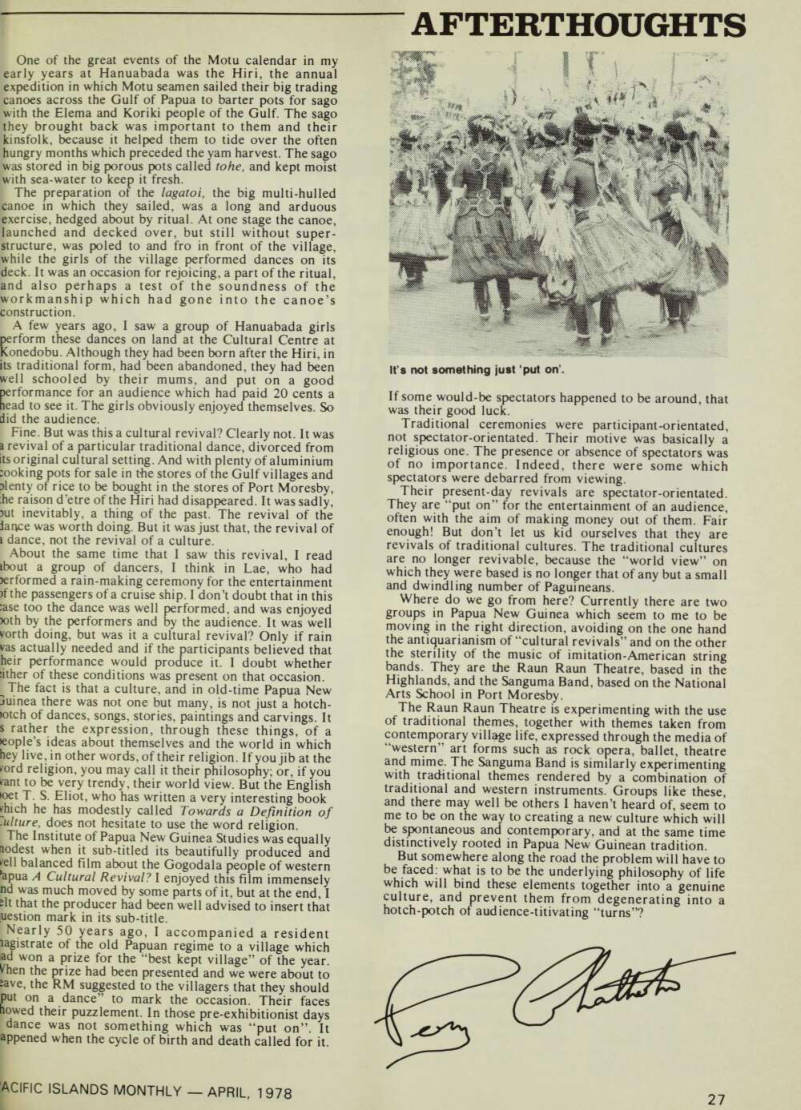
A few years ago, I saw a group of Hanuabada girls perform these dances on land at the Cultural Centre at Konedobu. Although they had been born after the Hiri, in its traditional form, had been abandoned, they had been well schooled by their mums, and put on a good performance for an audience which had paid 20 cents a head to see it. The girls obviously enjoyed themselves. So did the audience.
Fine. But was this a cultural revival? Clearly not. It was a revival of a particular traditional dance, divorced from its original cultural setting. And with plenty of aluminium looking pots for sale in the stores of the Gulf villages and plenty of rice to be bought in the stores of Port Moresby, he raison d’etre of the Hiri had disappeared. It was sadly, aut inevitably, a thing of the past. The revival of the lance was worth doing. But it was just that, the revival of i dance, not the revival of a culture.
About the same time that I saw this revival, I read ibout a group of dancers, I think in Lae, who had jerformed a rain-making ceremony for the entertainment )f the passengers of a cruise ship. I don’t doubt that in this ;ase too the dance was well performed, and was enjoyed x)th by the performers and by the audience. It was well vorth doing, but was it a cultural revival? Only if rain vas actually needed and if the participants believed that heir performance would produce it. I doubt whether sither of these conditions was present on that occasion.
I The fact is that a culture, and in old-time Papua New juinea there was not one but many, is not just a hotch- K)tch of dances, songs, stories, paintings and carvings. It s rather the expression, through these things, of a (eople’s ideas about themselves and the world in which hey live, in other words, of their religion. If you jib at the K>rd religion, you may call it their philosophy; or, if you rant to be very trendy, their world view. But the English >oet T. S. Eliot, who has written a very interesting book diich he has modestly called Towards a Definition of Mlture, does not hesitate to use the word religion.
The Institute of Papua New Guinea Studies was equally aodest when it sub-titled its beautifully produced and rcll balanced film about the Gogodala people of western *apua A Cultural Revival? I enjoyed this film immensely nd was much moved by some parts of it, but at the end, I sit that the producer had been well advised to insert that [uestion mark in its sub-title.
Nearly 50 years ago, I accompanied a resident magistrate of the old Papuan regime to a village which ad won a prize for the “best kept village” of the year, vhen the prize had been presented and we were about to save, the RM suggested to the villagers that they should put on a dance” to mark the occasion. Their faces bowed their puzzlement. In those pre-exhibitionist days dance was not something which was “put on”. It appened when the cycle of birth and death called for it.
If some would-be spectators happened to be around, that was their good luck.
Traditional ceremonies were participant-orientated, not spectator-orientated. Their motive was basically a religious one. The presence or absence of spectators was of no importance. Indeed, there were some which spectators were debarred from viewing.
Their present-day revivals are spectator-orientated.
They are “put on” for the entertainment of an audience, often with the aim of making money out of them. Fair enough! But don’t let us kid ourselves that they are revivals of traditional cultures. The traditional cultures are no longer revivable, because the “world view” on which they were based is no longer that of any but a small and dwindling number of Paguineans.
Where do we go from here? Currently there are two groups in Papua New Guinea which seem to me to be moving in the right direction, avoiding on the one hand the antiquarianism of “cultural revivals” and on the other the sterility of the music of imitation-American string bands. They are the Raun Raun Theatre, based in the Highlands, and the Sanguma Band, based on the National Arts School in Port Moresby.
The Raun Raun Theatre is experimenting with the use of traditional themes, together with themes taken from contemporary village life, expressed through the media of “western” art forms such as rock opera, ballet, theatre and mime. The Sanguma Band is similarly experimenting with traditional themes rendered by a combination of traditional and western instruments. Groups like these, and there may well be others I haven’t heard of, seem to me to be on the way to creating a new culture which will be spontaneous and contemporary, and at the same time distinctively rooted in Papua New Guinean tradition.
But somewhere along the road the problem will have to be faced: what is to be the underlying philosophy of life which will bind these elements together into a genuine culture, and prevent them from degenerating into a
hotch-potch of audience-titivating “turns”?
It’s not something just put on’.