In The Solomons Bush
pp. 21-26 · Read in the full issue
War And Culture Side By Side
Thirteen miles out of Honiara, capital of the Solomon Islands, over road that is not too bumpy by island standards, is Vilu Villaga It is owned by Fred Kona, whose intention it is to make his cultural and war museum one of the main tourist attractions of the Solomons. Peter L. Young tells the story.
Fred is quite a character.
Usually dressed in a pair of shorts and perhaps an open shirt, he hails you with his booming, “Welcome friend” and grabs your hand with a strong grip. He is a master ra conteur in his superior mix ture of English and Pidgin.
Fred is a remarkable man.
He is paramount chief for this area of Guadalcanal which is no mean achievement con sidering he was born on another island, Malaita. He originally came to Guadal canal to work on a plantation.
While on the plantation, Fred set about learning English by talking to the plan tation manager’s children. He eventually became an over seer.
Fred .will tell you proudly that he is a self-made man. He never went to school but he has learned to read. He now studies what he calls “the three laws” in his spare time; these laws are God’s Law, King’s Law and Custom Law.
He has sat as an adviser in local courts, and because of his knowledge of custom he was able to become a para mount chief.
Vilu Village seems to have everything and Fred will as sure you that it has. It contains a war museum, houses built in custom style, and Fred’s own agricultural pursuits in cluding a copra dryer, cocoa,
pineapples, Malay apples and
various other crops. In ad dition to this he is cultivating various orchids.
As Fred says, he never went to school but he knows how to grow first-grade copra and
first-grade cocoa.
On the day I visited Vilu I had given Fred Kona a few days notice by leaving a note for him at his post-office box (559 Honiara). This meant that he was well prepared to welcome my party with a group of traditional dancers from Visale, a Roman Catholic mission settlement further up the coast.
We sat down while the dan cers performed. Two men
sang unaccompanied with the verve and natural harmony that ensures modern Solomon Island choirs a future place among the best in the world.
The bare-breasted women, young and old, danced, wear ing grass skirts and creating a rhythm from rattling nuts tied around their ankles.
We talked with the dancers and discovered they were all relatives. I was interested to see that, on finishing each dance, the women immedi ately covered up their breasts this return to custom was for the dance only. I have often noticed Melanesian women, generally the older ones, going around Honiara market bare breasted. Some, when they see me approaching, put their hands across their breasts no doubt to avoid offending my European sensibilities.
After the dancing, Fred conducted us on a tour of the custom-style houses that he has built telling us what each section of the house was used for, giving us an introduction to Melanesian etiquette and regaling us with custom sto ries about the origins of various things in the hut. In side one of the houses is an ar ray of Solomon Island war weapons all of which appear quite old but have been beautifully constructed and preserved.
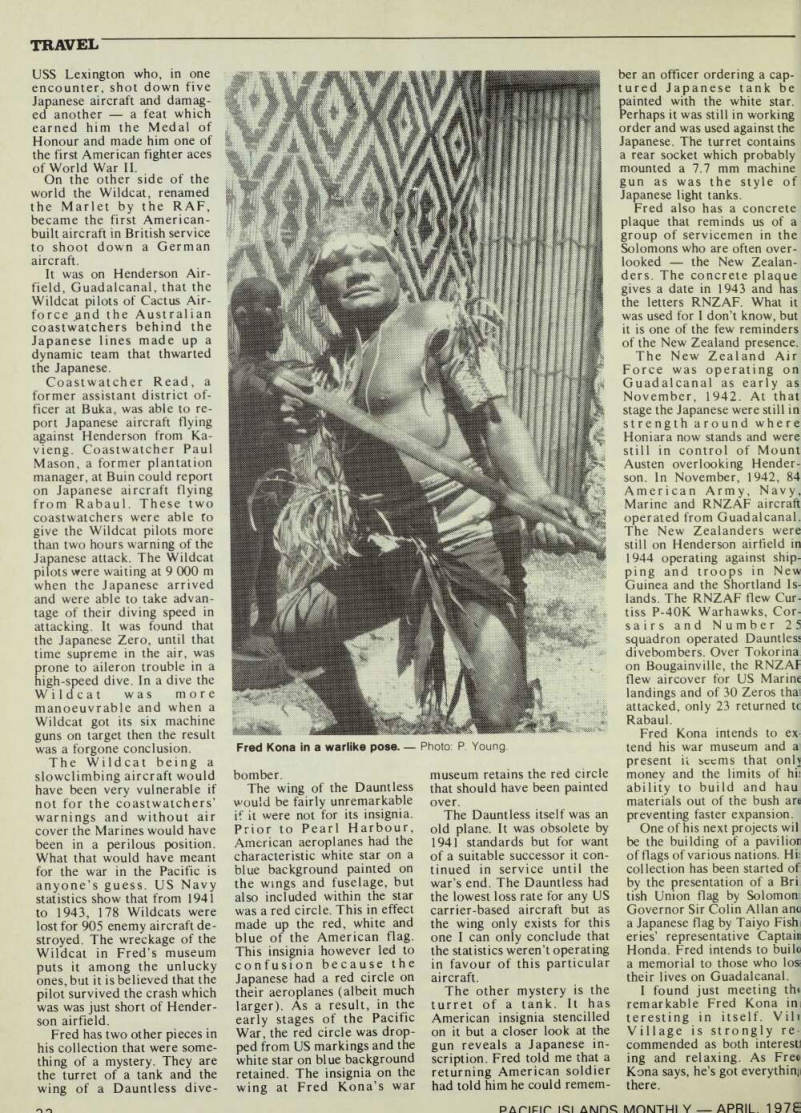
Later Fred was to delight my photographer wife by dressing up as a warrior.
There is no doubt about Fred’s ability to act the part as he demonstrated the use of the long spear, the axe and the club. His friends from Visale found that this rather amusing and we had to take a break ev ery few minutes when the hilarity started preventing Fred from looking ap propriately menacing for the camera. The whole photo graphic session was a light hearted romp but the pictures obtained were magnificent.
After that, we visited the war museum.
By far the most impressive
pieces in the museum are two Japanese 150 mm howitzers.
From my knowledge of the various types of guns used in the Guadalcanal campaign I concluded that the howitzer with the gun-shield was a model 96 cannon and like most of the other guns left around the island was prob ably constructed in Japan’s Osaka arsenal in 1942. The howitzer nearby is probably an earlier model of the 150 mm gun constructed in 1937.
These types of guns were used to bombard the thinly-held marine perimeter around Henderson airfield in 1942 and 1943. The Japanese had the advantage of an artillery observation post on Mount Austen which overlooks Hen ddtson. The 150 mm cannon could hurl a high explosive shell 10 365 m.
Not far from the cannon is a house full of helmets and guns. The guns are fairly rusted but there are two Japanese machine guns in quite good condition. Both are of a type that was standard with the Japanese forces dur ing World War 11, having been originally copied from the French Hotchkiss machine gun.
On a not-so-happy note, Fred told me that he had had an underwing cannon from an American fighter in his possession, but that fell victim to some marauding European gun-hunters who cut the gun out of its pod and took it out of the country. Fred accepts the loss philosophically, say ing that as Europeans brought Christianity to the Solomons then some Europeans can have something of his. The matter obviously still is a sore point but he won’t pursue the thieves.
Various other Japanese light guns are about including a Nambu anti-tank gun which is also in good condition.
Further along is the still re cognisable wreckage of an American Chance Vought Corsair, its white star on the fuselage and number “16”
still clearly outlined. Fred believes that it was the first Corsair shot down over Guadalcanal.
The Corsair with its power ful engine and dipping, gull wing had a long and dis tinguished history. It was one of the fastest aircraft of its time attaining what was then the remarkable speed of 670 kmh. Both American and New Zealand pilots operated the Corsair from Henderson Air field. In Europe, the Royal Navy used Corsairs to cover bombers attacking the giant German Battleship Tirpitz.
The aircraft later served in Korea and was also flown by pilots of the French Navy dur ing the war in Indo-China when France was unsuc cessfully trying to retain con trol of that part of south-east Asia.
Fred Kona has also salvag ed the wreckage of a Grum man Wildcat. The remarkable thing about this piece is that one wing still easily folds up as it would have on board an aircraft carrier.
Although later US pilots swore by the Wildcat, at first American navy pilots swore at the plane. The early models required the pilot to crank up the undercarriage himself.
This manual retraction re quired 30 turns of a crank near the pilot’s right hand and usually resulted in a porpoise like flight path after take off as the pilot battled to retract his undercarriage and carry on normal flying.
The Wildcat started off its combatant life inauspiciously.
Nine out of 11 stationed at Pearl Harbour were destroyed on the ground as were seven out of 10 at Wake. Captain Henry T Elrod USMC, however, evened up the score, sinking a Japanese destroyer by using his Wildcat as a dive bomber but that wasn’t sufficient to stop Wake falling after heroic defence.
The capabilities of the Wildcat were shown in the early days of the Pacific War by Lt “Butch” O’Hare of the
USS Lexington who, in one encounter, shot down five Japanese aircraft and damag ed another a feat which earned him the Medal of Honour and made him one of the first American fighter aces of World War 11.
On the other side of the world the Wildcat, renamed the Marlet by the RAF, became the first American built aircraft in British service to shoot down a German aircraft.
It was on Henderson Air field, Guadalcanal, that the Wildcat pilots of Cactus Air force the Australian coastwatchers behind the Japanese lines made up a dynamic team that thwarted the Japanese.
Coastwatcher Read, a former assistant district of ficer at Buka, was able to re port Japanese aircraft flying against Henderson from Ka vieng. Coastwatcher Paul Mason, a former plantation manager, at Buin could report on Japanese aircraft flying from Rabaul. These two coastwatchers were able to give the Wildcat pilots more than two hours warning of the Japanese attack. The Wildcat pilots were waiting at 9 000 m when the Japanese arrived and were able to take advan tage of their diving speed in attacking. It was found that the Japanese Zero, until that time supreme in the air, was prone to aileron trouble in a high-speed dive. In a dive the Wildcat was more manoeuvrable and when a Wildcat got its six machine guns on target then the result was a forgone conclusion.
The Wildcat being a slowclimbing aircraft would have been very vulnerable if not for the coastwatchers’ warnings and without air cover the Marines would have been in a perilous position.
What that would have meant for the war in the Pacific is anyone’s guess. US Navy statistics show that from 1941 to 1943, 178 Wildcats were lost for 905 enemy aircraft de stroyed. The wreckage of the Wildcat in Fred’s museum puts it among the unlucky ones, but it is believed that the pilot survived the crash which was was just short of Hender son airfield.
Fred has two other pieces in his collection that were some thing of a mystery. They are the turret of a tank and the wing of a Dauntless dive-
bomber.
The wing of the Dauntless would be fairly unremarkable if it were not for its insignia.
Prior to Pearl Harbour, American aeroplanes had the characteristic white star on a blue background painted on the wings and fuselage, but also included within the star was a red circle. This in effect made up the red, white and blue of the American flag.
This insignia however led to confusion because the Japanese had a red circle on their aeroplanes (albeit much larger). As a result, in the early stages of the Pacific War, the red circle was drop ped from US markings and the white star on blue background retained. The insignia on the wing at Fred Kona’s war
museum retains the red circle that should have been painted over.
The Dauntless itself was an old plane. It was obsolete by 1941 standards but for want of a suitable successor it con tinued in service until the war’s end. The Dauntless had the lowest loss rate for any US carrier-based aircraft but as the wing only exists for this one I can only conclude that the statistics weren’t operating in favour of this particular aircraft.
The other mystery is the turret of a tank. It has American insignia stencilled on it but a closer look at the gun reveals a Japanese in scription. Fred told me that a returning American soldier had told him he could remem
her an officer ordering a cap tured Japanese tank be painted with the white star.
Perhaps it was still in working order and was used against the Japanese. The turret contains a rear socket which probably mounted a 7.7 mm machine gun as was the style of Japanese light tanks.
Fred also has a concrete plaque that reminds us of a group of servicemen in the Solomons who are often over looked the New Zealan ders. The concrete plaque gives a date in 1943 and has the letters RNZAF. What it was used for I don’t know, but it is one of the few reminders of the New Zealand presence.
The New Zealand Air Force was operating on Guadalcanal as early as November, 1942. At that stage the Japanese were still in strength around where Honiara now stands and were still in control of Mount Austen overlooking Hender son. In November, 1942, 84 American Army, Navy, Marine and RNZAF aircraft operated from Guadalcanal.
The New Zealanders were still on Henderson airfield in 1944 operating against ship ping and troops in New Guinea and the Shortland Is lands. The RNZAF flew Cur tiss P-40K Warhawks, Cor sairs and Number 25 squadron operated Dauntless divebombers. Over Tokorina on Bougainville, the RNZAF flew aircover for US Marine landings and of 30 Zeros that attacked, only 23 returned tc Rabaul.
Fred Kona intends to ex tend his war museum and a present it seems that onh money and the limits of hi: ability to build and hau materials out of the bush are preventing faster expansion.
One of his next projects wil be the building of a pavilior of flags of various nations. Hi: collection has been started of by the presentation of a Bri tish Union flag by Solomon; Governor Sir Colin Allan anc a Japanese flag by Taiyo Fish cries’ representative Captain Honda. Fred intends to builc a memorial to those who los; their lives on Guadalcanal.
I found just meeting th* remarkable Fred Kona in teresting in itself. Vih Village is strongly re commended as both interest! ing and relaxing. As Freo Kona says, he’s got everythin] there.
Fred Kona in a warlike pose.- Photo: P. Young.
Censor had a
second blink
Mrs Laura Barrett, a Fiji film censor, saw a film, Con [ fessions of a Driving Instruc tor, in 1977, and passed it for I exhibition, without cuts, for anyone over 18. Later she saw [ the film at a public screening f and noted that some scenes [ went further in sex acts and nudity than in the version she had seen.
The result was that Pala Bros, owners of the Lilac Cinema, Suva, where the film was shown, were charged with showing a film not approved by the censors.
The magistrate, Mr Ronald Lindsay, in finding Pala Bros guilty, rejecting a submission by Mr Ramanlal Kapadia, for Pala Bros, that Mrs Barrett had imagined things the direc tor left to the imagination, or that she had used the extra scenes story to save face after she changed her mind and de cided to withdraw the film’s certificate.
Mrs Barrett, the magistrate said, was a person of con siderable intelligence, ability and experience, and showed a professional approach to her censorship duties. She did not appear to be given to prudery or flights of fancy.
Mr Linsay said the maxi mum fine for the offence was $2OO, but as the company was a first offender the fine would be $lOO.
The numbers
game in Tonga
Tonga’s population accord ing to the 1976 census is 90 072, made up of 88 257 Tongans, 452 Europeans, 686 part-Europeans, 265 other Pacific Islanders and 142 “others”. The census revealed that the Free Wesleyan Church of Tonga had 42 680 adherents, there were 14 510 Catholics, 12 324 in the Free Church of Tonga, 8 350 in the Church of Jesus Christ of the Latter Day Saints, 8 03 1 in the Church of Tonga, 1 919 Seventh-day Adventists, 874 Anglicans, and 338 in the As semblies of God. There were 1 046 “others”, including some who did not state their religion.
Of the total population 3 13 19 were literate in Tongan only, 472 in English
only, 36 639 in English and Tongan, and 4 952 were il literate. There were 28 452 unemployed, 9 421 engaged in agriculture, forestry and fishing, and 2 452 in pro fessional and technical posi tions. The figures revealed there were 59 688 single per sons, 26 814 were married, 2 632 widowed and 856 divorced.
Big shock
for gang-rapists
Five young men from the Fiji island of Nairai received a shock when they appealed to the Supreme Court against sentences of 3'A years gaol for gang-rape. An unsympathetic Chief Justice, Sir Clifford Grant, increased the sentences to five years and added six strokes of the cane for each.
The youths, aged 17 to 20, had been found guilty of gang raping a 16-year-old girl in her grandfather’s house in the village where they lived. Sir Clifford said he failed to un derstand why the trial magistrate imposed such a mild sentence. Gang rape was particularly abhorrent and in the case in question the offence was further aggra vated by the fact that the girl was attacked and raped in the security of her grandfather’s house.
He warned that if the girls and women of Fiji were to be protected, something had to be done to curb the drunken ness. Since the 1975 Royal Commission of Inquiry into Crime, which he conducted, there had been an alarming increase in rape in Fiji. As with most violent offences the five youths concerned had been drinking.
Clothes don't
make the man
Dress rules being applied in Papua New Guinea bars, hotels and restaurants are “unconstitutional” the coun try’s Law Reform Com mission believes.
The chairman of the com mission, Mr Bernard Narakobi, has accused man agers of breaking the spirit of the constitution by insisting on “the dress rules of the white man”. As a result, he
said, Papua New Guineans were being denied “one of the human goals entrenched in their constitution the right to participate equally in social and cultural life”.
Mr Narakobi gave details of a tentative recommendation to the government to outlaw all dress rules based on wear ing (or not wearing) specific types of clothing. Standards of neatness, not style or nature, should be the only criteria, he said.
He said that any insistence on the presence or absence of shoes, thongs, socks, ties, T shirts or any other specific types of clothing was dis
criminatory.
Mr Narakobi called for two amendments to the Dis criminatory Practices Act which already forbids actions based on differences in race, colour and ethnic origin. He wants the act extended to in clude style of dress.
Mr Narakobi called for another amendment to give citizens the unqualified right to take legal action over treat ment which they considered discriminatory. At present proceedings cannot be taken unless approval is given by the Minister for Justice.
Mr Narakobi said that ev ery day in PNG, people were being denied the right to enter theatres, restaurants, bars and other establishments because of the type of clothes they were wearing or not wearing.
He said there was short sightedness in a law which allowed a person to move freely on grounds of race and colour, but not on grounds that his shirt didn’t have a col lar.
Tropicalities
The constitution already ruled that commercial estab lishments should respond to the needs and attitudes of the people, and the written law should give effect to this goal, Mr Narakobi said.
Pensions for
PNG veteran ?
Papua New Guinea’s Minister for Defence, Mr Louis Mona, believes that all Papua New Guineans who fought with the Australian forces in World War 11 should receive some kind of pension, whether they were wounded or not.
He told the national execu tive of the Returned Services League in Canberra in Febru ary: "Almost all the fighting in PNG in 1942-43 was car ried out by Australian forces assisted by Papua New Gui neans who were called in to fight alongside them as soldiers.”
He said that the local peo ple had magnificent fighting records which were re cognised by the Australian soldiers. But their brave efforts had not been suffi ciently recognised by the Australian Government.
He added that the Australian Government had introduced legislation called “The Native Members of the
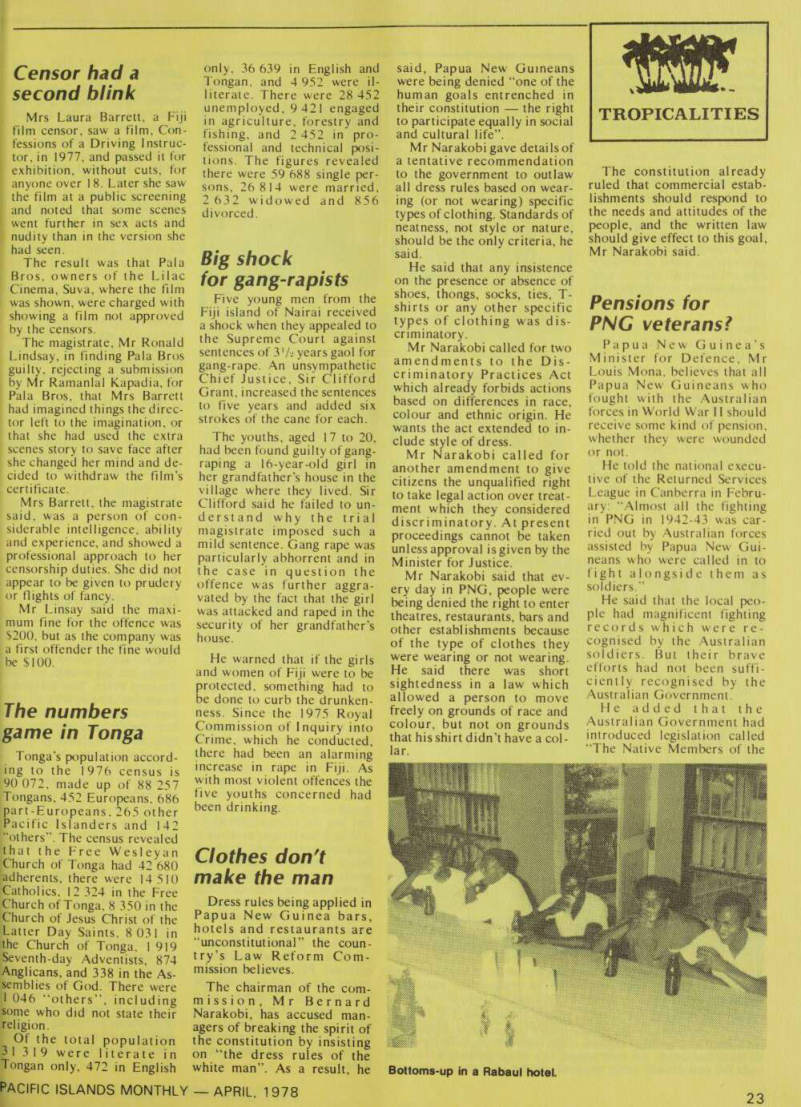
Bottoms-up in a Rabaul hotel.
Forces Benefits Act”, whose provisions were obviously in tended to be implemented.
But for some reason it had been forgotten until a few years ago when, due to pressure from the RSL, some payments had been made.
Many of those entitled to benefits had since died, re ceiving nothing for their ser vices.
But about 3 000 Papua New Guinean ex-servicemen were still alive, but without any or ganisations such as Legacy,
repatriation hospitals,
Medibank or old age pension schemes to cater for their needs.
Mr Mona said he believed that a special, united and final grant of SA3 million would be sufficient to pay these men a small pension to supplement their present paltry incomes.
He concluded; “The battle of World War II is not over yet. For every shot fired there is an echo. This battle is still being fought in the hearts and minds of mothers, wives, and the sweethearts ot these veterans’ sons and daughters.”
That stamp
business again
Niue is jubilant. Its philatelic bureau has an nounced that the island’s stamps have become its largest export earner. Ac cording to the bureau, quoted in the government newspaper, Tohi Tala Niue, the stamps “probably earned more last year than all other exports combined”.
The bureau was established six months ago after the government had made an agreement with American stamp promoter Mr Finbar Kenny who contracted, as he has with the Cook Islands Government, to handle Niue’s stamp issues and sales.
In the first three months of its existence, Tohi Tala Niue reported, “the bureau earned $l5 000 for the government, representing half of the gross earnings”.
Which is very nice for Mr Finbar Kenny for he also got $l5 000 out of the deal.
PIM and others have won dered for some time what the set-up was between the Cooks and Mr Kenny. Together, they’ve poured out a multi coloured stream of stamps over the past decade using any
excuse for a new com memorative issue including some which hadn’t the remotest connection with the Cooks. So far, however, there hasn’t been an issue com memorating the purchase of a new suit for Sir Albert!
Now, Tohi Tala Niue has lifted the lid. It reports: “The American group, which is headed by Mr Finbar Kenny and has indicated to TTN a reluctance for publicity, un dertakes the printing and marketing of the stamps all over the world, but mainly to the lucrative stamp market in the United States.
“And Niue’s part of the ar rangement is to lend its name to the stamps and hand ad dress the envelopes sent to stamp enthusiasts. For this ar duous task 10 girls, headed by the manageress, Mrs Val Mc- Coy, are employed in the philatelic bureau.
“The American company has a similar arrangement with the Cook Islands where it has been operating for more than 10 years. The contract is for the Niuean Government to collect 50% of the gross returns and for the American group to take the other 50% and pay the costs involved.”
Which is all right as far as it goes. Almost anything which brings income to the Islands, particularly little Niue or the Cooks, is to be welcomed, but is it wise to flood the stamp market for no other reason than to make money?
John W. Rabarts, manager of NZ-based Penwinkle Inter national Philatelic Auctions, wrote in a letter in PlM’s March issue; “I cannot help but feel that Niue is in danger of committing philatelic suicide, following Tonga, the Cook Islands, Aitutaki and Penrhyn.”
He argues that the policy adopted by the Cooks and Niue debases their stamps and writes: “For Tonga and the Cook group the die is cast.
Serious collectors have de serted them in droves or ‘cut off’ their collections in the 19605. Niue could yet be sav ed if they wish.”
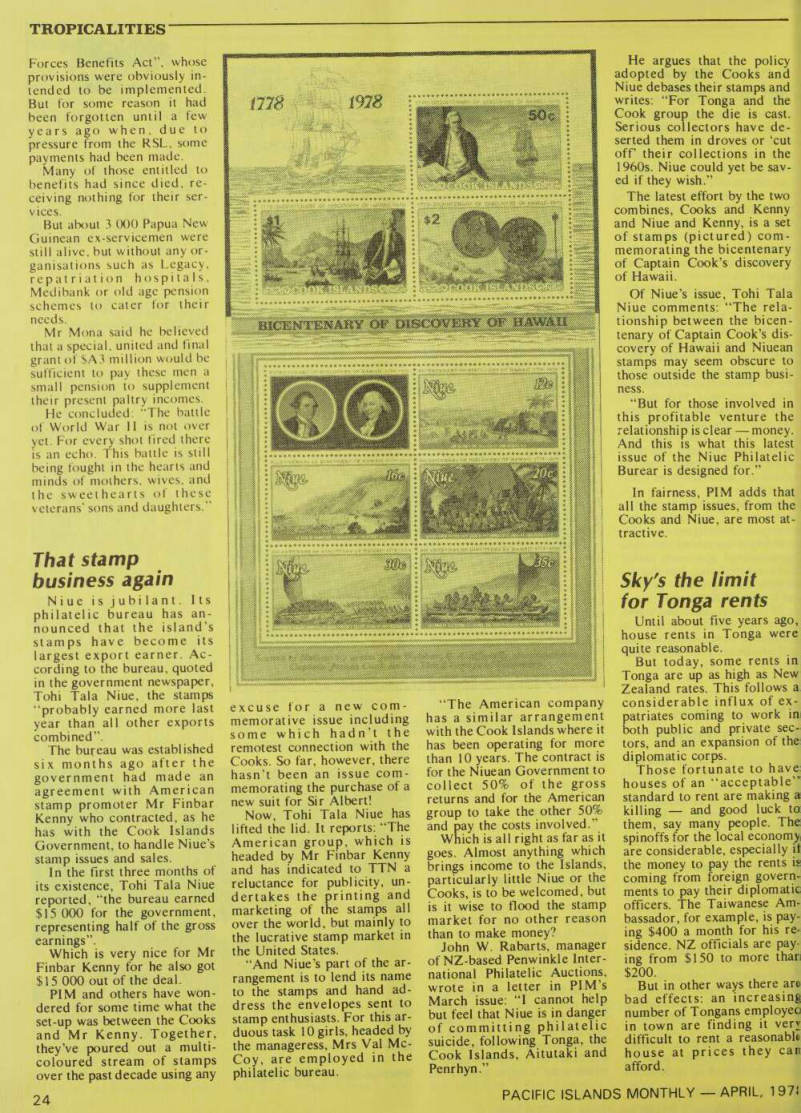
The latest effort by the two combines, Cooks and Kenny and Niue and Kenny, is a set of stamps (pictured) com memorating the bicentenary of Captain Cook’s discovery of Hawaii.
Of Niue’s issue, Tohi Tala Niue comments: “The rela tionship between the bicen tenary of Captain Cook’s dis covery of Hawaii and Niuean stamps may seem obscure to those outside the stamp busi ness.
“But for those involved in this profitable venture the relationship is clear money.
And this is what this latest issue of the Niue Philatelic Burear is designed for.”
In fairness, PIM adds that all the stamp issues, from the Cooks and Niue, are most at tractive.
Sky's the limit
for Tonga rents
Until about five years ago, house rents in Tonga were quite reasonable.
But today, some rents in Tonga are up as high as New Zealand rates. This follows a. considerable influx of ex patriates coming to work ini both public and private sec tors, and an expansion of the; diplomatic corps.
Those fortunate to have; houses of an “acceptable’” standard to rent are making a killing and good luck to; them, say many people. The spinoffs for the local economy are considerable, especially it the money to pay the rents is coming from foreign govern ments to pay their diplomatic officers. The Taiwanese Am bassador, for example, is pay ing $4OO a month for his re sidence. NZ officials are pay ing from $l5O to more than $2OO.
But in other ways there are bad effects: an increasing number of Tongans employee in town are finding it very difficult to rent a reasonable house at prices they can afford.
The high rents are also hav ing their effects on land prices. (While the land laws of the kingdom forbid the sale or purchase of land, the practice ; is rather different.) A section of farmland of the traditional size of 3.2 ha (8 acres) today commands a price of no less than $1 500. A few years ago it could have been bought for less than half that price.
One of the churches in Tonga is noted for the part that it has played and is still playing in pushing up the price of land to an exorbitant degree.
It is also understood that an overseas government has just paid $5O 000 for a piece of land in the heart of Nukualofa. The money was paid to get the owner to agree to leasing the land, and is quite apart from the annual lease payments. It does not and will not appear in the of ficial lease documents.
There is a growing local opinion that an immediate stop should be put to such practices.
Jumbo caused
a sensation
A Boeing 747 jet making its first landing in Papua New Guinea in mid-February drew a bigger crowd at Jackson field, Port Moresby’s airport than the Queen got last year.
More than 7 000 people crowded the public enclosures and roads at the airport, and police worked for two hours handling traffic and clearing traffic jams.
Qantas, which first op erated into PNG 33 years ago, flew the Jumbo from Sydney on a proving and de monstration flight. The jet will go into regular service on the route in April, sup plementing 707 services
already operated by Qantas
and Air Niugini.
The new arrival got bigger and better as excited radio an nouncers described the ar rival over a national radio hook-up it went from four storeys high to five and even tually to six in the space of a few minutes.
And one radio com mentator made air traffic of ficials gulp when he said “it’s now about to fly over the city at one hundred feet”.
Actually, it made a slow pass at about 3 000 ft, ap proaching over the sea. Before returning to Sydney, the jet made a demonstration flight over the north-eastern PNG mainland.
Luxury on
the cheap
Fiji has not yet reached the stage of providing a fleet of Rolls Royce cars for cabinet ministers, but is just short of it. The fleet of Holdens, bought in 1970, has reached the end of its economic life, and will be replaced by 12 air-conditioned Mercedes Benz, worth about $2O 000 each, but which will cost Fiji about $ll 000 each because the government gets them duty-free.
Mr Tomasi Vakatora, Minister for Communications, Works and Tourism, ex plaining the decision to buy Mercedes Benz, said they were longer lasting than Holdens, and would have a good resale value when the government wanted to sell them. The government ex pected to use them in the car pool for at least 10 years before considering a change.
The Mercedes Benz on order would run more cheaply than other cars because they used diesel fuel.
Happy ending to
Suwarrow story
The sad story (PIM, Nov 1977, p 11) of the disap pearance of the visitors’ book, post office box and other effects of the late Tom Neale from his island home of Suwarrow in the Cooks has a happy ending.
Tom’s friend of many years, Don O’Bryan, manager of the Cook Islands Trading Com pany, has set out the facts in a letter to another friend of Tom’s, Byron Hart. From his home in Boulder, Colorado, US, Mr Hart has sent PIM a copy of Mr O’Bryan’s letter, which says in part: “Now about the PIM story...
“To put you in the picture, a yacht did take Tom’s post of fice box, outboard motor, radio set, visitors’ book and some hand tools. But this yacht did not make
Rarotonga, but put into Bora Bora. The crew then handed over Tom’s property to another yacht (American) which came to Raro, con tacted me, and handed all the goods over to me.
“The post office box has been handed by me to the Rarotonga Post Office.
“I understand that the yacht crews that have called at Suwarrow since Tom left have been very good. They have kept the place cleaned, painted the shack and even remembered to feed the cat (cats? one only reported). The chickens have been looked after, too.
“The Catholic Mission vessel, which recently went to Suwarrow, should now be back in Raro. I have asked them to hand over to my staff all of Tom’s gear that was left on the island. As the skipper and engineer were all well known to Tom, I have no wor ries on that score.
“I expect to go back to Raro from my short stay on Mitiaro in the last week in January.
“Your guess is as good as mine what I’ll be getting from Suwarrow. Under Tom’s will I
am to dispose of it as best I can. Tom’s two children and four grandchildren share the estate (small as it is). I’ll do my best for the children ...”
A village with
all mod cons
Saturday, February 4, was power day for the small Fijian village of Vatukarasa, in in land Viti Levu, about an hour’s drive from Suva and then another 45 minutes up the Rewa River in a putt putt’.
In a government-assisted operation, the University of the South Pacific and British Volunteer Service Abroad engineers harnessed a small waterfall near the village to give an assured power supply for fans, drills, bright lights and hot water.
The villagers supplied the labour. They built a dam, which fell down, so they had to start all over again. They laid more than 90 m of pipe, most of it about 4.5 m under ground. The carried more than 100 bags of cement, and
This picture from the Western Samoa Prime Minister’s Department newspaper Savali shows an enterprising piglet at Tafaigata Prison Farm outside Apia helping itself to a meal, and it’s been going on for weeks. The piglet happened to pass the ruminating cow one day when it felt it had been squeezed out of its fair share of sow’s milk.
Here was another supply absolutely on tap. The cow didn’t object so the piglet made it a daily habit. It might seem to be a clever pig but as it’s growing faster and bigger than the rest of the litter its enterprise could land it in the soup.
other raw materials up a 400 m steep muddy track from a river bank. The USP pro duced the turbine in an ex perimental workshop. One of the BVSA engineers was Hil ary Wyper, from Glasgow, who has been in Fiji for about two years. Along with another volunteer, Mike Watkins, and government experts, she started work on the scheme, in October, 1977, and was on hand at Vatukarasa to see the Deputy Prime Minister, Ratu Sir Penaia Ganilau, com mission the plant.
It was no ordinary opening.
The villagers turned on full Fijian ceremonial to welcome Ratu Sir Penaia and his party.
Ratu Sir Penaia’s tasks in commissioning the plant were to turn on a tap to release water into the turbine, and to flick a switch to turn on the power. He “cut” his way into the powerhouse by snipping a ribbon across the door with a special pair of scissors.
The total cost of the scheme was about $lO 000, a com paritively small sum to spend to give people a major ameni ty of modern living. Excess power during the day is used to heat water. At night the power is used for lighting ev ery bure, the church and the village shop. The women may use a power point in the powerhouse for ironing. An electric refrigerator in the
shop will give villagers a much wider choice of food.
As a bonus the villagers may swim in the dam which stores the water for the tur bine.
A caning for NT's
curatorial ways
When New Zealand was selected to host the Second In ternational Symposium on Oceanic Art in February, one immediate reaction was prob ably not foreseen, the dismay of some delegates at the storage conditions of Maori artifacts and other treasures at the National Museum in Wellington, writes William Gasson in Wellington.
Two delegates from the Bishop Museum in Honolulu, Dr Anthony Werner, who is director of the Pacific Region Conservation Centre there, and Dr Roger Rose, Curator of Ethnology, were appalled.
“1 am very surprised that you have no conservation facility attached tothe museum," Dr Werner said.
In his view the museum’s Curator of Ethnology, Mrs Betty McFadgen, and her staff, “are doing the best job under appalling conditions they are so extremely over crowded".
“It just doesn’t seem that
the National Museum is given the consideration it deserves in view of the importance of its collection,” Dr Rose addec p Dr Werner toured the dingy basements in the museum, fingered the stacked carvings, spears, arrows and bows. He saw Maori canoes piled in a
courtyard under a tarpaulin,
fingered mould on a New Guinea arrow and said: “All this damage is insidious and it progresses over time. The aim of conservation is to prevent this type of damage, not to restore artifacts once they are
damaged.”
The symposium formed a Pacific Arts Association. It then promptly criticised the rapid deterioration and loss of Maori and Pacific artifacts, adopting a resolution calling on the New Zealand Government to provide conservation facilities in viewjof their almost total lack mthe country.
One delegate commented pointedly: “Pdynesian artifacts were brought here from the Islands for safekeeping.
Now some of the Islands have better preservation facilities than New Zealand, bo logically all the Polynesia items should be returned to the islands where they can be keDt ”
For good measure the association sent copies of its re-
solution to Prime Mmister Muldoon and the Minister for the Arts, Mr Alan Highet.
The museum’s director. Dr R. K. Dell, welcomed the at tention overseas visitors gave to the inadequate facilities at the museum, For some 20 years the museum has been trying to get the government to provide money to allow better facili ties to be built, jbe Ministry of Works is now prepar i ng working draw j f or a massive extension fo ® air .conditioned storage: and work room s. “The plans; are very good,” said Dr Dell..
“i t ’ s the execution of the plans; t hat worries me.” He doubtedl he wou be around to see them translated into build ■ when asked to put a price
museum’s gradually
treasures Di d could Qn f that , h 6 contents of the Maori Hall t u e major showroom:: «ot men«U wou , d b( , million dollars Arts Asa soc °° l on ? s international secretary Roger Meisch Nationae Museum Wellington. The presi, dent is Mr Geoffrey Musul wo( joga, director of the Nations Art Gallery and Museum at Pon Moresby. Papua New Guinea be P
Have you ever seen a crocodile at full gallop? This picture, a rare one indeed, was taken by Bob Hawkins while visiting the Bensbach area of PNG's Western Province. As a matter of fact crocodiles can gallop at 42 kmh but only when they are in a panic. Bob was the information counsellor with the Australian High Commission when he took the picture. The reptile panicked when it was wakened by Hawkins. Had it galloped the other way Bob would have panicked.