Agana And The American Dream
p. 19 · Read in the full issue
SOCIAL COMMENT Dr Jim Boutilier records his impressions of a short visit to Guam. They do not amount to a particularly flattering portrait, but his hope in writing this account is that it will balance more enthusiastic descriptions of the island which sometimes find their way into print.
I stayed in Agana, Guam, for a few days recently during a trip from Tokyo to Truk. It was my first visit to the island “where America’s day begins”, and which is, in many ways, a microcosmic reflec tion of the American ex perience in Oceania and Pacific East Asia.
As a newcomer though one who has travelled fairly extensively in the Islands my observations are, of course, superficial and sub jective. Moreover, they are confined to what, in the 19th century, would have been called “the beach”, and what, in 20th century North American parlance is the “main drag”, the four-lane thoroughfare which runs through Agana and the neighbouring municipalities between the upthrust coral ridges and the sea.
Perhaps if a justification is required for generalised com mentary on current urban conditions in a Pacific port town, we should perhaps re call the value which we place now on the observations of transients who visited such 19th century towns as Papeete, Levuka, or Tulagi.
The population is a polyglot one. Two little boys playing marbles in the shadow of a giant land mover are named Jose and Ramon, their fathers from the Philippines. Behind the counter at Pan American work 12 Vietnamese refugees from the war in South-east Asia, a conflict com memorated by Saigon Lil’s Warehouse, a local night club where a young lady billed as “Hot Stuff from San Fran cisco” appears “to nite and every nite”. An Indian book keeper is hunched over his ledgers trying to finish the ac counting for a fabric shop before leaving for a family wedding in Bombay. Rosa Cruz, whose parents are part-
Guamanian and part-Filipino,
is about to leave for a wedding in another part of the world, California, where thousands of Guamanians reside in Long Beach and San Diego.
Another young Guamanian has come the other way and is relaxing in the shade of a fish
ing boat while his friends make ready their yacht for a cruise to the northern Marianas. A taciturn Korean stands in front of his re staurant watching the traffic go by. Up the road, Pedro’s Restaurant features “The Warblers’’, Beth, Darlene, Carmen, and Bong direct from Manila. Nearby the Guam school of languages features tuition in English, Chamorro (a language in which many of the young Guamanians of Chamorro ex traction with whom I spoke seem to have little or no fluen cy), Spanish and Japanese.
The Japanese presence is considerable. The JAL 747 I travelled on was completely full and many of the passengers were Japanese honeymoon couples coming to Guam. Once there they were whisked away in Turtle Tours buses (a Japanese concern) to Japanese-owned hotels like the Guam Reef Hotel or the Dai Ichi. The first thing you see when you approach the Hilton Hotel is a wing housing the Genji, a Japanese re staurant. Many of the com mercial signs are in Japanese, there are a variety of small Japanese eating places, the Faith Book Store features Japanese in 30 Hours (as well as Vietnamese in a Nutshell), and one of the local stores has on display in its front window, along with Heidelberg beer steins and an indifferent rep roduction of a frontier flintlock, complete with powder horn, a set of Japanese samurai swords.
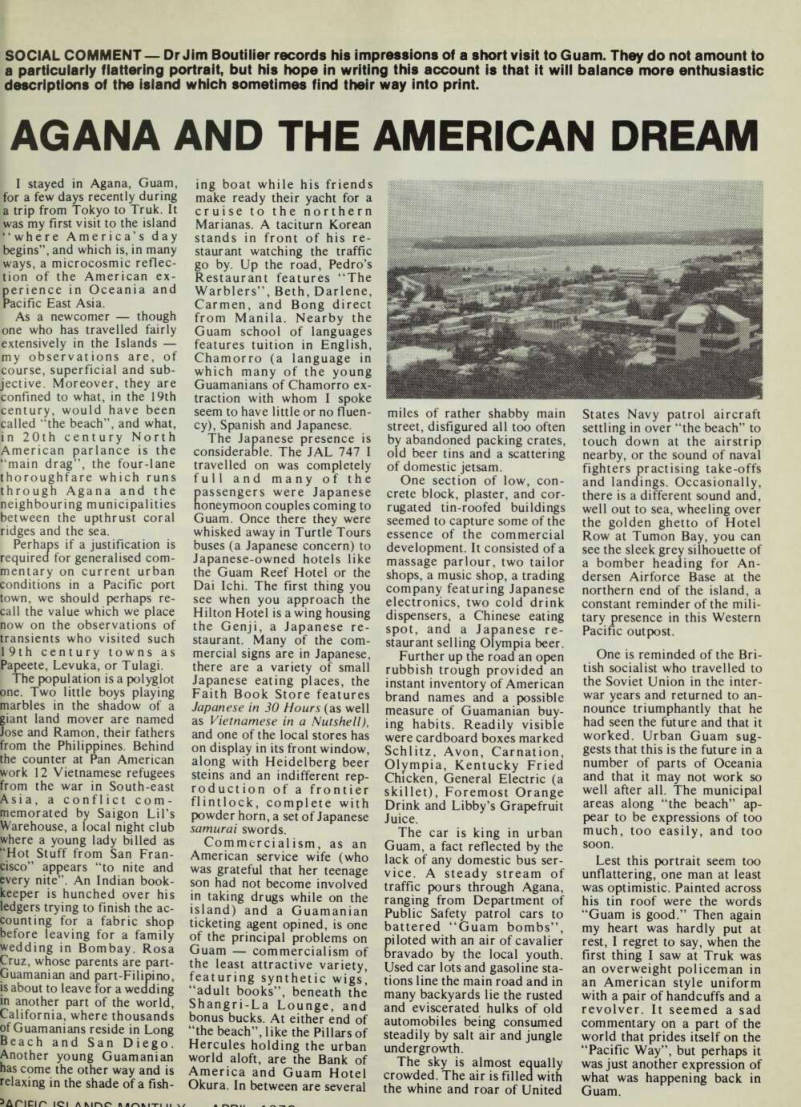
Commercialism, as an American service wife (who was grateful that her teenage son had not become involved in taking drugs while on the island) and a Guamanian ticketing agent opined, is one of the principal problems on Guam commercialism of the least attractive variety, featuring synthetic wigs, “adult books’’, beneath the Shangri-La Lounge, and bonus bucks. At either end of “the beach’’, like the Pillars of Hercules holding the urban world aloft, are the Bank of America and Guam Hotel Okura. In between are several
miles of rather shabby main street, disfigured all too often by abandoned packing crates, old beer tins and a scattering of domestic jetsam.
One section of low, con crete block, plaster, and cor rugated tin-roofed buildings seemed to capture some of the essence of the commercial development. It consisted of a massage parlour, two tailor shops, a music shop, a trading company featuring Japanese electronics, two cold drink dispensers, a Chinese eating spot, and a Japanese re staurant selling Olympia beer.
Further up the road an open rubbish trough provided an instant inventory of American brand names and a possible measure of Guamanian buy ing habits. Readily visible were cardboard boxes marked Schlitz, Avon, Carnation, Olympia, Kentucky Fried Chicken, General Electric (a skillet), Foremost Orange Drink and Libby’s Grapefruit Juice.
The car is king in urban Guam, a fact reflected by the lack of any domestic bus ser vice. A steady stream of traffic pours through Agana, ranging from Department of Public Safety patrol cars to battered “Guam bombs’’, piloted with an air of cavalier bravado by the local youth.
Used car lots and gasoline sta tions line the main road and in many backyards lie the rusted and eviscerated hulks of old automobiles being consumed steadily by salt air and jungle undergrowth.
The sky is almost equally crowded. The air is filled with the whine and roar of United
States Navy patrol aircraft settling in over “the beach” to touch down at the airstrip nearby, or the sound of naval fighters practising take-offs and landings. Occasionally, there is a different sound and, well out to sea, wheeling over the golden ghetto of Hotel Row at Turnon Bay, you can see the sleek grey silhouette of a bomber heading for An dersen Airforce Base at the northern end of the island, a constant reminder of the mili tary presence in this Western Pacific outpost, One is reminded of the Bri tish socialist who travelled to the Soviet Union in the inter war years and returned to an nounce triumphantly that he had seen the future and that it worked. Urban Guam sug gests that this is the future in a number of parts of Oceania and that it may not work so well after all. The municipal area s a long “the beach” ap pear to be expressions of too much, too easily, and too soon.
Lest this portrait seem too unflattering, one man at least was optimistic. Painted across his tin roof were the words “Guam is good.” Then again my heart was hardly put at rest, I regret to say, when the first thing I saw at Truk was an overweight policeman in an American style uniform with a pair of handcuffs and a revolver. It seemed a sad commentary on a part of the world that prides itself on the “Pacific Way”, but perhaps it was just another expression of what was happening back in Guam.