Papeete: The complex anatomy of
pp. 15-17 · Read in the full issue
a prison riot
POLITICAL VIOLENCE —Well-known authors Marie-Therese and Bengt Danielsson, writing from Tahiti, sort out the tangled threads leading up to the January riot in Papeete’s central prison which left two people dead, and point to its implications for the future.
When the bombing of the telephone exchange and the murder of a French businessman in Tahiti were reported in the November 1977 issue of PIM (pi 6), these crimes were described as serious blows to the traditional image of the island as an earthly paradise. What little was left of this glossy image, propagated by all designers of tourist posters, has now been definitely destroyed by the bloody prison riot on January 14 which left two dead. What is new and worries the hitherto complacent population is that all these violent acts are politically inspired and strongly anti- French.
It could hardly be otherwise. The constant policy of
the Paris government, since the early 19605, when General de Gaulle made his fateful decision to use the islands of French Polynesia for testing an endless series of nuclear bombs, has been to maintain the colonial system so as to prevent “the locals” from throwing out the bomb peo pie, as the Algerians did after independence, when they closed down the French nuclear bases on their terri tory.
To make the islands even more “secure”, they were im mediately occupied by thou sands of army troops and foreign legionnaires and hundreds of gendarmes and police agents representing the various branches of the French secret services, as well
as the special “Thought Police”, (Renseignements Last but not least, since the tests began, civilian settlers from France and the former French colonies in Africa have poured into Tahiti, at the rate of about 1 000 a year, and now number at least 15 000. Most of them have gone into business, bought land and some have married local women. It is therefore no exaggeration to say that Tahiti has been colonised in the worst 18th century fashion, and this at a time when elsewhere in the Pacific and the Third World the evolution has been exactly the opposite, towards freedom and independence for all other colonial peoples.
In such a blocked colonial
situation, as history has shown us, some frustrated indi viduals will unavoidably end up by resorting to violent ac tions, and this is precisely what has happened in Tahiti.
The first attempt at open revolt, however, was so clum sy that nobody took it seriously. It occurred in 1972, when a group of young Tahi tians stole a few boxes of blank ammunition from a French army camp outside Papeete. When caught, they explained their theft as a sym bolic act of defiance. They wanted to use the court as a public forum for their de mands: independence and cessation of all nuclear tests, One of these early protesters was a certain Charlie Ching who in spite of his Chinese
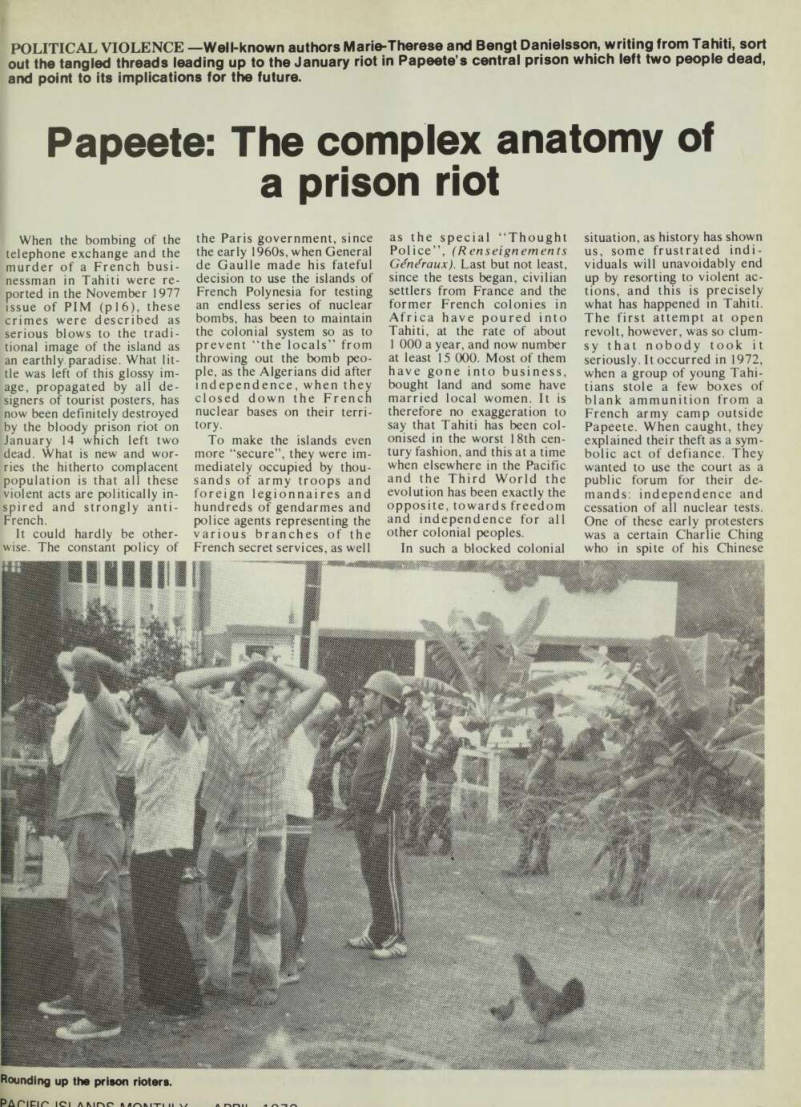
Rounding up the prison rioters.
name is culturally a Polyne sian. His greatest political asset is his close kinship tie with Pouvanaa a Oopa: he is a nephew of the old Tahitian freedom fighter who, in 1959, was sentenced, on trumped-up charges, to eight years in prison of which he had to serve seven and a half in France.
Benefiting from the general amnesty that traditionally follows the election of a new president of the French Re public, Charlie Ching was liberated in 1974, when Giscard d’Estaing’s term began. On his return home, he founded a new political party whose whole programme was immediate and complete in dependence from France. His first attempt to win support was at the polls, when Francis Sanford was re-elected depu ty, in September, 1976. Ching got only 676 votes, or 1.66% of the total votes cast.
But his real influence was greater and widening, for he appealed to an increasing number of poor and bewildered Polynesians who felt like strangers in their own land. Those who listened most eagerly to Charlie Ching’s simple message were the young, unemployed boys, who had been rejected by a society which they did not understand or care for. From a sociologi cal point of view, they rep resent a whole lost generation,
for they do not any longer believe in the traditional values of their parents'and grandparents and, on the other hand, European values are still foreign and unattaina ble to them. Most of ihem had by then formed gangs, some of which had adopted Ching’s political programme.
In June and July, 1977, one such gang called Te toto tupuna, “The blood of our an cestors”, decided to act. Not content with a symbolic act they decided to steal more useful stuff than blank muni tions dynamite. With the same ease, they entered the storerooms, first of a private construction firm and then of the Public Works Depart ment, and carried off more than 300 kg of dynamite. The perfect occasion to use it came in the middle of August, when the minister for the French overseas territories, Olivier Stirn, visited Tahiti.
Probably deterred by the strong protective guard which surrounded him, the Te toto tupuna commando chose to blow up the telephone ex change, situated in central Papeete, opposite the gover nor’s residence. If they had succeeded fully, the ensuing lack of this vital means of communication would prob ably have allowed them to commit other acts of sabotage.
As it was, they went about it in such an inept manner that
only the first of the four
charges exploded, producing
structural damage to the building, but none to the ap paratus. When searching the debris, the police found a message worded. “Take your flag, your people and your statute, Stirn, and go home!”
Since this first political bombing in Tahiti caused no casualties, it seemed quite unreal to most people, who did not feel seriously concern ed. The next attack by a Te toto tupuna commando, however, shocked everybody deeply. It occurred two weeks later, on the night of August 27, and the site was a villa in the swank residential section in Punaauia called the Lotus.
A former French navy officer turned businessman, Pierre d’Anglejean, was shot as he lay asleep in his bed. On a sheet of paper pasted on the wall was written in capital let
Ters. We Do Not Want
Any More Frenchmen
In Our Country. It Was
signed Te toto tupuna. Mrs d’Anglejean, sleeping in the same bed, was spared, ob viously because she was of Tahitian and Chinese ex traction. The only possible implication of all this was that Mr d’Anglejean had been murdered for no other reason than that he was French.
Nobody can keep a secret in Tahiti, and this time, with the help of a couple of informers,
the police managed to arrest 13 members of Te toto tupuna. A 14th member was brought back from Rarotonga, where he had believed himself safe from ex tradition. For good measure Charlie Ching was also ar rested, although he declared himself innocent and certainl> had not participated in any ol the commando raids. The of ficial charge brought againsi him was that he was the brains behind the gangs.
The significant fact here i; that the arrested members o the Te toto tupuna gangs, al in their late teens or early 20s had not previously committee any crimes and coulc therefore not be classified a juvenile delinquents. made no secret of their politi cal motives and only seemec to regret that they had no< been able to carry out mon than a small portion of thei action programme which ini eluded the blowing up oi French military planes ant navy ships serving the nucleai testing base on Mururoa They had also seriously coni sidered shooting down thi aircraft on which the ministe: for the French overseas ten ritories, Olivier Stirn, travel! ed, but had eventuall refrained, because there wer
numerous Polynesia
passengers.
With the arrival of the T toto tupuna gangs, the number
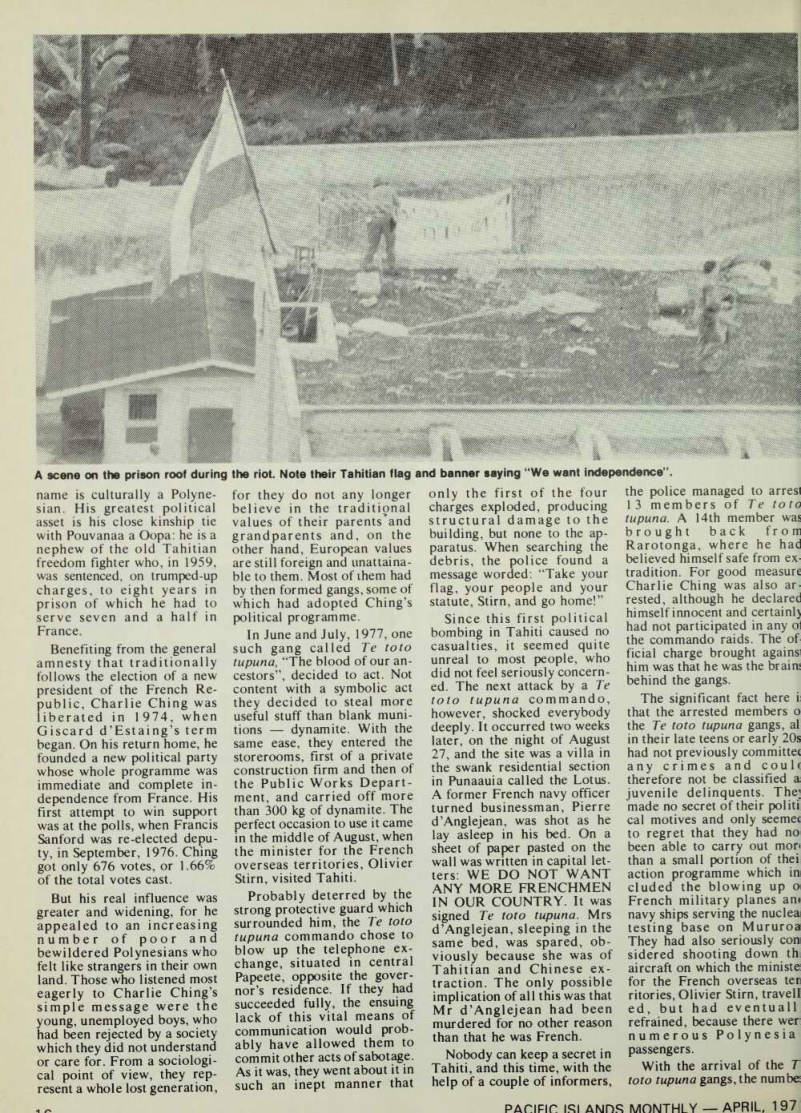
A scene on the prison roof during the riot. Note their Tahitian flag and banner saying “We want independence”.
of inmates in the new, modern prison building at Nuutania, west of Papeete, rose to 173.
Out of these 169 were Polyne sians, two foreign legion naires, one an Italian burglar and the other a French em bezzler. These figures show better than anything else how particularly vulnerable the Polynesians are to the viruses of crime introduced during the past decade.
The only previous prison riot in Tahiti took place in 1972 and resulted only in some material damage. The main request then made by the rioters was to have TV sets in stalled in the prison, and it was promptly granted by the governor. It is not unlikely that tlte inmates over the years have picked up a few ideas by watching the numerous crime movies and newscasts about prison riots in France, fre quently shown on our local TV programmes. However this may be, the riot which oc curred in the afternoon on January 14, was a much bloodier and more savage affair.
Some of the most hardened prisoners enticed a warder into their block, by pretend ing that one of them was sick.
They then fell upon the un suspecting warder and literally beat him to death with table legs. With keys taken from their unfortunate victim, they then opened the doors in the adjacent blocks.
When the other warders arriv ed on the scene, they were overpowered, in some in stances beaten, and thrown into empty cells. The only re maining warder tried in the meantime frantically to alert the gendarmerie stations in Papeete and at the airport, connected with the prison by a special line. But incredibly enough there was no answer probably because it was Saturday afternoon. The fran tic warder finally tried the or dinary telephone and man aged, without difficulty, to dial the Tahitian town police in Papeete who transmitted the chilling news to the authorities.
The first to arrive on the scene were the prison direc tor, Nedo Salmon, and the deputy director, his son Teina. They found the prison gate wide open and about 50 prisoners standing in the yard inside, apparently without any thought of escaping. The ex planation for this strange behaviour is very simple: they had not participated in the
murder of the warder and were still too surprised by their liberation to know what to do. Among them were prac tically all the members of the Te toto tupuna gangs. On the other hand, the murderers and some other hardened cri minals, altogether 14 men, had immediately escaped.
Nedo Salmon, who is a con summate politician and fine orator in Tahitian, tried to
persuade the prisoners to
return to their cells and declared himself ready to listen to any complaints they might have. They chose as their spokesmen four mem bers of the Te toto tupuna gangs who immediately delivered their demands.
They were: immediate inde pendence; send home all Frenchmen; stop poisoning us with your bombs.
The poor director, who had expected them to ask for better food, more frequent leave or perhaps a colour TV, could only promise to transmit their requests to the proper authorities.
By then the new High Com missioner, Paul Cousseran, had installed his headquarters opposite the prison, and the only answer he cared to give was, of course, to send for a company of foreign legion naires by air from Mururoa.
At the same time he ordered the 50 available gendarmes to encircle the prison building.
In spite of this, Nedo Salmon managed to extract a promise from the mutineers to hand over the dead and wounded warders on condition that those who came to fetch them were Tahitians and not Frenchmen.
As soon as this was done, the 50-odd prisoners who took an active part in the mutiny gave it an even more political character. First they searched the prison until they found a Tahitian red-white red flag, then they took it up to the roof and stuck it up on a
pole. Next they painted
streamers, made of bed sheets, with anti-French and anti bomb slogans. By then some of the mutineers had dis covered the warders’ beer supplies and collected all the bottles of spirits they could find in the dispensary.
A Tahitian party without music and dancing is no real party, and a record player was therefore brought up. Soon
everybody was wildly dancing
and singing. But now and then shouts were heard, mostly in French for the comprehension
of the journalists and the gen darmes: Vive Tindependance!
A has la bombe! Les Franqais dehors! The shouts were often accompanied by projectiles of various kinds aimed at the besiegers.
There is no doubt that the easiest solution, technically, would have been to cut off the water, food and electricity and wait for the mutineers to give up. But a drawn-out and successful defiance of the French authorities would have far-reaching re percussions, especially to be feared in view of the forthcoming general elections on March 12. The High Com missioner therefore decided (or had received orders from Paris) to use force.
The first attempt, made at midnight, was preceded by a volley of teargas grenades. As soon as the first exploded, however, the mutineers brought up three hostages to the roof and threatened to throw them down to certain death in the courtyard.
Their choice of hostages was again highly revealing of their general frame of mind: they consisted of the Italian burglar and the two Spanish legionnaires, locked up God knows what for and why in this civilian prison. The fourth European prisoner, the Frenchman, had hidden him self so well that the mutineers could not find him, which was probably very lucky for him.
The mutineers made the hostages sit on the edge of the roof so they could easily be pushed off it. This momen tarily stopped the barrage of teargas grenades.
The only thing for the High Commissioner to do was to wait for the mutineers to fall asleep, in good Tahitian tradi tion. By 4 am only half a dozen men were still on the roof and most were resting.
The hostages had also been allowed to stretch out. At 4.30 the High Commissioner gave the order for the assault to take place. A truck smashed down the main gate, and 50 gendarmes with weapons drawn rushed into the com
pound and placed dynamite
charges at all locked doors.
As soon as the prisoners on the roof realised what was going on, two of them grabbed one of the legionnaires and
began carrying him towards
the edge of the roof. The next moment three shots rang out.
One of the Tahitians staggered and fell, mortally wounded in the head and chest. The shots
had been fired by two of the best marksmen among the gendarmes, posted on a hill behind the prison. To avenge the death of his comrade, one of the other mutineers slashed the leg of their Italian with an axe, before disappearing into the building.
In the meantime, the gen darmes had advanced cautiously from block to block, throwing large num bers of teargas grenades into all rooms and corridors.
Nobody seemed to have the slightest inclination to resist, least of all those prisoners who, during all these goings on, had been sitting quietly in their cells, either locked or unlocked. Among them was, for instance, Charlie Ching.
Two hours after the signal to invest the prison building had been given, the last coughing, sneezing prisoner came out with his arms over his head or handcuffed behind his back.
A head count revealed that 14 prisoners were missing, and these were, of course, pre cisely the instigators of the break-out, who all had spent years behind the bars for “or dinary” crimes like theft, burglary, assault and rape and therefore were desperate enough to commit a murder in order to regain their freedom.
In a heavily populated is land like Tahiti, however, good hide-outs are extremely rare, and, like all other escaped prisoners in the past, these, too, were gradually re captured, until at the time of writing only three are still on the loose. Whereas, as we have already mentioned, the members of the two Te toto tupuna groups stayed within the prison walls, and took ad vantage of the opportunity that was offered them to pub licise their political ideas which evidently were shared by at least 40 or 50 of their fellow inmates.
The French authorities have ever since made spec tacular efforts to confuse the issues and deny all political significance to the telephone exchange bombing, the murder of Mr d’Anglejean and the prison riot. In a press conference, the High Com missioner went so far as to say that the nuclear tests and the military occupation of the is lands have absolutely nothing to do with recent events. In his view, the growth of violence in Tahiti, these last months, is simply a worldwide phenomenon from which no country can escape .. .