Melanesia and Asia
pp. 12-14 · Read in the full issue
Conflict at the meeting point of Melanesia and Asia
IRIAN JAVA —Nicolaas Jouwe delivers a sharp Melanesian response to a recent PIM article on Irian Jaya b) Indonesian scholar Dr R. S. Roosman. Mr Jouwe is president of the National Liberation Council of West Papuj New Guinea.
On October 19, 1961, the National Congress met in Hollandia. The 75 delegates, representing the entire ter ritory of WPNG, unaminously agreed and accepted the na tional flag (the Morning Star), national anthem (Hai Tanahku Papua, O, My Belov ed Papua), the state seal (Crowned Pigeon), and West Papua (New Guinea) as the name of the country. The flag and the state seal were de signed by me.
On October 18, 1961, the Government of Netherlands New Guinea, acting on the re commendation of the New Guinea Council, gazetted decrees relating to the two na tional emblems, the national anthem and the national name. Thus they became legal and were officially put into use on December 1, 1961. The Morning Star flew side by side with the Dutch flag and Hai Tanahku Papua was sung along with Wilhelmus, the Dutch national anthem. On February 16, 1962, the New Guinea Council informed Queen Juliana and the Dutch Government that the people of WPNG had chosen Decem ber /, 1970 as the target date for its independence.
While the Melanesians and the Dutch Government in WPNG were implementing educational and development programmes as preparations for independence, Indonesia, on the other hand, was at an advanced stage of negotia tions with the Soviet Govern ment to secure arms valued at more than US$2 billion in order to take WPNG by force.
The transfer of WPNG to the Indonesian Republic, through the intermediary of the United Nations Tempor ary Executive Authority (UNTEA) on May 1, 1963, signified the Indonesian Government’s success in crushing the hopes and aspira tions of the WPNG people, and-their preparations for in dependence by December 1, 1970 (just under two months after Fiji’s independence day, October 10, 1970).
Today, the Indonesian
Government, and individuals such as Dr Roosman, are ob viously putting out propagan da to discredit the Melanesian people in WPNG, and to pre sent an image of them as a bunch of primitive people still living in the Stone Age. And besides, the Indonesians are currently engaged in moves to persuade other Melanesian countries, particularly Papua New Guinea, through a fine exercise in political intimida tion, to recognise and accept WPNG as an integral part of Asia, and its people as Asians.
But the whole world knows that ethnically, geographi cally, culturally and by religion, WPNG is in direct contrast to Indonesia, or Asia for that matter. The truth is; WPNG should not and must not be separated from its natural environment, that c is Melanesia and/or Oceania.
Today, we the Melanesian people of WPNG, are not really so concerned so much with the artificial philoso phies and propaganda created by the Indonesians. We are
trying and will continue to try to upgrade our capabilities to be independent and to rehabilitate our traditional, ethnic, cultural, geographical and economic ties with Melanesians living east of WPNG. Indonesia is ap parently maintaining this forced separation by harsh and brutal means. During the past 15 years we, the Melane sian people of WPNG, have been successful in expanding our intellectual elite by more than 100 university graduates.
If one asks whether we, the Melanesian people of WPNG, are capable of running our own affairs, our answer is a positive yes. We are capable of ruling a country of our own. Starting at the top with the position of a Governor- General, a Prime Minister, Government Ministers and right on down to office clerks all these jobs could be held by Melanesians of WPNG themselves. A corps of 50 people to serve in the diplomatic service is even now ready to assume duty
when the time comes.
Economically, WPNG has a great potential to generate its own revenue. Its resources in clude oil, copper, nickel, natural gas, timber, fish, copra and so on. Apart from oil and copper, other natural resources have not yet been tapped or exploited. The In donesian Government has ir fact put WPNG’s timber re sources at the disposal ol Japanese firms for ex ploitation, almost at will. Oil exported out of WPNG dur ing last year alone was more than 50 million barrels wort! more than SUS7OO million The value of copper fluctu ated between SUS3OO tc SUS4OO million. The Indone sian Government receive: 35% royalty from WPNG ex ports. From these figures, ont can see clearly just how mucl of the Melanesian people’ wealth is being taken out o WPNG annually by Indonesi; and other countries, namel; Japan, the United States am Western European countries.
A most brutal, unjust am inhuman thing, quite contrar to the laws and regulations o the United Nations, was tha WPNG was forced to cut ol its links with its natural sur roundings, and Indonesia wa given the freedom to suppres and eliminate the original in habitants of WPNG and roi them of their wealth an natural resources. Accordin to reliable sources in Jakarta the Indonesian Government i at present enlisting suppoi from its near neighbours ti co-operate with her militaril to wipe out the liberatia movement in WPNG.
In 1973, newly independen countries, commonly know\ as the Third World group, le by Algeria, called on th United Nations to hold special session to determin rules and regulations for th protection of the natural r< sources of backward people; From April 9 to May 2, 197the UN General Assembly, i its Sixth Special Sessioi adopted Resolution 3202 (!
IV), called Programme of A>. tion on the Establishment of
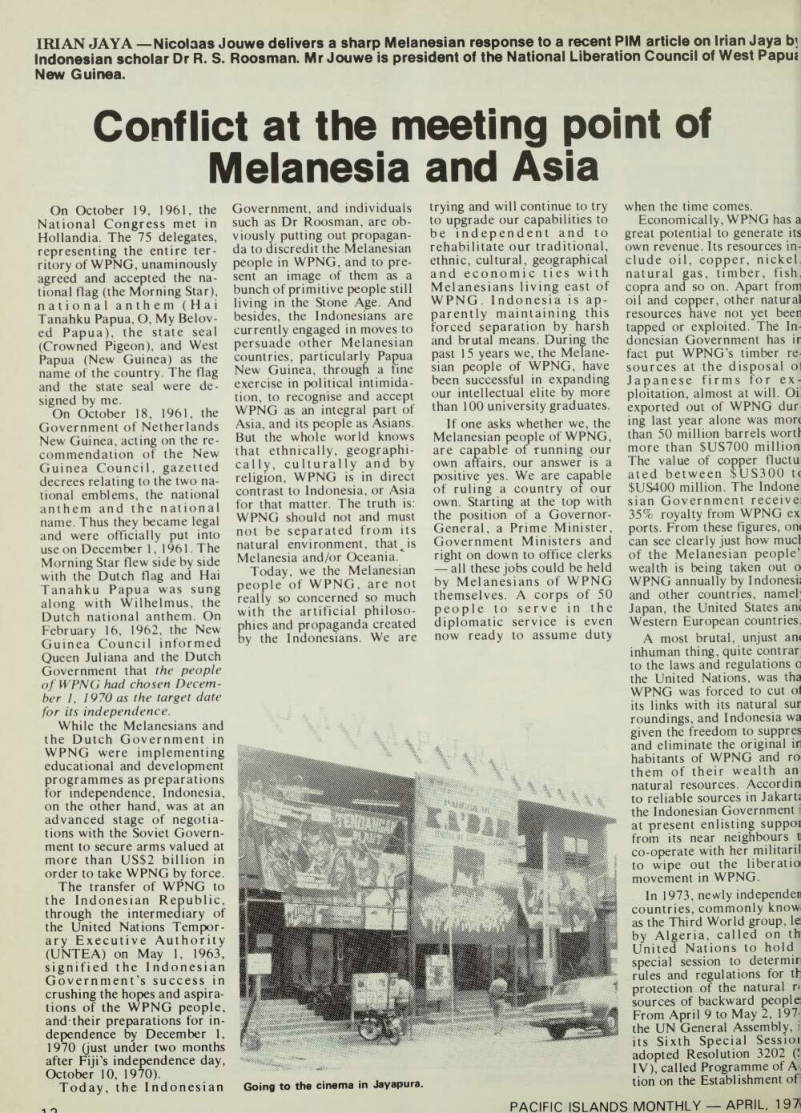
Going to the cinema in Jayapura.
New International Economic Order. The first chapter of this resolution read: “Fundamental problems of raw material and primary commodities as related to trade and development: “/. Raw Materials. All efforts should be made;— “(a) To put an end to all forms of foreign occupation, racial discrimination, apartheid, colonial, neo-col onial, and alien domination and exploitation through the exercise of permanent sovereignty over natural re sources.
“(b) To take measures for the recovery, exploitation, development, marketing and distribution of natural re sources, particularly of developing countries, to serve their national interest, to pro mote collective self-reliance among them, and to strengthen mutually beneficial economic co-op eration with a view to bring ing about the accelerated development of developing countries.” And so on.
Why should the Indone sians be allowed to continue this system of robbery and ex ploitation of WPNG right jnder the eyes of the Melane sian nations in particular, and the civilised world in general? \nd, above all, their actions ire contrary to the above cited binding resolution of the United Nations.
Why have millions of dol lars worth of goods, the right fill property of the Melane sians, been shipped away or stolen and used in the in terests of the Asians of In lonesia, who are already in jossession of rich territories hemselves?
Why do we people of Melanesia and Oceania have o go on our knees and beg to Jecome associate members of he European Economic Com munity, and have access to lid, when we allow other countries, including In lonesia, to ship away re sources from our own back wards?
I feel it is time for us Melanesians to give priority o a serious consideration of )ur common interests. What Indonesia is doing in WPNG s indeed contrary to the Universal Declaration of tfuman Rights. Indonesia is in act pursuing the very prac ices for which it condemned he colonial governments. The Jreamble of the Constitution )f the Republic of Indonesia
'Undang-Undang Dasar
1945) states: “ Whereas inde
pendence is the natural right of every nation, colonialism must be abolished in this world because it is not in con formity with humanity and justice. ”
Dr Roosman, in his article, as quoted earlier, says: ”... the spirit of tolerance which is now prevalent in Jayapura is in line with the Panchasila, Indonesia’s state philosophy, based on Five Principles of belief in God, humanity, national unity, de mocracy and social justice.”
Very well! It would be in the best interests of all concerned if Indonesia granted full inde pendence to the people of WPNG without bloodshed as the Australian Government has done in Papua New Guinea. If this can be done, Indonesia would be acting not only in line with its constitu tion, but above all it would create worldwide confidence and credibility in relation to the Indonesian state philoso phies and constitution.
In his article, “Jayapura is no longer a frontier town”, (PIM, Jan, p 39), Dr R. S.
Roosman touched on a num ber of points which clearly distinguish Indonesians from Melanesians in West Papua New Guinea (“Irian Jaya”). In fact, these differences form the basis of the present-day conflict between Irian Jaya’s original inhabitants, the Melanesians, and Asian migrants from Indonesia.
Dr Roosman says 80% of the Indonesian population is Moslem. This is incorrect.
Statistics published in a Moslem quarterly, The Moslem World, in Cairo, Egypt, last year, reveal that 95% of the Indonesian population is Moslem. This means that Indonesia is in fact the biggest Islamic state in the world.
In sharp contrast to this, about 95% of the indigenous population of WPNG is Chris tian (Protestants 55%, Roman Catholic 40% ), heathen 3% and Moslem 2% . The min ority Moslem community in WPNG is made up of coastal Melanesians, mainly living in the Raja Ampat group of is lands Waigeo, Salawati, Batanta, Misool, and on the west coast of Bird’s Head.
In October, 1956, the Pro testant church in WPNG became independent under the name Gereja Kristen Injili (GKI), or the Evangelical Christian Churches (ECC).
Before the Indonesian mili tary take-over of admin istration of WPNG from the
Netherlands, mesjids or mos aues were only to be seen on the Raja Ampat islands. Now mosques have sprung up like mushrooms throughout WPNG. Mosques are a status symbol in Indonesia. They are state institutions built with central government funds.
They help project the image of the greatness of an Islamic power in the Indonesian archipelago.
Dr Roosman tried to illus trate that the “spirit of tolerance” now prevalent in “Jayapura” is in line with Panchasila, Indonesia’s state philosophy, which is based on the Five Principles of belief in God, humanity, national unity, democracy and social justice. How attractive the state philosophy appears on paper! But the reality ex perienced by the Melanesians of WPNG from day to day is quite different.
In Indonesia, the majority rules. And that is the living fact faced by Melanesians in WPNG; the Indonesian ma jority rules. In every sector, the indigenous people are sup pressed, made to feel strangers in their own home land. The population ratio be tween WPNG and Indonesia 4s 1:130, a million Melane sians as against 130 million Asians.
Over the past 14 years, since Indonesia took over the administration of WPNG by force, leaders of underground movements within WPNG estimate that Indonesian forces have eliminated more than 155 000 Melanesians (May 1, 1963 to May 1, 1977).
This figure includes men, women and children. Jakar ta’s “wipe-out-the natives” operations are still enforced.
If an independent fact-finding commission from the UN or from already independent Melanesian countries in the Pacific, made a genuine in vestigation into these massacres, without inter ference from local authorities in “Irian Jaya”, that figure would well go beyond 200 000.
Dr Roosman in his article rather proudly claims that there are now 25 West Papua New Guineans occupying high positions in the provincial ad ministration in ‘ Irian Jaya”.
He says four of them have been made District Com missioners, and another 21 “departmental heads”. A reader of Dr Roosman’s arti cle would obviously conclude that the Melanesians in WPNG are still a backward
people. To understand their capabilities correctly and the educational level reached by the Melanesians in WPNG, let us look briefly at the history of WPNG, and the develop mental programme the Netherlands Government en tered into after WPNG was freed from Japanese occupa tion by General MacArthur and his Allied forces on April 22, 1944. (Indonesia was still in the hands of the Japanese at the time.) On September 1, 1944, the Netherlands Indish Civil Ad ministration (NICA), in an effort to develop “Papua Baru” (New Papua) the name advocated by a well known Dutch District Com missioner in the then Nether lands New Guinea, the late J.
P. K. van Echoud, who later became known as “Bapa Papua” (father of the Pa puans) established the Na tive Civil Administration Col lege (NCAC) at Kota Nica near Sentani. A total of 150 students went through this college.
Many of them were trained teachers and seminarians, products of the Protestant Mission Seminary at Miei in the Geelvinkbay, started earlier by another “Bapa Papua”, the late Rev Izaac Samuel Keyne. Rev Keyne was the man who composed the song “Hai Tanahku Papua” (“O, My Beloved Papua”) in 1923, which the New Guinea Council, the first WPNG Parliament, unani mously accepted as WPNG’s National Anthem in 1961. (The title Bapa Papua was given by the WPNG people only to these two Dutchmen, who contributed a great deal towards the advancement of Melanesians in WPNG.) Of the 150 students who went through NCAC at Kota Nica, 20 graduated as district officers, 50 as patrol officers, 20 as assistant police inspec tors and 60 as clerks. Senior WPNG leaders such as Mar cus Kaisiepo, Eliezer Bonay, Frans Kaisiepo, myself and many others, were among the first NCAC graduates. Frans Kaisiepo and Eliezer Bonay later successively became “Irian Jaya” governors.
During the 13 years from 1944 to 1957, acting on the recommendation of the first South Pacific Conference in Suva (April-May 1950), which emphasised the need for accelerated universal vocational training in the South Pacific Commission Is land territories, besides
NCAC, the Dutch Govern ment established the follow ing educational institutions to provide professional or
specialist training;
• 1947 a police college in Hollandia. • 1948 a seminary to train teachers and semi narians in Serui, Japen. • 1950 a college for as sistant medical officers, pathologists, dentists and nurses in Hollandia. • 1953 —agriculture and forestry college at Kota Nica. • 1954 nautical and meteorological college in Hollandia. • 1954 technical col leges in Hollandia and Sorong. • 1952-1955 —six junior high schools, one in each province, and a senior high school in Hollandia.
In November 1957, Australia and the Netherlands reached the Goroka Agree ment. Under this agreement, the two Governments agreed to carry out educational and development programmes in the then Territory of Papua and New Guinea and Nether lands New Guinea until such time as the Melanesian people of the two territories were prepared to determine their
own future. They would be given the opportunity to de cide this for themselves. The agreement also provided for possible unification of the two territories.
In mid- 1958 and early 1959, the Dutch Government introduced a “Papuanisation Programme”, or localisation, in WPNG. By the end of the decade, all positions in the civil administration, ranging from assistant district com missioner to clerk, were held by Melanesians. In the Department of Health, for ex ample, about 90% of the posi tions of assistant medical of ficers, assistant pathologists, assistant dentists and nurses, were held by Melanesians.
In the Agriculture and Forestry Department, 85% of the positions of agricultural and horticultural officer, and assistant agricultural and forestry officer, were held by
Melanesians. They included West Papua New Guineans who had studied at agriculture and horticulture colleges in Holland. Eighty five per cent of all coastal vessels, with tonnages of up to 500 tons, were run by Melane sians. Perhaps the only posi tions which Melanesians had not reached at that time were those of air pilots.
In 1959-1960, 100 students from junior and senior high schools were selected to study abroad on government scholarships. Those with high marks in English were sent to study at medical and technical colleges in Fiji and Papua New Guinea. The majority went to study in Holland and other European countries.
After Indonesia’s successful 1963-64 take-over if WPNG by force, most of these stu dents were persuaded to return to Indonesia and even tually to ‘lrian Jaya”. For tunately, a handful who went to Fiji and Papua New Guinea chose to continue their stu dies. They are now working as doctors, dentists and techni cians in Papua New Guinea, Fiji and Australia.
In early 1961, for the first time in the history of the whole island of New Guinea, a
one-man-one-vote secret ballot was conducted in WPNG to elect its first Parlia ment. It was called Nieuw Guinea Raad (th.e New Guinea Council), and was in augurated on April 5, 1961.
Its membership consisted of 23 elected Members and five nominated Members. At the inaugural ceremony in Hollandia, which was also at tended by the Australian and New Zealand Foreign Ministers, representatives of the United Kingdom, France and Papua New Guinea, and Her Majesty Queen Juliana, Queen of the Kingdom of the Netherlands, through the Dutch under-secretary for Home Affairs, invited the Melanesian people of WPNG to choose a target date for the realisation of independence. • It was reported in late February from Port Moresby that two senior members of a West Irian freedom fighters" movement were being held there for questioning. Papua\ New Guinea’s Foreign Affairs : Minister, Mr Ebia Olewale,, said the men, Mr Amos Indey and Dr Dorius Maury, had given themselves up to the authorities after crossing into
Png.
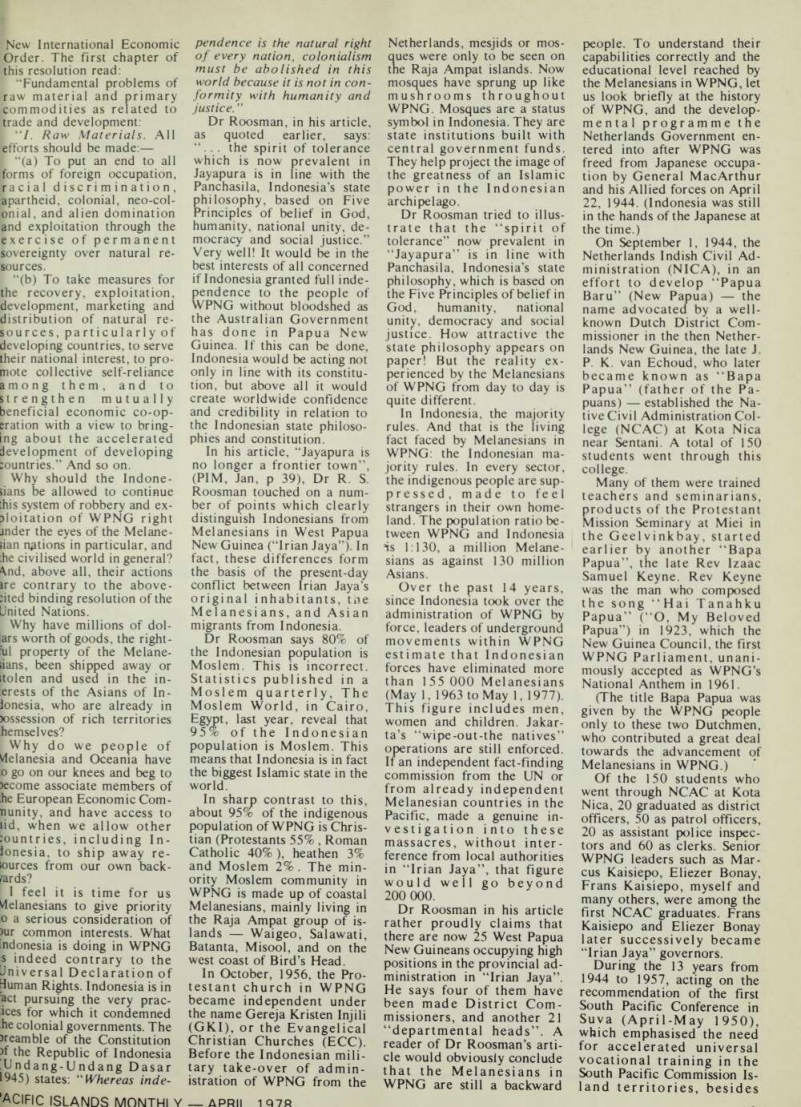
Mr Jouwe.