Japan’S Plea: Give Is Access Tp Your Waters
pp. 10-11 · Read in the full issue
The big powers are wooing the Pacific Islands. The Islands are feeling their strength, more particularly sincei they decided to parcel up the ocean Into fishing and economic zones, and Invite the fishing nations to make bids for their favours. Japan is vitally interested and, below, the Japanese Ambassador to Australia and hia country’s spokesman in the Islands, Mr Yoshio Okawara puts Japan’s case at PlM’s invitation.
The South Pacific, which has long been a remote place in the minds of the Japanese, is now attracting many Japanese, especially the younger generation, as a paradise of sparkling seas, colourful wildflowers and friendly, warm-hearted in habitants.
As soon as the Pacific na tions gained independence, Japan entered into diplomatic relations and has since been maintaining close and cordial relations with them. We are highly impressed by the efforts being made by the Pacific peoples towards econ omic and social development, and Japan, as a member of the Asia-Pacific community, wishes to make due con tribution towards their welfare and prosperity.
In accordance with this wish, the Japanese Govern ment has been extending bilateral co-operation to the Pacific nations, when re quested to do so, mainly in the form of technical assistance.
At the same time, Japan has collaborated in multilateral aid programmes such as the Skipjack Tuna Tagging Programme of the South Pacific Commission, and has participated in the interna tional co-operation schemes of the United Nations Development Programme, Asian Development Bank and other similar organisations of which Japan is a member.
Among the development efforts of the Pacific coun tries, particular note should be taken of their active in terests in fisheries develop ment in the vast sea areas which will come under their jurisdiction through the re cent development of an inter national order of the sea. We, in Japan, are following this re cent development with great interest.
Rice and fish have been the staple foods of the Japanese since time immemorial. In the
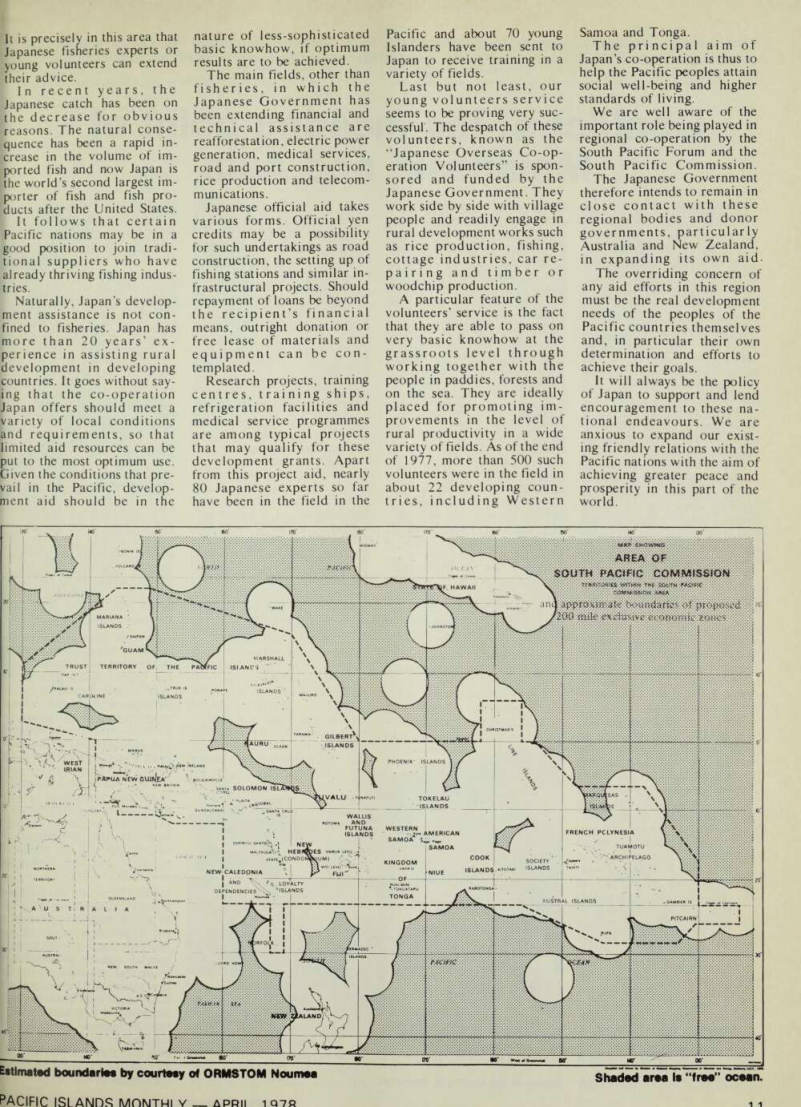
case of rice, we attained more than complete self-reliance many years ago. But as far as fish is concerned, Japan has had to look outside her own coastal waters for almost 40% of her annual consumption of 10 million tonnes. Now, with the establishment of a 200mile zone, Japanese fishing fleets are increasingly anxious to seek the agreement of the coastal states so that Japan’s fishing activities can be main tained • Pacific plan to establish a 200-mile zone by the end of March this year and, parallel to that, active consideration is being given to an interna tional management scheme of highly migratory species.
Against the background of these recent developments, we see greater awareness on the part of the Pacific nations of their own resources and of the need to develop their in digenous prosperity. We sup port the Pacific peoples’ aspirations in this field. In so doing we wish to emphasise two aspects of the issue which will bring about closer co-op eration between the Pacific nations and Japan.
The first aspect is that of Japan’s fishing activities. As the Japanese observer stated at the 17th South Pacific Con ference in Pago Pago last Sep tember, we would very much like to be given access to fish eries resources when and where a surplus exists. We put forward this request on the basis of the clear consensus achieved at the Law of the Sea Conference. Of course, we will have to have mutually ac ceptable arrangements with the coastal nations.
Naturally, we are well aware of the complexity of the problem of highly migratory species. We feel that, in the light of the highly migratory nature of fish and the mobility of fisheries, some form of in ternational management is
necessary to overcome practi cal difficulties. It goes without saying that such management should be based on objective statistical and biological data covering the whole range of migration, which in turn would require the co-op eration of all the countries concerned.
It is on the basis of this belief that we are co-op erating in the Skipjack Tag ging Programme initiated by the SPC. Indeed, Japan’s voluntary contribution towards this research programme indicates its readiness to co-operate wherever viable projects are undertaken. It is our desire to continue to participate in this and other programmes aimed at rational management of highly migratory species. We will be happy to extend our co-operation, if requested to do so, to such fields as re search, data collection and analysis. I am sure that our past experience and expertise in these fields could be of help in any prospective man agement schemes.
This leads me to elaborate on the second aspect on which Japan is to commit itself. In addition to extending our co operation in the field of re search and management as I referred to earlier, we also welcome the opportunity to help develop the fishing in dustries of the countries in the region. This includes the development of coastal fish eries, aquaculture and the processing of fishery pro ducts. Our assistance in the field of fishery takes the following form; • We accept about 100 fish eries trainees annually from abroad. Among them about 30 are accepted into three group training courses, one for coastal fishery, one for aquaculture and one for a fishery co-operative course.
The remaining 70 are ac cepted into individual train
ing courses at various labora tories, plants and factories.
All the expenses are borne by the Japanese Government. • We send approximately 100 fishery experts abroad to work with local experts or fishermen in various fields.
Despite language barriers, their work has been greatly esteemed by recipient govern ments including those in the Pacific region. • We have also a projeci aid system wherein a group ol experts with vessels and equipment are sent out to as sist in establishing research laboratories, exploratory fish ing, processing centres and sc on. One unique example ol this kind is the Southeast Asia Fishery Development Centre which comprises three depart ments, one for training, based in Bangkok, one for research in Singapore, and one foi aquaculture in the Philip pines. • The last category of fish ery aid is bilateral grants anc soft loans for such projects a research vessels, model pro cessing plants, fishery school and other similar schemes.
More importantly, we an aware of the fact that, quit apart from those relativel; large-scale fishing Industrie which are supplying fish 01 fish products to Japan, there ii a strong need on the part c local populations to catch fisi for their own consumption Up till the present, Island na tions have imported a largi proportion of the fish the: consume from outside fishini nations who operate fleets ii the Pacific.
It is easy to appreciate th concern of the Island nation at having had to purchase large quantity of the fis< caught just off their fish-abun dant coasts. The task ahead o us is very simple. It is essen tial that the Island peopl themselves should learn ti catch fish in the most efficien and yet optimum way cousin tent with their requirement]
It is precisely in this area that Japanese fisheries experts or young volunteers can extend their advice.
In recent years, the Japanese catch has been on the decrease for obvious reasons. The natural conse quence has been a rapid in crease in the volume of im ported fish and now Japan is the world’s second largest im porter of fish and fish pro ducts after the United States.
It follows that certain Pacific nations may be in a good position to join tradi tional suppliers who have already thriving fishing indus tries.
Naturally, Japan’s develop ment assistance is not con fined to fisheries. Japan has more than 20 years’ ex perience in assisting rural development in developing countries. It goes without say ing that the co-operation Japan offers should meet a variety of local conditions and requirements, so that limited aid resources can be put to the most optimum use.
Given the conditions that pre vail in the Pacific, develop ment aid should be in the
nature of less-sophisticated basic knowhow, if optimum results are to be achieved.
The main fields, other than fisheries, in which the Japanese Government has been extending financial and technical assistance are reafforestation, electric power generation, medical services, road and port construction, rice production and telecom munications.
Japanese official aid takes various forms. Official yen credits may be a possibility for such undertakings as road construction, the setting up of fishing stations and similar in frastructural projects. Should repayment of loans be beyond the recipient’s financial means, outright donation or free lease of materials and equipment can be con templated.
Research projects, training centres, training ships, refrigeration facilities and medical service programmes are among typical projects that may qualify for these development grants. Apart from this project aid, nearly 80 Japanese experts so far have been in the field in the
Pacific and about 70 young Islanders have been sent to Japan to receive training in a variety of fields.
Last but not least, our young volunteers service seems to be proving very suc cessful. The despatch of these volunteers, known as the “Japanese Overseas Co-op eration Volunteers” is spon sored and funded by the Japanese Government. They work side by side with village people and readily engage in rural development works such as rice production, fishing, cottage industries, car re pairing and timber or
woodchip production.
A particular feature of the volunteers’ service is the fact that they are able to pass on very basic knowhow at the grassroots level through working together with the people in paddies, forests and on the sea. They are ideally
placed for promoting im
provements in the level of rural productivity in a wide variety of fields. As of the end of 1977, more than 500 such volunteers were in the field in about 22 developing coun tries, including Western
Samoa and Tonga.
The principal aim of Japan’s co-operation is thus to help the Pacific peoples attain social well-being and higher standards of living.
We are well aware of the important role being played in regional co-operation by the South Pacific Forum and the South Pacific Commission.
The Japanese Government therefore intends to remain in close contact with these regional bodies and donor
governments, particularly
Australia and New Zealand, in expanding its own aid.
The overriding concern of any aid efforts in this region must be the real development needs of the peoples of the Pacific countries themselves and, in particular their own determination and efforts to achieve their goals.
It will always be the policy of Japan to support and lend encouragement to these na tional endeavours. We are anxious to expand our exist ing friendly relations with the Pacific nations with the aim of achieving greater peace and prosperity in this part of the world.
Estimated boundaries by courtesy of ORMSTOM Noumea
Shaded area It “free” ocean.