The Quiet American
pp. 48-49 · Read in the full issue
On A Hot Tin Roof
A few years back, habitual travellers in the Pacific were continually crossing the trail of a quiet American named Robert Trumbull. It was probably something of a shock to most of them to learn that he was a foreign correspon dent from the New York Times, stationed in Sydney Outwardly, he seemed the antithesis of the fictionalised American correspondent abroad.
But there was no mistaking his fundamental interest in the Islands. It went far beyond the superficial observations of the usual run of hit-and-miss, once-only journalists in the Is lands and this comes out strongly in his new book, Tin Roofs and Palm Trees.
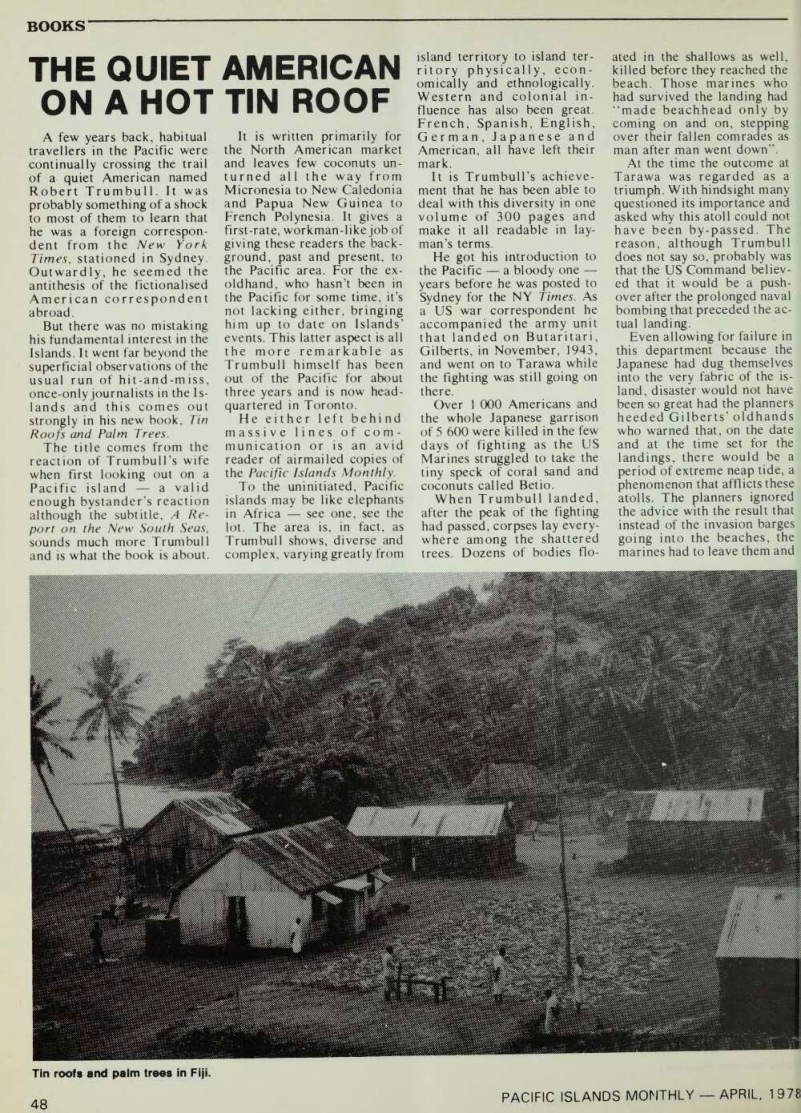
The title comes from the reaction of Trumbull’s wife when first looking out on a Pacific island a valid enough bystander’s reaction although the subtitle, A Re port on the New South Seas, sounds much more Trumbull and is what the book is about.
It is written primarily for the North American market and leaves few coconuts un turned all the way from Micronesia to New Caledonia and Papua New Guinea to French Polynesia. It gives a first-rate, workman-like job of giving these readers the back ground, past and present, to the Pacific area. For the ex oldhand, who hasn’t been in the Pacific for some time, it’s not lacking either, bringing him up to date on Islands' events. This latter aspect is all the more remarkable as Trumbull himself has been out of the Pacific for about three years and is now head quartered in Toronto.
He either left behind massive lines of com munication or is an avid reader of airmailed copies of the Pacific Islands Monthly.
To the uninitiated. Pacific islands may be like elephants in Africa see one, see the lot. The area is, in fact, as Trumbull shows, diverse and complex, varying greatly from
island territory to island ter ritory physically, econ omically and ethnologically.
Western and colonial in fluence has also been great.
French, Spanish, English, German, Japanese and American, all have left their mark.
It is Trumbull’s achieve ment that he has been able to deal with this diversity in one volume of 300 pages and make it all readable in lay man’s terms.
He got his introduction to the Pacific a bloody one years before he was posted to Sydney for the NY Times. As a US war correspondent he accompanied the army unit that landed on Butaritari, Gilberts, in November, 1943, and went on to Tarawa while the fighting was still going on there.
Over 1 000 Americans and the whole Japanese garrison of 5 600 were killed in the few days of fighting as the US Marines struggled to take the tiny speck of coral sand and coconuts called Betio.
When Trumbull landed, after the peak of the fighting had passed, corpses lay every where among the shattered trees. Dozens of bodies flo
ated in the shallows as well, killed before they reached the beach. Those marines who had survived the landing had “made beachhead only by coming on and on, stepping over their fallen comrades as man after man went down”.
At the time the outcome at Tarawa was regarded as a triumph. With hindsight many questioned its importance and asked why this atoll could not have been by-passed. The reason, although Trumbull does not say so, probably was that the US Command believ ed that it would be a push over after the prolonged naval bombing that preceded the ac tual landing.
Even allowing for failure in this department because the Japanese had dug themselves into the very fabric of the is land, disaster would not have been so great had the planners heeded Gilberts’ oldhands who warned that, on the date and at the time set for the landings, there would be a period of extreme neap tide, a phenomenon that afflicts these atolls. The planners ignored the advice with the result that instead of the invasion barges going into the beaches, the marines had to leave them and
Tin roofs and palm trees in Fiji.
wade the last half-mile over almost exposed reef, directly into the fire of the dug-in Japanese guns.
On the 25th anniversary of the battle for Tarawa, Trum bull returned to Betio and the Gilberts, this time by Fiji Air ways (later Air Pacific), to find plenty of old war relics I still decorating Betio but that urbanisation had by then ' overtaken the area, with the usual mixed results.
“What does the future hold for these atoll people,” he asks. “The limited ex pectation of their tiny, spar sely-endowed islets, coupled with expanding awareness of a larger world, unquestionably dictate a steady emigration of the young to lands of greater opportunity, like the blacks from numerous small Carib bean islands whom one meets in Miami, New York and Montreal.”
What he does not say is that there are few places where the surplus Gilbertese now get free entry, all other island ter ritories operating as closed a shop, migrant-wise, as Australia and New Zealand.
By contrast to the poverty stricken Gilberts there are the lucky people of the “smallest and richest” island Nauru.
Trumbull describes how, at the South Pacific Conference held there in 1975, the hotel was enlarged to 56 rooms, a Honolulu firm built a $5 million airconditioned civic centre for the conference: a Japanese contractor widened and repaved the road and a fleet of minibuses was im ported to whisk delegates from hotel to conference hall.
The local airline, Air Nauru, flew in a jazz band from Rarotonga, dance teams from Truk, the Gilberts and the Marshalls, souvenir T shirts from Hong Kong, oysters from Australia, strawberries from Japan and steaks from Honolulu. There was a drought on at the time so a Japanese tanker was char tered to bring Nauru 30 000 tonnes of fresh water. The delegates, remarks Trumbull, voted it the best SPC ever.
Even the more work-a-day life on Nauru sounds, as he describes it, like a socialist’s dream of paradise. “All the necessities of life and some luxuries were free or
ridiculously cheap,” he re
ports. Families had two or
more cars and “enough cameras, radios and other toys ... to stock a small shop.”
When these things broke down there were plenty more to be bought where they came from. Government-built houses rented for $5 a month and there wasn’t any taxation.
Nor is the good life likely to end when the phosphate, which now provides all these goodies, runs out at the end of the century. By that time, ac cording to Nauru’s financial advisers, they will have enough stashed away in long term investment funds for all the Nauruans then in ex istence to continue to live in the manner to which Hammer deßoburt and the other founding fathers of the re public had accustomed their fathers and grandfathers.
Cargo cults in Papua New Guinea and the New Hebrides, attempted land grabs and tax havens in the latter: the shenanigins of the CIA in the US Trusteeship is land of Saipan in the fifties: nepotism in the Cooks: copper in Bougainville: nickel in New Caledonia: and, of course, burgeoning politics every where. You name it and if it’s Pacific, this diligent author had probably said something about it somewhere.
Nonetheless, this is not a very personal story, as no doubt befits a major effort on the part of a foreign corres pondent. But because of its usual objective approach it does lack that feeling of hap py-go-lucky, out-of-this worldiness that is still charac teristic of Pacific Islanders.
This is something that we have learned to do without anyway, since writers like Nancy Phelan stopped us laughing with our South Seas friends, and went off to write about Turkey or South America.
In spite of being god fathered by no less than two universities, Washington and Australian National, Tin Roofs and Palm Trees is in teresting, easy to read and as similate without even one academic, numbered footnote
to distract the mind.
Tudor.
Judy
(TIN ROOFS AND PALM TREES. By Robert Trumbull. Published by Austrelien Netionel University Press, PO Box 4, Cenberre. end University of Weshington Press. AI16.95.)