People
pp. 34-35 · Read in the full issue
Captain Hugh Birch, who held a number of senior ex ecutive appointments in Qan tas, following long service as a pilot, is extending his ac tivities in the tourism field.
Soon after his retirement from Qantas he became regional manager, Australia, for the Tonga Visitors Bureau and regional sales manager, Australia, for South Pacific Island Airways. His latest ap pointment is as regional direc tor, Australia, for the Office of Tourism of American Samoa. Promoting the at tractions of the area keeps him busy.
Ratu Josua Toganivalu will be Fiji’s first High Com missioner to New Zealand.
One of a family from the chiefly island of Bau, he has been closely connected with government affairs for many years, both in the Fijian ad ministration and in the central government. He held cabinet rank as Minister for Agriculture, Fisheries and Forests. The Fiji Prime Minister, Ratu Sir Kamisese Mara, announcing Ratu Josua’s appointment, said the government attached the greatest importance to rela tions with New Zealand.
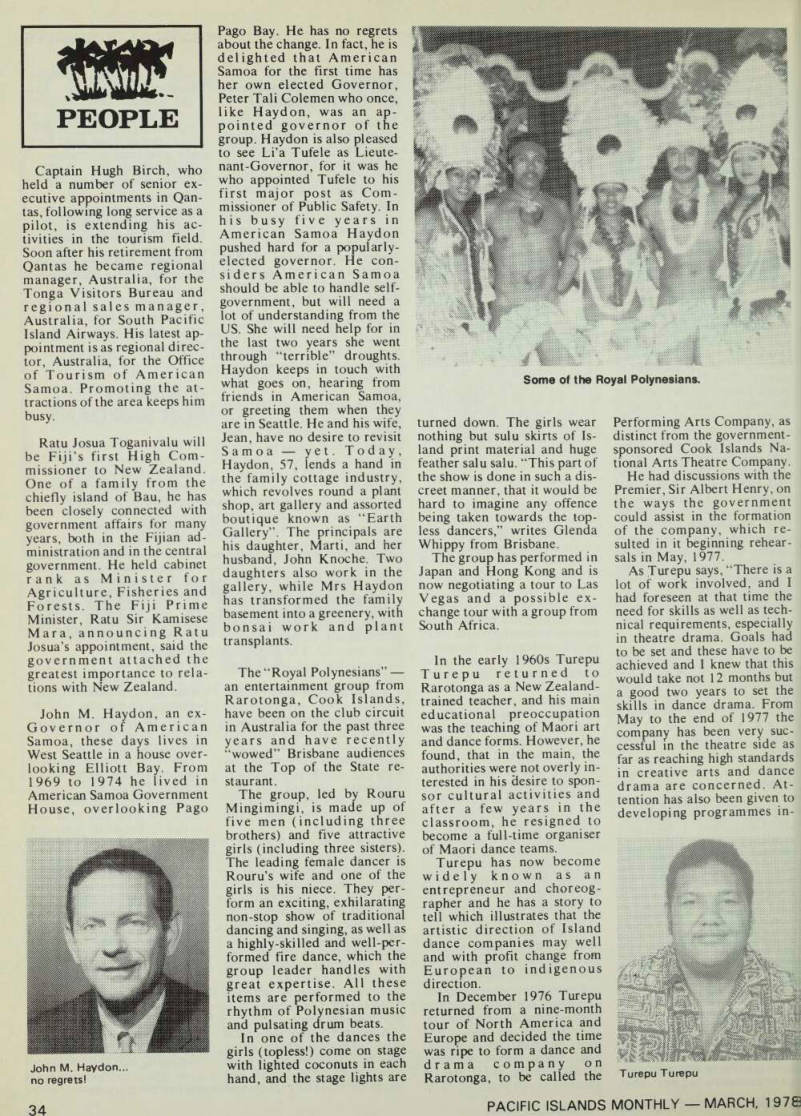
John M. Haydon, an ex- Governor of American Samoa, these days lives in West Seattle in a house over looking Elliott Bay. From 1969 to 1974 he lived in American Samoa Government House, overlooking Pago
Pago Bay. He has no regrets about the change. In fact, he is delighted that American Samoa for the first time has her own elected Governor, Peter Tali Colemen who once, like Haydon, was an ap pointed governor of the group. Haydon is also pleased to see Li’a Tufele as Lieute nant-Governor, for it was he who appointed Tufele to his first major post as Com missioner of Public Safety. In his busy five years in American Samoa Haydon pushed hard for a popularly elected governor. He con siders American Samoa should be able to handle self government, but will need a lot of understanding from the US. She will need help for in the last two years she went through “terrible” droughts.
Haydon keeps in touch with what goes on, hearing from friends in American Samoa, or greeting them when they are in Seattle. He and his wife, Jean, have no desire to revisit Samoa yet. Today, Haydon, 57, lends a hand in the family cottage industry, which revolves round a plant shop, art gallery and assorted boutique known as “Earth Gallery”. The principals are his daughter, Marti, and her husband, John Knoche. Two daughters also work in the gallery, while Mrs Haydon has transformed the family basement into a greenery, with bonsai work and plant transplants.
The “Royal Polynesians” an entertainment group from Rarotonga, Cook Islands, have been on the club circuit in Australia for the past three years and have recently “wowed” Brisbane audiences at the Top of the State re staurant.
The group, led by Rouru Mingimingi, is made up of five men (including three brothers) and five attractive girls (including three sisters).
The leading female dancer is Rouru’s wife and one of the girls is his niece. They per form an exciting, exhilarating non-stop show of traditional dancing and singing, as well as a highly-skilled and well-per formed fire dance, which the group leader handles with great expertise. All these items are performed to the rhythm of Polynesian music and pulsating drum beats.
In one of the dances the girls (topless!) come on stage with lighted coconuts in each hand, and the stage lights are
turned down. The girls wear nothing but sulu skirts of Is land print material and huge feather salu salu. “This part of the show is done in such a dis creet manner, that it would be hard to imagine any offence being taken towards the top less dancers,” writes Glenda Whippy from Brisbane.
The group has performed in Japan and Hong Kong and is now negotiating a tour to Las Vegas and a possible ex change tour with a group from South Africa.
In the early 1960 s Turepu Turepu returned to Rarotonga as a New Zealand trained teacher, and his main
educational preoccupation
was the teaching of Maori art and dance forms. However, he found, that in the main, the authorities were not overly in terested in his desire to spon sor cultural activities and after a few years in the classroom, he resigned to become a full-time organiser of Maori dance teams.
Turepu has now become widely known as an entrepreneur and choreog rapher and he has a story to tell which illustrates that the artistic direction of Island dance companies may well and with profit change from European to indigenous direction.
In December 1976 Turepu returned from a nine-month tour of North America and Europe and decided the time was ripe to form a dance and drama company on Rarotonga, to be called the
Performing Arts Company, as distinct from the government sponsored Cook Islands Na tional Arts Theatre Company.
He had discussions with the Premier, Sir Albert Henry, on the ways the government could assist in the formation of the company, which re sulted in it beginning rehear sals in May, 1977.
As Turepu says, “There is a lot of work involved, and I had foreseen at that time the need for skills as well as tech nical requirements, especially in theatre drama. Goals had to be set and these have to be achieved and I knew that this would take not 12 months but a good two years to set the skills in dance drama. From May to the end of 1977 the company has been very suc cessful m the theatre side as far as reaching high standards in creative arts and dance drama are concerned. At tention has also been given to developing programmes in-
John M. Haydon... no regrets!
Some of the Royal Polynesians.
Turepu Turepu
corporating legends, dance forms, the music of the Cook Islands, and improvised drama”.
Turepu maintains that art should be developed as art, with no other motives behind it and that work in music and art drama should be creative and dynamic.
Turepu’s main overseas experience began in 1974, when he formed a partnership with Paulette Vienot, the Director of the Tahiti-Niue Travel Agency, who made all the arrangements for the overseas tour, with Turepu taking responsibility for choreography and direction.
The company of 31 then was composed of Rarotongan boys and girls and top talent from Tahiti with Tahiti supplying the larger number of girls, and three singers. In Hawaii two performers also joined. In two tours in 1974 and 1976 they played in over 50 cities in the United States and Canada, the biggest audience being 8 000 in Phoenix, Arizona. This was at Sun City, a model city for retired people.
Both tours, and especially that of 1976 were financial successes, which enabled the group to get to the Riviera, to Italy, and culminating with a two-night performance in Moscow According to Turepu, dancers in the company were able to clear $lOO per week after all other expenses were met and the financial support given by the French airline UTA did much to ensure the success of the tours. In American cities the party gave frequent promotional performances for the airline Turepu sees himself as having a continuing future as a chore og r a ph e r and entrepreneur. u „,, When I was in Europe, especially in Cannes, I was studying, observing the various teams, and in panicular a folk-loric team from Mexico. I noted their choreography, their whole dance presentation, their cos : turning. The feeling of Mexico was there, right in their show, I think that our own show did portray the Pacific image, Overseas crowds must associate certain important features of a particular country, for instance here on Rarotonga, a drum dance about the wreck of the Yankee would sell well in the States. I am hoping to do a dance item on Charles Banks, who ab-
sconded from Wells Fargo and later lived on Rarotonga.
I got this idea from an article in PIM.”
At the present time, the Per forming Arts Company is developing its repertoire by appearing at the hotels on Rarotonga and there is a quality and variety about its work that is not attained by most of the other parties per forming on the island.
The Palau Political Status Commission, which is work ing for a new status for this group of islands in the Carolines, has lined up a big gun to help their campaign Professor John Kenneth Galbraith, who has agreed to become Palau’s adviser, friend and associate with the commission. An ex-Harvard University professor and US Ambassador to India under the Kennedy regime, he is regarded as one of America’s leading experts in the interna tional field. He is the author of more than 14 books and numerous articles, mainly on economics. The Palauans hope that with him in the team, their negotiating status will be regarded as at top level. The professor is due to visit Palau in March.
Brian Jones, 35-year-old Welsh sergeant in the RAF, who said he was fed up with the UK weather, has gone to Tuvalu to become PA (per sonal assistant) to the Queen’s Commissioner, Mr Tom Layng. He volunteered for the job. He and his wife, Shirley, will stay in Tuvalu till inde pendence in October. Brian has been in the RAF for 18 years. He served in Hong Kong from 1972 to 1974.
Tuvalu is his first Pacific post ing. Come October, its back to the UK again and its weather, hopefully in Devon or Corn wall.
Bishop Fine Halapua, Vicar of Tonga and assistant Bishop of the Diocese of Polynesia, retired on Decem ber 31. He will still hold a general licence from the diocesan bishop to function as a priest and a bishop. Two Anglican priests took up new duties in Tonga on January 1.
The Rev Mataiasi ’Ahokava became priest-in-charge of Vavau and Haapai, and the Rev Sosaia Fineanganofo became priest-in-charge of Nukualofa. Both are directly responsible to the Bishop in Polynesia, Bishop Jabez Bryce.