A Row Of Silent Graves Speaks
pp. 36-37 · Read in the full issue
Of Lost Hopes In The Cooks
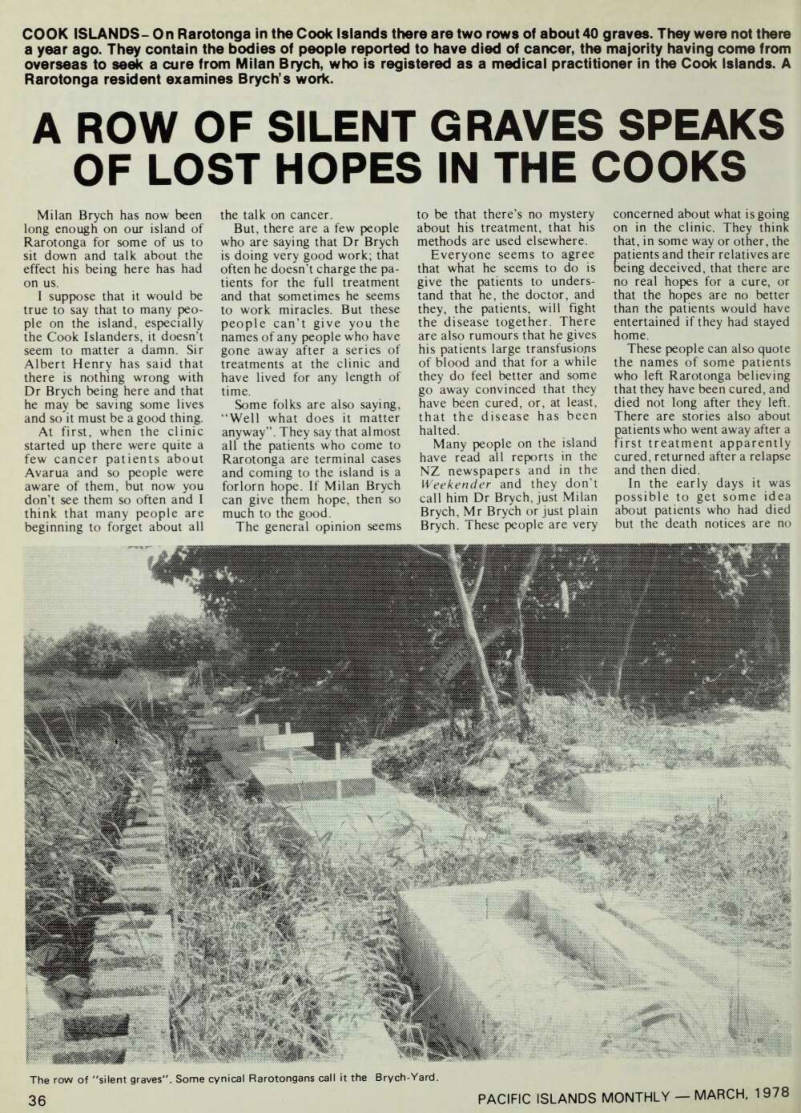
COOK ISLANDS - On Rarotonga in the Cook Islands there are two rows of about 40 graves. They were not there a year ago. They contain the bodies of people reported to have died of cancer, the majority having come from overseas to seek a cure from Milan Brych, who is registered as a medical practitioner in the Cook Islands. A Rarotonga resident examines Brych’s work.
Milan Brych has now been long enough on our island of Rarotonga for some of us to sit down and talk about the effect his being here has had on us.
I suppose that it would be true to say that to many peo ple on the island, especially the Cook Islanders, it doesn’t seem to matter a damn. Sir Albert Henry has said that there is nothing wrong with Dr Brych being here and that he may be saving some lives and so it must be a good thing.
At first, when the clinic started up there were quite a few cancer patients about Avarua and so people were aware of them, but now you don’t see them so often and I think that many people are beginning to forget about all
the talk on cancer.
But, there are a few people who are saying that Dr Brych is doing very good work; that often he doesn’t charge the pa tients for the full treatment and that sometimes he seems to work miracles. But these people can’t give you the names of any people who have gone away after a series of treatments at the clinic and have lived for any length of time.
Some folks are also saying, “Well what does it matter anyway”. They say that almost all the patients who come to Rarotonga are terminal cases and coming to the island is a forlorn hope. If Milan Brych can give them hope, then so much to the good.
The general opinion seems
to be that there’s no mystery about his treatment, that his methods are used elsewhere.
Everyone seems to agree that what he seems to do is give the patients to understand that he, the doctor, and they, the patients, will fight the disease together. There are also rumours that he gives his patients large transfusions of blood and that for a while they do feel better and some go away convinced that they have been cured, or, at least, that the disease has been halted.
Many people on the island have read all reports in the NZ newspapers and in the Weekender and they don’t call him Dr Brych, just Milan Brych, Mr Brych or just plain Brych. These people are very
concerned about what is going on in the clinic. They think that, in some way or other, the patients and their relatives are being deceived, that there are no real hopes for a cure, or that the hopes are no better than the patients would have entertained if they had stayed home.
These people can also quote the names of some patients who left Rarotonga believing that they have been cured, and died not long after they left, There are stories also about patients who went away after a first treatment apparently cured, returned after a relapse and then died.
In the early days it was possible to get some idea about patients who had died but the death notices are no
The row of "silent graves”. Some cynical Rarotongans call it the Brych-Yard.
longer published in the Cook Islands News. People who are against Brych say that every thing shouldn’t be so mysterious and that if he is being successful in his methods he should be pub lishing results and evidence so that his critics can be answered. But we don’t get to hear very much at all.
Some people are making money out of the fact that the clinic is working and I sup pose they would tell you that to have the clinic on Rarotonga is a good thing.
Various cost figures are talk ed about on the beach, but it looks as if it costs between $7 000 and $lO 000 for treat ment. Brych insists that the patients come to Rarotonga with relatives to look after them and the relatives and the patients, when they are not in hospital, have to stay at motels designated by the clinic. The reason given is that the clinic provides nursing help at the motels. Anyway, it costs, so it is said, $35 a day for a patient or a relative to stay at one of these motels.
About $lB goes to the owner
of the motel and the rest goes to the clinic.
In the early days, a lot of the patients stayed at the hostel at Tereora and it was pretty grim there but now the patients are put up in motels.
It is rather a surprise the way some of the shrewd people on the island have been able to build motels mainly to look after cancer patients and their relatives.
There is plenty of proof that many of the patients have died. Alongside the European cemetery, down by the air port, there is now a double line of graves that the locals call the “Brychyard”. A few weeks ago I counted about 35 graves and most Saturdays since, I have seen men digging more graves.
It is pretty common knowledge that one particular church looks after all the burials and that it costs about $4OO for the grave-digging and service. There is also a story going round that the only supplier of coffins on the island got in an increased stock as he really is expecting an increase in business.
One thing that worries some
of us is the extent to which the government has helped Brych.
He lives in a government house, auite a number of the trained nurses from the hospital now work for him and he has taken over half the surgical wing in the hospital at Black Rock.
We wonder what the New Zealand Government must be thinking about the help that Brych is receiving, considering that he has been discredited in New Zealand.
Dr Joe Williams, the Minister of Health, is obviously very much involved with Brych personally and there are a lot of people who say that it is not right for this to happen.
A rather strange thing has now happened. Because of the government’s attitude about the cancer clinic and offering to allow unconventional medical people to practise in the Cook Islands even if they save only one life a Filipino faith healer has turned up here. His manager says that he wants to help people in the Cook Islands, that he makes no charges and that people who are helped may
make donations to the man ager.
The faith healer says that he is not a medical man and that he should be allowed to work in the Cook Islands. All this has put Sir Albert Henry in an awkward position and he has now said that as a favour to his friend Francis Sandford, of Tahiti, the faith healer will be allowed to stay in the Cook Islands for three months to see how good his work is.
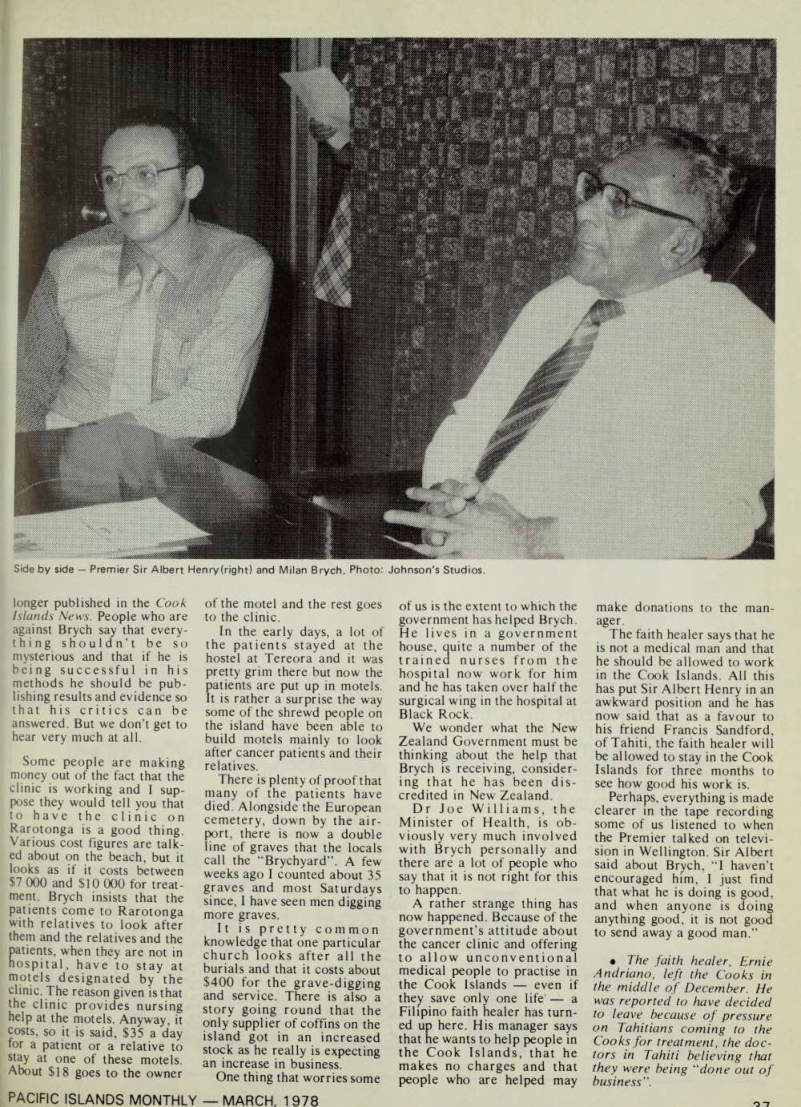
Perhaps, everything is made clearer in the tape recording some of us listened to when the Premier talked on televi sion in Wellington. Sir Albert said about Brych, “I haven’t encouraged him, I just find that what he is doing is good, and when anyone is doing anything good, it is not good to send away a good man.” The faith healer, Ernie Andriano, left the Cooks in the middle of December. He was reported to have decided to leave because of pressure on Tahitians coming to the Cooks for treatment, the doc tors in Tahiti believing that they were being “done out of business ”.
Side by side - Premier Sir Albert Henry(right) and Milan Brych. Photo: Johnson's Studios.