Currents
pp. 28-33 · Read in the full issue

Political
Softly, Softly
To Niue Polls
Niue’s assembly elections in March could almost pass un noticed in Niue let alone the rest of the Pacific, writes a
Niue correspondent.
Traditionally quiet and un controversial, the elections this year are not expected to produce any startling changes.
Based more on the Polyne sian system of consensus rather than palagi politics, the elections are held every three years to fill the 20-member as sembly.
Each village has one rep resentative to fill 14 of the seats, usually by agreement at village level before the elec tion date, and six common roll seats are contested throughout the island.
At the last election only three of the village seats were contested. Usually the village likes to settle on one can didate before nominations close to simplify the whole election procedure and to show a united front to the rest of the country.
For the six common roll seats last election, there were 20 contestants and this year there will probably be as many if not more as the Niuean’s interest in politics gradually increases.
All campaigning is done “mouth to ear’’ with little need for extensive nationwide campaigns as, in a place the size of Niue with less than 4 000 people, everyone knows everyone else’s business any way.
After someone expresses an interest in going into politics, they are judged informally by the rest of the community on the basis of their family con nections. The size of the aspir ing politician’s family is noted and whether the family is on good terms with other families.
Although Niue has no for mal hierarchical system, the advantages of coming from a good family, one with money, land and skill in food pro
duction, are considerable in
politics.
The Premier is elected after the election by an absolute majority in the assembly as is the cabinet, comprising four members including the Pre mier. The present Premier, Mr Robert R. Rex, who has never been challenged in the three terms he has presided over the assembly, is expected to stand again and retain his position. Although aging he turned 70 in January Mr Rex is still considered the only likely candidate for Pre mier by many Niueans.
Women have no great political influence in Niue even though two of the mem bers in the last assembly were women, one of whom was the wife of the Premier.
The political issues, as far as they are considered along with family connections, will probably be based on the perennial problems involving reading, education, water and
pensions.
New Hebrides’
New Era
The signing into office of the New Hebrides’ Council of Ministers by the High Com missioners of Britain and France in Vila on January 11 symbolised the opening of a new era for the 72-year-old condominium, the era of in ternal self-government.
True, the new Council of Ministers a Chief Minister and six others came into being in unusual cir cumstances; none of the 38member Representative As sembly from which the Coun cil emerged was actually elected.
Due to the boycott of the November 29 election by the Vanuaaku Party, which had come out of the country’s first election in 1975 as the majori ty party, no seats were con tested on November 29. In stead of taking part in the poll, the Vanuaaku Party proclaimed its own People’s Provisional Government throughout the country, with more or less success depend ing on the degree of its sup port in various areas.
But despite the odd cir cumstances of the birth of the new institutions, and despite the continuing tensions be tween the “ins” and the “outs” of present New Hebrides
political life, there are some grounds for optimism that its future development will not be as chaotic as many have feared.
The claim by the VP’s secretary for information, Kalkot Matas, in a January statement, that the new regime was merely a puppet of the ad ministering powers was ac tually borne out to some ex tent by the actual statement made in introducing his new government by the Chief Minister, George Kalsakau.
But not, perhaps, in the way Mr Matas expected.
Mr Kalsakau’s speech was virtually one long complaint that Britain and France had retained too many powers for themselves, that in the cir cumstances the government would be little more than a “puppet” of the administering powers, and that this situation would not be tolerated. Mr Kalsakau dwelt particularly on the question of the new government’s lack of control of the public service, financial affairs and the police.
On the public service, he appealed to the High Com missioners to confirm of ficially and publicly” not only that the present admin istration of the condominium is under the control of the government, but that the government also had powers of recruitment, dismissal and assignment of public servants.
On the budget, Mr Kalsakau referred to “rumours”, clearly coming from condominium sources,
that the budget could not be submitted to the assembly before July or August. He then proceeded to ask the re sponsible minister to step up work on the budget so that it could be presented by April 1 He also criticised the deci sion by the British and French not to hold the promised pub lic inquiry into the events ir Vila on November 29, wher British police fired tearga: into a crowd of anti-VP de monstrators, causing some inj uries.
The tone of Mr Kalsakau references to the VP, and th< offer he has made of thre< seats in the council o< ministers to VP members gave grounds for hope of re conciliation between the tw' sides. The same could be sai of the comments made befor the Assembly by its president Mr Maxime Carlot.
In reply to Mr Kalsakauj speech, the High Comi missioners Mr Stratton who had flown from Londo especially for the occasion and M Eriau, who had conn from New Caledonia stressed the importance o development towards indo pendence by stages, and <• solidarity and unity. They laij particular stress on the m portance attached by their tw governments to the main tenance of law and order the period leading to indepe; dence, due in 1980, an pledged active measures this end.
On the issue of the inqun into the November 29 event
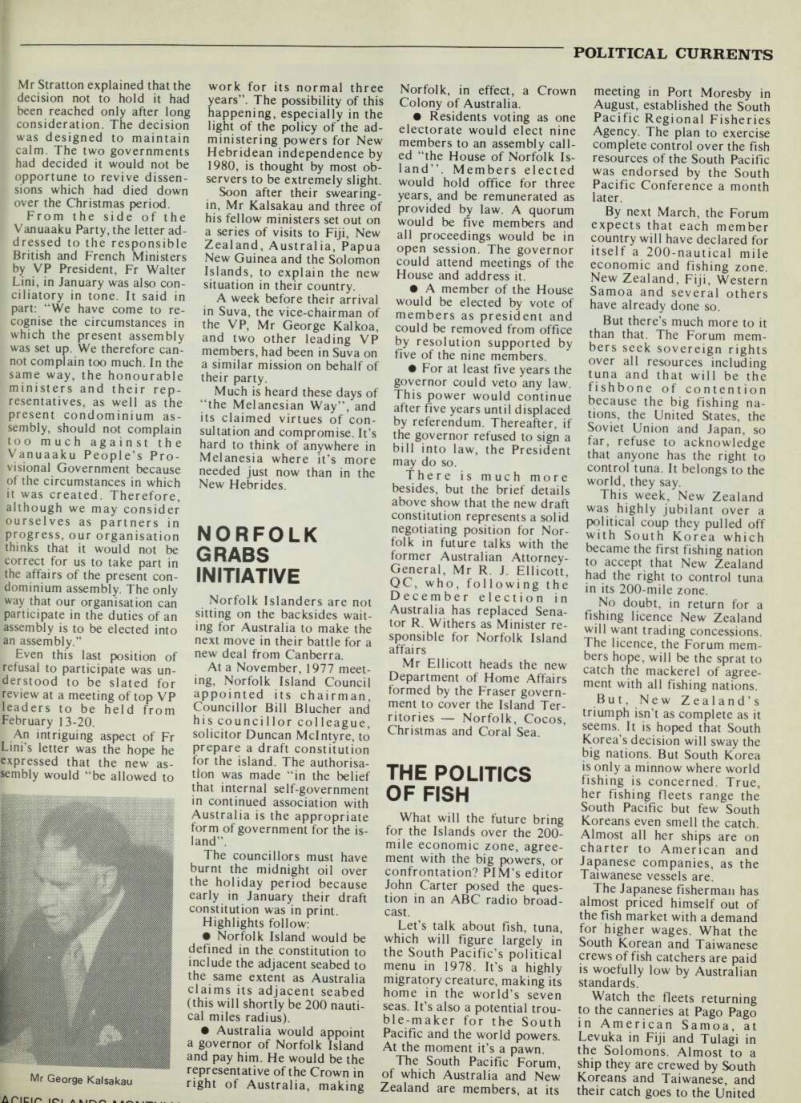
This structure taking shape on the mam street of Alofi, Niue's capital “city”, is the New Zealand Government s gift to the islan ders to mark their attainment of self-government The Pre-fabri cated building of kauri costing $50 000, will be the Assembly Build ing. It faces the sea on a site recently occupied b Y Niue s first hospital built 66 years ago, which also served as bachelors quar ters, Chief of Police HQ and, finally, the old House of the Assembly.
Mr Stratton explained that the decision not to hold it had been reached only after long consideration. The decision was designed to maintain calm. The two governments had decided it would not be opportune to revive dissen sions which had died down over the Christmas period.
From the side of the Vanuaaku Party, the letter ad dressed to the responsible British and French Ministers by VP President, Fr Walter Lini, in January was also con ciliatory in tone. It said in part: “We have come to re cognise the circumstances in which the present assembly was set up. We therefore can not complain too much. In the same way, the honourable ministers and their rep resentatives, as well as the present condominium as sembly, should not complain too much against the Vanuaaku People’s Pro visional Government because of the circumstances in which it was created. Therefore, although we may consider ourselves as partners in progress, our organisation thinks that it would not be correct for us to take part in the affairs of the present con dominium assembly. The only way that our organisation can participate in the duties of an assembly is to be elected into an assembly.”
Even this last position of refusal to participate was un derstood to be slated for review at a meeting of top VP leaders to be held from
February 13-20.
An intriguing aspect of Fr -ini’s letter was the hope he expressed that the new as sembly would “be allowed to
work for its normal three years”. The possibility of this happening, especially in the light of the policy of the ad ministering powers for New Hebridean independence by 1980, is thought by most ob servers to be extremely slight.
Soon after their swearing in, Mr Kalsakau and three of his fellow ministers set out on a series of visits to Fiji, New Zealand, Australia, Papua New Guinea and the Solomon Islands, to explain the new situation in their country.
A week before their arrival in Suva, the vice-chairman of the VP, Mr George Kalkoa, and two other leading VP members, had been in Suva on a similar mission on behalf of their party.
Much is heard these days of “the Melanesian Way”, and its claimed virtues of con sultation and compromise. It’s hard to think of anywhere in Melanesia where it’s more needed just now than in the New Hebrides.
Norfolk
Grabs
Nitiative
Norfolk Islanders are not sitting on the backsides wait ing for Australia to make the next move in their battle for a new deal from Canberra.
At a November, 1977 meet ing, Norfolk Island Council appointed its chairman, Councillor Bill Blucher and his councillor colleague, solicitor Duncan Mclntyre, to prepare a draft constitution for the island. The authorisa tion was made “in the belief that internal self-government in continued association with Australia is the appropriate form of government for the is land”.
The councillors must have burnt the midnight oil over the holiday period because early in January their draft constitution was in print.
Highlights follow: • Norfolk Island would be defined in the constitution to include the adjacent seabed to the same extent as Australia claims its adjacent seabed (this will shortly be 200 nauti cal miles radius). • Australia would appoint a governor of Norfolk Island and pay him. He would be the representative of the Crown in right of Australia, making
Norfolk, in effect, a Crown Colony of Australia. • Residents voting as one electorate would elect nine members to an assembly call ed “the House of Norfolk Is land”. Members elected would hold office for three years, and be remunerated as provided by law. A quorum would be five members and all proceedings would be in open session. The governor could attend meetings of the House and address it. • A member of the House would be elected by vote of members as president and could be removed from office by resolution supported by five of the nine members. • For at least five years the governor could veto any law.
This power would continue after five years until displaced by referendum. Thereafter, if the governor refused to sign a bill into law, the President may do so.
There is much more besides, but the brief details above show that the new draft constitution represents a solid negotiating position for Nor folk in future talks with the former Australian Attorney- General, Mr R. J. Ellicott, QC, who, following the December election in Australia has replaced Sena tor R. Withers as Minister re sponsible for Norfolk Island affairs Mr Ellicott heads the new Department of Home Affairs formed by the Fraser govern ment to cover the Island Ter ritories Norfolk, Cocos, Christmas and Coral Sea.
The Politics
Fish
What will the future bring for the Islands over the 200mile economic zone, agree ment with the big powers, or confrontation? PlM’s editor John Carter posed the ques tion in an ABC radio broad cast.
Let’s talk about fish, tuna, which will figure largely in the South Pacific’s political menu in 1978. It’s a highly migratory creature, making its home in the world’s seven seas. It’s also a potential trou ble-maker for the South Pacific and the world powers.
At the moment it’s a pawn.
The South Pacific Forum, of which Australia and New Zealand are members, at its
meeting in Port Moresby in August, established the South Pacific Regional Fisheries Agency. The plan to exercise complete control over the fish resources of the South Pacific was endorsed by the South Pacific Conference a month later.
By next March, the Forum expects that each member country will have declared for itself a 200-nautical mile economic and fishing zone.
New Zealand, Fiji, Western Samoa and several others have already done so.
But there’s much more to it than that. The Forum mem bers seek sovereign rights over all resources including tuna and that will be the fishbone of contention because the big fishing na tions, the United States, the Soviet Union and Japan, so far, refuse to acknowledge that anyone has the right to control tuna. It belongs to the world, they say.
This week, New Zealand was highly jubilant over a political coup they pulled off with South Korea which became the first fishing nation to accept that New Zealand had the right to control tuna in its 200-mile zone.
No doubt, in return for a fishing licence New Zealand will want trading concessions.
The licence, the Forum mem bers hope, will be the sprat to catch the mackerel of agree ment with all fishing nations.
But, New Zealand’s triumph isn’t as complete as it seems. It is hoped that South Korea’s decision will sway the big nations. But South Korea is only a minnow where world fishing is concerned. True, her fishing fleets range the South Pacific but few South Koreans even smell the catch.
Almost all her ships are on charter to American and Japanese companies, as the Taiwanese vessels are.
The Japanese fisherman has almost priced himself out of the fish market with a demand for higher wages. What the South Korean and Taiwanese crews of fish catchers are paid is woefully low by Australian standards.
Watch the fleets returning to the canneries at Pago Pago in American Samoa, at Levuka in Fiji and Tulagi in the Solomons. Almost to a ship they are crewed by South Koreans and Taiwanese, and their catch goes to the United
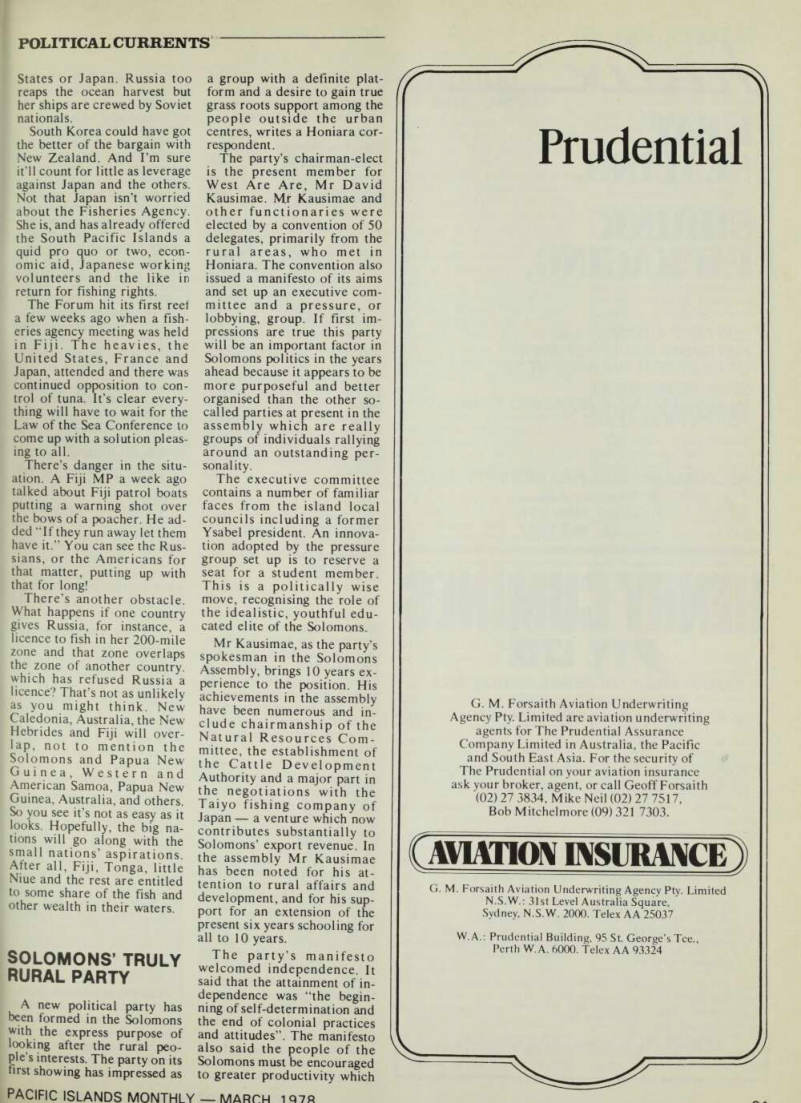
Mr George Kalsakau
States or Japan. Russia too reaps the ocean harvest but her ships are crewed by Soviet nationals.
South Korea could have got the better of the bargain with New Zealand. And I’m sure it’ll count for little as leverage against Japan and the others.
Not that Japan isn’t worried about the Fisheries Agency.
She is, and has already offered the South Pacific Islands a quid pro quo or two, econ omic aid, Japanese working volunteers and the like in return for fishing rights.
The Forum hit its first reef a few weeks ago when a fish eries agency meeting was held in Fiji. The heavies, the United States, France and Japan, attended and there was continued opposition to con trol of tuna. It’s clear every thing will have to wait for the Law of the Sea Conference to come up with a solution pleas ing to all.
There’s danger in the situ ation. A Fiji MPa week ago talked about Fiji patrol boats putting a warning shot over the bows of a poacher. He ad ded “If they run away let them have it.” You can see the Rus sians, or the Americans for that matter, putting up with that for long!
There’s another obstacle.
What happens if one country gives Russia, for instance, a licence to fish in her 200-mile zone and that zone overlaps the zone of another country, which has refused Russia a licence? That’s not as unlikely as you might think. New Caledonia, Australia, the New Hebrides and Fiji will over lap, not to mention the Solomons and Papua New Guinea, Western and American Samoa, Papua New Guinea, Australia, and others.
So you see it’s not as easy as it looks. Hopefully, the big na tions will go along with the small nations’ aspirations.
After all, Fiji, Tonga, little Niue and the rest are entitled to some share of the fish and other wealth in their waters.
Solomons’ Truly
Rural Party
A new political party has been formed in the Solomons with the express purpose of looking after the rural peo ple’s interests. The party on its first showing has impressed as
a group with a definite plat form and a desire to gain true grass roots support among the people outside the urban centres, writes a Honiara cor respondent.
The party’s chairman-elect is the present member for West Are Are, Mr David Kausimae. Mr Kausimae and other functionaries were elected by a convention of 50 delegates, primarily from the rural areas, who met in Honiara. The convention also issued a manifesto of its aims and set up an executive com mittee and a pressure, or lobbying, group. If first im pressions are true this party will be an important factor in Solomons politics in the years ahead because it appears to be more purposeful and better organised than the other so called parties at present in the assembly which are really groups of individuals rallying around an outstanding per sonality.
The executive committee contains a number of familiar faces from the island local councils including a former Ysabel president. An innova tion adopted by the pressure group set up is to reserve a seat for a student member.
This is a politically wise move, recognising the role of the idealistic, youthful edu cated elite of the Solomons.
Mr Kausimae, as the party’s spokesman in the Solomons Assembly, brings 10 years ex perience to the position. His achievements in the assembly have been numerous and in clude chairmanship of the Natural Resources Com mittee, the establishment of the Cattle Development Authority and a major part in the negotiations with the Taiyo fishing company of Japan a venture which now contributes substantially to Solomons’ export revenue. In the assembly Mr Kausimae has been noted for his at tention to rural affairs and development, and for his sup port for an extension of the present six years schooling for all to 10 years.
The party’s manifesto welcomed independence. It said that the attainment of in dependence was “the begin ning of self-determination and the end of colonial practices and attitudes”. The manifesto also said the people of the Solomons must be encouraged to greater productivity which
is a clear sign of David Kausimae’s influence as he has made this statement many times in the past 10 years.
The party also supported the establishment of a na tional marketing board which is an idea that has been “in the air” for some time now in the Solomons legislature. The convention agreed that greater attention should be paid to explaining why various development projects were important. Delegates felt that if the people did not un derstand why a project was important then they would not co-operate fully.
The party affirmed that it intended to be a loyal opposi tion.
Mr Kausimae, outlining the party’s approach to general political issues, said it would congratulate the government when it did good things for the rural people and would offer constructive criticism when necessary.
Cook Islands’
Election
Stakes
The whole of the Cook Is lands are agog with the news that there has been a split in the political ranks and that Dr. Joe Williams, William Estall and Raui Pokoati; all former staunch members of the Cook Islands party have decided to break away from the party and its leader, Sir Albert Henry.
Now, don’t for a moment think that this break has been sudden and unexpected writes a Rarotongan political corres pondent. For many a long night people have sat around and talked about what will happen “when Albert goes’’.
Perhaps the recent by-election loss by the Cook Islands Party was the most obvious indica tion that the former im pregnable walls of the Cook Islands Party were about to crumble. Perhaps the fact that the Premier has called an early election also caused those with political ambitions in the Cook Islands to look very deeply into their prospects and to try to work out where they are likely to be placed if, and when a shake up of political power occurs.
Obviously Joe Williams, William Estall and Raui Pokoati have all come to the conclusion that the charismatic rule of Sir Albert Henry is coming to its end and that without the personal magnetism, which he has com manded, the Cook Islands Party will lose power.
Therefore, these three have decided to make a move, hop ing to cash in on any redistribution of power after the general election. To change sides in Cook Islands politics is not a new feature and there are a number of very prominent members of the party who have changed allegiance before and quite clearly would be prepared to do the same again.
Central to all the talk about the future political control of the Cook Islands is the whole question of the suitability of a two-party system for the Cook Islands situation. If you talk quietly with many of the is lands’ leaders you will find that many consider that the members of the Legislative Assembly should be rep resenting their island consti tuencies and not some politi cal party. It seems that laveta Short read this trend well when he conducted his cam paign which won for him the by-election in Takitumu.
Let’s look now at the politi cal figures who are likely to throw their hats into the ring in an effort to grab the reins of authority. It may well be that the present two political par ties, the Cook Islands Party and the Democratic Party, will cease to be effective forces and that less formalised organisations will be built up around particular leaders.
There will be a hard core of “traditional” leaders who will continue to represent their electorates. In the outer is lands there are men of mana who will continue to hold the seats on islands like Mangaia, Atiu, Manihiki, Rakahanga, Penrhyn and Puka Puka, but without exception they do not, seem to possess the breadth of outlook that would allow any of them to become the na tional leader.
Aitutaki presents a partic ularly interesting problem.
For many years Aitutakians, from the Premier down, have dominated the membership of the Cabinet, and there is a great deal of resentment onr
Rarotonga, the largest island in terms of population that it has had such a small share in the legislative and executive direction of the islands. Fur thermore, it is openly said that most Aitutakians feel most strongly that although they have three members, Dr Williams, William Estall and Geoffrey Henry, who all hold cabinet postions, they very seldom visit the island they represent and they do not seem to be overly interested in the affairs of Aitutaki.
Nepotism is a word that is bandied about a great deal these days and it may well be that the followers of the Cook Islands Party will suffer severely if there is a change in power. The Premeir’s son Tupui Henry, in earlier times was often touted as being a successor to his father, but er ratic behaviour of recent years may well lead to his political demise. However, he may well hold his seat for the island of Mauke, for above all he has worked assiduously to improve conditions on that is land. A worrying question is, what will happen to the public service if the Cook Islands Party is defeated? Many of the top positions are held by ar dent supporters of the party and the public service may well be decimated if a change over takes place.
Quite a lot of gambling goes on these days in the Cook Is lands and perhaps the TAB at the old Hotel Rarotanga might like to run a sweepstake on who is to emerge as the leader, if Sir Albert is defe ated.
Let’s look at the field.
When the books were opened some time ago equal favourites would have been Geoffrey Henry and Joe Williams, with the latter perhaps having a slight edge in the odds, but it has been whittled away because of his involvement with the cancer cure man Milan Brych. At double figures would have been Tupui Henry, and most of the punters would have said he owed this level of favourit ism to the support he receives from Lady Henry, who weilds a great deal of power behind the throne. A sentimental bob or two might have gone on Tom Davis, the present leader of the Cook Islands’ De mocratic Party but most peo ple seem to agree that
although Tom is well-inten tioned, he just does not have the political muscle needed to manage the affairs of the country.
At long odds, initially, were a couple of New Zealand-edu cated solicitors, laveta Short and Vincent Ingram, who have been at work quietly but steadily establishing a politi cal base, The nod must go at this stage to laveta Short, if only for the fact that he has successfully won a by-election and that he probably has a greater degree of local sup port in the Takitumu area of Rarotonga from family loyal ties.
And, of course, like any large handicap field, there are always the dark horses, who may be able to command enough support to affect the ultimate outcome. There is no telling but that Harry Napa, who has been studying politi cal science in New Zealand, may decide to return and con test the election in the Arorangi area, where his father commands a great deal of respect, both as a busi nessman and as Tinomana Ariki, the paramount chief of Arorangi.
There are also rumours about that Sadarka Sadaraka, who in the 1965 era made an attempt to enter politics, may again enter the contest, Sadaraka has had a great deal of experience in the admin istrative fields, in both the Cook Islands and in Nauru, and is now living in New Zea land. And, of course, there are old political protagonists, like Mana Strickland, who have been waiting for many years to re-enter the sphere of authori ty. Mana missed out winning a seat in the last election by a handful of votes, and if there is a swing away from the Cook Islands Party, Mana is one who is likely to find himself back in the assembly, where his political and business acu men would again make him a force to be reckoned with, especially as he still com mands a great deal of respect among many of the older voters on Rarotonga.
The next few weeks will un doubtedly see a great deal of wheeling and dealing going on and this will be one of the most interesting electoral handicaps to have been run in the Pacific region for many a year.
Imbroglio
At San Diego
Sharp Micronesian critic ism of a new US draft working paper on free association followed a January con ference in San Diego, Califor nia, between US and Microne sian negotiators. The talks followed up on last year’s meetings at Molokai, Hawaii.
The Marshalls and Palau delegations rejected the US draft in a joint letter, and rep resentatives of the Microne sian Commission on Future Political Status and Transi tion (CFPST) told US am bassador Peter Rosenblatt that it “clearly represents a backward step from what we had regarded as the starting point”.
Objections voiced by Micronesian spokesmen Mr Baily Olter, chairman of the Commission’s Status Com mittee, and Mr Andon Amaraich, CFPST chairman, included. • On internal affairs, the document indicated that Micronesians had to change their constitutions or forms of government to suit the com pact of association, which would be supreme. • Under the old 1976 draft compact the US could apply international agreements to Micronesia, unless Micro nesia objected. The provision for objection had been taken out. • On foreign affairs, the new document says that the US will represent Micronesia abroad and will negotiate and conclude treaties and other international agreements on behalf of Micronesia.
Amaraich pointed out that this was in conflict with the Micronesian position of the Law of the Sea. • In the 197 6 draft, Micronesians may negotiate and conclude agreements of a cultural or technical nature with foreign organisations.
This had also been taken out. • Under finance, now call ed “economic assistance”, the amounts listed in the old com pact are deleted and no new amounts appear. Fur thermore, there is no separate provision for economic development loans.
Amaraich listed these and other changes, where many specific provisions of the draft compact of 1976, which had assured certain rights and
protections to Micronesians, had been withdrawn.
He stressed that delegates should not accept these as final views of the CFPST, which had yet to meet, but only preliminary views of some members.
In other moves, the House of Representatives of the Con gress of Micronesia rejected a statement by ambassador Rosenblatt that status negotia tions should be concluded by the end of March, 1978. The House resolution claimed that the proposed referendum on the Micronesian constitution should be held before the next status negotiations could re sume.
A Junket
For Samoans
The New Year brought a new Governor and a new era of administration to American Samoa. The historical event began with a parade of floats decorated with tropical flora and interspersed with a varie ty of marching groups of high school students, cannery workers and tiny tots, all gathered to celebrate the in auguration of Peter Tali Cole man and Tufele Lia’a as American Samoa’s first elected Governor and Lieute nant-Governor.
The flags were lowered on the old administration and raised again to symbolise the beginning of the new and the end of the long string of ap pointed governors 49 of them in the last 70 years.
Governor Coleman has now returned to the office which he held 21 years ago. And, co incidentally, it is the same Governor Rex Lee who suc ceeded Coleman 16 years ago, who has now been succeeded by Coleman.
The inauguration ceremony abounded in Samoan tradition with the ceremonial sprin kling of coconut juice on Col eman’s head , the kava ceremony, and the lavish dis play of gifts, including dozens of pigs and miles of cloth, fine mats and tapa, presented to all the distinguished guests by the people of the Manu’a Islands.
Singing and dancing com petitions and the spectacular race of the fautausi followed continuing well into the after noon. Three extravagant balls marked the climax.