Afterthoughts
p. 27 · Read in the full issue
If speeches made at the South Pacific Conference in Pago Pago a few months ago are anything to go by, there would appear to be, ,all over the Pacific, a growing disenchantment with the Coca Cola civilisation.
“Our girls go from the farms to the town schools,” said a speaker from the New Hebrides. “Next we see them riding behind a long-haired youth on a motorbike, then in a pub, then they come back to the farm and bring mum and dad an illegitimate baby.”
This doesn’t only happen in the New Hebrides. Here in Papua New Guinea too, wherever you go in the villages, you find elderly mums and dads who have launched their own families into the world and would like to sit back and take it easy, but who now find themselves stuck with bringing up their daughters’ illegitimate children.
And here in Papua New Guinea we are witnessing the rise of a cult of Melanesianism. The Melanesian way of life is extolled, and we are exhorted to do things, even quite unmelanesian things, in a melanesian way.
It could, of course, be argued that there is no such thing as a Melanesian way of life. Melanesia does not have the cultural unity of Polynesia. Rather there are hundreds of mini-cultures and mini life-styles among the Island groups to which the early European explorers gave the name of Melanesia to cloak their own ignorance of the Islands and their peoples.
However, these mini life-styles do have certain common features to an extent which perhaps justifies the use of the phrase “Melanesian way of life.”
Indeed, with my own memories of that way of life as I observed it being lived in Papua 50 years ago, I have much sympathy with the apostles of Melanesianism and their disciples— provided that they are prepared to stop emotionalising, to sit down and think out what they really mean and what they really want, and to abandon the preposterous theory that the Melanesian way of life stems from some innate virtue in the Melanesian soul, some peculiar quality in the Melanesian blood stream.
Quite clearly, the traditional Melanesian way of life was a product of the Melanesian environment. Its basic characteristics, and virtues, were those of self-reliance and unselfishness.
The Papuans I knew when I first came to Paua were self-reliant at individual, family, kinship group and village levels because they had to be self-reliant or perish. They obtained their food by growing vegetables on their ancestral lands and by hunting and fishing. In times of famine they went out and gathered the fruit of the cycas palm, pounded it up, washed the poison out of it, and cooked and ate it. Their descendants, in a similar situation, get handouts of rice from Civil Defence. They obtained shelter by building their own houses from materials gathered by themselves from the bush and grasslands; and very roomy and confortable houses many of them were. Their descendants rent poky little Housing Commission houses and grumble about them.
The unselfishness of the traditional Melanesian way of life was also a product of the environment. Unlike those parts of the world whose economies included the growing of grain crops which could be stored for long periods to torm a basis for wealth and power (as Joseph did in Egypt), the Melanesians produced nothing storable. 1 heir most storable crop, the yam, would barely last over trom one harvest to the next; the others had to be eaten as they were harvested. When they had surpluses they shared them; there was nothing else they could do with them So they learned to live unselfishly, and in doing so created a
basically egalitarian society.
Because the Melanesian life-style was a product of the Melanesian environment it proved to be very vulnerable to changes in that environment, and during my 53 Papuan years I have watched with great sadness its virtual disappearance.
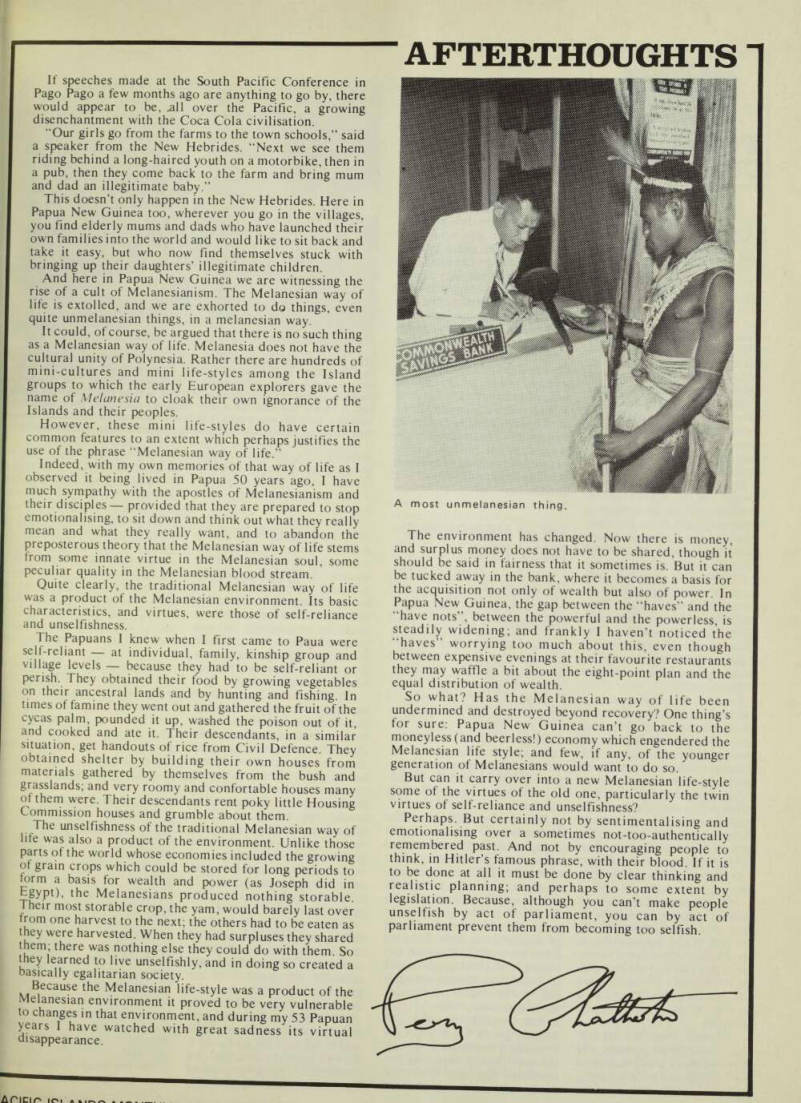
The environment has changed. Now there is money, and surplus money does not have to be shared, though it should be said in fairness that it sometimes is. But it can be tucked away in the bank, where it becomes a basis for the acquisition not only of wealth but also of power. In Papua New Guinea, the gap between the “haves” and the “have nots”, between the powerful and the powerless is steadily widening; and frankly I haven’t noticed the “haves” worrying too much about this, even though between expensive evenings at their favourite restaurants they may waffle a bit about the eight-point plan and the equal distribution of wealth.
So what? Has the Melanesian way of life been undermined and destroyed beyond recovery? One thing’s for sure; Papua New Guinea can’t go back to the moneyless (and beerless!) economy which engendered the Melanesian life style; and few, if any, of the younger generation of Melanesians would want to do so.
But can it carry over into a new Melanesian life-style some of the virtues of the old one, particularly the twin virtues of self-reliance and unselfishness?
Perhaps. But certainly not by sentimentalising and emotionalising over a sometimes not-too-authentically remembered past. And not by encouraging people to think, in Hitler’s famous phrase, with their blood. If it is to be done at all it must be done by clear thinking and realistic planning; and perhaps to some extent by legislation. Because, although you can’t make people unselfish by act of parliament, you can by act of parliament prevent them from becoming too selfish.
A most unmelanesian thing.