New Caledonia Community
pp. 20-21 · Read in the full issue
A Shadow Over A Silent
Indonesian Dr R. S. Roosman, who is senior lecturer in Indonesian studies at the University of Papua Nev Guinea, was in New Caledonia in December. He could be forgiven for believing he was at home in Indonesia fo there is a comparatively large Indonesian community in New Caledonia, many third generation descendants c Indonesian indentured labourers brought from Java early in the century. Now, there looms in their lives th threat of expulsion. Radical Melanesians have said that as soon as New Caledonia becomes independent minority groups will be expelled. Dr Roosman tells the story.
The history of the Indone sians in New Caledonia goes back to the turn of the century when a demand for labourers from Asia occurred in the nickel industry and coffee plantations in the French ter ritory. An agreement was reached with the Dutch East Indies Government to supply New Caledonia with labourers, mainly from Java, for five-year periods, follow ing which they were to be re patriated. Most of them were agricultural, domestic or manual workers.
The first of successive con tingents arrived in Noumea in 1901; by 1911 their numbers had climbed to 1 200; by 1930 to 7 000; and by 1939 to 7 735. The numbers of new arrivals fluctuated according to the needs of the plantation and mining interests. During the 1930-33 depression many were repatriated. From 1933, the importation of Indonesian labour was resumed, although departures still exceeded new arrivals. Old contracts were also renewed.
The Pacific War brought a halt to the influx but the In donesian population in creased naturally by 700 dur ing these years. At the end of World War 11, the French authorities in Noumea an nounced that all labourers were freed from their inden ture contracts. Large numbers of Indonesians returned to their country thereby creating a labour shortage in the ter ritory. Those who remained behind were given the oppor tunity to become French citizens by naturalisation. The arrival in Noumea on July 16, 1949 of 500 Indonesians with three-year contracts did something to relieve the labour shortage.
The inflow of Indonesian labourers continued until 1965 when New Caledonia put a stop to permanent im migration from Indonesia. In 1963 their numbers were registered as 3 536 of which 2 000 had been born in New
Caledonia, and 1 542 in In donesia.
The first Indonesian Consul was appointed on July 1, 1951. The present consul, Mr Suroso Prawirodirdjo, who was appointed in July, 1975, is the ninth. In October 1977, 1 850 New Caledonian re sidents were registered as In donesian nationals at the con sulate, consisting of 1 184 males and 666 females. A substantial number are second or third generation while the rest, mostly those over 40, are first generation Java-born In donesians.
Prior to 1 970, France negotiated with the Indone sian Government the re cruitment of Indonesian labourers for New Caledonia, and between July, 1970, and April, 1971, about 550 In donesians were employed in the territory under the spon sorship of the Compagnie In dustr i e 11 e d e Trav a u x (CITRA), and were dis tributed among several
French companies operating
in New Caledonia. Their numbers have decreased since then, and by 1974, with the slump in the nickel industry, the entire contingent was re
patriated.
Quite a number of former Indonesian contract labourers freed from their indenture in 1945 suc ceeded in becoming private entrepreneurs, as shopkeepers, restaurant and bus owners, contractors and electricians. Others, who re mained in the rural areas, became small farmers. Most of them, however, have re mained wage earners in the nickel industry, the public service, or urban firms. When the nickel trade was booming, many youngsters from the rural areas drifted into Noumea where jobs were plentiful; they never returned to their villages, even after the nickel slump had set in.
The successful ones man aged to raise their social level to that of the middle-class.
There is even a second
generation NC Indonesian, who graduated from a univer sity in France, and now has a busy medical practice in Noumea.
Many of the Indonesians who have settled in New Caledonia have become French citizens. The reasor usually given is the social welfare benefits for which only French citizens qualify It is difficult to tabulate the exact number of Indonesiar descendants in Nev Caledonia since these change: of citizenship have seldom been reported to the Indone sian Consulate.
There is a tendency amon| the NC Indonesians to identi fy themselves with their an cestral origin and cultura heritage. They usually cal themselves descendants in donesiens. Most of the firs and second generation speai Javanese usually mixeo with French. Third generatioi Indonesians speak mainl French, and understand
Javanese passively.
The traditions of wearin Indonesian dress and eatim Indonesian food can still b seen in Noumea and eve more so in the rural areas. In donesian rituals at births weddings and deaths are sti being observed, and the In donesian village tradition o gotong royong or mutual a; sistance, is maintained in Ne Caledonia.
With the recent discoverie of nickel resources in Irr donesia on the island o Gag in Irian Jaya (West Irian and in the Celebes Japai the main importer of nicke: has redesigned its nickel poll cy toward both countries.
In 1973-74 nickel price dropped substantially, anr Japan managed to keep the:; low with the notice that it ha “accumulated stocks suffl cient for the next few years* This prompted numerou workers in New Caledonia i be laid off or put on an ear pension.
The rosy days seem to F
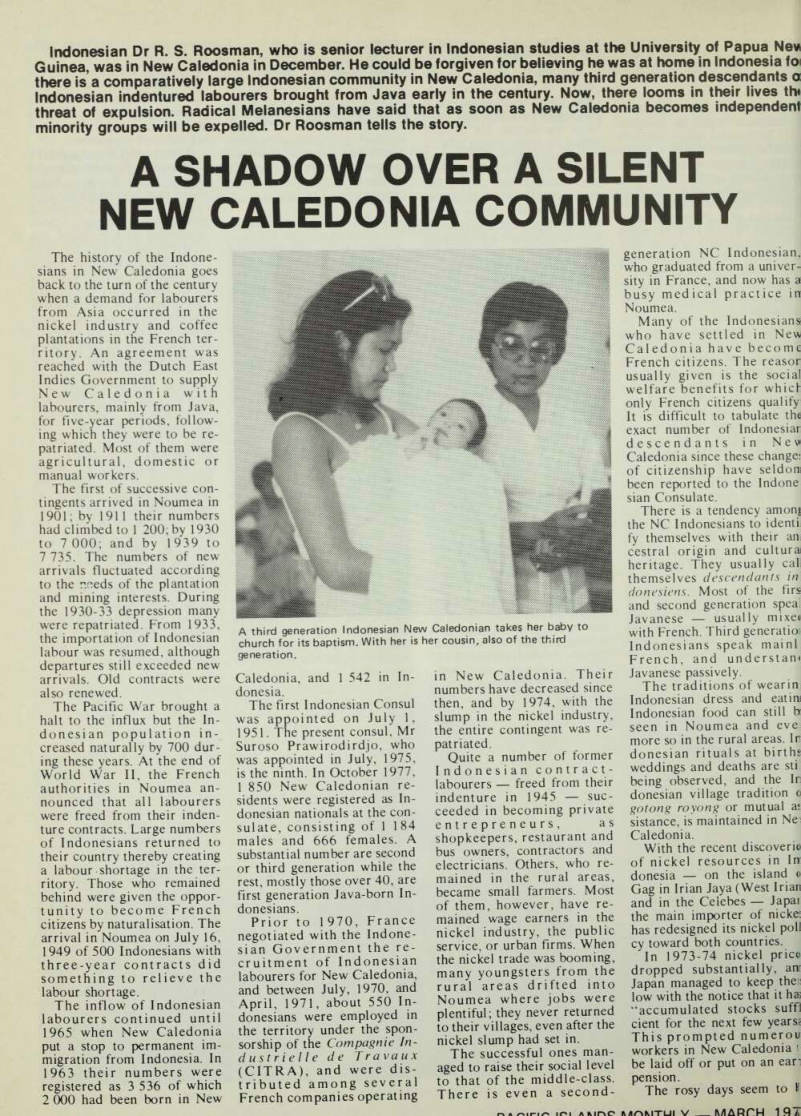
A third generation Indonesian New Caledonian takes her baby to church for its baptism. With her is her cousin, also of the third generation.
over: prices of daily commodities, mostly imported from France, Australia and New Zealand, have skyrocketed, and N&w . Caledonians, having taken their island’s wealth too much for granted in the past, are I complaining that they have now to be contented with less, The social security system in New Caledonia has pref vented the depression in the nickel industry from being as disastrous as one would ex- P ect - From their parents or grandparents, NC Indonesians have learned that politics is tabu in the territ tory. In the early days, involvement in politics could mean deportation to Indonesia with no prospect of getting a job. This inborn fear . has further marked the NC Indonesians as a non-political group. Until the Pacific War their public social activities were limited to the founding of a funeral association headed by a Muslim elder referred to as marabou and a soccer club. Their traditional gotong royong (mutual assistance) system is the only element that binds the members together and characterises them as a clan-conscious group.
They mix easily and pleasantly with the other ethnic groups in New Caledonia, the French, Chinese, Vietnamese, Melanesmns, Ta hitians, and Walhsians. Many Frenchmen stationed in New Caledonia have married NC Indonesian
girls, while, nowadays, it is not uncommon for NC In donesian young men to take French brides, Political leadership has al ways been absent among the NC Indonesians. In the early days it was difficult to unite them due to their illiteracy, and because they represented a classless group of im poverished farmers, farm labourers and manual workers originating from dif ferent locations in Java, who felt that everybody should share the egalitarian idea of “nobody is less or more than the others”, As communications with Indonesia were cut off during the Pacific War, the NC In donesians followed with In terest the reports of Radio Australia on the political changes which were taking place in Indonesia. When Sukarno proclaimed indepen dence on August 17, 1945, a contingent of NC Indonesians sailed in 1948 to Java “to join the national struggle for inde pendence”.
Java was in political disar ray at the time, and the New Caledonian contingent was neglected altogether. Many of them returned to New Caledonia disappointed after sharing the miseries of war for several years. Nevertheless until 1972, Sukarno’s portrait was still to be seen hanging in various NC Indonesian homes in the rural areas around Kone and Paita. Taking into consideration that Sukarno was deposed by Suharto in
1966, their ignorance can be blamed on the lack of infor mation provided by the In donesian consulate in Noumea. Jakarta has tried very hard to erase the memo ries of the former regime.
Every year on August 17 the Indonesian Consulate celebrates Independence Day together with the Indonesian community in New Caledonia with Indonesian speeches, songs and dances. There are social clubs in Noumea which bind the NC Indonesian youth together and keep them in touch with the Indonesian Consulate, such as the Club des jeunes indonesiens, the Muslim-oriented Amicale islamique indonesien, and the Amicale des Niaoulis of sec ond-generation NC Indone sians (Niaoulis). Finally, there is a NC Indonesian women’s association Dutika Handayani which also co operates closely' with the In donesian Consulate.
One can see that the task of the Indonesian Consulate in Noumea does not merely con sist in issuing visitors’ visas to Indonesia, or, as it happened in the past, assisting the French administration with the recruitment of contract workers. They must guide the NC Indonesian community in maintaining their ancestral culture and arts, such as Javanese music, dance and drama— a role well-liked by the French authorities as it enriches the life of the multi racial society of New Caledonia.
Until today no NC Indone sian has ever played an im
portant role in New Caledo nian politics except 55-year old Amril Djunaedi, a Noumea resident, who now leads a local faction of the New Caledonian Socialist Party which, while demanding self-government, refuses inde pendence from France. Ex tremist threats have been voiced by the radical Melane sian movements that “the minority groups would be ex pelled from New Caledonia as soon as the territory becomes
independent”.
A group of New Caledonian first-generation Indonesians are maintaining their business and family relations with In donesia, and have been buying land and houses in Java “for their retirement”. Second and third generation NC In donesians, who are New Caledonia-born, French-edu cated, and naturalised French citizens, shrug their shoulders and comment “that they would go to France”. Those who remain Indonesian citizens hold the opinion that “there will be always a place for them in Indonesia”.
It can be speculated that whatever the political future of New Caledonia, the NC In donesians, who are now in their fifth generation, will be still needed for their skills.
And as they have adjusted themselves so well to the political and economic ups and-downs in New Caledonia, they may as well stay on their island and realise that they are Caldoches (Caledonians) first, and only French or In donesian second.
Second, third and fourth generations are represented by this family group in front of their house in the Magenta area of Noumea.
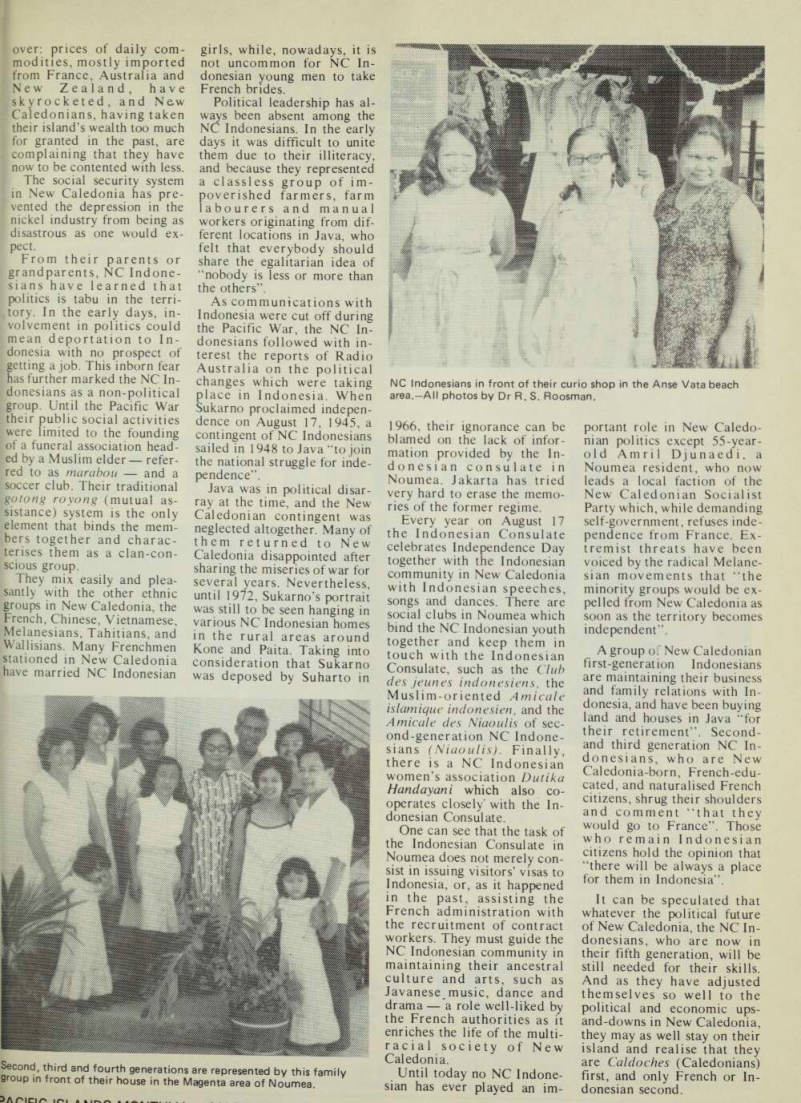
NC Indonesians in front of their curio shop in the Anse Vata beach area.—All photos by Dr R. S. Roosman.