Sir Albert Henry
pp. 18-19 · Read in the full issue
the enduring politician
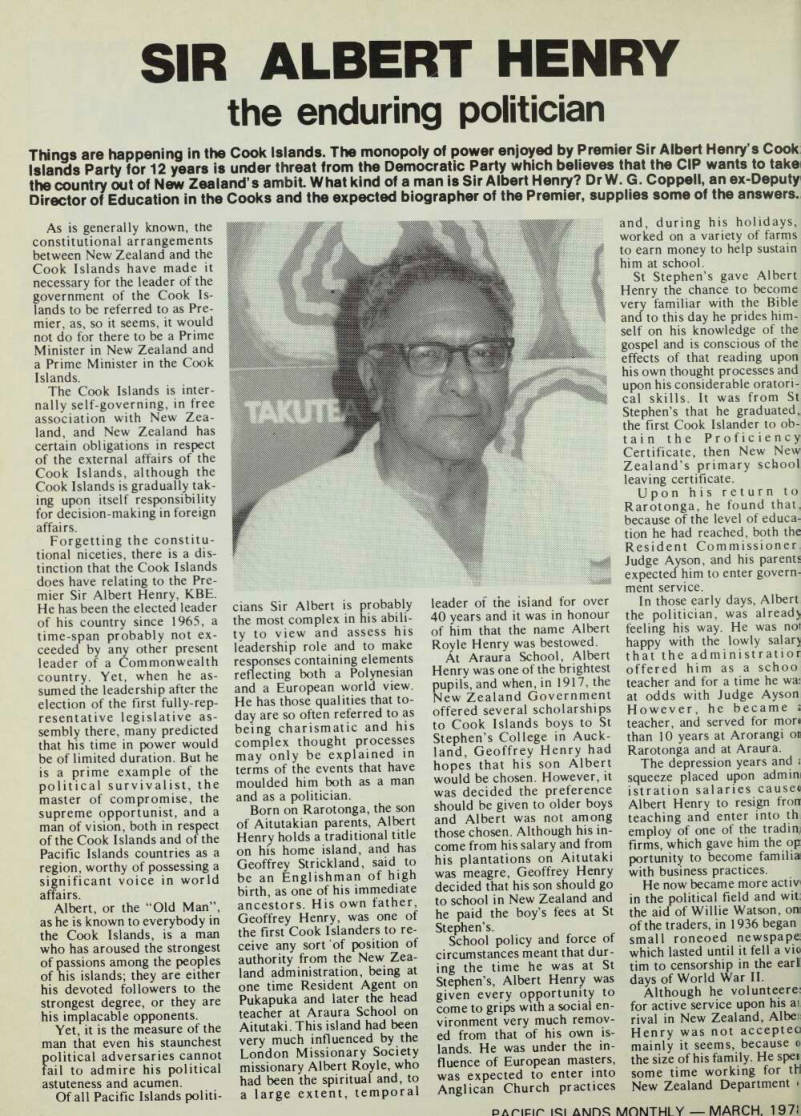
Things are happening in the Cook Islands. The monopoly of power enjoyed by Premier Sir Albert Henry’s Cook Islands Party for 12 years is under threat from the Democratic Party which believes that the CIP wants to take the country out of New Zealand’s ambit. What kind of a man is Sir Albert Henry? Dr W. G. Coppell, an ex-Depufy Director of Education in the Cooks and the expected biographer of the Premier, supplies some of the answers.
As is generally known, the constitutional arrangements between New Zealand and the Cook Islands have made it necessary for the leader of the government of the Cook Is lands to be referred to as Pre mier, as, so it seems, it would not do for there to be a Prime Minister in New Zealand and a Prime Minister in the Cook Islands.
The Cook Islands is inter nally self-governing, in free association with New Zea land, and New Zealand has certain obligations in respect of the external affairs of the Cook Islands, although the Cook Islands is gradually tak ing upon itself responsibility for decision-making in foreign affairs.
Forgetting the constitu tional niceties, there is a dis tinction that the Cook Islands does have relating to the Pre mier Sir Albert Henry, KBE.
He has been the elected leader of his country since 1965, a time-span probably not ex ceeded by any other present leader of a Commonwealth country. Yet, when he as sumed the leadership after the election of the first fully-rep resentative legislative as sembly there, many predicted that his time in power would be of limited duration. But he is a prime example of the political survivalist, the master of compromise, the supreme opportunist, and a man of vision, both in respect of the Cook Islands and of the Pacific Islands countries as a region, worthy of possessing a significant voice in world affairs Albert, or the “Old Man’’, as he is known to everybody in the Cook Islands, is a man who has aroused the strongest of passions among the peoples of nis islands; they are either his devoted followers to the strongest degree, or they are his implacable opponents.
Yet, it is the measure of the man that even his staunchest political adversaries cannot fail to admire his political astuteness and acumen.
Of all Pacific Islands politi-
cians Sir Albert is probably the most complex in his abili ty to view and assess his leadership role and to make responses containing elements reflecting both a Polynesian and a European world view.
He has those qualities that to day are so often referred to as being charismatic and his complex thought processes may only be explained in terms of the events that have moulded him both as a man and as a politician.
Born on Rarotonga, the son of Aitutakian parents, Albert Henry holds a traditional title on his home island, and has Geoffrey Strickland, said to be an Englishman of high birth, as one of his immediate ancestors. His own father, Geoffrey Henry, was one of the first Cook Islanders to re ceive any sort of position of authority from the New Zea land administration, being at one time Resident Agent on Pukapuka and later the head teacher at Araura School on Aitutaki. This island had been very much influenced by the London Missionary Society missionary Albert Royle, who had been the spiritual and, to a large extent, temporal
and, during his holidays, worked on a variety of farms to earn money to help sustain him at school.
St Stephen’s gave Albert Henry the chance to become very familiar with the Bible ana to this day he prides him self on his knowledge of the gospel and is conscious of the effects of that reading upon his own thought processes and upon his considerable oratori cal skills. It was from St Stephen’s that he graduated, the first Cook Islander to ob tain the Proficiency Certificate, then New New Zealand’s primary school leaving certificate.
Upon his return to Rarotonga, he found that, because of the level of educa tion he had reached, both the Resident Commissioner.
Judge Avson, and his parents expected him to enter govern ment service.
In those early days, Albert the politician, was already feeling his way. He was not happy with the lowly salary that the administratior offered him as a schoo teacher and for a time he wai at odds with Judge Ayson However, he became 2 teacher, and served for mort than 10 years at Arorangi on Rarotonga and at Araura.
The depression years and ; squeeze placed upon admim istration salaries causeo Albert Henry to resign front teaching and enter into th employ of one of the trading firms, which gave him the op portunity to become familial with business practices.
He now became more activ' in the political field and wit; the aid of Willie Watson, om of the traders, in 1936 began small roneoed newspaper which lasted until it fell a vio tim to censorship in the earM days of World War 11.
Although he volunteere; for active service upon his ai rival in New Zealand, Albei Henry was not accepteo mainly it seems, because o the size of his family. He spei some time working for tH New Zealand Department <
leader of the island for over 40 years and it was in honour of him that the name Albert Royle Henry was bestowed.
At Araura School, Albert Henry was one of the brightest pupils, and when, in 1917, the New Zealand Government offered several scholarships to Cook Islands boys to St Stephen’s College in Auck land, Geoffrey Henry had hopes that his son Albert would be chosen. However, it was decided the preference should be given to older boys and Albert was not among those chosen. Although his in come from his salary and from his plantations on Aitutaki was meagre, Geoffrey Henry decided that his son should go to school in New Zealand and he paid the boy’s fees at St
Stephen’s.
School policy and force of circumstances meant that dur ing the time he was at St
Stephen’s, Albert Henry was
given every opportunity to come to grips with a social en vironment very much remov ed from that of his own is lands. He was under the in fluence of European masters, was expected to enter into Anglican Church practices
Agriculture at Te Kauwhata, then moved to the North Shore in Auckland to work as a bus cleaner.
It was then that his political education began to quicken.
He became an active member of the Brown’s Bay Labour Party, was one of the founders of the Cook Islands Progressive Party and pri marily responsible for the for mation of a New Zealand Branch of the CIPA. He came into contact with several New Zealand left-wing politicians and trade unionists, who ob viously did much to widen his understanding of political processes.
This period of his life led him into confrontation with the administration in the Cook Islands over the forma tion of a trade union there and the attempts to suppress the activities of the CIPA. In view of his present opposition to the formation of links between trade unions in New Zealand and workers’ groups in the Cook Islands, it is worth knowing that in that time Albert Henry is said to have opposed the growth of trade unionism as he felt that it would create an undesirable division between Cook Islan ders.
Undoubtedly, he learnt much from this period of con frontation and he was to suffer the stings of adversity when the business activities and the
shipping venture he sponsored through the CIPA foundered.
Then followed the long period of self-exile in Auck land, when he was to work at the sugar refinery and in a large warehouse. He became active in trade union affairs, represented the voice of Cook Islanders in New Zealand and came to the notice of those who wielded political power in New Zealand. Above all, he was able to maintain links with the political structure he had created in the Cook Is lands, through the CIPA.
It was with the moves towards self-determination in 1964-65 that Albert Henry was able to return to the Cook Islands and call upon a level of personal expertise un paralleled among Cook Islan ders.
He was also able to call upon old loyalties and to capitalise on his political knowledge to achieve his political ambitions. He cre ated the only viable political party and provided the leadership necessary to fill the political vacuum created by the granting of internal self government.
Much has been said and written since 1965 about his leadership and the various decisions he has made. Often his motives may have been misinterpreted. Sometimes, he has been accused, rightly or wrongly, of pursuing self-in terest, but sufficient to say
that he has been able to give a period of relative stability to a mini-nation facing all the problems set by factional in terests, difficulties of com munication, economic vicissitudes and of an in herited political structure, which may not have been the most appropriate for the needs of the Cook Islands people.
Today in the Cook Islands, the most favoured topic of conversation is concerned with the outcome of the next general election. Will the Cook Islands Party be able to maintain its strength? Will there be an emergence of a new political grouping based on a new generation of well educated Cook Islanders?
Most intriguing of all, “Who will succeed Albert when he steps down?” In a re cent television interview in New Zealand, Sir Albert was asked, “What sort of man will succeed you? His reply was “I have been pushed by so many, all around. Although we have quite a lot of capable young men, with university degrees, the people did not feel that there were any of them that had a steadying influence in this very lively period in the life of our country. So, sud denly I gained a new life, I don’t know where it came from, but I feel quite healthy and strong so I decided never to retire. I shall be leading my
party again at the next elec tion.”
Here is a man who deserves to be honoured for all his vir tues and all his failings. This is now being done by members of his family and by many of his political supporters.
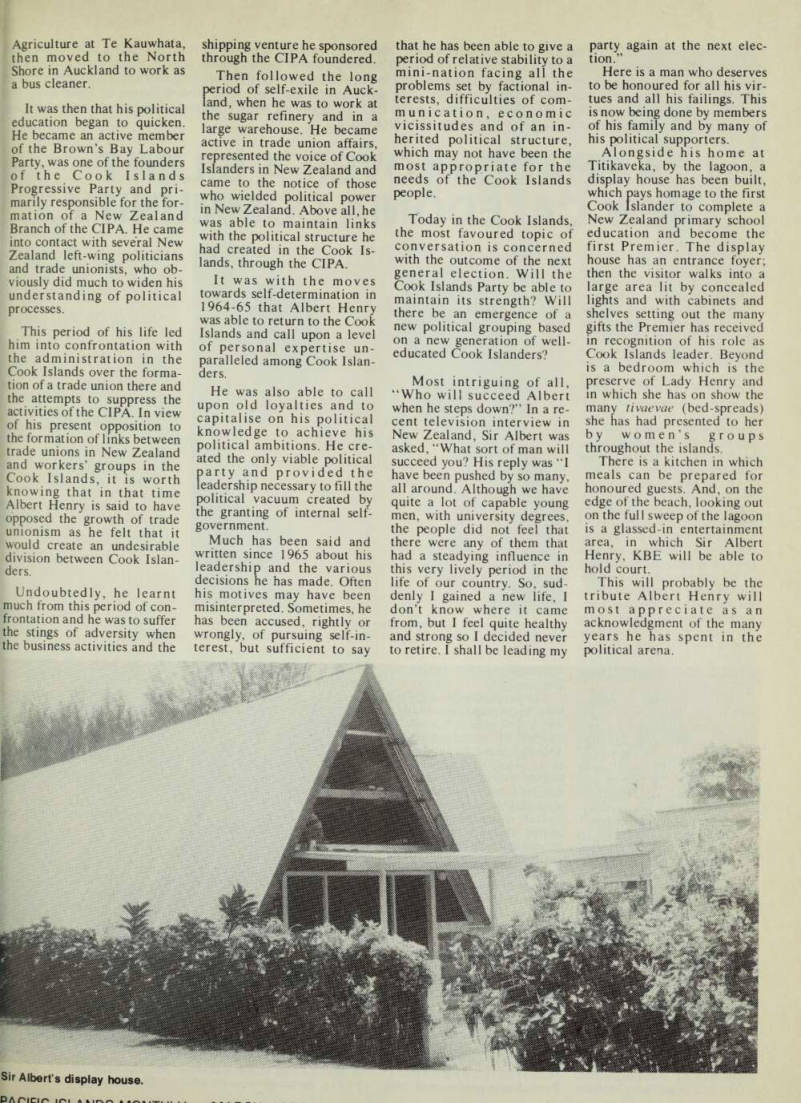
Alongside his home at Titikaveka, by the lagoon, a display house has been built, which pays homage to the first Cook Islander to complete a New Zealand primary school education and become the first Premier. The display house has an entrance foyer; then the visitor walks into a large area lit by concealed lights and with cabinets and shelves setting out the many gifts the Premier has received in recognition of his role as Cook Islands leader. Beyond is a bedroom which is the preserve of Lady Henry and in which she has on show the many tivaevae (bed-spreads) she has had presented to her by women’s groups throughout the islands.
There is a kitchen in which meals can be prepared for honoured guests. And, on the edge of the beach, looking out on the full sweep of the lagoon is a glassed-in entertainment area, in which Sir Albert Henry, KBE will be able to hold court.
This will probably be the tribute Albert Henry will most appreciate as an acknowledgment of the many years he has spent in the political arena.
Sir Albert’s display house.