Easter Island, a de-mystified
pp. 14-17 · Read in the full issue

Travel
Easter Island, a de-mystified dot on the tourists’ map
Easter Island, a speck in the South Pacific, so far away from its neighbours, has always ranked with the pyramids, with Stonehenge and others as one of the ancient mysteries. But the tourists have discovered Easter Island and its statues and it is a mystery no longer. Grant McCall, a lecturer in social anthropology at the University of New South Wales, spent two years on Easter Island doing field work for his PhD. This is his story.
The son of Robert McNamara liv ed on Easter Island from 1972 to 1973, milking cows and selling his dairy produce from door to door, while the Vietnam war, in which his father played such an influential role, raged. I once asked Craig (in his 20s) why the son of a former United States Secretary of Defence and now President of the World Bank should wish to live in a dilapi dated shack that even the Rapanui, as the Easter Islanders call them selves, would not consider inhabit ing. He replied that he was doing it to escape; to hide out on the world’s most remote inhabited island.
Easter Island lies about mid-way between the Chilean coast and the Eastern Polynesian capital, Papeete, surrounded by thousands of square kilometres of blue Pacific, speckled only occasionally by rocky islets, such as Dude and Sala-y-Gomez, the nearest inhabited neighbour being the sparsely-populated Pit cairn Island, over two thousand kilometres distant.
But even in Craig McNamara’s time, there was a weekly air service, operated by LAN-Chile, between Santiago de Chile and Tahiti. And, especially during the Presidency of Salvador Allende, something like half a dozen ships called each year, where, formerly, an annual supply ship had been the only interruption to life on one of the most startling monuments to human ingenuity ever organised and constructed.
It was a Dutchman, Jacob Rogge veen, who was the first European to land on that eastern most vertice of the Polynesian triangle. He was searching for the great South Land, but on Easter Day, 1722, he found instead a rocky island, populated by red-haired, tattooed people, who fought and traded sweet potatoes beneath huge basalt statues, some weighing more than 80 tons.
Roggeveen, during his brief visit, could not have known that the red hair was due to the use of cosmetic red ochre, but this report and those of others fired European imagina-
tion to pay subsequent visits. James Cook, the Comte de La Perouse the Spanish expedition, Captain Beechey, and many of the other famous and infamous navigators who charted the Pacific spent their hours or days off Rapanui’s rocky and dangerous coasts.
In the 19th century, with the development of whaling, Easter Is land became a frequent calling place to renew ship’s stores, with sweet potatoes and bananas. In 1821, four different ships called within a few months of one another.
In all, between 1722 and 1862, nearly 60 different ships stopped at Rapanui, most of them in the 19th century. The islanders learned the art of barter with the Europeans, often specifying which manufac tured products they wanted in ex change for their local produce.
Slave raids, disease, depopula tion, missionaries, traders, com mercial exploitation, and all of the other benefits of contact with Euro pean civilisation that other parts of Polynesia have enjoyed were also the pattern on Rapanui. The annex ation by Chile in 1888 merely com pleted the inevitable process. The islanders themselves had petitioned France for a protectorate many times and, in the 1880 s, were even promised a gendarme, though the order was never carried out.
Today, Easter Island is still remote, but hardly isolated. Twice weekly, a Boeing 707 roars over the island’s only town, Hangaroa, where 1500 Rapanui and about 500 Chileans live and work, mostly for the government services. Tourist parties can now experience in a few days what intrepid seafarers had to invest months of arduous sea travel to achieve; the sacred settlement of Orongo, perched on a volcano rim, the colossal statues, lying like fallen chess pieces about the island’s land scape, and the cyclopean ceremonial altars, which mark the prehistoric settlements of the ancient clans around the island’s perimeter.
A few weeks ago, I received the tiny Easter Island telephone direc tory, listing about 100 subscribers. I reflected that I could now ring my
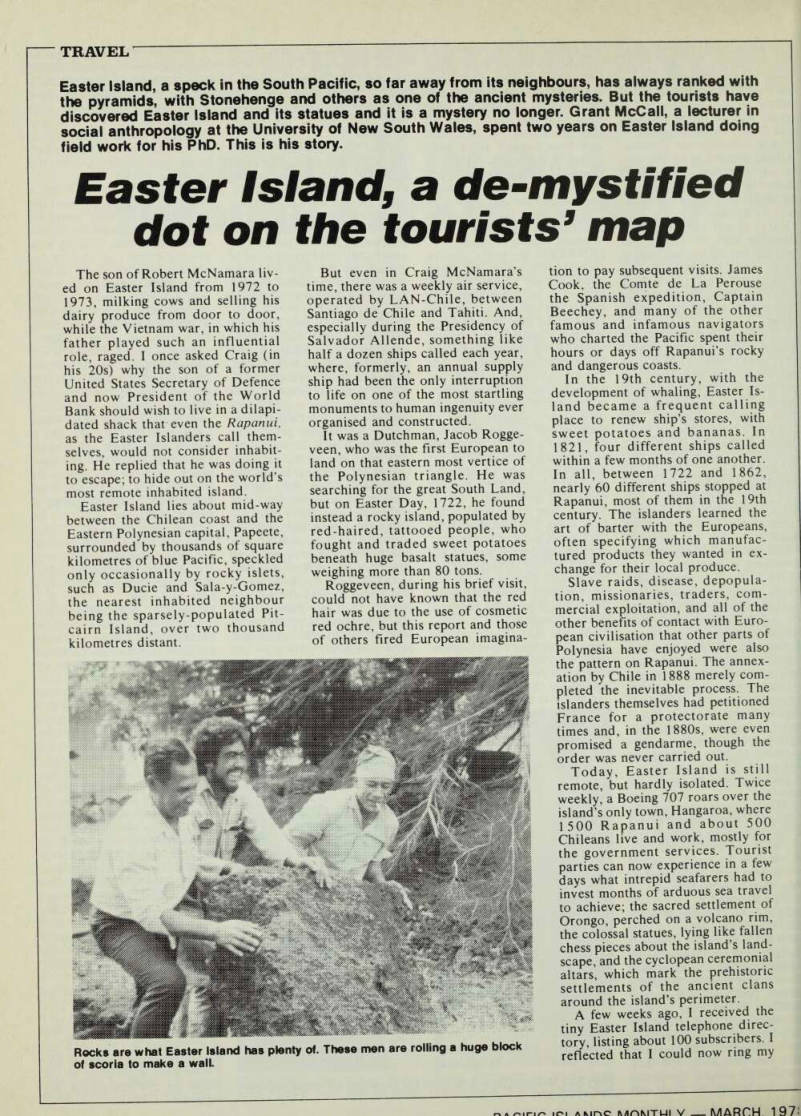
Rocks are what Easter Island has plenty of. These men are rolling a huge block of scoria to make a wall.
friends on Easter Island, from the comfort of my own home, should I wish to clear up any points of kin ship or custom that I neglected dur ing my two years’ field research there in 1972-1974.
I wonder, though, if they would now have as much time to speak with me. It was usually easy to get them to turn off their short-wave radios to answer my questions, but how could I compete with the two hours of closed circuit television programming that they have each night?
Can social anthropology (or a people) withstand the onslaught of Spanish-dubbed versions of Perry Mason, The Pink Panther, or Kung fu? “Civilisation” has really come to Rapanui.
While no evidence exists to de monstrate that Easter Islanders ever left their island in the pre-contact period, several of them took advan tage of European vessels to travel.
In 1795, two young men begged to be taken to Britanniee , on a merchant ship commanded by Charles Bishop. Australia might have had its first Rapanui tourist in 1821, if Sydney merchant, Captain Thomas Raine, had acceded to a re quest by a young islander. Instead, Raine left some seeds and gave the disappointed adventurer a bottle on a string as a souvenir. The first documented Rapanui traveller was lire Hina ’a Tuke, who left his island in 1806, in the company of Captain Benjamin Page, on the Adventure.
Five years later, the islander was baptised Henry Easter , at Rotherhithe Church, near the Lon don docks. According to tradition, Ure Hina returned to his home with many tales of his adventures and brought with him new ideas for house construction.
In the 20th century, many islan ders have travelled to various parts, verifying that the spirit of adventure which drove the Polynesians to set tle on Rapanui, still lives on. Many have been to Mainland Chile and some own property there, while others have travelled to North America and Europe. Several have paid visits to Tahiti, where there is Rapanui land at Pamata’i, purchas ed in the last century from the Catholic Church. Others have been to distant New Zealand. One young islander is studying for a PhD at the East-West Center in Honolulu.
While most Rapanui travellers travel by jet today, there are also those who have taken a more dangerous way. Between 1944 and 1958, largely due to the strict Chilean controls on off-island movement, 40 islanders tried, in
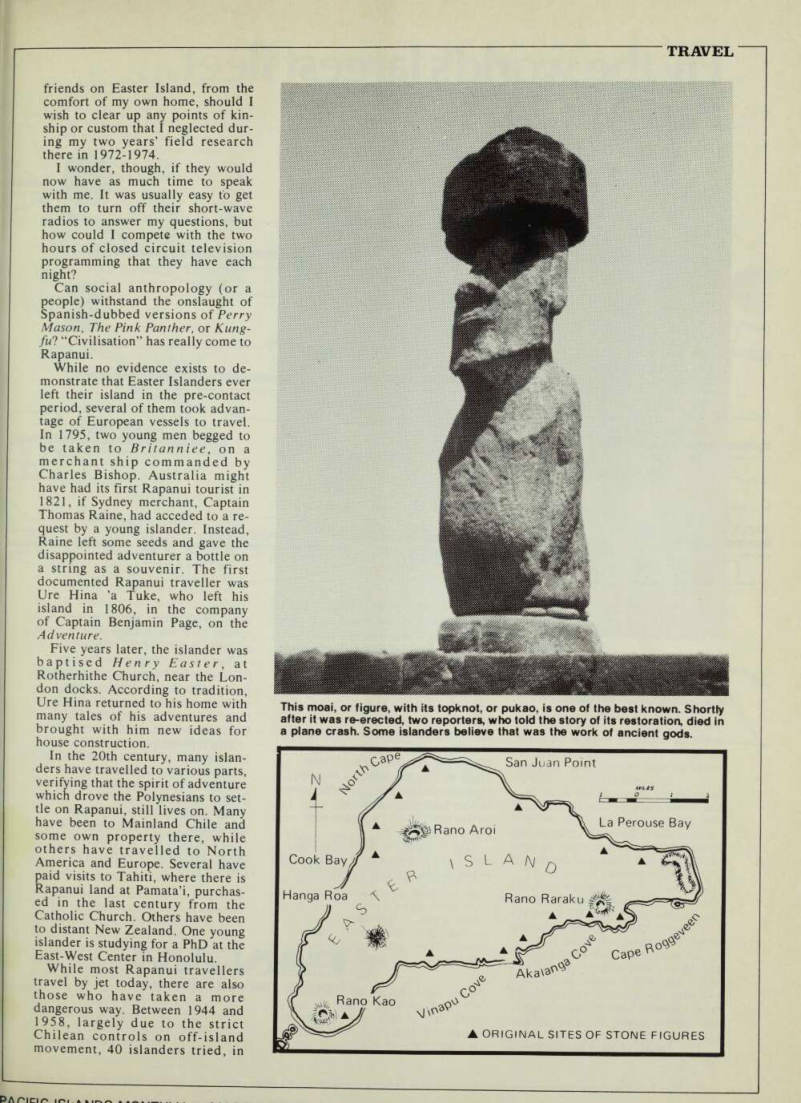
This moai, or figure, with its topknot, or pukao, is one of the best known. Shortly after it was re-erected, two reporters, who told the story of its restoration, died in a plane crash. Some islanders believe that was the work of ancient gods.
eight different trips, to sail or drift in small boats to other destinations.
With the exception of one group, all of the voyagers were headed for Tahiti. Over half were never heard from again. Since 1958, when that series of voyages ended in an unsuc cessful one, the Rapanui have used ships and planes. However, in April of this year, five young men tried again to take a small yacht to Tahiti.
Two of them were known to me and I recall their questions about life in Australia and their desire to come here to work. As far as I know, they failed in their desperate attempt to realise the freedom that they cannot enjoy in today’s Chile.
Dissatisfaction with their Chilean overlords varies amongst the Rapanui population, depending upon current economic cir cumstances. On a personal level, there are more marriages today be tween islanders and Chileans than there are between islanders. Many islanders have positive feelings about Chileans as individuals, but do not admire Chile as a country.
Occasionally, cargo cult- type revolts have occurred against Chile in this century. The first one involv ed the last King of Rapanui, Simeon Riroroko, who was taken to Chile and never returned to his island.
Another, in 1915, involved a Rapanui prophetess, trained as a catechist in Mangareva, who led a revolt based upon messages from God. She was also unsuccessful and some of her supporters were taken to Chile, never to be seen again.
The last outbreak occurred in 1964-1965, when a charismatic young man, trained as a school teacher in Chile, presented demands to bring about an end to military rule on the island. In the ensuing furore, a troop ship was sent from Chile, shots were fired, though no one was seriously injured. Perhaps the presence of a Canadian medical expedition saved the young leader’s life, for the requested reforms were implemented and, in 1966, the is land became an official part of Chile. For the first time, the Rapanui could vote as full citizens of their metropolitan country.
If visitors have come to Rapanui in the last two centuries because of its mysterious monuments, the Islanders leave their remote home to escape from them. All around them are reminders of a glorious heritage; but only a few old men and women can now recount the ancient stories. People told me that an in fluenza epidemic in the 1920 s took most of the islanders with true knowledge of their past.
Since then, Juan Tepano (infor mant to Alfred Metraux) and Pedro Atan (the wily Mayor during the visit of Thor Heyerdahl) have died.
The last son of the King of Rapanui died, only, in 1976. Those remain ing, such as Victoria Rapahango, Luis Pate, Leon Tuki, and Jose Fati notice that their eyesight is failing and their step becoming more un sure each day.
Those others who do tell the old stories have often learned them from Spanish translations of one of the European works on Easter Is land. The local carvers, with few ex ceptions as they have done for most of this century copy their statuettes from published photo graphs of figures traded by their an cestors and now in European museums.
Recently, three Rapanui wood household idols, obtained from the last century, were sold in New York for more than $2OO 000. Prices for modern copies, the prospective visi
tor will be relieved to know, go for much less.
Trading statues with outsiders and guiding them around the monu ments have been Rapanui activities for over two centuries and so has the spinning of inventive stories to en tertain ingenuous foreigners.
Most of the Rapanui today speak Spanish and many know French and English, the latter with a heavy yan qui accent, derived from contact with an American Air Force Base on the island between 1966 and 1971.
The modern visitors will find that the vivacity and friendliness remarked upon by many an early visitor will still characterise the islanders he will meet today.
Even with the improved com munications and frequency of air links, I am certain that the feeling that I had when I saw the LAN- Chile plane disappear into the clouds is still one the present visitor would have; of peace, calm, and, even, contentment at being on the world’s most remote island.
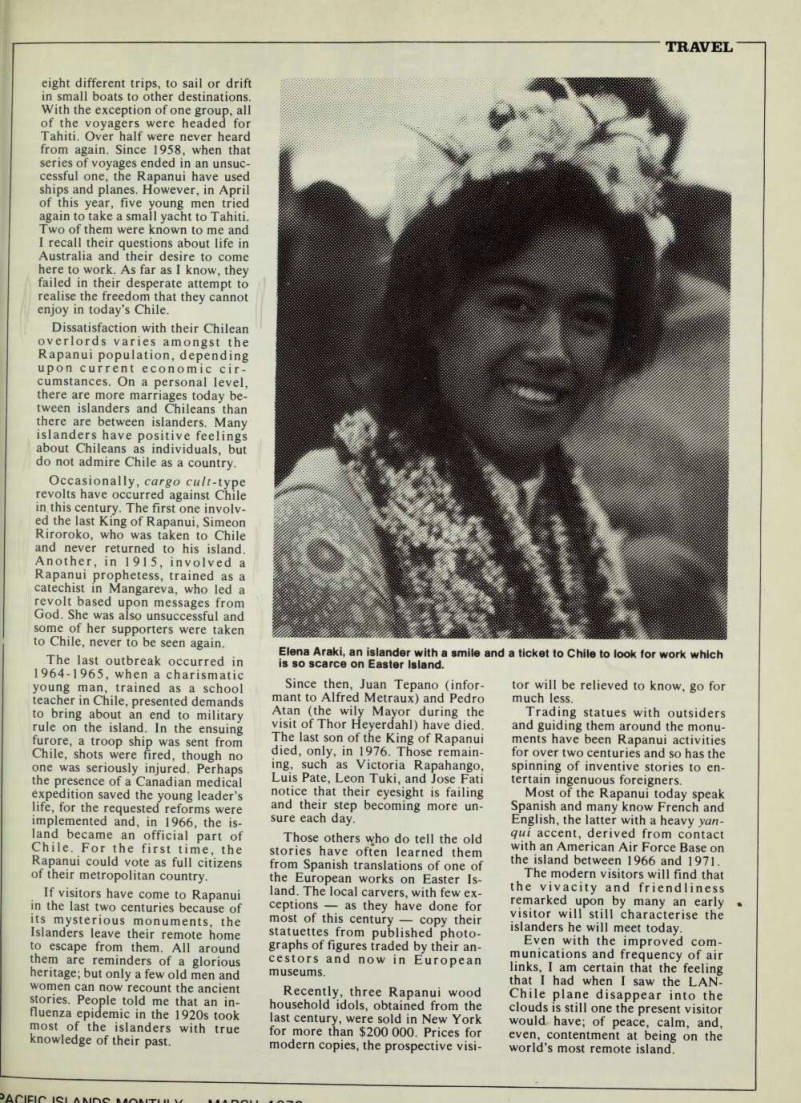
Elena Araki, an islander with a smile and a ticket to Chile to look for work which is so scarce on Easter Island.