Through A Glass, Darkly
pp. 12-13 · Read in the full issue
Aid To The Islands-
The dialogue recorded below by one of PlM’t special Islander writers represents a lypteal conversation between an aid consultant-cum-expert and one of his Tongan counterparts regarding the aid his government is going to assist In, or, at least, thinks of assisting In. It is reproduced here for the benefit of other consultants/experts who should know what their colleagues are doing In Tonga and other places and how they should conduct their discussions. Names have been altered to protect the innocent.
JENKINS (NZ Govt Treas ury); Good morning, Mr Semisi.
SEMI SI: Good morning. How are you enjoying your stay in Tonga?
JENKINS: Very well indeed.
Didn’t get to sleep till four this morning. Met up with some of my Kiwi mates and sheilas and a dozen other aid consultants from other coun tries at our High Com missioner’s place; good swing ing party there, then we finish ed off the party in my room back at the hotel. Then we hopped into bed and listened to tne 2nd Test. Wasn’t that great stuff, our beating the stuffing out of the Frogs? That proves once and for all we are the champions, doesn’t it?
SEMISI: How many runs did
they make?
JENKINS: It’s rugby, not cricket! Haven’t you heard?
SEMISI: Listen, I’m sorry to interrupt you, but I haven’t got much time this morning, as in an hour’s time I have an appointment with the third team, in as many months, from the Asian Development Bank, followed by someone from the Australian Government, a couple from SPEC and Mr Abdul from the UNDP.
JENKINS: Gee, that’s a fairly full programme. Tell me, do you nave many of their types calling here? And what is this third team from the ADB that Pom from the British Overseas Development Minis try was saying something about them last night.
SEMISI: Well, it’s like this; I get your type here practically every month sometimes ev ery day. As for the ADB team, month before last we had a team of four here doing a preliminary economic survey of the kingdom. UNDP did one last year but apparently ADB is rather suspicious of
reports produced by others.
Hence their first team. Then last month, another team of four came to check on some areas of that report that were
still rather hazy. Now this team is coming this morning to finally verify the report, in case circumstances have changed, and to see whether Tonga really needs the pro ject. You see, it is going to cost ADB a lot of money and they have to make sure that what money they put in will be
well-spent.
JENKINS: But, of course; like what our High Com missioner is doing here keeping a watch on how you spend our sheep farmers’ money. But, these teams and their travels and entertain ment etc must cost a fortune!
SEMISI: Well, that is not the way ADB looks at it. Anyway, it comes out of the project vote itself; just like the way the Australians are doing it.
JENKINS: Talk of the blink ing arrogant Aussies! They are getting as smart as the Japanese. Hey, I believe they have promised you millions for the next three years.
SEMISI: Yes, but that’s mostly what they do pro mising and the emphasis is on making sure that the projects will be for the benefit of the nation. So feasibility studies and supplementary studies figure rather prominently in their budget. Generally, about one-third of the total voted for any project will pay the fees etc of the visiting Australian experts, a sixth for the supplementary study that normally follows, a sixth will be taken care of by inflation, and the remaining one-third held in abeyance awaiting the results of the annual federal election in case there is a change in government and, hence, a chance in aid policy.
Anyway, whatever happens that one-third will stay in Australia as part of the aid policy is to give first preference for the supply of management experts and materials and equipment to Australian firms.
JENKINS: The stingy Aus sies! They always win, as they
do with their NAFTA aid programme to New Zealand.
They give it to you with one hand and take it away (and more if possible) with the other like the way those Maoris did our pakeha ances tors. As for us, I’m sure you will understand the little we do for your people. What with our balance of payments deficits reaching record levels, our farmers’ products being rejected by the rest of the world (which forget they owe us a living), our Pommy dominated unions kicking us in the rumps and taking over the Promised Land, the Japanese and the Koreans stealing our fish from under our very nose, our solo mums, with their high social benefits, getting as numerous as our married mums you name it, we have got it! So, what can we do? Surely, you can under stand.
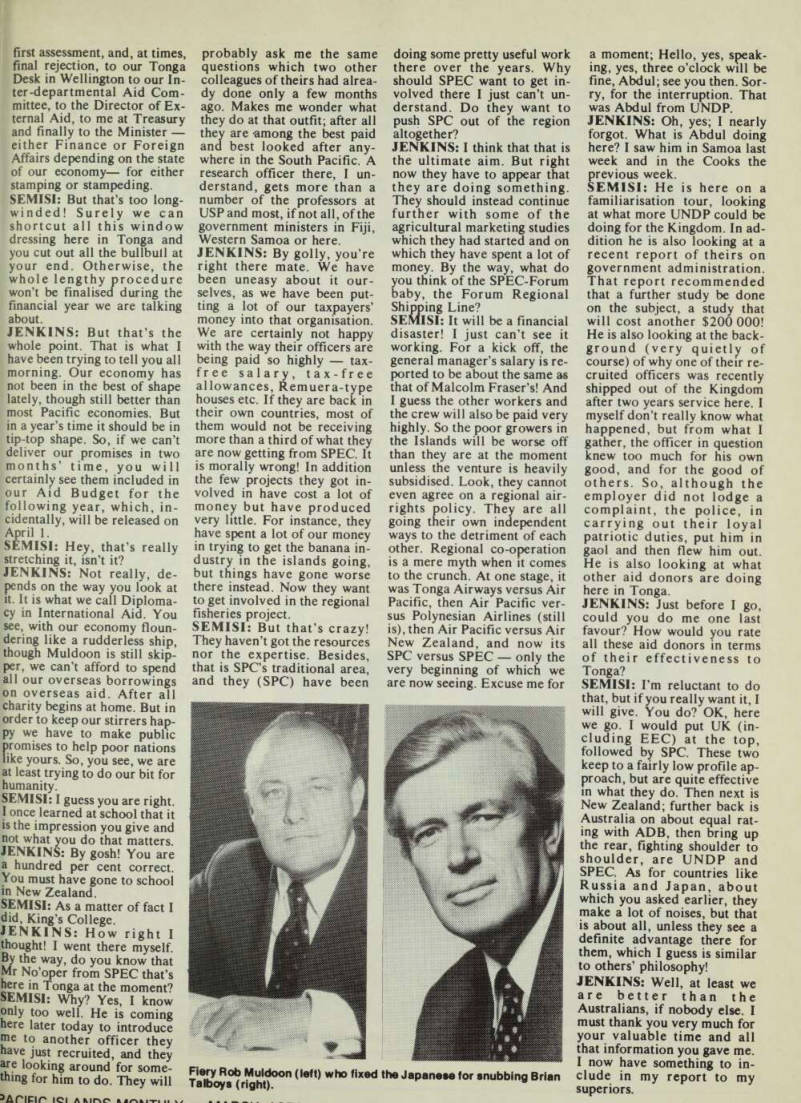
SEMISI: Sure, of course, we do. We have heard how your fiery Rob Muldoon has fixed the Japanese for snubbing Brian Talboys by banning all their fishermen from New Zealand waters (those parts which you can police), and in viting the Russians to come and fish in your waters, or at least legalise their poaching.
That is a very good move, very good move indeed. You first objected violently, but at long last you are agreeing with our opening our shores to our Russian comrades. It shows that your country is now beginning to mature
politically.
JENKINS: No! No! You na tives, I’m sorry, I mean you people are missing the point altogether. This is what we have wanted all the time. We and our ANZUS partners had to object to your wanting the Russians to come here, hence our prompt promises to in crease all our aid to you severalfold so that you would give up your flirtation with those comrades which you have now done. Once you
have given them up, we hose in and invite them to our shores so that we, together with our Yankee mates, can keep an eye on them. You see, our Muldoon may appear to put his foot into it every time he opens his mouth, but in reality he doesn’t. He would be the most courageous and shrewdest statesman of modern times; did you hear what he called President Carter? a mere boy of a peanut farmer! What about his description of Malcolm Fraser the Prime Receiver of a usurped government that needs an election each year to be given a mandate!
SEMISI: But what about his calling the Islanders mere coconuts whom nobody wants?
JENKINS: Now, now, that is being unkind. Sure, he did sa> that but that is not what he meant. Being a shrewd politi cian he wants to make people merely wonder at the possible meanings of his statements sc that no one can catch him out even though the court has caught him out and a few o his ministers on libel cases. Ir ministerial terminology, tha is called the Licence of beinj a Minister, as the taxpayer; always pay; at least in Nev Zealand!
SEMISI: Now, coming bad to the point; what about ou requests for the next financia year?
JENKINS: Well, we hav promised you about $ million. We have had preliminary look at your pro posals and they seem OK. I re peat they seem OK. Now wha you now have to do is to for mally submit them throug your proper official channels that is, through your depart mental committee to you minister, to your plannim cotomittee, to your aid com mittee, to your Cabinet; the; to our aid secretary here fc processing to His Excellenc our High Commissioner fc
first assessment, and, at times, final rejection, to our Tonga Desk in Wellington to our In ter-departmental Aid Com mittee, to the Director of Ex ternal Aid, to me at Treasury and finally to the Minister either Finance or Foreign Affairs depending on the state of our economy— for either stamping or stampeding.
SEMISI: But that’s too long winded! Surely we can shortcut all this window dressing here in Tonga and you cut out all the bullbull at your end. Otherwise, the whole lengthy procedure won’t be finalised during the financial year we are talking about.
JENKINS: But that’s the whole point. That is what I have been trying to tell you all morning. Our economy has not been in the best of shape lately, though still better than most Pacific economies. But in a year’s time it should be in tip-top shape. So, if we can’t deliver our promises in two months’ time, you will certainly see them included in our Aid Budget for the following year, which, in cidentally, will be released on April 1.
SEMISI: Hey, that’s really stretching it, isn’t it?
JENKINS: Not really, de pends on the way you look at it. It is what we call Diploma cy in International Aid. You see, with our economy floun dering like a rudderless ship, though Muldoon is still skip per, we can’t afford to spend all our overseas borrowings on overseas aid. After all charity begins at home. But in order to keep our stirrers hap py we have to make public promises to help poor nations like yours. So, you see, we are at least trying to do our bit for
humanity.
SEMISI: I guess you are right.
I once learned at school that it is the impression you give and not what you do that matters.
JENKINS: By gosh! You are a hundred per cent correct.
You must have gone to school in New Zealand.
SEMISI; As a matter of fact I did, King’s College.
JENKINS: How right I thought! I went there myself.
By the way, do you know that Mr No’oper from SPEC that’s here in Tonga at the moment?
SEMISI: Why? Yes, I know only too well. He is coming here later today to introduce jpe to another officer they have just recruited, and they are looking around for some thing for him to do. They will
probably ask me the same questions which two other colleagues of theirs had alrea dy done only a few months ago. Makes me wonder what they do at that outfit; after all they are -among the best paid and best looked after any where in the South Pacific. A research officer there, I un derstand, gets more than a number of the professors at USP and most, if not all, of the government ministers in Fiji, Western Samoa or here.
JENKINS: By golly, you’re right there mate. We have been uneasy about it our selves, as we have been put ting a lot of our taxpayers’ money into that organisation.
We are certainly not happy with the way their officers are being paid so highly tax free salary, tax-free
allowances, Remuera-type
houses etc. If they are back in their own countries, most of them would not be receiving more than a third of what they are now getting from SPEC. It is morally wrong! In addition the few projects they got in volved in have cost a lot of money but have produced very little. For instance, they have spent a lot of our money in trying to get the banana in dustry in the islands going, but things have gone worse there instead. Now they want to get involved in the regional fisheries project.
SEMISI: But that’s crazy!
They haven’t got the resources nor the expertise. Besides, that is SPC’s traditional area, and they (SPC) have been
doing some pretty useful work there over the years. Why should SPEC want to get in volved there I just can’t un derstand. Do they want to push SPC out of the region altogether?
JENKINS: I think that that is the ultimate aim. But right now they have to appear that they are doing something.
They should instead continue further with some of the agricultural marketing studies which they had started and on which they have spent a lot of money. By the way, what do you think of the SPEC-Forum baby, the Forum Regional
Shipping Line?
SEMISI: It will be a financial disaster! I just can’t see it working. For a kick off, the general manager’s salary is re ported to be about the same as that of Malcolm Fraser’s! And 1 guess the other workers and the crew will also be paid very highly. So the poor growers in the Islands will be worse off than they are at the moment unless the venture is heavily subsidised. Look, they cannot even agree on a regional air rights policy. They are all going their own independent ways to the detriment of each other. Regional co-operation is a mere myth when it comes to the crunch. At one stage, it was Tonga Airways versus Air Pacific, then Air Pacific ver sus Polynesian Airlines (still is), then Air Pacific versus Air New Zealand, and now its SPC versus SPEC only the very beginning of which we are now seeing. Excuse me for
a moment; Hello, yes, speak ing, yes, three o’clock will be fine, Abdul; see you then. Sor ry, for the interruption. That was Abdul from UNDP.
JENKINS: Oh, yes; I nearly forgot. What is Abdul doing here? I saw him in Samoa last week and in the Cooks the previous week.
SEMISI: He is here on a familiarisation tour, looking at what more UNDP could be doing for the Kingdom. In ad dition he is also looking at a recent report of theirs on government administration.
That report recommended that a further study be done on the subject, a study that will cost another $2OO 000!
He is also looking at the back ground (very quietly of course) of why one of their re cruited officers was recently shipped out of the Kingdom after two years service here. I myself don’t really know what happened, but from what I gather, the officer in question knew too much for his own good, and for the good of others. So, although the employer did not lodge a complaint, the police, in carrying out their loyal patriotic duties, put him in gaol and then flew him out.
He is also looking at what other aid donors are doing here in Tonga.
JENKINS: Just before I go, could you do me one last favour? How would you rate all these aid donors in terms of their effectiveness to Tonga?
SEMISI; I’m reluctant to do that, but if you really want it, I will give. You do? OK, here we go. I would put UK (in cluding EEC) at the top, followed by SPC. These two keep to a fairly low profile ap proach, but are quite effective m what they do. Then next is New Zealand; further back is Australia on about equal rat ing with ADB, then bring up the rear, fighting shoulder to shoulder, are UNDP and SPEC. As for countries like Russia and Japan, about which you asked earlier, they make a lot of noises, but that is about all, unless they see a definite advantage there for them, which I guess is similar to others’ philosophy!
JENKINS: Well, at least we are better than the Australians, if nobody else. I must thank you very much for your valuable time and all that information you gave me.
I now have something to in clude in my report to my superiors.
Fiery Rob Muldoon (left) who fixed the Japanese for snubbing Brian Talboys (right).