Germany notices
pp. 23-26 · Read in the full issue
Tropicalities
Best of both
worlds for some
Mr John Kite, personnel of ficer with the South Pacific Commission, has had his sec ondment from the Tongan Government extended for another two-year term.
He is one of three civil ser vants from the kingdom who are overseas working with regional organisations. The others are Mr Mahe Tu pouniua, director of the South Pacific Bureau of Economic Co-operation (SPEC), and Mr F. Fifita, an administrator with the University of the South Pacific.
During their secondment, their jobs in Tonga are kept open for them by acting of ficers, and their secondment period is included in calcula tions of their pension rights with the Tonga Government.
Considering that their sal aries with the regional organ isations are several times more than what they would be paid in their old jobs at home, there has been mounting re sentment among Tongan civil servants over the past couple of years at the present ar rangements. Why, civil ser vants are saying, should they get the best of both worlds?
Why should they not be oblig ed to resign from their Tongan posts when they ac cept such positions, and take their chances with the rest when they return?
Germany notices
the Solomons
Radio Deutsche Welle, the )fficial West German station vhich broadcasts from Col >gne, has noticed the
Jolomons forthcoming inde
>endence on July 1. In a hortwave broadcast beamed o Australia and Asia, the adio’s current affairs programme “Panorama” levoted a short newscast to he Solomons.
The journalist who wrote he despatch was not noted for lis political geography as he lad included Bougainville in >a pua New Guinea as part of he Solomons. The two largest owns were given as Kieta and Joniara.
Announcing the financial ettlement, the news was a tit le out of date quoting figures rom before the London Con
ference in which the loan ele ment of the settlement was changed to an outright grant.
The broadcast stated that, “because of their weak econ omy the Solomons will get a ‘Golden Handshake’ from Britain of £26 million over four years, £lB million in or dinary development aid. The European Economic Com munity will provide an extra £2 million from its develop ment fund”.
Apart from the economy, the radio station said the two other problems facing the Solomons were the status of the Gilbertese and re publicanism. It was reported that the Solomons had asked for a two-tier system of citizenship but that the British has said that such a concept would be unacceptable to the United Nations.
On the matter of re publicanism it was noted that this was primarily the idea of the opposition in the Legisla tive Assembly and that this was receiving opposition from the grass roots level, especially from local councils.
Apart from geographical errors and being slightly out of date, the item was an in teresting opportunity to “see ourselves as others see us”, comments a Honiara resident.
Ecologist looks
at the Islands
Will the Pacific Islands be able to create a delicate balance between economic progress and concern for the environment?
That was the main question asked by Dr S. Dillon Ripley, secretary of the world-famous Smithsonian Institution, dur ing his recent Dillingham lec ture at the University of Hawaii’s East-West Center.
Dr Ripley, an authority on the wildlife of the Pacific and Asia, told a large audience of faculty members and students at the East-West Center in January that he has been in terested in Pacific Island en vironmental problems since 1936 when he took part in a zoological expedition to New Guinea for the Philadelphia Academy of Sciences. It was his first job as a biologist and he travelled from New York to New Guinea to study the is land’s birds. He was paid $5O a month.
“Islands,” he explained,
“are fragile ecosystems, more so because of their immediacy to the elements. In a sense, is lands provide biologists the perfect model upon which to test theories in disciplines such as biogeography. We have of late recognised that processes of colonisation and extinction in parks have a dis tinct similarity to these pro cesses on islands. Islands, therefore, are good rep resentatives of the en vironment at large. We can use islands in many instances as our early-warning system for potential ecodisasters.”
Dr Ripley discussed at length one Pacific island development project he believes might bring immedi ate economic wealth but would, in the long run, de stroy a valuable natural heritage for the next genera tion of islanders.
The example is Palau, in Micronesia, where a combin ed group of Japanese and American developers have
made studies towards build ing a billion dollar oil trans shipment and industrial superport complex. Palauan leaders are endorsing the pro ject although there is vocal opposition led by High Chief Ibedul.
“It is estimated,” Dr Ripley explained, “that as much as eight million cubic metres of ocean bottom would be dredged to create proper facilities. Similarly, some 12 000 (foreign) workers and their families would be brought to Palau, a number equal to the existing popula tion. Undoubtedly, a popula tion influx of this size and subsequent urbanisation would result in breaking down the existing Palauan cultural heritage and tradi tional life.”
According to Dr Ripley, Palau’s coastal waters are among the most ecologically rich and diverse in Oceania.
“The marine system,” he said, “comprises prime exam ples of coral reef, marine lakes, mangrove swamps, sea grass beds, and limestone is lands sustaining thousands of species. At least 82 of the spe cies present are characterised as ‘endangered, threatened or vulnerable’.”
While Dr Ripley described Palau as “a potential ecodisaster” he cited Rennell in the Solomon Islands as an environmental “success story.” Government officials in Honiara have turned down a plan by Far Eastern com panies to mine bauxite there because it would cause major harm to the island ecosystem.
“Perhaps the most im portant outgrowth of the Ren nell affair,” Dr Ripley said, “has been the development of a conservation ethic in Honiara, the capital. Shortly after the mining proposal was dropped, officials of the Solomon Islands Government got in touch with the Smith sonian for assistance in facilitating the attendance of their delegates to the conven tion on conservation in the South Pacific Region, and the Second Regional Symposium on Conservation in the Pacific.
“We were, of course, delighted to provide and to further the cause of conserva tion in the region. En vironmentalists attach great significance to the proposed convention which provides the framework for conserva tion and science in the South Pacific. If implemented, this convention will tie disparate cultures into a common alliance for environemntal conservation. I am hopeful that steps will be taken soon to protect these unique island ecosystems.”
Dr Ripley taught en vironmental science and natural history at Yale for 18 years and later was director of the University’s Peabody Museum. In 1963, he joined the Smithsonian Institution in
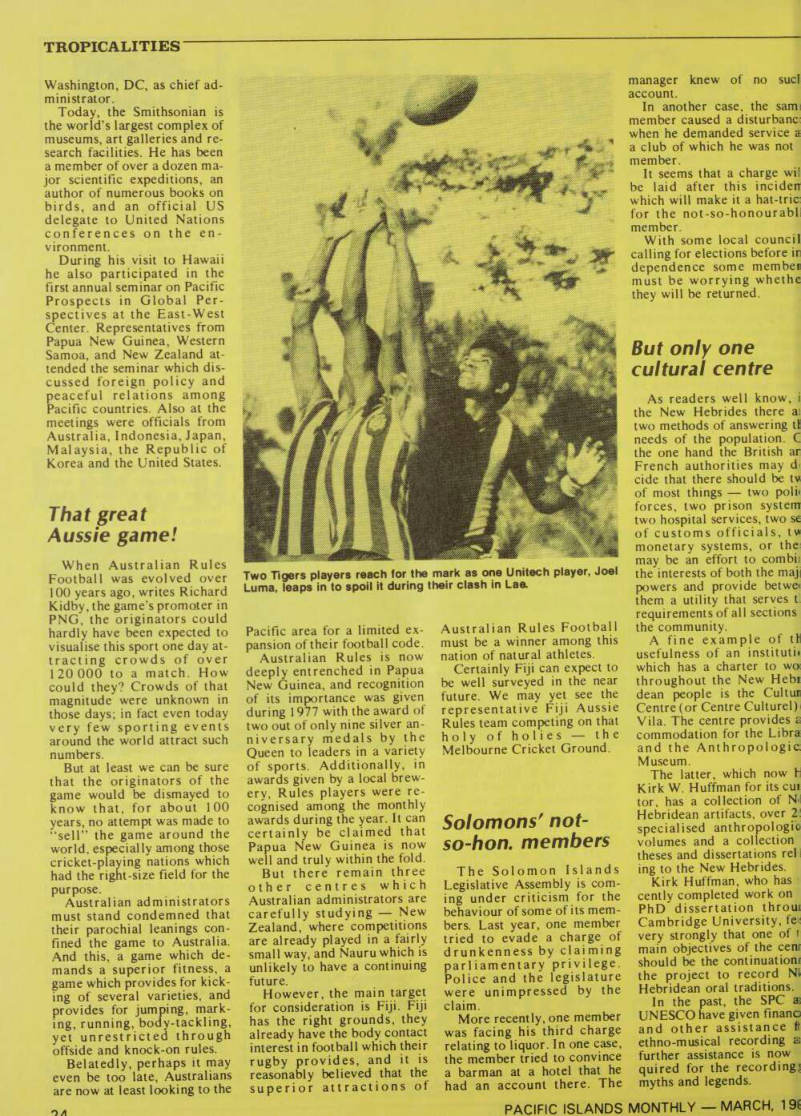
Dr Dillon Ripley ... delighted over Rennell.
Washington, DC, as chief ad ministrator.
Today, the Smithsonian is the world’s largest complex of museums, art galleries and re search facilities. He has been a member of over a dozen ma jor scientific expeditions, an author of numerous books on birds, and an official US delegate to United Nations conferences on the en vironment.
During his visit to Hawaii he also participated in the first annual seminar on Pacific Prospects in Global Per spectives at the East-West Center. Representatives from Papua New Guinea, Western Samoa, and New Zealand at tended the seminar which dis cussed foreign policy and peaceful relations among Pacific countries. Also at the meetings were officials from Australia, Indonesia, Japan, Malaysia, the Republic of Korea and the United States.
That great
Aussie game!
When Australian Rules Football was evolved over 100 years ago, writes Richard Kidby, the game’s promoter in PNG, the originators could hardly have been expected to visualise this sport one day at tracting crowds of over 120 000 to a match. How could they? Crowds of that magnitude were unknown in those days; in fact even today very few sporting events around the world attract such numbers.
But at least we can be sure that the originators of the game would be dismayed to know that, for about 100 years, no attempt was made to “sell” the game around the world, especially among those cricket-playing nations which had the right-size field for the purpose.
Australian administrators must stand condemned that their parochial leanings con fined the game to Australia.
And this, a game which de mands a superior fitness, a game which provides for kick ing of several varieties, and provides for jumping, mark ing, running, body-tackling, yet unrestricted through offside and knock-on rules.
Belatedly, perhaps it may even be too late, Australians are now at least looking to the
Pacific area for a limited ex pansion of their football code.
Australian Rules is now deeply entrenched in Papua New Guinea, and recognition of its importance was given during 1977 with the award of two out of only nine silver an niversary medals by the Queen to leaders in a variety of sports. Additionally, in awards given by a local brew ery, Rules players were re cognised among the monthly awards during the year. It can certainly be claimed that Papua New Guinea is now well and truly within the fold.
But there remain three other centres which Australian administrators are carefully studying New Zealand, where competitions are already played in a fairly small way, and Nauru which is unlikely to have a continuing future.
However, the main target for consideration is Fiji. Fiji has the right grounds, they already have the body contact interest in football which their rugby provides, and it is reasonably believed that the superior attractions of
Australian Rules Football must be a winner among this nation of natural athletes.
Certainly Fiji can expect to be well surveyed in the near future. We may yet see the representative Fiji Aussie Rules team competing on that holy of holies the Melbourne Cricket Ground.
Solomons' not
so-hon. members
The Solomon Islands Legislative Assembly is com ing under criticism for the behaviour of some of its mem bers. Last year, one member tried to evade a charge of drunkenness by claiming parliamentary privilege.
Police and the legislature were unimpressed by the claim.
More recently, one member was facing his third charge relating to liquor. In one case, the member tried to convince a barman at a hotel that he had an account there. The
manager knew of no sucl account.
In another case, the sami member caused a disturbanc: when he demanded service a a club of which he was not member.
It seems that a charge wil be laid after this inciden which will make it a hat-tric: for the not-so-honourabl member.
With some local council calling for elections before in dependence some member must be worrying whethe they will be returned.
But only one
cultural centre
As readers well know, i the New Hebrides there ai two methods of answering tt needs of the population. C the one hand the British ar French authorities may d cide that there should be tv of most things two poli« forces, two prison system two hospital services, two se of customs officials, tv monetary systems, or the may be an effort to combii the interests of both the maji powers and provide betwei them a utility that serves t! requirements of all sections the community.
A fine example of tH usefulness of an institute which has a charter to woi throughout the New Hebe dean people is the Cultur Centre (or Centre Culturel) Vila. The centre provides a commodation for the Libra and the Anthropologic Museum.
The latter, which now hi Kirk W. Huffman for its cui tor, has a collection of N«1 Hebridean artifacts, over 2;
specialised anthropologic
volumes and a collection theses and dissertations reL ing to the New Hebrides.
Kirk Huffman, who has cently completed work on PhD dissertation throui Cambridge University, fe; very strongly that one of f main objectives of the cent should be the continuation! the project to record Nl Hebridean oral traditions.
In the past, the SPC as UNESCO have given finano and other assistance ft ethno-musical recording s further assistance is now quired for the recording' myths and legends.
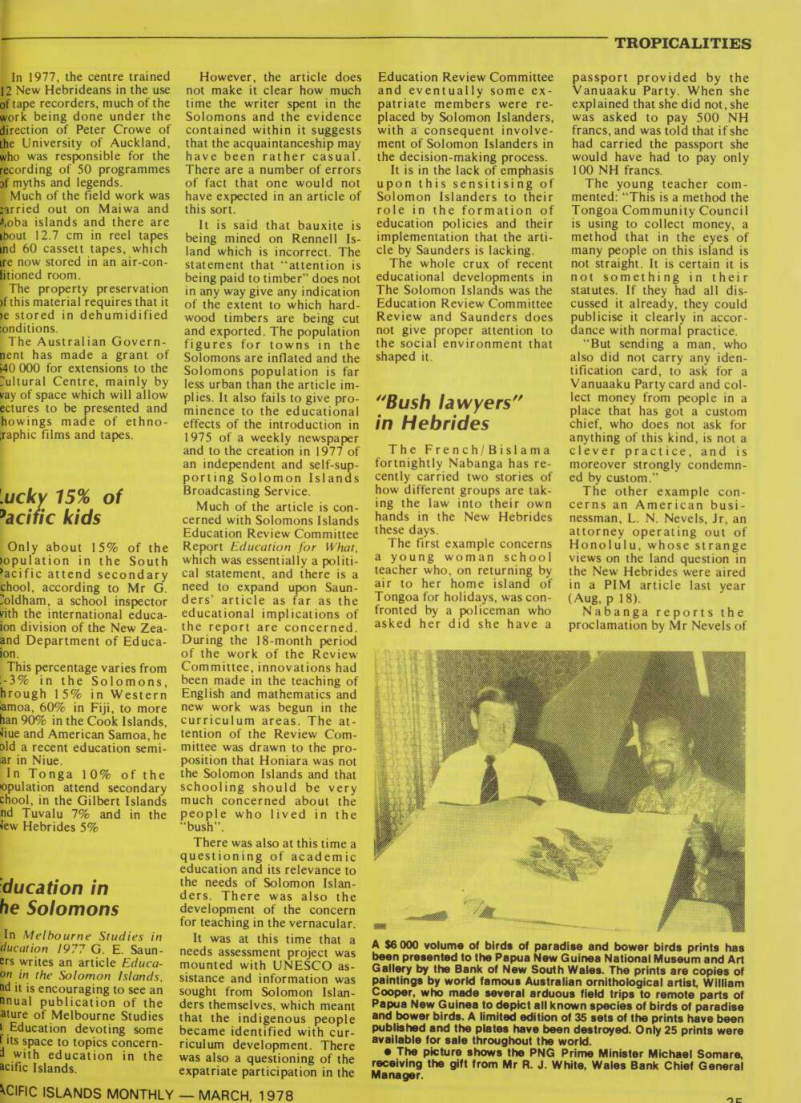
Two Tigers players roach for the mark as one Unitech player, Joel Luma, leaps in to spoil it during their clash in Lae.
In 1977, the centre trained 12 New Hebrideans in the use of tape recorders, much of the work being done under the direction of Peter Crowe of the University of Auckland, who was responsible for the recording of 50 programmes of myths and legends.
Much of the field work was :arried out on Maiwa and A,oba islands and there are ibout 12.7 cm in reel tapes ind 60 cassett tapes, which ire now stored in an air-con litioned room.
The property preservation >f this material requires that it >e stored in dehumidified :onditions.
The Australian Govern nent has made a grant of >4O 000 for extensions to the Cultural Centre, mainly by vay of space which will allow ectures to be presented and howings made of ethno iraphic films and tapes.
.ucky 15% of
Pacific kids
Only about 15% of the mpulation in the South
> acific attend secondary
chool, according to Mr G. loldham, a school inspector jrith the international educa ion division of the New Zea and Department of Educa ion.
This percentage varies from • -3% in the Solomons, hrough I 5% in Western lamoa, 60% in Fiji, to more ban 90% in the Cook Islands, Jiue and American Samoa, he old a recent education semi ar in Niue.
In Tonga 10% of the opulation attend secondary chool, in the Gilbert Islands nd Tuvalu 7% and in the Jew Hebrides 5%
ducation in
he Solomons
In Melbourne Studies in ducation 1977 G. E. Saun as writes an article Educa on in the Solomon Islands, nd it is encouraging to see an nnual publication of the ature of Melbourne Studies 1 Education devoting some f its space to topics concernwith education in the acific Islands.
However, the article does not make it clear how much time the writer spent in the Solomons and the evidence contained within it suggests that the acquaintanceship may have been rather casual.
There are a number of errors of fact that one would not have expected in an article of this sort.
It is said that bauxite is being mined on Rennell Is land which is incorrect. The statement that “attention is being paid to timber” does not in any way give any indication of the extent to which hard wood timbers are being cut and exported. The population figures for towns in the Solomons are inflated and the Solomons population is far less urban than the article im plies. It also fails to give pro minence to the educational effects of the introduction in 1975 of a weekly newspaper and to the creation in 1977 of an independent and self-sup porting Solomon Islands Broadcasting Service.
Much of the article is con cerned with Solomons Islands Education Review Committee Report Education for What, which was essentially a politi cal statement, and there is a need to expand upon Saun ders’ article as far as the educational implications of the report are concerned.
During the 18-month period of the work of the Review Committee, innovations had been made in the teaching of English and mathematics and new work was begun in the curriculum areas. The at tention of the Review Com mittee was drawn to the pro position that Honiara was not the Solomon Islands and that schooling should be very much concerned about the people who lived in the “bush”.
There was also at this time a questioning of academic education and its relevance to the needs of Solomon Islan ders. There was also the development of the concern for teaching in the vernacular.
It was at this time that a needs assessment project was mounted with UNESCO as sistance and information was sought from Solomon Islan ders themselves, which meant that the indigenous people became identified with cur riculum development. There was also a questioning of the expatriate participation in the
Education Review Committee and eventually some expatriate members were replaced by Solomon Islanders, with a consequent involvement of Solomon Islanders in the decision-making process.
It is in the lack of emphasis upon this sensitising of Solomon Islanders to their role in the formation of education policies and their implementation that the article by Saunders is lacking.
The whole crux of recent educational developments in The Solomon Islands was the Education Review Committee Review and Saunders does not give proper attention to the social environment that shaped it.
"Ruch • bL !s n * a y\Y erS
If! Hebrides
The Fren c h / Bi si am a fortnightly Nabanga has recently carried two stories of how different groups are taking the law into their own hands in the New Hebrides these days.
The first example concerns a young woman school teacher who, on returning by air to her home island of Tongoa for holidays, was confronted by a policeman who asked her did she have a
passport provided by the Vanuaaku Party. When she explained that she did not, she was asked to pay 500 NH francs, and was told that if she had carried the passport she would have had to pay only 100 NH francs, The young teacher com mented: “This is a method the Tongoa Community Council is using to collect money, a method that in the eyes of many people on this island is not straight. It is certain it is not something in their statutes. If they had all dis cussed it already, they could publicise it clearly in accor dance with normal practice, “But sending a man, who also did not carry any iden tification card, to ask for a Vanuaaku Party card and col lect money from people in a place that has got a custom chief, who does not ask for anything of this kind, is not a clever practice, and is moreover strongly condemn ed by custom.”
The other example con cerns an American busi nessman, L. N. Nevels, Jr, an attorney operating out of Honolulu, whose strange views on the land question in the New Hebrides were aired in a PIM article last year (Aug, p 18).
Nabanga reports the proclamation by Mr Nevels of
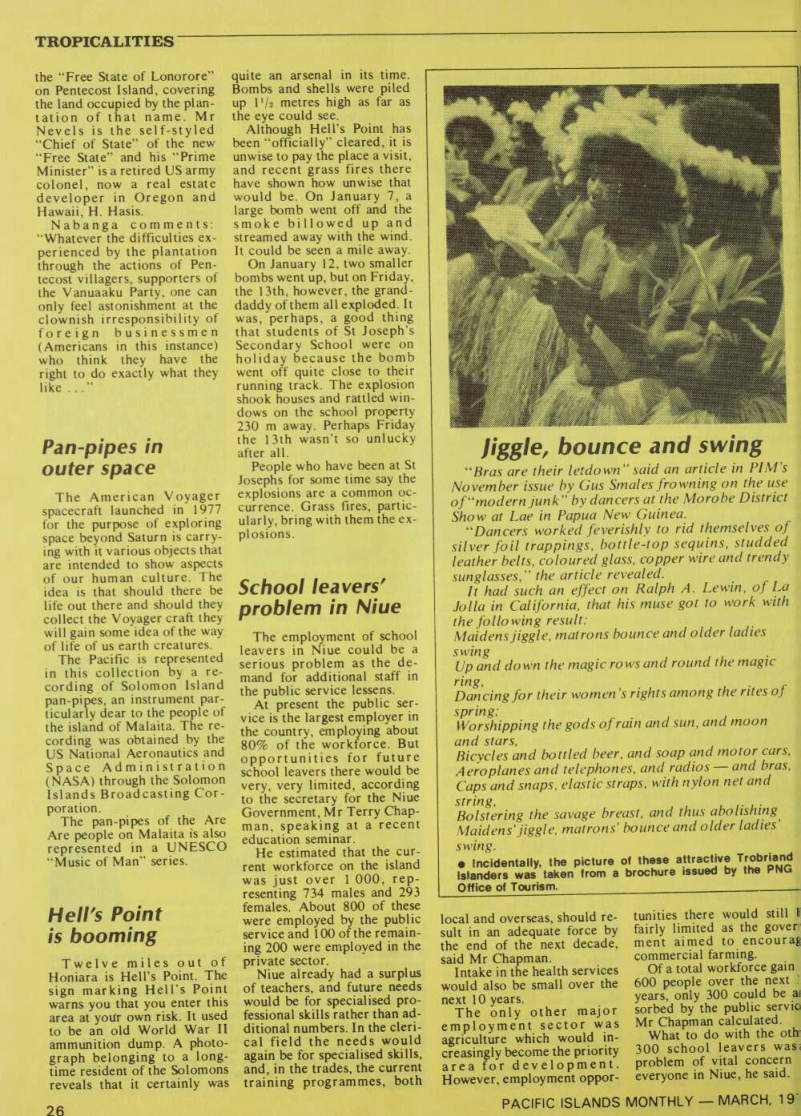
A $6 000 volume of birds of paradise and bower birds prints has been presented to the Papua New Guinea National Museum and Art Gallery by the Bank of New South Wales. The prints are copies of paintings by world famous Australian ornithological artist, William Cooper, who made several arduous field trips to remote parts of Papua Now Guinea to depict all known species of birds of paradise and bower birds. A limited edition of 35 sets of the prints have been published and the plates have been destroyed. Only 25 prints were available for sale throughout the world.
The picture shows the PNG Prime Minister Michael Somare, receiving the gift from Mr R. J. White, Wales Bank Chief General
Manager.
the “Free State of Lonorore” on Pentecost Island, covering the land occupied by the plan tation of that name. Mr Nevels is the self-styled “Chief of State” of the new “Free State” and his “Prime Minister” is a retired US army colonel, now a real estate developer in Oregon and Hawaii, H. Hasis.
Nabanga comments; “Whatever the difficulties ex perienced by the plantation through the actions of Pen tecost villagers, supporters of the Vanuaaku Party, one can only feel astonishment at the clownish irresponsibility of foreign businessmen (Americans in this instance) who think they have the right to do exactly what they like ...”
Pan-pipes in
outer space
The American Voyager spacecraft launched in 1977 for the purpose of exploring space beyond Saturn is carry ing with it various objects that are intended to show aspects of our human culture. The idea is that should there be life out there and should they collect the Voyager craft they will gain some idea of the way of life of us earth creatures.
The Pacific is represented in this collection by a re cording of Solomon Island pan-pipes, an instrument par ticularly dear to the people of the island of Malaita. The re cording was obtained by the US National Aeronautics and Space Administration (NASA) through the Solomon Islands Broadcasting Cor poration.
The pan-pipes of the Are Are people on Malaita is also represented in a UNESCO “Music of Man” series.
Hell's Point
is booming
Twelve miles out of Honiara is Hell’s Point. The sign marking Hell’s Point warns you that you enter this area at yodr own risk. It used to be an old World War II ammunition dump. A photo graph belonging to a long time resident of the Solomons reveals that it certainly was
quite an arsenal in its time.
Bombs and shells were piled up I'/z metres high as far as the eye could see.
Although Hell’s Point has been “officially” cleared, it is unwise to pay the place a visit, and recent grass fires there have shown how unwise that would be. On January 7, a large bomb went off and the smoke billowed up and streamed away with the wind.
It could be seen a mile away.
On January 12, two smaller bombs went up, but on Friday, the 13th, however, the grand daddy of them all exploded. It was, perhaps, a good thing that students of St Joseph’s Secondary School were on holiday because the bomb went off quite close to their running track. The explosion shook houses and rattled win dows on the school property 230 m away. Perhaps Friday the 13th wasn’t so unlucky after all.
People who have been at St Josephs for some lime say the explosions are a common oc currence. Grass fires, partic ularly, bring with them the ex plosions.
School leavers'
problem in Niue
The employment of school leavers in Niue could be a serious problem as the de mand for additional staff in the public service lessens.
At present the public ser vice is the largest employer in the country, employing about 80% of the workforce. But opportunities for future school leavers there would be very, very limited, according to the secretary for the Niue Government, Mr Terry Chap man, speaking at a recent education seminar.
He estimated that the cur rent workforce on the island was just over 1 000, rep resenting 734 males and 293 females. About 800 of these were employed by the public service and 100 of the remain ing 200 were employed in the
private sector.
Niue already had a surplus of teachers, and future needs would be for specialised pro fessional skills rather than ad ditional numbers. In the cleri cal field the needs would again be for specialised skills, and, in the trades, the current training programmes, both
local and overseas, should re sult in an adequate force by the end of the next decade, said Mr Chapman.
Intake in the health services would also be small over the next 10 years.
The only other major employment sector was agriculture which would in creasingly become the priority area for development.
However, employment oppor
tunities there would still I fairly limited as the gover merit aimed to encourag commercial farming.
Of a total workforce gain 600 people over the next years, only 300 could be ai sorbed by the public servio Mr Chapman calculated.
What to do with the oth' 300 school leavers was; problem of vital concern everyone in Niue, he said.