Fiji court hears tale of wreck,
p. 65 · Read in the full issue
and draws a lesson or two
A Fiji marine court of inquiry in November severely reprimanded the captain, chief engineer and chief mate of the government vessel Tabilai which sank last August, at a cost of more than $1 million. The story below backgrounds the court’s findings.
The Fiji Government is taking no chances with its newest landing craft, the 42.5 m Yaubula. Unfor tunate experiences with two similar craft, the Tabilai, which sank off Cikobia on August 30, following a double grounding of the Duiyabaki in March, have prompted the extra attention to the Yaubula.
Defects found in the Tabilai will not be repeated in the Yaubula. The initial trials of the Yaubula were prolonged because of defects in the pumping system. Then it was de cided to lay wooden sheathing, not included in the original design, on the steel deck to protect it from heavy equipment. Evidence before a marine court of inquiry into the Tabilai had suggested that her pump ing system was not efficient and that cargo had moved on her steel deck.
The loss of the Tabilai was esti mated at more than $1 million, in cluding $250 000 worth of cargo.
The Duiyabaki ran on a reef patch off Vanuabalavu on March 20. She managed to release herself, only to go aground again on March 25, this time off Tuvuca. The cost of re storing the Duiyabaki to full op eration was estimated at $136 500, at a time when the government was acutely short of money for repairs.
Evidence before the court of in quiry into the sinking of the Tabilai suggested there was a need for tightening some procedures. The craft seemed bound for trouble even before she left Suva for the Lau area. The loading ramp broke while a bulldozer was being loaded, and this delayed her sailing for several days.
Then there was a conflict of evidence between the secretary of the Marine Board, Mr Ravindra Nath, and the acting fleet superin tendent, as to who was responsible for the marine checker. The Tabilai left without a physical check by the marine checker, but that sort of thing had happened before.
The master, Captain Akaei Taka, described difficulties experienced on the voyage. A bulldozer started shifting and caused a list to star board, but he also considered im balance in the water tanks con tributed to the listing. The list was corrected while the Tabilai was at
Lakeba,but recurred when the craft put to sea again.
Captain Taka was unworried as he had confidence in the engineers.
Nevertheless, he decided to anchor for the night off the Tongan Passage, between Vanuabalavu and Cikobia.
He had gone to his cabin while the engineers were working on the pump to eject extra water taken in.
He had been called when the volume of water increased and the pump failed to work. He tried to beach the Tabilai on the nearest reef, but failed. He then ordered the passengers into a dinghy while the crew tried to save the craft. They were unsuccessful. Everyone then put on life jackets and swam for the shore, but the steward Josefa Waisura, 60, did not make it and was lost.
Moses Qali, a member of the crew, said he was first overboard
before the Tabilai capsized. He saw Waisura floating in the water. He sta y ed with Waisura for about 20 minutes and started to lose strength. * Waisura, telling him he 566 “ he could get help from Cikobia. He did not go back, once not re P ort Waisura’s difficulties to anyone, Captain Edward Lysons, senior marine officer with the Marine Department and marine surveyor f° r Marine Board, said the pumping and drainage system in the Tabilai was not good because of the arrangement of piping and valves to the ballast tanks used to keep it on an even keel. If attempts were made f° pump ballast in or out of one tank was quite likely that it would be pumped in or out of one of the other tanks, and that was the very thing one did not want to do. The system had only one pump, and that was in sufficient.
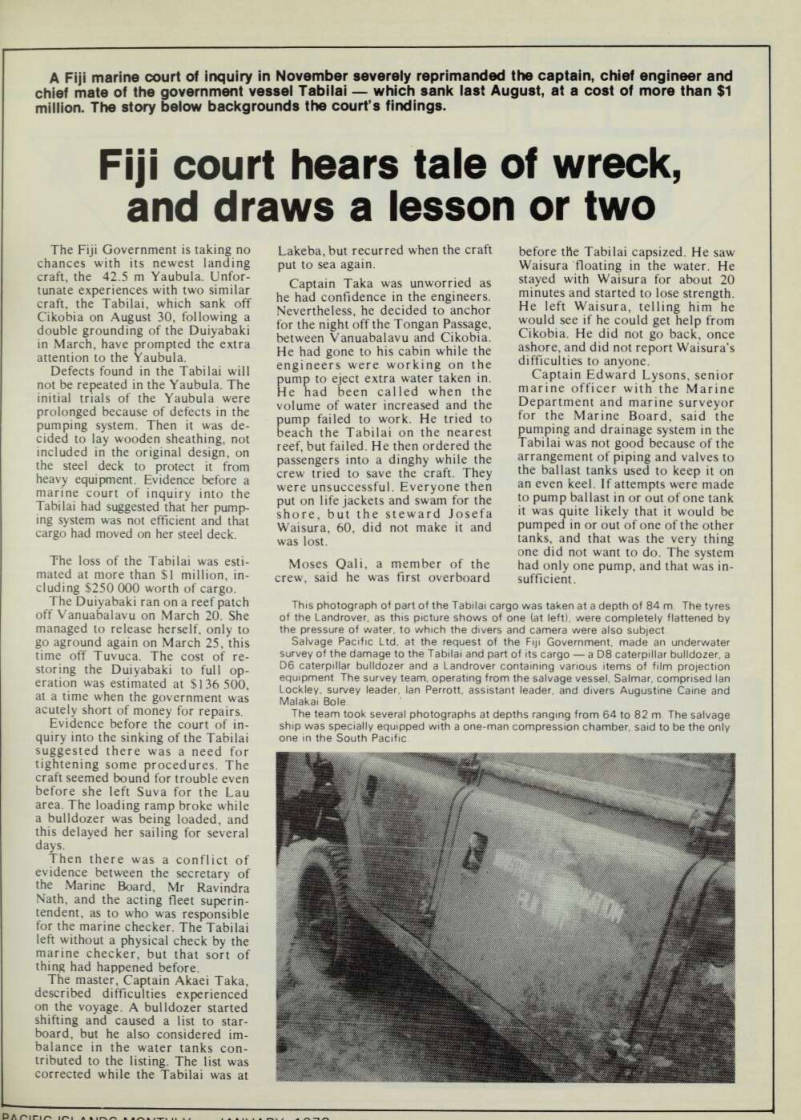
This photograph of part of the Tabilai cargo was taken at a depth of 84 m The tyres of the Landrover, as this picture shows of one (at left), were completely flattened by the pressure of water, to which the divers and camera were also subject Salvage Pacific Ltd, at the request of the Fiji Government, made an underwater survey of the damage to the Tabilai and part of its cargo a D 8 caterpillar bulldozer, a D 6 caterpillar bulldozer and a Landrover containing various items of film projection equipment The survey team, operating from the salvage vessel, Salmar, comprised lan Lockley, survey leader, lan Perrott, assistant leader, and divers Augustine Caine and Malakai Bole The team took several photographs at depths ranging from 64 to 82 m The salvage ship was specially equipped with a one-man compression chamber, said to be the only one in the South Pacific