A costly error of judgment
pp. 67-68 · Read in the full issue
in Suva, 1928
W Craig and Bert Weston recall events of 50 years ago in Suva, Fiji, and the primitive New Guinea of those days Mr Craig’s story concerns a freak accident which accompanied the scuttling of an old coal hulk outside Suva harbour, and Mr Weston’s his first hair-raising contact with the occult, New Guinea-style. “Yesterday” is a new regular RIM feature which will recall each month interesting facets of Island history.
For about a score of years there rested, buoyed on a firm and secure mooring in Suva harbour, an old and decrepit coal hulk. Once a proud sail ing ship which ploughed through many of the world’s oceans in the course of her ac tive career, she had been con demned by the steamship age to serve her final owners as an unglamorous but useful coal depot.
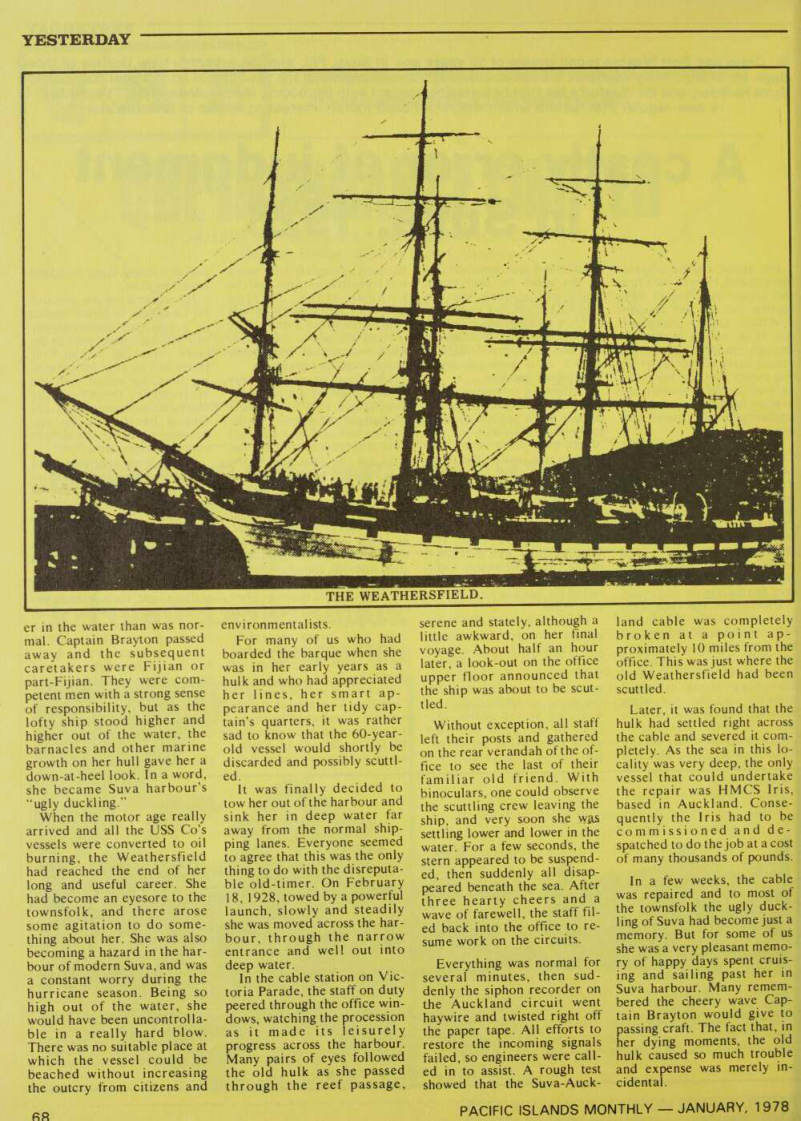
Built at Renfrew on the Clyde in the year 1865 and named the Weathersfield, this iron vessel of 1 118 tonnes was designed for the Liver pool-India trade, originally as a full-rigged ship but later as a barque. Operated by the firm of Greenshield Cowie Co Ltd on the lucrative Indian com merce, she was credited with very fast sailing on this route.
Diverted to the New Zea land service, the Weathers field arrived in Wellington on her first voyage on January 24, 1882. After a number of successful, including some hazardous, voyages to and from the UK, the ship, when approaching Wellington on April 8, 1888, was unfor tunately grounded on the Otaki beach. Here she was
condemned and remained fast on the beach for four years.
While still aground, she was sold to a Captain Cooper for £475, and sold again to a T G. McCarthy of Wellington, who had the ship re-floated in 1892 and towed into Wellington harbour.
Following extensive over haul and re-registration, the barque made several voyages to London. Towards the end of her busy years under can vas, she was used in the inter colonial trade, her last voyage being with a cargo of timber from Bunbury, Western Australia. After lying at anchor in Wellington harbour for a long period, the Weathersfield was purchased by the Union Steamship Com pany in 1908 and in 1909 she sailed for Suva to be used as a coal hulk.
In the early years of ner new assignment, the custodian caretaker was a Captain Brayton who lived with his wife and family in quarters provided on board, probably the same accommodation as was used by the sailing cap tains in the good old days when she was in her prime.
For some years. Captain
Brayton’s daughter Lily was a well-known actress on the London stage. During Brayton’s stewardship, it was considered quite a treat to be invited on board for afternoon tea, but of course not during coaling operations.
The transfer of coal was usually made by a gang of Fijians armed with long-handied shovels and assisted by the ship’s winches. There was coal dust everywhere in the hold, on the deck and in the air, but the living quarters were, of necessity, kept tightly closed during these operations. The Fijians seemed to treat this grimy dusty work as a huge joke and went about their task with tremendously good humour, punctuating the work with peals of laughter at any unfortunate mishap. They really worked very hard, but the hard toil did not prevent them from being extremely careful to keep the coal dust out of their huge mops of woolly hair.
During the period when the Canadian-Australasian line of steamers were coal-burning, the officers on each ship had the frustrating job of rounding-up the firemen and stokers
and delivering them on board at sailing time.
It became a regular practice for an officer to hire a landau or a taxi and systematically call at all the hotel bars in the town. Starting at the Pier Hotel half an hour before sail ing time, he* would visit the Melbourne, the Club, the Garrick and sometimes the Grand Pacific, in an en deavour to collect the defiant and often tipsy crew, If any crew members were still missing after the hotel sweep, a discreet search of certain areas would be made, However, the stokers were usually located in the hotels and the steamer would seldom be delayed for more than an hour or two.
Passengers lining the ship’s railings, and their friends pa tiently waiting on the wharf, could be counted on to raise a hearty cheer as the unwilling crew members were man handled on board the ship and the gangway quickly lowered to permit a speedy departure.
In the course of time, the demand for coal became less and less, and the hulk held smaller and smaller quanti ties, until she rode much high-
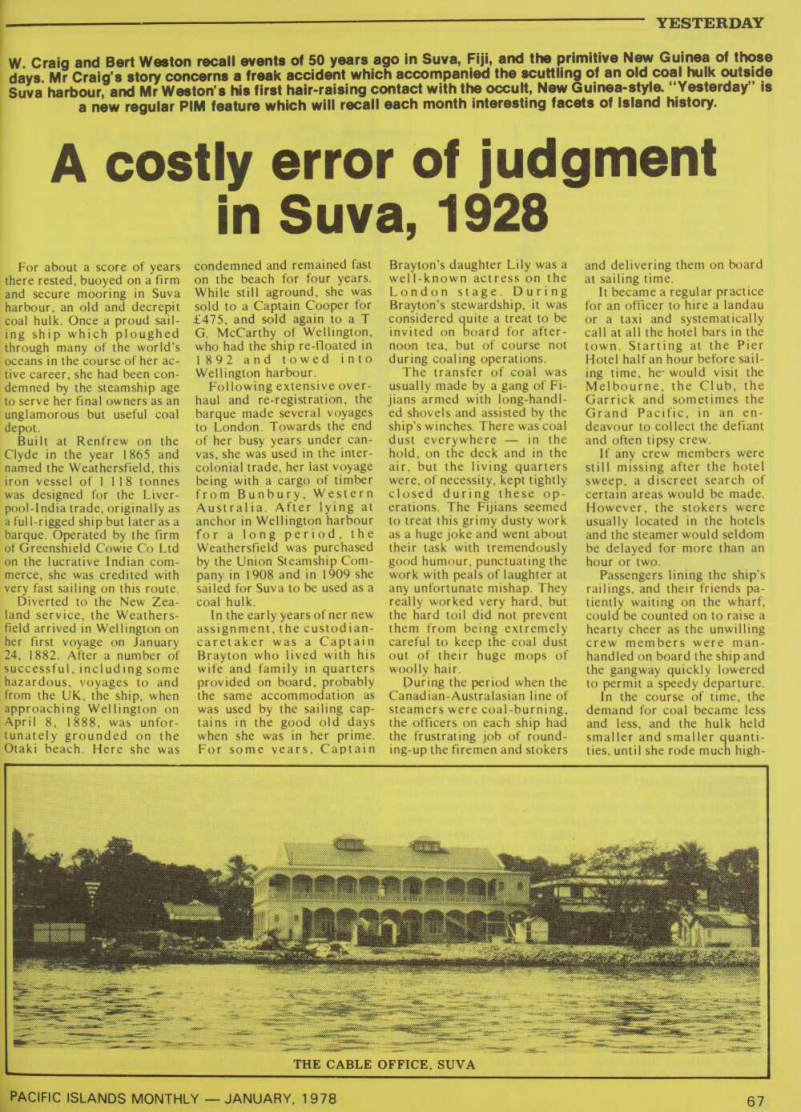
The Cable Office. Suva
er in the water than was nor
mal. Captain Brayton passed
away and the subsequent caretakers were Fijian or part-Fijian. They were com petent men with a strong sense of responsibility, but as the lofty ship stood higher and higher out of the water, the barnacles and other marine growth on her hull gave her a down-at-heel look. In a word, she became Suva harbour’s “ugly duckling.”
When the motor age really arrived and all the USS Co’s vessels were converted to oil burning, the Weathersfield had reached the end of her long and useful career. She had become an eyesore to the townsfolk, and there arose some agitation to do some thing about her. She was also becoming a hazard in the har bour of modern Suva, and was a constant worry during the hurricane season. Being so high out of the water, she would have been uncontrolla ble in a really hard blow.
There was no suitable place at which the vessel could be beached without increasing the outcry from citizens and
environmentalists.
For many of us who had boarded the barque when she was in her early years as a hulk and who had appreciated her lines, her smart ap pearance and her tidy cap tain’s quarters, it was rather sad to know that the 60-year old vessel would shortly be discarded and possibly scuttl ed.
It was finally decided to tow her out of the harbour and sink her in deep water far away from the normal ship ping lanes. Everyone seemed to agree that this was the only thing to do with the disreputa ble old-timer. On February 18, 1928, towed by a powerful launch, slowly and steadily she was moved across the har bour, through the narrow entrance and well out into deep water.
In the cable station on Vic toria Parade, the staff on duty peered through the office win dows, watching the procession as it made its leisurely progress across the harbour.
Many pairs of eyes followed the old hulk as she passed through the reef passage,
serene and stately, although a little awkward, on her final voyage. About half an hour later, a look-out on the office upper floor announced that the ship was about to be scut tled.
Without exception, all staff left their posts and gathered on the rear verandah of the of fice to see the last of their familiar old friend. With binoculars, one could observe the scuttling crew leaving the ship, and very soon she was settling lower and lower in the water. For a few seconds, the stern appeared to be suspend ed, then suddenly all disap peared beneath the sea. After three hearty cheers and a wave of farewell, the staff fil ed back into the office to re sume work on the circuits.
Everything was normal for several minutes, then sud denly the siphon recorder on the Auckland circuit went haywire and twisted right off the paper tape. All efforts to restore the incoming signals failed, so engineers were call ed in to assist. A rough test showed that the Suva-Auck
land cable was completely broken at a point ap proximately 10 miles from the office. This was just where the old Weathersfield had been scuttled.
Later, it was found that the hulk had settled right across the cable and severed it com pletely. As the sea in this lo cality was very deep, the only vessel that could undertake the repair was HMCS Iris, based in Auckland. Conse quently the Iris had to be commissioned and de spatched to do the job at a cost of many thousands of pounds.
In a few weeks, the cable was repaired and to most of the townsfolk the ugly duck ling of Suva had become just a memory. But for some of us she was a very pleasant memo ry of happy days spent cruis ing and sailing past her in Suva harbour. Many remem bered the cheery wave Cap tain Brayton would give to passing craft. The fact that, in her dying moments, the old hulk caused so much trouble and expense was merely in cidental.