A Sweet Potato
p. 63 · Read in the full issue
For A Seat
Teacher Greg Murphy had an idea while lecturing at the Goroka Teachers’ College a travelling theatre to bring drama to the bush. lan Crichton tells how the idea became a reality.
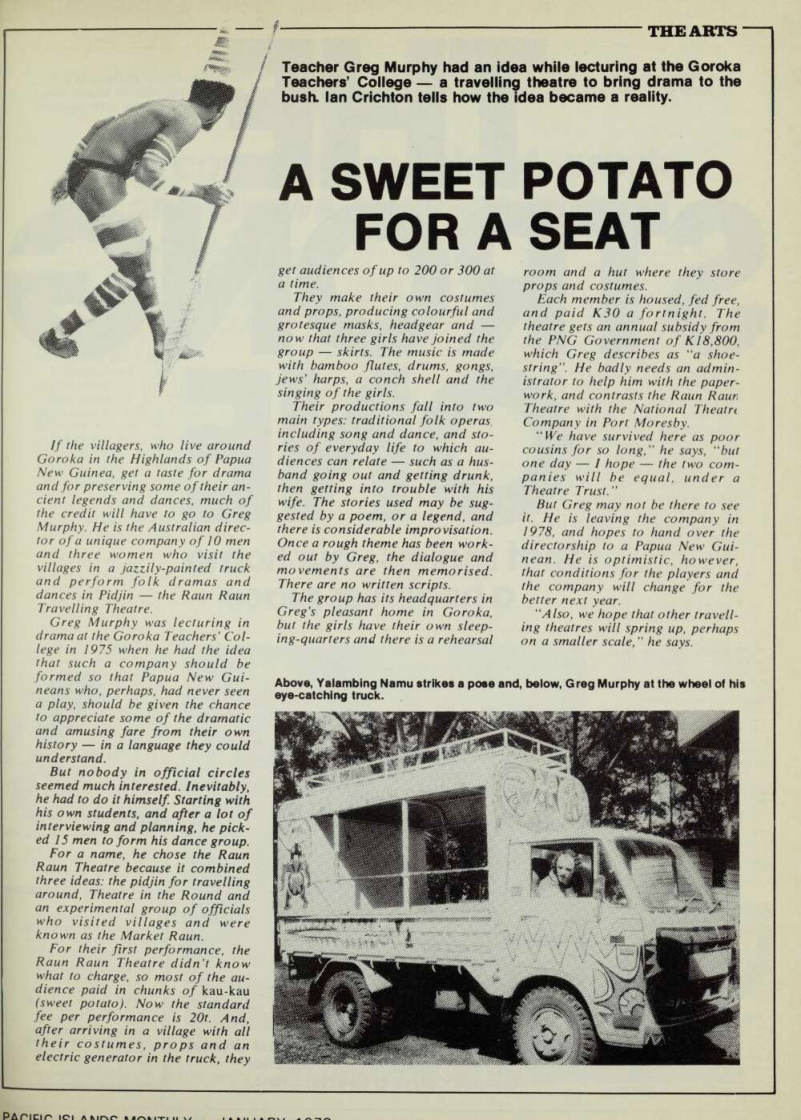
If the villagers, who live around Goroka in the Highlands of Papua New Guinea, get a taste for drama and for preserving some of their an cient legends and dances, much of the credit will have to go to Greg Murphy. He is the Australian direc tor of a unique company of 10 men and three women who visit the villages in a jazzily-painted truck and perform folk dramas and dances in Pidjin the Raun Raun Travelling Theatre.
Greg Murphy was lecturing in drama at the Goroka Teachers’ Col lege in 1975 when he had the idea that such a company should be formed so that Papua New Gui neans who, perhaps, had never seen a play, should be given the chance to appreciate some of the dramatic and amusing fare from their own history in a language they could understand.
But nobody in official circles seemed much interested. Inevitably, he had to do it himself. Starting with his own students, and after a lot of interviewing and planning, he pick ed 15 men to form his dance group.
For a name, he chose the Raun Raun Theatre because it combined three ideas: the pidjin for travelling around, Theatre in the Round and an experimental group of officials who visited villages and were known as the Market Raun.
For their first performance, the Raun Raun Theatre didn’t know what to charge, so most of the au dience paid in chunks of kau-kau (sweet potato). Now the standard fee per performance is 20t. And, after arriving in a village with all their costumes, props and an electric generator in the truck, they
get audiences of up to 200 or 300 at a time.
They make their own costumes and props, producing colourful and grotesque masks, headgear and now that three girls have joined the group skirts. The music is made with bamboo flutes, drums, gongs, jews’ harps, a conch shell and the singing of the girls.
Their productions fall into two main types: traditional folk operas including song and dance, and stories of everyday life to which audiences can relate such as a husband going out and getting drunk, then getting into trouble with his wife. The stories used may be suggested by a poem, or a legend, and there is considerable improvisation.
Once a rough theme has been worked out by Greg, the dialogue and movements are then memorised.
There are no written scripts.
The group has its headquarters in Greg’s pleasant home in Goroka, but the girls have their own sleeping-quarters and there is a rehearsal
room and a hut where they store props and costumes.
Each member is housed, fed free, and paid K3O a fortnight. The theatre gets an annual subsidy from the PNG Government of KlB,BOO, which Greg describes as ”a shoe string”. He badly needs an admin istrator to help him with the paper work, and contrasts the Raun Raun Theatre with the National Theatre Company in Port Moresby, “We have survived here as poor cousins for so long,” he says, “but one day / hope the two corn panies will be equal, under a Theatre Trust.”
But Greg may not be there to see it. He is leaving the company in 1978, and hopes to hand over the directorship to a Papua New Gui nean. He is optimistic, however, that conditions for the players and the company will change for the better next year.
“ Also, we hope that other travell ing theatres will spring up, perhaps on a smaller scale, ” he says.
Above, Yalambing Namu strikes a pose and, below, Greg Murphy at the wheel of his eye-catching truck.