Of Joy Out
pp. 60-61 · Read in the full issue
A Moment
Of Sogeri
High
Over the years I have seen a great number of year-books, school maga zines and other records of school achievement produced to bring the merits of schools to the notice of their own supporters and the wider
general public.
In general there is a sameness about them which tends to deaden the visual senses, team photographs, school boyish/girlish poetry, rather forced short stories and a mass of in group anecdotes and school “jokes”.
In very few instances do the prin ters of these outpourings give to them a stamp of authority. They do not say they are associated with pro ductions which enhance their trade.
I have also had the pleasure, some times of a very doubtful nature, of looking at the art-work being pro duced by schoolchildren.
Often I have the impression that the spontaneity that is characteristic of the visual artistry of small children is “taught” out of them by the time they come into adolescence and should be at a psychological moment in time when they should be expressing, in both written and visual forms, the emotional and social transitional forces they are
experiencing.
Among all these schools I have seen in the artistic setting, two in particular have left an indelible im pression upon me. One was the In dian High School at Phoenix, Arizona, where the pupils, drawn from many of the Indian tribes are producing dynamic art work, which commands so much attention that it wins national awards with regulari ty.
Now I can say that I have had another moment of joy, for I have been able to experience the impact of the outburst of artistic attainment which is emerging from Sogeri Na tional High School in Papua New Guinea. I want to report on four items which have now been made available for general distribution.
The pupils at Sogeri National High School aged 16, 17 and 18 years of age, are obviously being guided in their visual arts work by teachers who are sympathetic
towards the preservation of the tra ditional art-styles, yet who are pre pared to encourage their pupils to adapt those forms to move with a modern Papua New Guinea and to
produce graphic art-forms which
are exciting in their use of colour and symbolism and which presage the development of the modern art forms of their country.
Tairu was published by the
school, having been compiled and edited by Barry Ison, and it was a commemorative booklet which was given to the important personages attending the independence ceremo nies. . , The young people of the school have retold stories associated with rituals from the 20 provinces of Papua New Guinea. In his foreword Michael Somare says “In the harmo
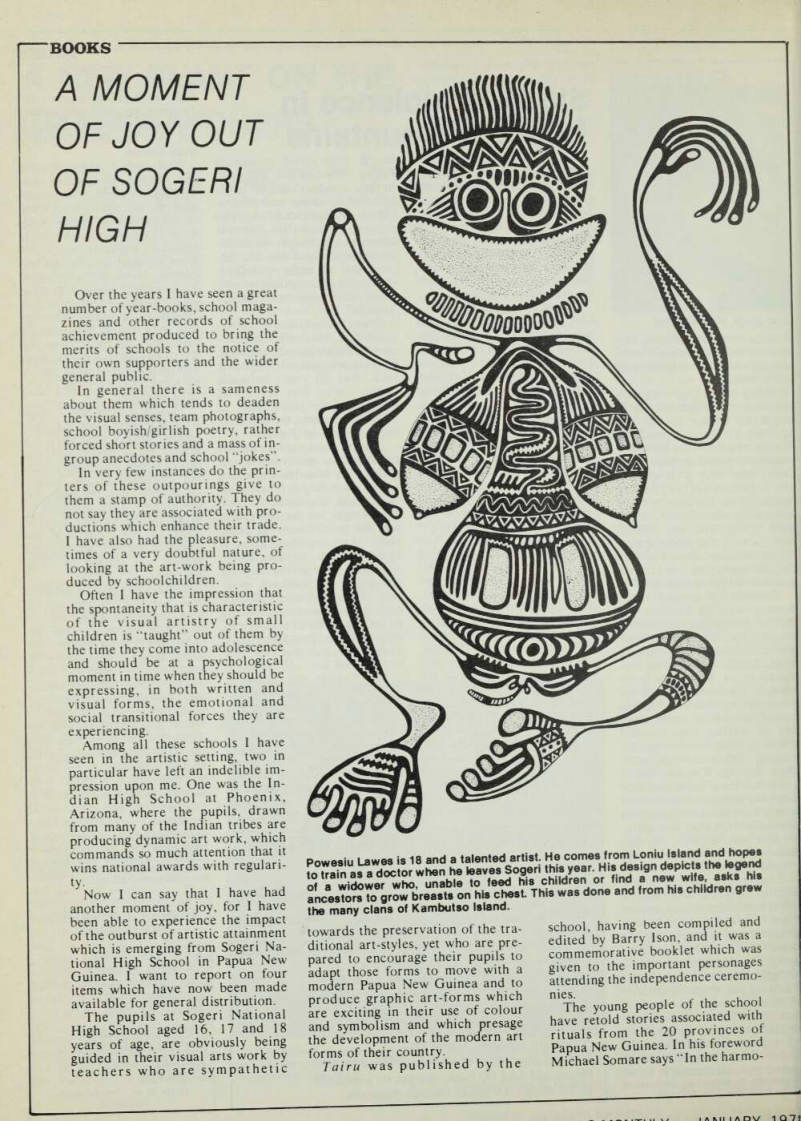
Powesiu lawes is 18 and a talented artist. He comes from Loniu Island and hopes to train as a doctor when he leaves Sogeri this year. His design depicts the legend of a widower who, unable to feed his children or find a new wife, asks his ancestors to grow breasts on his chest. This was done and from his children grew the many clans of kambutso Island.
ny and co-operation of these stu dents, who represent every province of this land, is reflected our hope for the future; for what we achieve will be through our nation as a whole,
whose identity is unmistakedly
Papua New Guinean”.
The students have done as their Prime Minister has urged. In story, verse and design they have said, in as vital a way as possible, that Papua New Guinea is marked by enormous diversity, yet it is possible to discern that there are unifying forces at work. This publication, like two others, has been most competently printed by the local Hebamo Press, with clever use being made of sepia design work on a good quality yellow paper.
Pukari, which appeared in 1976, says of itself that the students “relate their traditions, interpret old designs, comment on their society, create new ideas, for that is the way of Pukari”, Pukari, being the “voices of New Guinea”.
In its basic layout Pukari is very similar to Tairu, with Barry Ison again being the compiler and editor.
But, on this occasion, the produc tion was in the hands of the Tofua Press of San Diego. There may be very good reasons for the book being published in the United States.
The printing has been competently done, but I feel that the Hebamo Press has well enough demonstrated the capacity of presses in Papua New Guinea to produce work of the high est quality; that it is a great pity to see work, which is so closely iden tified with Papua New Guinea, being produced outside the country.
Now for two other items, which have elements of uniqueness about them and which merit accolades in their own right.
Jean Holtham has edited Iseda Miusiki, which is a book of songs composed by students at Sogeri.
Hebamo Press and a team of song writers and artists at the school have come together in a most happy way to bring out a variety of musical ex periences songs about home, patriotic songs, Turn hack hoy, a musical play, love songs, spirituals, Paul songs about St Paul’s life melodies without words, and chord reference charts.
The same dynamic graphic art work adorns the pages and all the notation and words have been done by hand a genuine students’ effort, yet a music teacher friend of mine has commented most favoura bly upon the musical merits of the songs and various other pieces.
I am sure that many pupils, living on islands throughout the Pacific and in the metropolitan countries will benefit greatly from delving into the contents of Iseda Miusiki.
Last, and far from least, there is
Asimha, “a collection of designs from Sogeri Senior High School”.
This is the work of 15 students, who have given us 20 42 x 28 cm graphic designs. These epitomise the spirit which runs through all these Sogeri productions.
There is colour, movement, humour, pathos, attention to the past and an extroverted look towards the future and of a calling upon the resources offered by other art-styles in the Pacific region.
I called upon acquaintances, who could speak with authority as graphic artists and as printers and
all were able to tell me that this col lection is of outstanding merit. The printing has been done with im maculate attention to detail.
Hebamo Press deserves public recognition for its achievements.
All in all I can say only that I wish other schools, both within the Pacific Islands and in New Zealand and Australia could be inspired to produce work of the standard that is coming from Sogeri. Perhaps, I may be proved wrong, but I have the dis tinct feeling that all these items will some day be looked upon as collec
tors’ items.
W. G. Coppell.
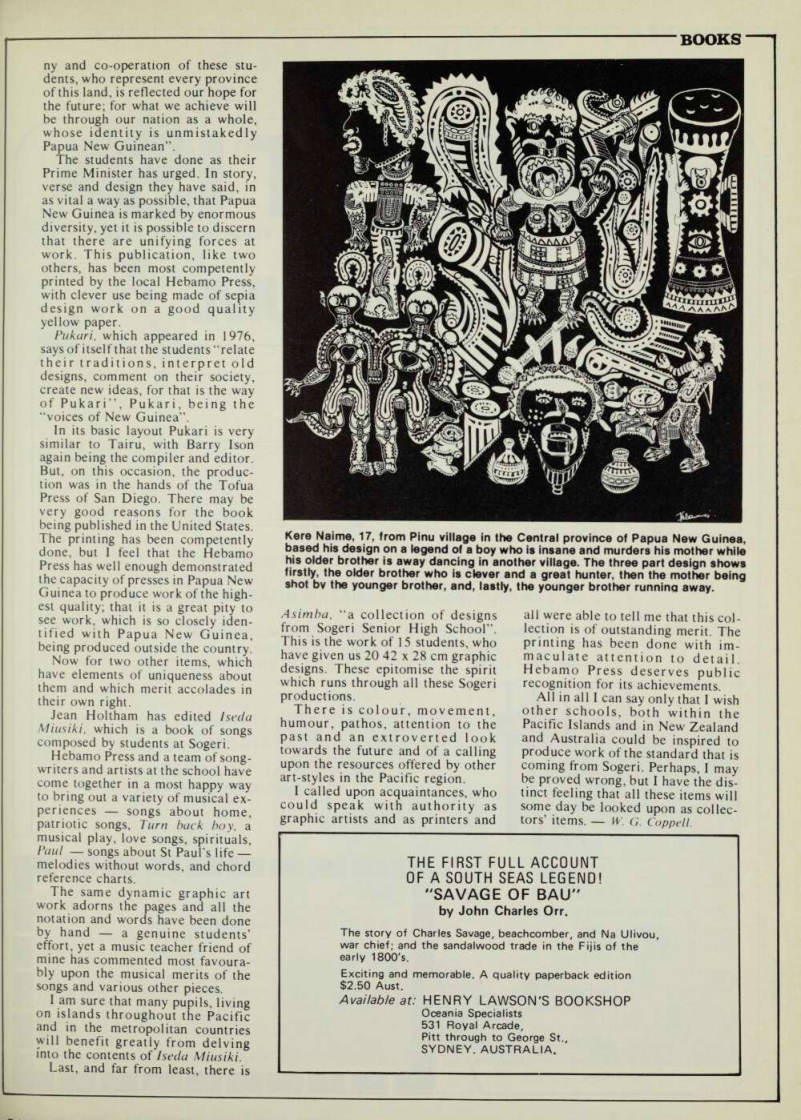
Kere Naime, 17, from Pinu village in the Central province of Papua New Guinea, based his design on a legend of a boy who is insane and murders his mother while his older brother is away dancing in another village. The three part design shows firstly, the older brother who is clever and a great hunter, then the mother being shot bv the younger brother, and, lastly, the younger brother running away.