Personal Credo
pp. 21-22 · Read in the full issue
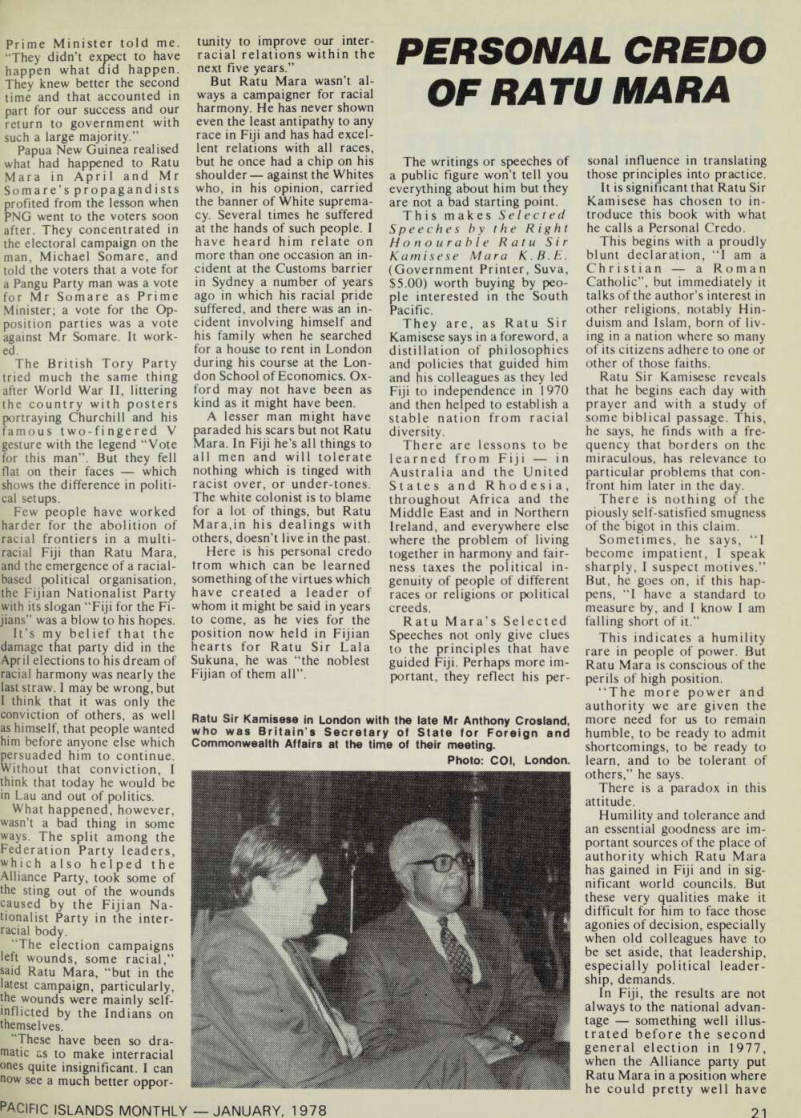

Of Ratu Mara
The writings or speeches of a public figure won’t tell you everything about him but they are not a bad starting point.
This makes Selected Speeches by the Right Honourable Ratu Sir Kamisese Mara K.B.E. (Government Printer, Suva, $5.00) worth buying by peo ple interested in the South Pacific.
They are, as Ratu Sir Kamisese says in a foreword, a distillation of philosophies and policies that guided him and his colleagues as they led Fiji to independence in 1970 and then helped to establish a stable nation from racial
diversity.
There are lessons to be learned from Fiji in Australia and the United States and Rhodesia, throughout Africa and the Middle East and in Northern Ireland, and everywhere else where the problem of living together in harmony and fair ness taxes the political in genuity of people of different races or religions or political creeds.
Ratu Mara’s Selected Speeches not only give clues to the principles that have guided Fiji. Perhaps more im portant, they reflect his per
sonal influence in translating those principles into practice.
It is significant that Ratu Sir Kamisese has chosen to in troduce this book with what he calls a Personal Credo.
This begins with a proudly blunt declaration, “I am a Christian a Roman Catholic”, but immediately it talks of the author’s interest in other religions, notably Hin duism and Islam, born of liv ing in a nation where so many of its citizens adhere to one or other of those faiths.
Ratu Sir Kamisese reveals that he begins each day with prayer and with a study of some biblical passage. This, he says, he finds with a fre quency that borders on the miraculous, has relevance to particular problems that con front him later in the day.
There is nothing of the piously self-satisfied smugness of the bigot in this claim.
Sometimes, he says, “I become impatient, I speak sharply, I suspect motives.”
But, he goes on, if this hap pens, ”1 have a standard to measure by, and I know I am falling short of it.”
This indicates a humility rare in people of power. But Ratu Mara is conscious of the perils of high position.
“The more power and authority we are given the more need for us to remain humble, to be ready to admit shortcomings, to be ready to learn, and to be tolerant of others,” he says.
There is a paradox in this attitude.
Humility and tolerance and an essential goodness are im portant sources of the place of authority which Ratu Mara has gained in Fiji and in sig nificant world councils. But these very qualities make it difficult for him to face those agonies of decision, especially when old colleagues have to be set aside, that leadership, especially political leader ship, demands.
In Fiji, the results are not always to the national advan tage something well illus trated before the second general election in 1977, when the Alliance party put Ratu Mara in a position where he could pretty well have
written his own ticket in the selection of candidates and therefore, as it turned out, of most of the elected members of Parliament and so of the Cabinet material available to him.
In the event, the selection of candidates was passed on to a committee of seven and ex posed to pressures that led to a number of choices that could hardly be called the best available.
But part of Ratu Mara’s Credo is relevant. “We must be ready to listen at all times ... It is only through dialogue that one can find real and last ing solutions.”
This belief of his is basic. It shows itself repeatedly perhaps nowhere more emphatically or more usefully in a mixed society than in his attitude to race relations.
“Race is a fact of life in Fiji,” he said at a dinner to mark the centenary of The Fiji Times in 1969.
“There are differences of background and outlook; of colour, culture and religion.
These are not things to be swept under the table where we can pretend they don’t ex ist. They are things to be faced up to squarely by men and women of goodwill of all races. No race has a monopoly of virtue. All races have good and bad among them.
D ifferences can be honestly held but men, women and children of all races have much in common, not least the desire for a better life for all the people of Fiji. It is in such things that we can find a common purpose and a com mon goal . . . While re cognising that there are things on which we differ, let us re spect and tolerate the other man’s views.”
Here is the foundation of the political structure which, in my view, is a major factor perhaps the most effective and practical one of all in Fiji’s stability as a nation, de spite its multi-racial and
multi-religious composition.
The country’s system of electing members of the House of Representatives puzzles outside observers sometimes, but it is based on principle of high importance that each major racial group will be guaranteed at least some voice in the making of national policy.
So Fijians, Indians and General Electors (Europeans, Chinese and all others who are neither Fijian nor Indian) start off by choosing parlia
mentanans from among mem bers of their own group.
These are the Communal members.
Then the three groups vote together for three more rep resentatives, one Fijian, one an Indian and the third a General Elector, in national constituencies that combine the communal groupings in proportions that reflect
population numbers.
The net result is a guarantee that constitutionally fixed numbers of Fijians, Indians and General Electors will make up the parliament.
The number in each group can be varied if population or other changes make this de sirable, but the essential prin ciple remains that each racial group is guaranteed
representation.
There is nothing unique in the principle behind the system.
Guaranteed Maori rep resentation has long been a feature of New Zealand’s parliamentary structure and the constitution of India pro vides an assurance of some parliamentary seats for rep resentatives of“scheduled castes and tribes”.
There are valuable by-pro ducts of the system in Fiji.
It is established custom for each of the major racial groups to be given places on boards or committees, official or otherwise.
The more responsible employers seek in staff re cruitment to achieve, to at least some degree, the racial balance which is a declared aim in the civil service.
Official invitation lists are consciously drawn up to en sure a similar distribution.
There are those who claim that this creates polarisation and that such race conscious ness perpetuates divisions in the community.
They underestimate the effect of continual, conscious deliberate efforts to see tha no group is left out.
Fiji hasn’t become a heaver on earth. The political systen and its by-products haven’ miraculously closed all gap: of tension, but they hav< helped to reduce the danger o such gaps widening int< unbridgeable chasms.
That in itself is a pretty con siderable achievement, fo: which Ratu Sir Kamisess Mara, by the example am precept well illustrated in hi Collected Speeches, can tak> no mean share of credit.
L. G. Ushe[?]