Strip Jack (and
pp. 23-26 · Read in the full issue
Tropicalities
New Caledonia's
tourist boom
Some French humorists have suggested that since the Caledonian tourist industry is the upswing, the easiest ivay to overcome the nickel dump would be simply to raise tourist charges. And dnee the Japanese have cut he price on nickel ore ship nents from New Caledonia by 14%, an equivalent rise in ourist charges has jokingly been suggested as a counter balance. At the moment, over ;eas visitors are being offered jarticularly attractive rates in Noumea, with a seven-day itay, ex-Sydney, costing iround $3OO including hotel oom and airfare.
The Noumea visit of the french Minister for Tourism, vlr Jacques Medicin, planned or December 1 977, has iroused growing enthusiasm or tourism. Visitor arrival igures reached a record level n 1 977, soaring around 15 000; as nickel grows tar lished, tourism glows.
Recent activities enlivening he visitor industry have in duded the “Safari Caledo lien" annual motor rally in October and the “Carnaval" n November, which has now ilso become an annual affair, fhese events were surrounded >y numerous other inter sland sporting contests and in exchange of visitors be ween two old penal settle nents of the Pacific, New Caledonia and Norfolk Is and.
The exchange of residents between Noumea and Norfolk vas arranged by a special :harter of F 27 Fokker friendship by East-West \irlines, Australia, over the ong All Saints weekend in November. While the Caledo lians made the acquaintance )f the descendants of the Bounty mutineers, the Nor blk Islanders were able to ex perience the interesting con rast of an island that has leveloped in the French tra lition.
Part of that tradition has blossomed in many parts of die world, including the Caribbean, where the islands )f the French Antilles have exported many migrants to Caledonia and with them a revival of the colour ind rhythm of the “Car laval”.
Noumea’s latest and third
“Carnaval" lasted over two weekends in November, honoured by “Miss Carnaval" and her attendants. Festivities included a quest for the most handsome “Mr Muscles” the top contenders were all Polynesians. A colourful pro cession of decorated floats paraded through the streets of Noumea where various enter tainment stalls were organ ised.
The Carnaval was accom panied by varied sporting contests and preceded the previous weekend by the is land’s eleventh annual “Safari Caledonien” motor trial.
Twenty-nine drivers were at the start for this gruelling event which was won by the Australian team Ross Dunkerton-Beaumont in a Datsun. In addition to the im aginable hazards of the rough dirt roads through the Caledonian mountains, dri vers had to change course at the last minute in the south of the island when a nickel op erator inadvertently blocked the road with a great load of dirt from the mines.
The dust-clad Safari cars and drivers were not the only colourful scene in Noumea towards the end of the year.
The local TV station planned a special colour premiere for Caledonian addicts to “the small screen” “le petit ecrun ”.
A special Christmas variety show was filmed around Noumea in colour, featuring local groups of jazz musicians and dancers, from Tahitian to Melanesian and modern ballet. The spectacular local backdrops included Coconut Square in Noumea’s central park, the open-air theatre “Theatre de rile” on Nou peninsular, foreshores of the Caledonian lagoon and the beautiful gardens of Mme Henriette Pentecost on Rocher a la voile, Sailing Rock Point, overlooking Anse Vata beach.
Strip Jack (and
Jill) Naked in Apia
The management acted quickly when SUS 2 200 went missing from the Bank of Western Samoa in Apia. Staff were ordered to remain on the spot and police were called.
Policemen and women un ceremoniously proceeded to strip a dozen male and female clerical staff in a search for
the missing money. It wasn’t found.
The strippees were angry.
One woman claimed the cops hadn’t kept the matter to themselves, and that one per son had pointed her out in the street as someone who’d been stripped in the bank. A man whose wife had been stripped complained that they’d suffered later when people asked her embarrassing and humiliating questions.
The bank management kept mum on the incident. So did Police Commissioner Sir Angus Sharp, who said he was waiting for a report from the Criminal Investigation Branch.
Don't gef bitten
by a Fiji gee-gee
A tourist has written an in dignant letter to Fiji’s Minis try of Tourism complaining about the lack of facilities in his hotel for treating his wife who’d been bitten by a horse when she went to pat it.
Inquiries at the reception desk produced nothing more effective than a packet of bandaids.
Mr Ken Oates, chairman of the Fiji Visitors Board, squirmed. He would only say that hotels were required to keep first aid kits for staff, so there should certainly be some help available for guests. In the meantime, don’t get bitten ...
New tie between
PNG , Aborigines A new strand in a growing network of relationships be tween Australian Aborigines and independent Papua New Guinea was formed last year.
Speaking to an Australian Na tional Press Club luncheon in Canberra in November, Mr Galarrwuy Yunupingu, chair man of the Australian Aborigines’ Northern Land Council, said; “Two months ago I met Father John Momis at a con ference of Pacific peoples in Honiara, Solomon Islands (PIM, Dec. pi 9), and he in vited me to Papua New Guinea, where I met ministers of the government in Port Moresby. Father Momis is a traditional owner of Bougain ville Island, where in 1967 Conzinc Riotinto signed an agreement negotiated by the
Australian Government to mine copper. In 1974, after independence, the agreement was renegotiated by the Papua New Guinea Government, with the advice of interna tional experts.
“The new agreement ex tracted from the company far more justice, in money, con trol and safeguards for the people of Papua New Guinea.
“Today, the Northern Land Council is employing one of these same international ex perts, Mr Stephen Zorn, of New York, who was with us in Darwin last month in the Ranger talks on uranium development. One of our honorary consultants is Dr Ross Garnaut, an Australian in the National University at Canberra.
“Let me remind you that Aboriginal people would prefer to be able to do this professional work for them selves. But, for reasons you might think about, we don’t have our own experienced
professionals yet."
PNG girls' gusto
for Rugby League
Women’s rugby league is the fastest growing sport in Papua New Guinea. The game got started in 1976 and there are now 1 3 teams playing in the Port Moresby city area alone. The girls play the game hard and fast and, with their entertaining style of play, are drawing big crowds of men, women and children.
The girls are well turned out in jerseys, shorts, football socks and boots. As the game warms up spectators near the touch lines have to keep their wits about them as boots are discarded by girls unused to them and hurled from the field.
When a player is laid out following a hard tackle, one usually expects to see a little man race on to the field carry ing his life-saving bucket of cold water and sponge. Not so in PNG women’s rugby league. The job is effectively performed by a stout matron or two. One would expect that there would be hair-pulling,
scratching and biting when tempers are lost on the field.
Not a bit of it. The girls are as capable of a right cross followed by a left upper-cut as any male player.
What part do men play in PNG’s latest spectator sport?
There aren’t any qualified female referees yet and, any way, the girls think it guaran tees impartiality to have a man on the field to blow the whistle.
If ever women’s rugby league becomes a South Pacific Games sport, the rest of the South Pacific nations had better look out. The PNG girls will be hard to stop.
A Solomons "sub"
that wasn't
Four fishermen from Baolo village on Santa Ysabel, Solomon Islands, thought they were dreaming when a “sub marine” appeared as they were fishing offshore at 3 am one morning. It appeared out of the sea about 200 metres from their boat, and lit up the sea with a powerful searchlight.
One of the fishermen, old enough to remember what submarines looked like dur ing the fighting around Guadalcanal in World War 11, had no doubt as to what it was. The fishermen paddled like mad to reach the shore.
They looked back to see the “submarine” move closer to breakers from the reef, and then turn away to join three ships further out to sea.
Later, a crew member from a Solomons Taiyo fishing mother vessel explained in Honiara that the sighting must have been of the lights at tached to the ship’s longline.
It was launched near the end of Choiseul, and reached as far as Santa Ysabel, where, as he spoke, it was still being dragged around the vicinity to catch large fish. The lights are attached to every buoy and they are illuminated when the line is being pulled and sub merged. When the line is afloat, the lights go out.
"Decolonising" place
names in Solomons The Solomons legislature voted unanimously last year to “decolonise” place names with the approach of indepen dence. What this means is
that, where possible, the Solomons government will seek to replace names given by the British during the col onial period with more ap propriate Melanesian names.
Most speakers who took part in the debate stressed that it would be in keeping for an in dependent Solomons to have, its own place names, and that this would help to build up a sense of national identity.
However, it is likely that one name will stay Henderson Airfield, named after an American Marine pilot, a hero of the Battle of Midway.
West Solomons
raids over land
Roviana people in the Western Solomons, well known for head-hunting ac tivities in the past, took the field again late last year, when nearly 200 people turned on an exchange of village raids.
Sparked off by a land dis pute, the first incident saw 100 men taking part in a fight at Jericho village, New Georgia Island. Four men
were injured. The second raid saw the destruction of four houses in Enoggae village.
Forty-nine people were
later fined SI 10 each, and one man was bound over to keep the peace for one year, at Munda Magistrate’s Court. A further 75 people were fined at the Gizo Magistrate’s Court for unlawful assembly follow ing the Jericho fight.
Solomons head
comes back
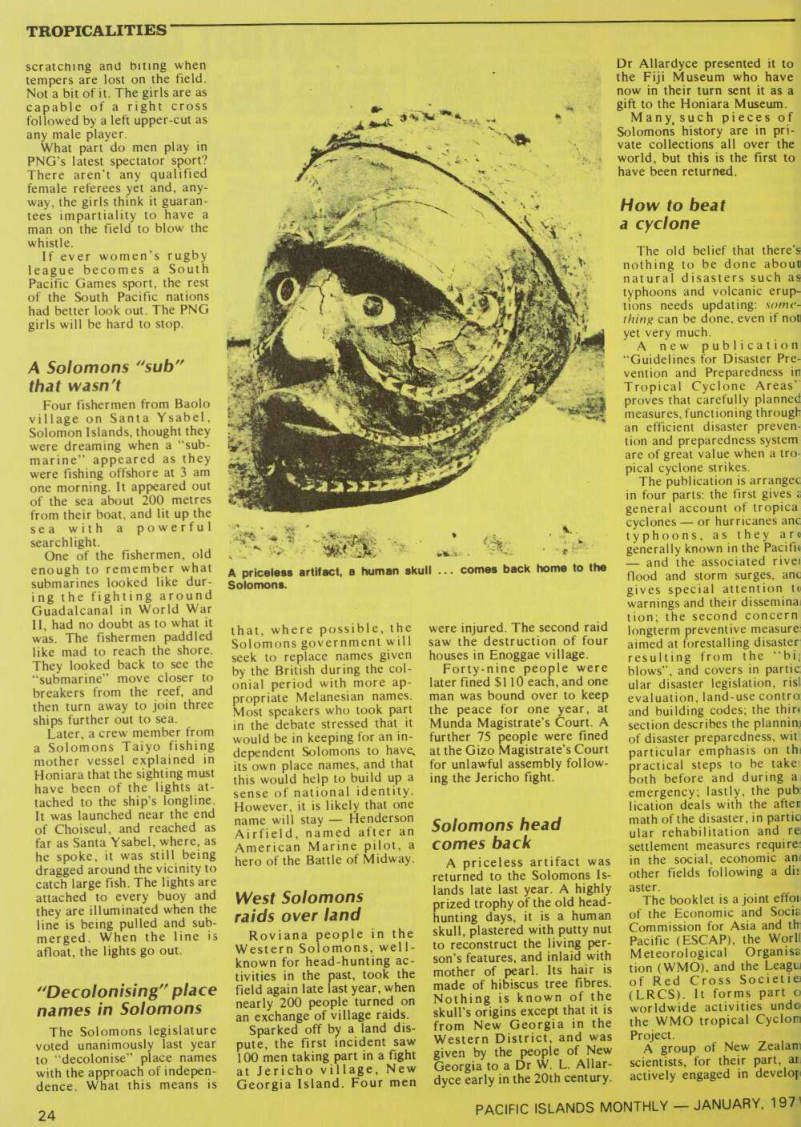
A priceless artifact was returned to the Solomons Is lands late last year. A highly prized trophy of the old head hunting days, it is a human skull, plastered with putty nut to reconstruct the living per son’s features, and inlaid with mother of pearl. Its hair is made of hibiscus tree fibres.
Nothing is known of the skull’s origins except that it is from New Georgia in the Western District, and was given by the people of New Georgia to a Dr W. L. Allar dyce early in the 20th century.
Dr Allardyce presented it to the Fiji Museum who have now in their turn sent it as a gift to the Honiara Museum.
Many, such pieces of Solomons history are in pri vate collections all over the world, but this is the first to have been returned.
How to beat
a cyclone
The old belief that there’s nothing to be done about natural disasters such as typhoons and volcanic erup tions needs updating; some thing can be done, even if not) yet very much.
A new publication “Guidelines for Disaster Pre vention and Preparedness irr Tropical Cyclone Areas’ proves that carefully planned measures, functioning through an efficient disaster preven tion and preparedness system are of great value when a tro pical cyclone strikes.
The publication is arrangec in four parts: the first gives s general account of tropica cyclones or hurricanes anc typhoons, as they ar« generally known in the Pacific and the associated rivei flood and storm surges, ano gives special attention to warnings and their disseminai tion; the second concern longterm preventive measure; aimed at forestalling disaster resulting from the “bi| blows”, and covers in partic ular disaster legislation, risl. evaluation, land-use contro; and building codes; the thin section describes the planning of disaster preparedness, wit:: particular emphasis on thi practical steps to be take; both before and during aj emergency; lastly, the pub: lication deals with the aften math of the disaster, in partio ular rehabilitation and re settlement measures requires in the social, economic am other fields following a di« aster.
The booklet is a joint effor of the Economic and Sods Commission for Asia and thi Pacific (ESCAP), the WorK Meteorological Organise tion (WMO), and the Leagu of Red Cross Societies (LRCS). It forms part o worldwide activities undo the WMO tropical Cyclom Project.
A group of New Zealam scientists, for their part, aij actively engaged in develop
A priceless artifact, a human skull ... comes back home to the Solomons.
ing early warning systems for /olcanic eruptions and earth quakes.
It is still impossible to pre dict exactly when major earthquakes and volcanic eruptions will occur, but Dr John Latter, a seismologist with the Geophysics Division in Wellington, has explained liow he and his colleagues are ;ackling the problem.
“The idea,” he says, “ is to nstall a chain of warning levices some distance apart, >eginning from the volcanic :rater. These devices are so ensitive that they will detect ;arth movement hundreds of niles away.
“Just before an eruption oc :urs, there is often a violent hake in the earth. If this hap >ens and all warning systems ndicate the same readings, hen it is assumed to be an or linary earthquake. However, f the installed devices near he crater show a higher read ng, then immediate precau ions must be taken against a >ossible eruption.”
Dr Latter visited the New Hebrides in 1967 and looked it Yasur Volcano on Tanna, and Ambrym. He said t would be very useful to have i seismic network on these is ands, but costs had so far )roved prohibitive.
laving a piece of
Marshalls history
Dr Edward Jelks, American listorical archeologist, is upervising the stabilisation md documentation of the )ebrum plantation house on -ikiep Island in the Marshalls.
Built in the late 19th cen ury, the Debrum house is the )nly surviving copra planta ion house of its period in the Marshalls. It still contains let ers, photographs, furnishings, ools and records of the early -opra business during the Jerman and Japanese admin istrations.
Located on isolated Likiep Island, the building has been righting a losing 90-year bat tle with the tropical climate.
Water seeping through the badly leaking roof has rotted supports and threatens the valuable documents and ar tifacts within.
The stabilisation project.
sponsored by the Trust Ter ritory Historic Preservation Programme, is designed to re pair the structure to prevent further deterioration, and to microfilm all historical docu ments for future research.
The US coastguard
gets tough
A US federal court has made its first-ever conviction under the 1971 Safe Boating Act, which prohibits grossly negligent voyages.
Terry Nugent, of Califor nia, set out on a trans-Pacific voyage from California last August, disobeying a regula tion that declared his vessel unsafe for the trans-oceanic trip. After capsizing twice and drifting for 40 days, Nugent switched on his emergency radio beeper and was rescued following an extensive search effort which was estimated to have cost the Navy about SUSIO4 000. Nugent was given a suspended six-month gaol term and a suspended maximum fine of $1 000. He was also placed on a year’s un supervised probation.
Coastguard Rear-Admiral James Moreau expressed satisfaction with the decision and pointed out that the law was strictly designed to pro tect the individual, as well as save the public taxpayers’ money. He also said that he hoped the court’s decision would discourage any similar type of adventure as well as make it clear to people who feel that their vessel may be unsafe that they can go to the coastguard to establish its safety or otherwise.
Copping the cuffs
on Niue
A labourer in the Public Works Department of Niue was well and truly caught playing around with the law when he took it into his own hands recently.
Spotting a police van park ed outside the department for repairs he decided to in vestigate the handcuffs dan gling on the side of the door.
But he failed to take into ac count the rather set ways of the law, and found himself firmly clipped to the door of the police van for more than two hours before being freed by police.
The varied
faces of PIM
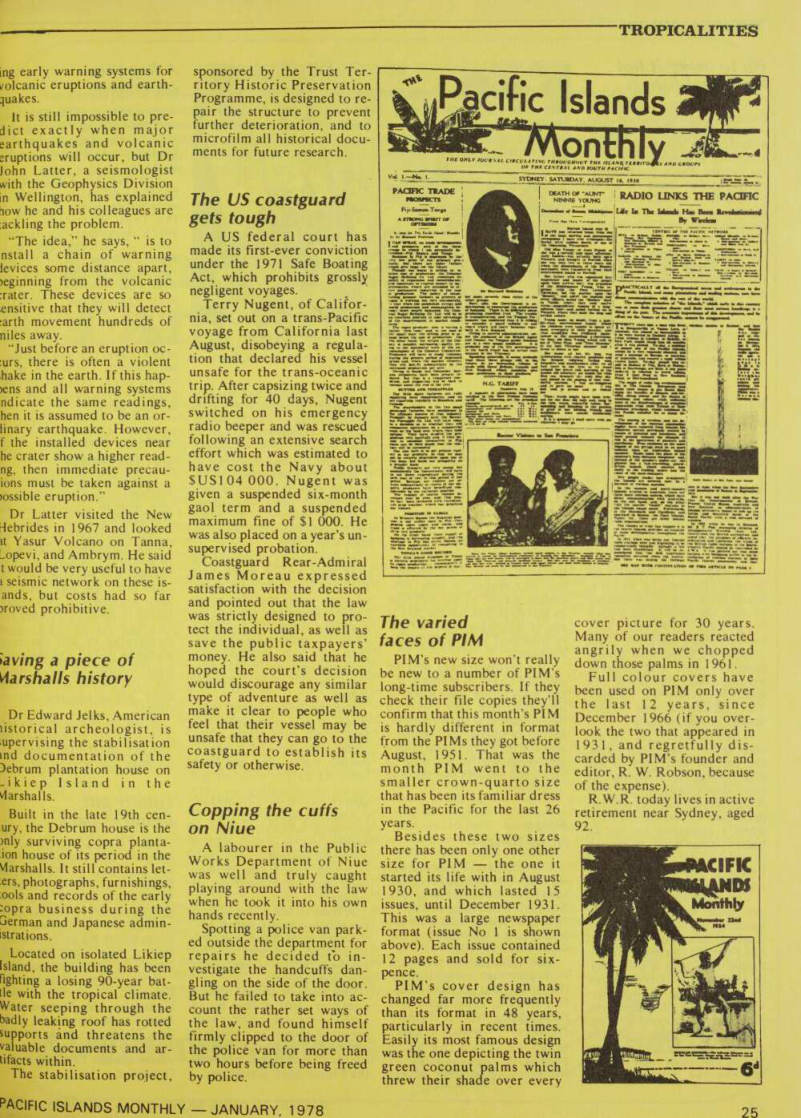
PI M’s new size won’t really be new to a number of PI M’s long-time subscribers. If they check their file copies they’ll confirm that this month’s PIM is hardly different in format from the PI Ms they got before August, 1951. That was the month PIM went to the smaller crown-quarto size that has been its familiar dress in the Pacific for the last 26 years.
Besides these two sizes there has been only one other size for PIM the one it started its life with in August 1930, and which lasted 15 issues, until December 1931.
This was a large newspaper format (issue No 1 is shown above). Each issue contained 12 pages and sold for six pence.
PlM’s cover design has changed far more frequently than its format in 48 years, particularly in recent times.
Easily its most famous design was the one depicting the twin green coconut palms which threw their shade over every
cover picture for 30 years.
Many of our readers reacted angrily when we chopped down those palms in 1961.
Full colour covers have been used on PIM only over the last 12 years, since December 1966 (if you over look the two that appeared in 1931, and regretfully dis carded by PI M’s founder and editor, R. W. Robson, because of the expense).
R.W.R. today lives in active retirement near Sydney, aged 92.
Fiji to make it hot
for illegal fishers
A warning to commercial fishermen; keep out of Fiji waters when the 200 nautical mile zone is declared, unless you hold a licence. A bill to go before Fiji’s parliament provides for fines of up to $lOO 000 on foreign vessels il legally inside the zone. But the fine could be $2OO 000 if a court decided to fine both captain and licensee. In ad dition, there could be con fiscation of the ship, its fishing gear, apparatus, cargo and stores. Licensed ships may be fined up to $25 000 for licence breaches.
Enough to give potential offenders the Fijitters ...
Pandora's box of
Pacific history
The most exciting Pacific maritime find of recent times is the discovery of the bones of the Royal Navy frigate Pan dora, which was wrecked off the Australian coast, about 80 to 100 miles off Cape Glen ville, near Cape York, in 1791.
An expedition headed by Stephen Domm, of Sydney, found the wreck on November 16 with the help of an RAAF Neptune Marine re connaissance aircraft from Townsville fitted with a mag nometer. The magnometer pinpointed metal in the wreck, possibly the cannon.
The Pandora was found almost buried in sand.
A stone water jar 70 cm high, some brass pintles from the rudder and part of the bilge pump were among the first items recovered. The Australian Government promptly declared the Pan dora’s remains to be an historic shipwreck, to protect it from would-be treasure hunters. An archeological survey will be made.
The Pandora’s treasure is not gold, but history. The Pandora was despatched from England to run-down and ar rest Fletcher Christian and his fellow mutineers of the Boun ty. It got neither Christian nor the Bounty, but 14 mutineers were arrested on Tahiti and were being returned to Eng land in the frigate when she foundered. Four of them were among the many men drown ed. For the details of that
unhappy piece of Pacific history, see pTO.
Previous searches have been made for the wreck.
Some years ago a man claimed he had found it and offered the “Pandora’s bell” for sale, but his story was a hoax.
No layin' 'em out
in Lae cricket
The Lae Cricket As sociation, Papua New Guinea, has introduced a new dis ciplinary rule; a club will lose its match points for the day if any of its players start a fight or take part in a fight during the match.
It’s hardly cricket, and we shouldn’t have to mention it,” the Association apologised in announcing the rule in November. But the President, Mr Arua Rarua, said tempers had run high at a recent match and some sort of warning to clubs and players had become necessary.
Fijian
food fiesta
The Fiji Hotel Association took up the challenge of the Minister of Tourism, Mr Tomasi Vakatora recently and entertained him and his guests to a Fijian lunch at the School of Catering.
The uninitiated, writes a Fiji gourmet, might have thought it was marrow soup, fish fingers, roast pork and rice pudding. Not so. Waibuta Papukeni a rich creamy bowl of steaming gold pumpkin, Ika vakaliga ni marama succulent slivers
of reef fish dipped and fried in coconut batter to a crisp golden brown; Vuaka vaka painapiu (tender tranches of pork cooked with pineapple and capsicum and launched in a boat of pineapple itself), served with rourou, tapioca and okra; then vakaloma vi n aka mai n a T e bar a (selected Rewa rice baked in milk with eggs).
If you weren't satisfied with that you could have had Waibuta Kai (batabata) chill ed fresh water shellfish soup; kakana draudrau (platter of assorted local vegetables), Murg masala-spiced cur ried chicken served in a coconut and Vudi vakasoso (banana in special caramel sauce).
Canapes before lunch were made of Fiji pineapple, fish and fried dalo (taro). The coffee was admitted to be im ported, but it need not have been. As for the wine, we got by on the Riesling very well in fact. Very well indeed.
I almost believed the story of the man who told me he caught prawns in the noose of a sasa by putting it over their tails and then letting it swim back and catch itself on its feelers.
A feast fit for a king and the solitary lovely queen.
So it can be done, and very well done; and with normal kitchen facilities and in a reasonable time.
One swallow doesn’t make a summer; but a few more swallows of that vudi vakasoso should be enough to convince the most doubting tourist and hotelier that the Fijians have something.
A flag flies
on Ponape
Ponape in the Carolines has decided to fly its own flag, the first of the districts in the United States Trust Territory to do so.
The flag has a light-blue background with six white stars similar to the six stars of the Trust Territory’s flag which respresent the six dis tricts of Micronesia. But Ponape’s stars are for the six islands of the district Ponape island, Kapingamarangi, Mokil, Ngatik, Nukuoro and Pingelap. With the stars are a halved coconut shell used as a sakau(kava)cup and doconut palm leaves. The leaves, on a white back, symbolise the people’s dependency on the coconut palm.
Brassy, but she
got the brass
Crude but effective are the methods of blackmail used by one woman shopper at the Nukualofa market, Tonga.
She was recently observed buying vegetables, offering $2 in payment, accepting her change, and walking away. A little later she was observed again arguing with the vendor, saying he hadn’t given her the change of her $2, and threatening to call the cops unless he did so. On the prin ciple, “Anything for a quiet life”, the vendor caved in and gave her a second lot of change.
When an eyewitness to the whole affair remonstrated with her, she treated him to an icy stare and headed off.
Lottery gift
bounces back
Jose Camacho Tenorio (Joeten). the Territorial Par ty’s candidate in the election! for Governor of the Northern!
Marianas, made a grand! gesture in November. He gave; a brand new Datsun four-door sedan as the big prize in a lot tery to raise funds for a new* church at Grapan on Saipan.
Who won it? Luis T.
Camacho, father of Dr Carlos?
Camacho, the Democratic: Party’s candidate in the elec tion. The car probably carried! stickers later, calling onr voters to elect Dr Camacho as?
Governor.
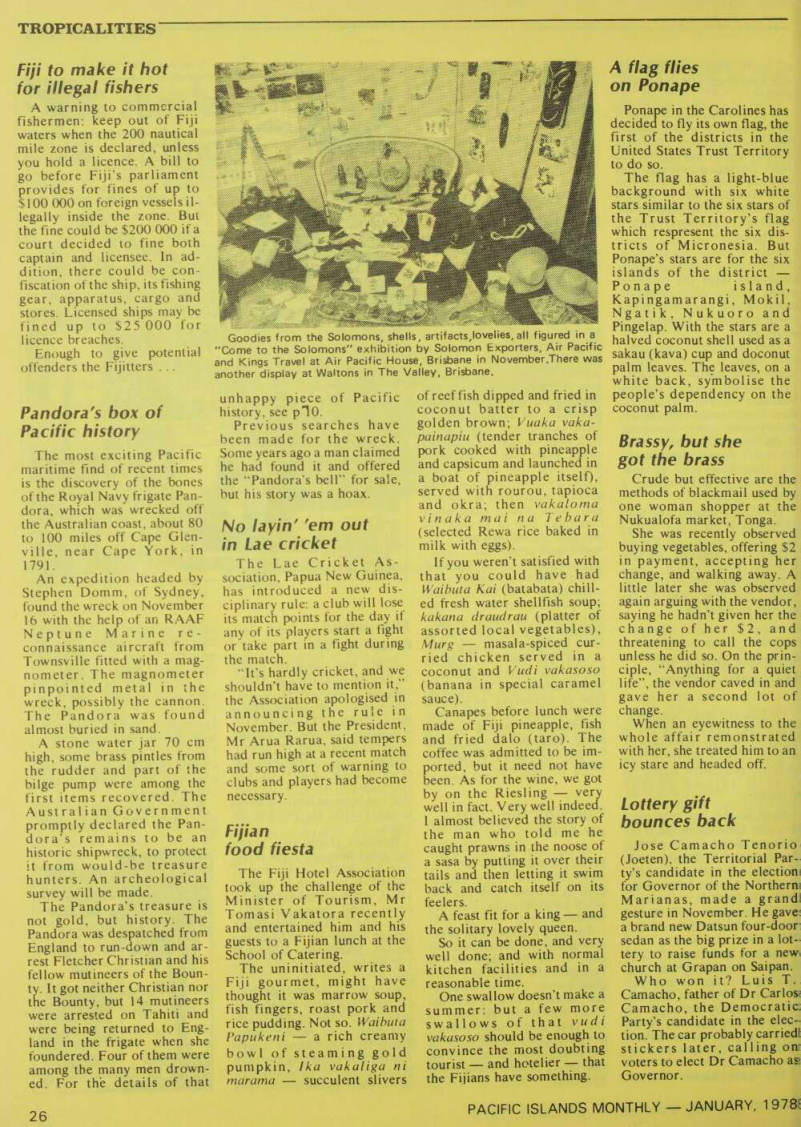
Goodies from the Solomons, shells, artifacts,lovelies, all figured in a "Come to the Solomons" exhibition by Solomon Exporters, Air Pacific and Kings Travel at Air Pacific House, Brisbane in November. There was another display at Waltons in The Valley, Brisbane.