Prime Minister told me.
p. 21 · Read in the full issue
“They didn’t expect to have happen what did happen.
They knew better the second time and that accounted in part for our success and our return to government with such a large majority.”
Papua New Guinea realised what had happened to Ratu Mara in Apri 1 and Mr
Somare’s propagandists
profited from the lesson when PNG went to the voters soon after. They concentrated in the electoral campaign on the man, Michael Somare, and told the voters that a vote for a Pangu Party man was a vote for Mr Somare as Prime Minister; a vote for the Op position parties was a vote against Mr Somare. It work ed.
The British Tory Party tried much the same thing after World War 11, littering the country with posters portraying Churchill and his famous two-fingered V gesture with the legend “Vote for this man”. But they fell flat on their faces which shows the difference in politi cal setups.
Few people have worked harder for the abolition of racial frontiers in a multi racial Fiji than Ratu Mara, and the emergence of a racial based political organisation, the Fijian Nationalist Party with its slogan “Fiji for the Fi jians” was a blow to his hopes.
It’s my belief that the damage that party did in the April elections to his dream of racial harmony was nearly the last straw. I may be wrong, but I think that it was only the conviction of others, as well as himself, that people wanted him before anyone else which persuaded him to continue.
Without that conviction, I think that today he would be in Lau and out of politics.
What happened, however, wasn’t a bad thing in some ways. The split among the Federation Party leaders, which also helped the Alliance Party, took some of the sting out of the wounds caused by the Fijian Na tionalist Party in the inter
racial body.
“The election campaigns left wounds, some racial,” said Ratu Mara, “but in the latest campaign, particularly, the wounds were mainly self inflicted by the Indians on themselves.
“These have been so dra matic as to make interracial ones quite insignificant. 1 can now see a much better oppor
tunity to improve our inter racial relations within the next five years.”
But Ratu Mara wasn’t al ways a campaigner for racial harmony. He has never shown even the least antipathy to any race in Fiji and has had excel lent relations with all races, but he once had a chip on his shoulder— against the Whites who, in his opinion, carried the banner of White suprema cy. Several times he suffered at the hands of such people. I have heard him relate on more than one occasion an in cident at the Customs barrier in Sydney a number of years ago in which his racial pride suffered, and there was an in cident involving himself and his family when he searched for a house to rent in London during his course at the Lon don School of Economics. Ox ford may not have been as kind as it might have been.
A lesser man might have paraded his scars but not Ratu Mara. In Fiji he’s all things to all men and will tolerate nothing which is tinged with racist over, or under-tones.
The white colonist is to blame for a lot of things, but Ratu Mara,in his dealings with others, doesn’t live in the past.
Here is his personal credo trom which can be learned something of the virtues which have created a leader of whom it might be said in years to come, as he vies for the position now held in Fijian hearts for Ratu Sir Lala Sukuna, he was “the noblest Fijian of them all”.
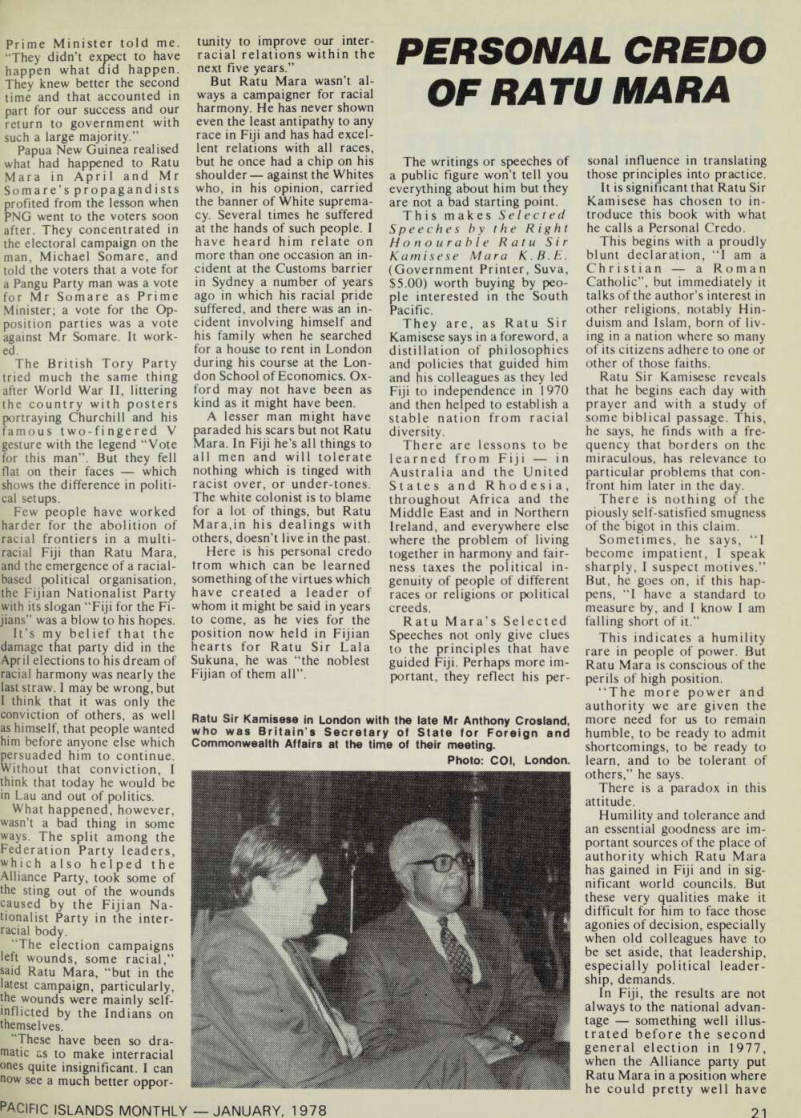
Ratu Sir Kamisese in London with the late Mr Anthony Crosland, who was Britain’s Secretary of State for Foreign and Commonwealth Affairs at the time of their meeting.
Photo: COI, London.